Vrao Hot Springs
The Mystique of Vrao Hot Springs: A Chronicle of Heat and Rumor
What follows is drawn from expedition records, naturalist surveys, the personal journals of three separate aristocrats who visited the Gilded Grottoes and refused to explain why they were there, and an extended conversation with a Calientes elder who found the entire academic tradition of writing things down faintly baffling. I am grateful to all of them, though the aristocrats have asked not to be named.
The Birth of Warmth in a Frozen Land
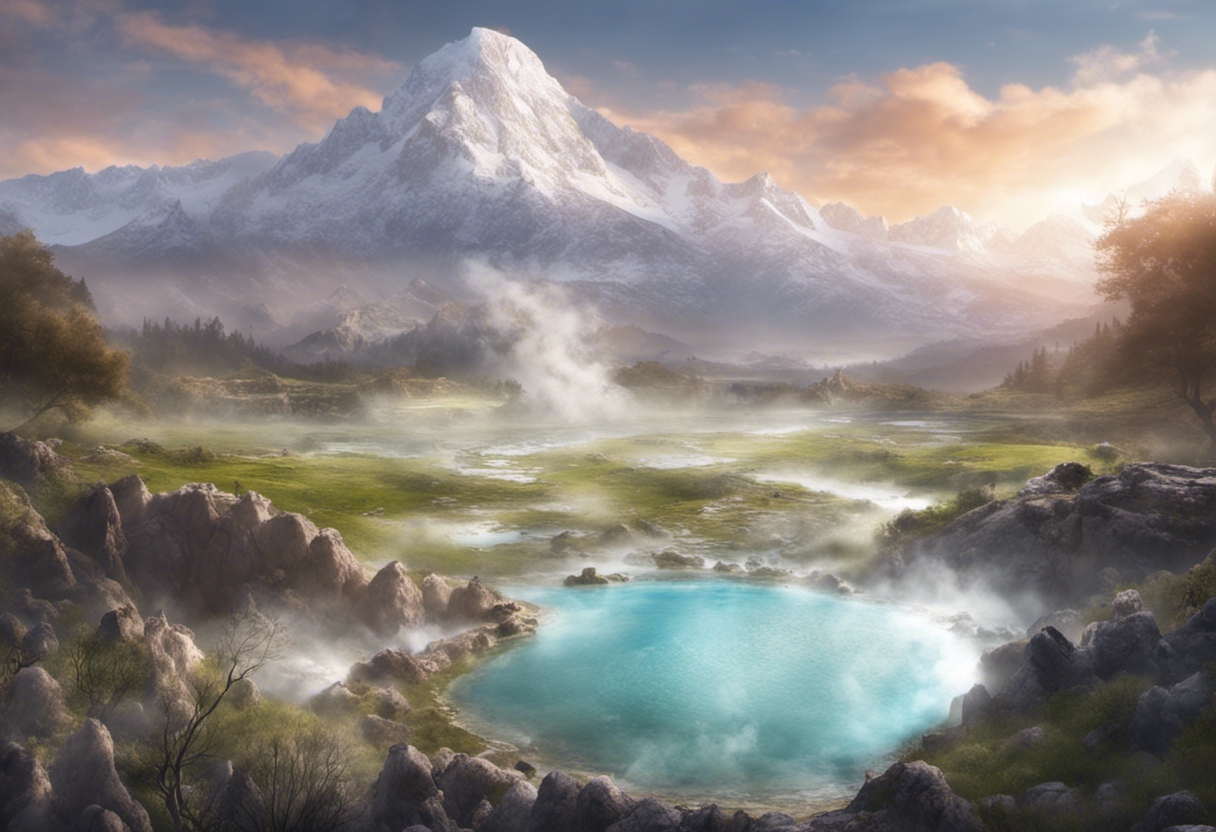
There is a moment, approaching the Vrao Hot Springs from the north, when the traveller first smells it (steam and minerals and something faintly alive) carried on a wind that was, five minutes ago, cold enough to bite through wool. Then comes the warmth itself, arriving not as a wall but as a gradual reprieve, the landscape transitioning from the white severity of Antaea's southern alpine reaches into something that defies all geographical expectation: hundreds of square miles of steaming earth, mineral-bright water, and impossible vegetation, tucked into the Sierra do Verno mountains like a secret that the mountains have been keeping since before anyone thought to ask.
Nobody agrees on why it's warm. This is, depending on your temperament, either the most frustrating or the most wonderful thing about the Vrao Hot Springs.
The theories are as varied as the people who've tried to explain the inexplicable:
- Portals to Elemental Realms: The most dramatic interpretation holds that somewhere beneath the springs lies a fiery rift, a portal to the elemental plane of fire, its searing essence seeping upward through the bedrock to warm the water above. Scholars who favor this theory tend to speak about it with an enthusiasm that makes practical people nervous.
- Dwarven Legacy: Tales persist of ancient dwarven forges buried deep beneath the crust, ablaze with the relentless fire of creation, their unyielding flames imparting heat to the water that flows above them. The nearby presence of dwarven engineering traditions in the region gives this more credibility than it might otherwise deserve.
- A Dragon's Breath: Whispers, older than the current settlements and woven into the songs of the Calientes, speak of a golden dragon whose breath scorched the cold heart of the land: a single act in some long-ago age whose warmth persists as an enduring gift, or perhaps a lingering warning.
- Natural Wonders: The most sensible interpretation, naturally, is also the least satisfying: a volcanic pulse deep within the earth, or water drawn into geothermal depths and returned to the surface superheated. The geologists who argue this position are probably right, and nobody at the springs cares very much.
- Mysterious Minerals: Certain prospectors and alchemists speak of luminous stones somewhere in the deep rock, their radiant heat a blessing to those above and a profound hazard to anyone who gets close enough to examine them directly.
The Vrao Hot Springs have outlasted every theory offered to explain them. They will likely outlast the next round as well.
A Nomadic Harvest: The People of Sulaco
In the shadow of myth and geothermal mystery, life does what life invariably does: it adapts, and then it thrives.
The people of Sulaco, hardened by generations of subarctic living and more practically-minded than the debate over dragons versus geology would suggest, have learned to read the springs' shifting moods with the precision of farmers reading weather. Certain zones of the thermal field are stable enough to cultivate. The mineral-rich waters, combined with the geothermal warmth and the volcanic soil, produce agricultural conditions found nowhere else in Antaea, and the crops that grow here cannot be grown anywhere else on the continent. Full stop. The Sulacans understand this, and they have built an economy around it.
But the earth here is fickle. A spring that warms a field for a decade can shift its vent in a season, turning farmland back to permafrost overnight, or, more dramatically, turning it into a scalding morass that swallows structures and ruins harvests in an afternoon. The villages of the Vrao region do not have the luxury of permanence. Their homes are built to be dismantled in hours. Their possessions are kept to what can be moved on short notice. Their horses (their prized, beloved, well-fed horses) represent not wealth but survival: the ability to move quickly when the land decides to change its mind about hospitality.
This relationship with impermanence has shaped a culture that outsiders often mistake for poverty. It is not. It is expertise.
The Nomadic Villages of the Vrao Hot Springs
The traveller who encounters a Calientes settlement for the first time will likely spend a confused moment trying to understand what they are seeing. The structures are not temporary in the way that a traveller's tent is temporary. They are engineered for relocation: fitted joints, modular walls, folded frameworks that a practiced family can have standing or stored in under an hour. The overall effect is of a village that exists in a state of permanent readiness, which is exactly what it is.
The Calientes (the name given to the nomadic people of the Vrao springs, and worn with pride) have built a culture as vibrant as it is practical. Their clothing blazes with color, its patterns telling stories of specific springs, specific migrations, specific seasons remembered through embroidery and dye. Their music carries echoes of an ancient southern tradition, rhythms that have survived the centuries intact because they were too good to let go. Communal feasts are the social architecture of their society: you understand the Calientes by watching how they eat together, how the sharing of food moves around a circle, what gets offered to a stranger first.
The centerpiece of those feasts, and of much else in Calientes life, is the Frutaluna wine. It is considered a gesture of friendship deeper than words.
Unique Flora of the Calientes
The four plants below cannot be cultivated elsewhere. This has been tried. It has not worked. The combination of mineral-rich water, geothermal soil chemistry, and whatever other ineffable quality the springs provide appears to be irreproducible in any controlled agricultural environment. The Calientes do not find this surprising. They find it appropriate.
Frutaluna
The Frutaluna arrives like a piece of the moon that somehow took root: a moon-shaped fruit, its peel translucent and faintly luminescent, glowing at dusk with a soft light that sets the market stalls shimmering on harvest evenings. The flavor defies any single comparison: peach and lychee, overlaid with cool mint, a combination that should be contradictory and is somehow perfect. Tradition holds that the Frutaluna eaten under the full moon brings good fortune, and while no scholar has yet quantified the mechanism of this blessing, the tradition persists with the enthusiasm that tends to indicate folk wisdom that has quietly worked for a long time.
Solecito Berries
Small, golden, and dangerous-looking in the way of things that are genuinely delicious: the Solecito Berries cluster in tight groups on low trailing vines, sun-kissed and bright enough to spot from a distance. Sweet and tart in exactly the right proportion, they are primarily the province of children, eaten by the fistful at every communal celebration in the Vrao region. Adults eat them too but prefer to maintain the fiction that they are setting an example.
Raízgelida
A tuber of crystalline blue (the specific blue of deep glacial ice, vivid and a little uncanny) the Raízgelida is the staple crop that anchors Calientes cuisine. When cooked it has the reliable comfort of a potato with a more complex flavor underneath: nutty, earthy, something mineral that speaks of the soil it came from. It appears at every communal meal, prepared in a dozen ways depending on the season and the cook. It is the Calientes equivalent of bread: fundamental, shared, an unspoken assertion of community at every table.
Flor de Vapores
The most otherworldly of the thermal flora: a flower that blooms in the steam itself, its petals transitioning from deep blue at the outer edge to a vivid turquoise at the center, as though the flower contains its own sky. The scent is real: a gentle, calming presence that experienced healers have used in traditional ceremonies for generations, treating ailments of the body and the spirit with equal conviction. Whether the healing properties are genuine is a question the Calientes consider so obvious it barely needs answering, and the visiting naturalists who have tested the Flor de Vapores extracts in controlled conditions have thus far declined to fully argue the point.
Cultural Notes
Community and family are not simply values for the Calientes; they are structural requirements of a life in which the land may ask you to move with no warning. You survive together, you farm together, you move together, and you celebrate together. The communal feast is not merely cultural tradition; it is the regular practice of solidarity that makes the rest of the life possible.
Culinary traditions reflect both the local produce and techniques refined across centuries of thermal cooking. The Frutaluna wine, fermented from the translucent fruit in clay vessels that travel with the village, is considered the appropriate greeting for a guest, the appropriate close for a negotiation, and the appropriate comfort for a hard season. It is not offered casually. The offering means something.
The Gilded Grottoes of Vrao: Oases of Opulence and Decadence
The contrast between the nomadic villages of the Calientes and the establishments I am about to describe is, to put it mildly, significant. I have tried to write about the Gilded Grottoes without editorializing. I have not entirely succeeded.
The Gilded Grottoes occupy the stable thermal zones that the Calientes cannot afford to settle: not because the Calientes lack the skill to recognize them, but because someone else got there first with significantly more money and considerably fewer scruples about permanence. Here, in pockets of geological reliability where the geothermal activity is consistent enough to guarantee warm water year-round, the wealthy elite of Antaea have built their retreats: elaborate pleasure complexes that make the word "indulgent" sound like a modest understatement.
The Mistress of Merriment: Lady Ysavela
The social architecture of the Grottoes, such as it is, centers on one figure.
Lady Ysavela is an elf of the sun-kissed highlands, her lineage as ancient as the springs themselves, and she has been orchestrating the entertainments of the aristocratic class at Vrao for longer than most of those aristocrats' bloodlines have existed. Her enterprise, Eternal Ecstasy Events, has become the gold standard for extravagance in Antaea: if Lady Ysavela organized your celebration, you have arrived. If she declined to organize it, you are left wondering what, exactly, you did wrong.
Her advantage is not merely resources. It is time. Elven longevity gives her an accumulated mastery of entertainment that no human impresario can match; she has been perfecting this craft for centuries, and each year's festivities are refined by the lessons of the years before. Every event she produces eclipses the last. The standard she has set for herself is honestly unreasonable, and she meets it anyway.
The Skyship Port: Celestial Gateway
The Celestial Gateway is the Grottoes' connection to the wider world of privilege: a skyship port, enchanted for privacy and protected against the considerable weather of the Sierra do Verno, that receives weekly arrivals from "The Heavens" and other significant points of origin. The ships that dock here fly the flags of legendary houses, their hulls maintained to standards that would shame most naval vessels. Their passengers arrive dressed for an event, because arriving at the Grottoes is the event.
The port is, for those not invited to the Grottoes, an excellent vantage point for observing what they are not attending.
The Sentinels of Secrecy: The Mercenary Guard
What separates the Gilded Grottoes from the nomadic villages that surround them is not merely money. It is a line of armed professionals.
The mercenary cadre that enforces the boundary between Grotto territory and the rest of the Vrao region is formidable, well-compensated, and entirely disinterested in the philosophical dimensions of their employment. They keep the revelers' excesses contained and their secrets internal. They also, with the same professional consistency, ensure that the Calientes villagers remain on the correct side of that boundary, which the Calientes, for their part, find distasteful in ways they express through songs rather than confrontations.
Grotto Highlights
The Grottoes vary considerably in character. The stable thermal zones that made construction possible each have their own geology, and the establishments built around them have developed distinct identities over the years.
The Azure Respite
Owned by a reclusive mage of significant but undisclosed power, the Azure Respite has made its reputation on a single remarkable engineering achievement: underwater viewing chambers, built into the sides of a deep geothermal pool, through which guests may observe the extraordinary ecosystem that flourishes around the thermal vents below. Exotic aquatic creatures of species found nowhere on the surface drift past the glass in the permanent blue-green light of the deep water. The mage does not discuss how the creatures got there.
The Crimson Haven
The playground of a flamboyant drakin prince whose name appears in seven different Antaean noble genealogies depending on which you consult, the Crimson Haven is the loudest establishment at the Grottoes in every sense. Its grand halls are built on a scale that suggests the architect was working from a different scale model than is standard, and the walls (this is well-attested by enough independent witnesses that it is no longer considered rumor) are said to sing with ancient magic. Not metaphorically. The stone itself carries harmonics.
The Verdant Retreat
For those who arrive at the Grottoes with something other than hedonism as their primary goal, the Verdant Retreat offers an alternative. Its thermal gardens have been cultivated over decades into something approaching genuine transcendence: paths of meditative gravel between plants that grow in the mineral-rich spring runoff, spaces of extraordinary quiet in an area not otherwise known for quiet. The owner's philosophy, as near as anyone has been able to determine, is that excess and stillness are not opposites but complements, and that one enhances the other. The waiting list for a private season at the Verdant Retreat is reportedly years long.
The Whispering Stone of Ardent Depths
Beneath the surface swirl and social theatrics of the Vrao Hot Springs, deeper than the geothermal vents and the mage's aquatic chambers and whatever the Calientes will tell you the minerals contain, lies something the region's legends treat with a different quality of reverence.
The Whispering Stone.
Its exact description varies by account (a stone, a fragment, an object of some kind), but the core of the legend is consistent: the Stone is the heart of the hot springs' heat, a fragment of the very sun that fell from the heavens eons ago and buried itself at the bottom of everything. It is said to command elemental fire. It is said to hold the secret to eternal youth, a secret that the ageless elves of the Grottoes pursue with an enthusiasm that says something complicated about elven psychology.
Expeditions have been funded. Tunnels have been dug. Fortunes have been spent. The Whispering Stone remains unfound, which skeptics argue is because it doesn't exist. The Calientes, when asked, give the answer of a people who have lived above this ground for generations: they say the Stone is real, that it knows who is looking for it, and that it will surface when it decides the time is right. They say this with a calm that is either wisdom or a very good performance of wisdom, and it is not always possible to tell which.
The Steam Spectres and The Heat Crawlers
Life at the Vrao Hot Springs is extraordinary. It is also, with some frequency, fatal.
The environment itself makes no allowances for the unprepared. Vents shift without warning, turning solid ground into scalding mud in minutes. Gases that seep from certain thermal zones carry no smell and produce symptoms (disorientation, then euphoria, then unconsciousness) that have claimed lives in every generation. The Calientes teach their children which areas are unsafe before they teach them to read. In the Grottoes, the mercenary guard's less-discussed function is pulling the occasionally incautious guest back from vents they've wandered toward while distracted.
And then there are the creatures.
Steam Spectres
The thermal gases that occasionally seep from the springs in sufficient concentration are dangerous in their own right, but in this region they carry something additional: the Steam Spectres. Ethereal, barely visible, born from fumes that locals describe as carrying the quality of grief, these entities are spoken of in Calientes tradition as the angry spirits of those who died in the scalding waters, returned to the surface in the steam, seeking to pull the living down with them.
They are worst at twilight, when the distinction between steam and something that moves with intention becomes genuinely difficult to establish. Experienced guides will not cross certain stretches of the springs at dusk, and their reasons, delivered with flat practicality, are persuasive to any sensible traveller.
Heat Crawlers
The Vrao Hot Springs' most physically imposing danger: Heat Crawlers are massive arachnids, heat-adapted to a degree that allows them to hunt in the boiling mud around the springs where nothing else can follow. Their chitinous hides shimmer in the heat haze, the primary reason they are often not seen until they are close. Their venom burns with the specific, horrible quality of the thermal waters. They do not particularly prefer humans, which is the only comfort the naturalists who study them can offer. They prefer the unique cultivated plants of the Calientes, the Frutaluna and Flor de Vapores especially, which brings them, with unhelpful regularity, directly to the edge of the villages.
The Calientes have protocols for Heat Crawlers with the same matter-of-fact thoroughness they apply to everything else the springs throw at them. The grottos' guards have less experience, and the incident records at the Celestial Gateway contain several entries that begin with variations on "a guest wandered from the marked paths."
These threats, natural and supernatural alike, are not abstractions at the Vrao Hot Springs. They are the cost of living somewhere this extraordinary: a cost the Calientes pay with clear eyes and practical preparation, and that the Grotto visitors occasionally discover was not included in Lady Ysavela's event fees.
The Vrao Hot Springs remain one of the most singular locations in Antaea, perhaps in the known world. A place of paradox: warmth and cold, nomadic wisdom and aristocratic excess, ancient mystery and mundane agriculture. The steam rises from the springs without concern for the contradictions it veils. The Calientes pack and move when the earth requires it. The Grottoes hold their parties. The Whispering Stone keeps its counsel.
And somewhere below all of it, if the legends are right, something waits.