Acarinha
Acarinha: The Last Shore Before the Unknown
"Every departure for the Second Lands begins in Acarinha. Most of them end there too: the returned expeditions, the survivors, the people who went and came back changed. The city absorbs all of this. It has been absorbing it for a long time."
Sage Orion, in his written introduction to the Second Lands reference collection
At a Glance
| Continent | Antaea |
| Region / Province | Sea of the Heavens (island) |
| Settlement Type | City |
| Population | ~22,000 permanent; significant seasonal population from expedition staging |
| Dominant Races | Human (majority), Dwarf, Elf, Smaling, mixed others |
| Ruler / Leader | Lady Sable Nereid of House Nereid |
| Ruling Body | House Nereid; hereditary governance with commerce and community council advisory structure |
| Primary Deity | Ryujin |
| Economy | Tropical fruit cultivation, fishing, adventure expedition services, nautical instrument production, maritime trade hub |
| Known For | Being the closest port to the Second Lands and the primary departure point for expeditions there; for the nautical instruments that Acarinha's craftspeople produce: specifically accurate, specifically sought-after, and not replicated elsewhere; and for the Whispering Sails Festival, held annually at the harbor |
First Impressions
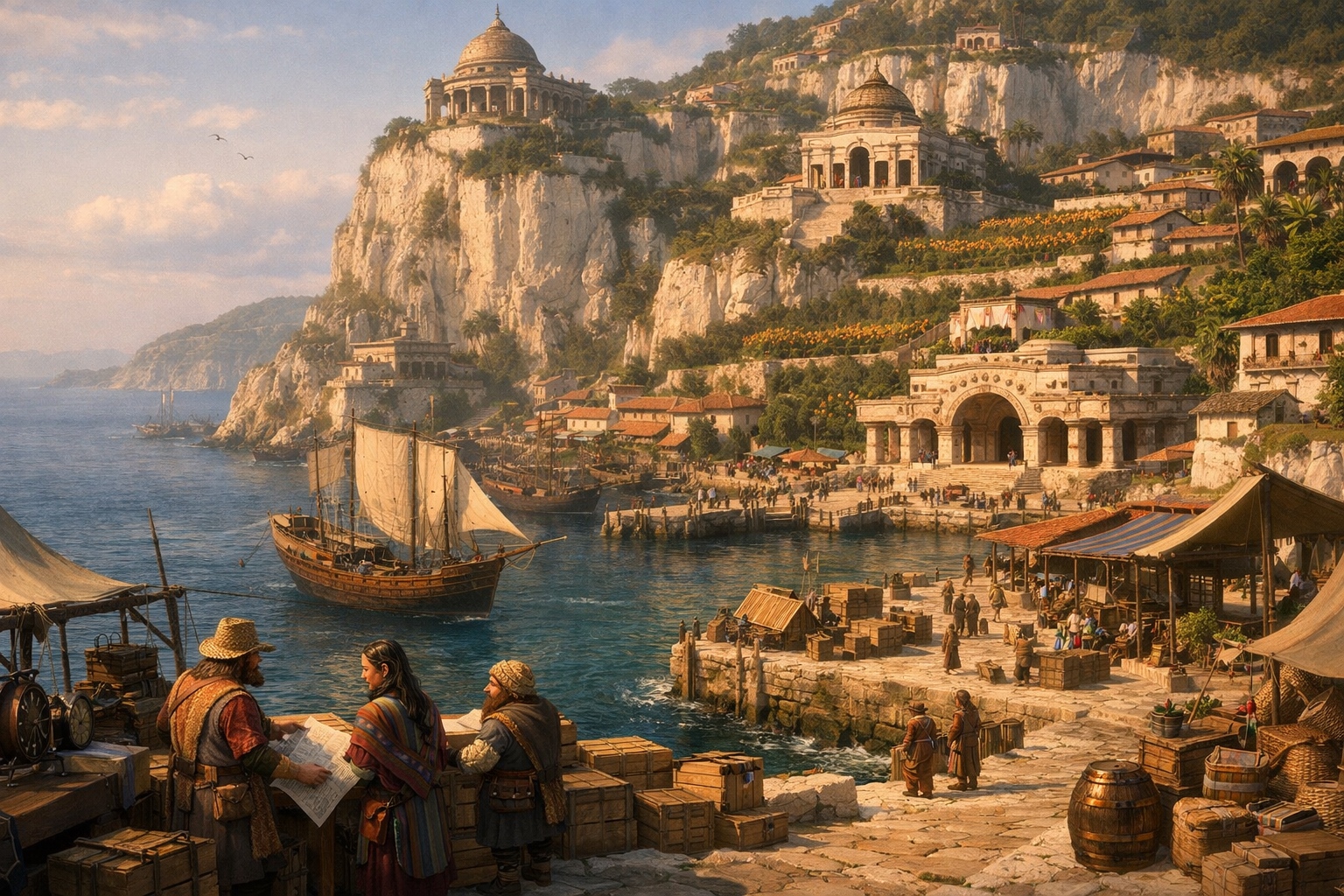
The cliffs are the first thing from sea approach: the dramatic coastal elevation that the city's highest buildings crown, the white stone turning gold in the afternoon light and grey-pink at dawn. Acarinha rises in tiers from the harbor to the clifftop, each tier's architecture adjusted to the grade, until the uppermost level holds the Nereid residence and the observatory that Sage Orion has occupied for thirty years.
The harbor level is working city: the docks, the expedition provisioning warehouses, the nautical instrument workshops, the fish market, the dozens of establishments that exist to serve people preparing to depart for somewhere significantly more dangerous than where they currently are. The Second Lands trade is visible in the specific character of the preparation supplies: the specialized preservation equipment, the navigation tools, the weapons and armor that general commerce would not generate in this concentration.
Above the harbor, the city becomes more residential and more orchard. The fruit-growing terraces that step up the cliff face between the inhabited tiers give Acarinha a vertical green quality unlike most coastal cities, and in season, the mango and pineapple scent joins the salt and fish of the harbor level.
The Ryujin temples (there are three, at different points on the city's vertical range) are visible from most positions within the city and from the harbor approach. The largest is carved into the clifftop itself, which is either an engineering achievement or an act of religious ambition depending on who is describing it.
Geography & Setting
Acarinha occupies a natural harbor on one of the larger islands of the Sea of the Heavens, positioned along the island routes that feed into the crossings east toward the Second Lands. The harbor's depth accommodates the expedition-scale vessels that the Second Lands departure requires, which is why the city's role as a departure point became established and why it has maintained it.
The cliff system that gives the city its vertical character is a geologically significant feature; the cliff face is a remnant of an ancient continental edge, and the specific stone composition has allowed the carved-terrace architecture that makes Acarinha's silhouette distinctive. The orchards on the terraces produce in a microclimate created by the cliff face's heat retention, which extends the growing season beyond what the latitude would otherwise support.
The Second Lands themselves are approximately four days' sail to the east under favorable conditions, and the Acarinha harbor is the last reliable water and provisioning stop before the crossing. This geography, more than anything else, made the city.
The People
Demographics
Acarinha's permanent population reflects the full demographic range that a major trading and expedition city accumulates over centuries. Human families dominate the permanent population; Dwarf and Elf communities hold significant roles in the nautical instrument production and the scholarly/archival functions respectively. The city's relationship with the Second Lands has, over time, attracted people with specific orientations (the curious, the ambitious, the people for whom the ordinary range of known world is insufficient), which gives the permanent population a slightly higher density of people who are interesting than equivalent-sized cities elsewhere might have.
The expedition population is the most volatile demographic element: the staging parties for Second Lands expeditions, the returning parties, and the support industries for both produce a transient population that peaks in certain seasons and that has deeply shaped the city's character even in the non-peak periods.
Economy
The expedition services are the economic engine: not in the sense that they are the largest single industry, but in the sense that the spending associated with Second Lands preparation and return sustains the provisioning, equipment, and services industries that in turn sustain the city's scale. The fruit cultivation and fishing provide the food security; the nautical instruments are the prestige export; the trading hub function captures a share of the broader Sea of the Heavens commerce.
The nautical instruments deserve specific mention. The astrolabes, sextants, and compass systems that Acarinha's craftspeople produce are specifically accurate in ways that competing instruments from other production centers are not, and the specific reason for this accuracy (the combination of material sourcing, calibration technique, and the applied knowledge that four generations of Second Lands navigational feedback has produced) is held closely enough that the gap has not been closed by other producers.
Primary Exports
- Nautical instruments: The astrolabes, sextants, and navigation systems; premium market across the known sea-trading world
- Tropical fruits: The terrace cultivation's output; mangoes, pineapples, and the mixed cultivation; the preservation tradition here is sophisticated enough to export goods that maintain quality
- Expedition services: Guides, provisioning, vessel preparation, the accumulated Second Lands knowledge that Sage Orion's archive makes available to qualified users
Primary Imports
- Metals for instrument production: The raw materials that the instrument workshops require
- Grains and preserved staples: The terrace cultivation cannot cover the full population's staple food requirements
- Second Lands goods: What the returning expeditions bring back; the range is impossible to predict and constitutes a semi-regular premium trade in curiosities and occasionally genuinely significant materials
Key Industries
- The Nautical Instrument Workshops: Scattered through the harbor district; the workshop cluster that produces Acarinha's signature export
- The Terrace Orchards: Managed by several farming families; the cultivation system that produces the fruit export
- The Expedition Services District: The harbor-level complex of provisioning, equipment, and knowledge services for Second Lands departures
Food & Drink
Acarinha eats like a city that grows its own fruit, catches its own fish, and has been feeding expedition crews for centuries. The cuisine is varied (the returning expeditions have brought food knowledge from the Second Lands over generations, and the influence has worked its way into the permanent culture), and the quality is high because the competition between the harbor establishments for the expedition spending has been running long enough to produce genuine distinction.
The fish preparations are the technical heart of the cuisine. The harbor's morning market produces the catch and the harbor establishments have been working with that catch long enough that every preparation tradition that can be applied to the specific species of the Sea of the Heavens has been developed here. Grilled, preserved, in stew with the tropical fruit reductions, in the specific curing preparations that the expedition provisioners use: the range is the widest single-city fish cuisine in Antaea.
The Whispering Sails Festival's traditional food, the specific dishes that are prepared for the harbor gathering and that are associated with the safe-return prayers, are prepared by the fishing families who have been doing it for generations and whose versions are considered definitive.
Culture & Social Life
Acarinha's social life has been shaped by the Second Lands relationship in ways that are deep enough to be invisible to people who grew up here. The acceptance of significant risk as a normal life element, the matter-of-fact relationship with people who may not return, the specific way that the city holds the returned (both celebrating and treating the change they have come back with as something that requires accommodation) are cultural features that visitors notice as unusual and that residents find unremarkable.
House Nereid's governance style contributes to this: the family's "stewards rather than sovereigns" tradition means that the governance is less authoritative than the city's scale would typically produce, and the community's internal self-organization (the block associations, the expedition support networks, the instrument-making guild structures) has developed to fill the space.
The Council Tree is the governance meeting point for the city's most significant community deliberations: a large tree in the harbor square whose age predates the city's formal founding by a century and under which, by tradition, the major decisions that require community consensus are made.
Festivals & Traditions
The Whispering Sails Festival
The annual festival is the city's primary communal event and its most distinctive cultural expression. In the harbor, on the festival day, the vessels that are moored decorate with sails of every color and design: the fishing boats, the trading vessels, the expedition ships. As the tide turns, the decorated vessels move in a slow harbor procession, and it is said, and has been said for as long as the festival has been held, that when the wind is right and the sails are all moving together, the sound of them is something more than fabric against air. The prayers that accompany the procession are for safe voyages and good catches and the return of those who have gone to the Second Lands. The festival ends at the harbor front with the specific shared meal that is the oldest food tradition in the city.
The Instrument Consecration
When a significant new nautical instrument is completed (one of the major commissions, the large expedition sextants or the full astrolabe systems) the workshop that made it brings it to the Ryujin temple for the consecration ceremony that formally marks it as ready for sea use. The ceremony involves the workshop's master, the temple's priest, and the intended user if present. The instrument is placed at the altar overnight. What the ceremony does to the instrument's accuracy is not something the priests explain in terms that the craftspeople find satisfying.
Music & Arts
Maestro Lyra Featherquill's musical tradition is Acarinha's most recognized cultural export. Her compositions incorporate the wave rhythms, the sail-wind harmonics, and the specific acoustic qualities of the harbor's stone and water that she has lived alongside for decades. The style she has developed ("the Acarinha sound," as it has been described by scholars who have studied it from outside) has influenced musicians across the Sea of the Heavens trade network without Lyra having any interest in the influence. She is interested in the music.
The local art tradition centers on the textile weaving of the terrace farming families and the nautical instrument aesthetic: the decorative elements of the instruments, which are worked with the same care as the functional components and which have produced a school of decorative craft that is collected separately from the instruments' navigational function.
Religion
Primary Faith
Ryujin is the dominant deity in a city whose entire existence is organized around the sea and whose most significant cultural activity involves departures across it. The three temples express three different aspects of the relationship: the harbor-level temple for the fishing community's daily observance; the mid-city temple for the mercantile and expedition community; the cliff-top temple for the kind of seeking that the Second Lands relationship produces. The priests' awareness of what the Second Lands represents (the genuine unknown, the place where the expected rules may not apply) has given the Acarinha Ryujin tradition a specifically humble quality about the limits of what the faith can promise.
Secondary / Minority Faiths
Martus, the God of Luck and Fortune, is popular in a city where the expedition success rate is close enough to random that luck has more obvious relevance than the general population. The coin-spinning shrines are everywhere in the harbor district.
Talbar has a small but respected presence among the expedition brokers and contract-writers: the people who turn the chaos of departure and return into agreements, ledgers, and enforceable terms.
Echo is observed among the harbor families and the returnee-support circles: the belief that people come back changed, and the community either absorbs that change together or fractures.
Kraut has a following among the terrace farming families: the agricultural deity in a fruit-cultivation context.
These are institutionally present without competing with Ryujin's primacy.
Caldrin (the deity of roads, crossroads, and safe passage) has a natural home in a city that is the last reliable stop before the most dangerous sea crossing in the region. The Expedition Provisioners' Row is, in Caldrin's terms, an extended offering: the careful preparation that gives travelers the best possible chance of going out and coming back. Departing expedition members make offerings at Caldrin shrines near the Departure Dock, and the tradition of touching the dock's carved stone marker is understood by some as an act of Caldrin's propitiation as much as a personal ritual.
Caminus, the deity of craftspeople and the transformation of material through skilled labor, is observed among the nautical instrument workshops clustered in the harbor district. The astrolabes, sextants, and compass systems that Mira Copperglass and her colleagues produce are among the most precise instruments in the known world, and the community of makers who maintain that standard (through calibration technique, material knowledge, and the applied learning that four generations of Second Lands navigational feedback has produced) takes its craft with the seriousness Caminus's faith names. The Instrument Consecration ceremony at the Ryujin temple is understood in the workshops as a collaboration between two faiths, each governing a different dimension of what makes a good instrument.
Lantha, the moon deity of watchfulness and coastal navigation, has a quiet but genuine following in a city where the pre-dawn harbor activity and the night watches over departing expeditions are permanent features of community life. The navigators who use Acarinha's instruments for night crossings invoke Lantha before the stars appear; the fishing families who work before dawn maintain small household shrines. The observatory that Sage Orion has occupied for thirty years sits in Lantha's domain as much as any formal navigation authority's; the watching of the night sky is both his scholarly practice and the faith's primary devotion.
Dolen, the deity of sorrow and the longing of the separated, is observed quietly by the families and communities who remain in Acarinha while their members cross to the Second Lands. The expedition success rate being what it is ("close enough to random," as the community understands it), the weight of not knowing, of watching the harbor for a return that may not come, has produced a genuine following for the deity of homesickness and estrangement. The prayers that accompany the Whispering Sails Festival carry Dolen's dimension alongside Ryujin's: not just for safe voyages, but for the grace to wait.
Nyxollox, the gentle deity of peaceful death and transition, tends the spiritual needs that the Second Lands' relationship with mortality has made impossible to ignore. In most cities, Nyxollox is invoked at deathbeds and funerals; in Acarinha, the deity is also present in the returning expedition debriefs, where the nature of what expedition members have encountered, and sometimes barely survived, requires a framework for understanding death as something that can be approached, survived adjacent to, and processed afterward. The Shinigami community's private framework addresses a specific aspect of unusual mortality; Nyxollox's faith addresses the more universal one.
Secret / Underground
Shinigami (the deity of death and the afterlife, with a following that the mainstream Ryujin community would find uncomfortable) has a specific following in a city where the Second Lands regularly returns people who have encountered mortality in specific and unusual ways. The followers are not necromancers in the traditional sense; they are people who have come back from the Second Lands with specific knowledge about death and what follows it that the mainstream faith's framework does not accommodate. Their gatherings are quiet and focused and not advertised.
History
Founding
Acarinha began as a fishing village on the cliff harbor; the protected water made it viable and the fish made it worthwhile before the Second Lands connection was established. The first formal expedition to the Second Lands departed from this harbor, which is documented. Whether the village was meaningfully larger than other villages at that point is disputed by the historical record. The expedition's return, or the return of the three of the twelve who returned, is the founding moment of the city's identity.
Key Events
House Nereid's Establishment (approx. 400 years ago)
The Nereid family's coastal origin (described in the family history as "descended from ancient sea-folk," which the historical record treats as metaphorical and which Lady Sable treats as information she does not have enough context to evaluate) predates the formal governance structure. The family's establishment as the city's stewards came through the specific competence they demonstrated during the period when Acarinha's size crossed the threshold where informal community governance was insufficient.
The Orchard Blight (approx. 150 years ago)
A fungal disease destroyed the first-generation terrace orchards across a three-year period. The recovery, which involved a replanting program funded by Acarinha's trading relationships and a diversification of species that has made the current cultivation more resilient, was managed by the predecessor of the current Nereid governance. The blight's memory is maintained in the specific protocols for monitoring the terrace health that the farming families observe as institutionalized caution.
The Second Lands Trade Formalization (approx. 80 years ago)
When the Second Lands expedition market became large enough to require systematic management, Sage Orion's predecessor established the archive system and the expedition knowledge service that has been the institutional foundation of the city's Second Lands role since. The formalization involved the creation of specific licensing systems for departure provisioners, the establishment of the return debriefing protocols, and the beginning of the systematic documentation that Orion's current archive represents.
Current State
Acarinha is the most significant city in its portion of the Sea of the Heavens island chain and is aware of it in the specific way that cities with genuine importance tend to be: quietly, with the infrastructure maintenance and institutional investment that importance requires. The specific current concern is the Second Lands return patterns: the last two expedition seasons have produced a higher proportion of significantly changed returnees than the historical average, and the Shinigami community's private interpretation of this data is more specific than they have shared with the broader community.
Leadership & Governance
House Nereid: Overview
House Nereid governs as stewards: the family's consistent self-description, which has been consistent enough over generations to have become genuine. The governance involves the City Council and the Commerce Guild in a practical partnership; the community forums under the Council Tree are genuine deliberation rather than formal ratification. Lady Sable's authority is real and respected; the community's participation in the governance process is also real and respected. These two things coexist in Acarinha more smoothly than they do in most equivalently-sized cities.
Lady Sable Nereid
Human, Female; fifties; the Nereid residence at the clifftop
Sable has governed Acarinha for fourteen years with the combination of practical intelligence and genuine care for the city that the Nereid tradition has produced in most of its generations. She is specifically interested in the Second Lands return data that the archive has been accumulating; the pattern of changed returnees is something she has been tracking in conversation with Sage Orion for the last two seasons, and her interest is both the governance responsibility and the personal curiosity of someone whose great-grandparents were among the city's early expedition organizers.
Her approach to the community forums is not performative; she attends them without a predetermined outcome and has been known to change her position based on what is said in them, which the governance scholars who study Antaea cities have noted as unusual.
Notable Figures
Captain Thalos Stormeye: Master of the Harbor Fleet
Dwarf, Male; sixties; the harbor and the deep sea approaches
Thalos is the most experienced deep-water captain operating out of Acarinha and the most sought-after pilot for the Second Lands crossing. His knowledge of the approach conditions (the specific currents, the weather patterns, the navigational hazards in the four days between Acarinha and the Second Lands' edge) is the accumulated product of thirty-seven crossings, more than any other living pilot. His services are expensive and his availability is limited and he does not apologize for either. He is the person Lady Sable consults when the crossing conditions are in question.
Maestro Lyra Featherquill: Acarinha's Musician
Elf, Female; age indeterminate; the harbor quarter and the cliff-top terrace
Lyra has been composing in Acarinha for long enough that the city's sonic character, the specific sounds that she grew up absorbing and that now appear in her compositions, has been transmitted through her work back into the culture that produced it. She is present at the Whispering Sails Festival in the role of the person who knows what the sound should be and whose ear measures whether it is that. Her scheduled performances sell out months in advance; her unscheduled ones, when she plays at the harbor front in the evening, draw whatever audience happens to be present.
Sage Orion: Keeper of the Second Lands Archive
Human, Male; sixties; the clifftop observatory and archive
Orion has maintained the Second Lands knowledge archive for twenty-five years and has made it the most comprehensive single-location resource for Second Lands expedition preparation in the known world. His system for debriefing returning expeditions (the specific questions, the cross-referencing with previous returns, the pattern identification) is the institutional practice that has made the archive genuinely useful rather than merely comprehensive.
His private research, which is separate from the archive's public function, involves the specific question of what the Second Lands' relationship with known-world metaphysics implies. He has three files that he has not yet incorporated into the public archive and that he describes as "not yet ready for public circulation."
Key Locations
Seat of Power
- The Nereid Residence: At the clifftop; the family's home and the formal governance administration; the terrace adjacent to the residence is where the most significant community forums are held when the Council Tree's harbor square is insufficient in scale
Houses of Worship
- The Harbor Ryujin Temple: The largest; at the harbor level; the daily observance center for the fishing community and the expedition departures
- The Clifftop Ryujin Temple: Carved into the cliff face itself; the most visually dramatic structure in the city; used for the major festival ceremonies and for the specific seeking that the Second Lands relationship produces
- The Martus Shrine District: Not a single building; a series of shrines and coin-spinning stations throughout the harbor district; maintained collectively by the expedition services businesses
Inns & Taverns
- The Nereid's Rest: The premium establishment in the harbor district; used by major expedition organizers and wealthy traders; the architecture includes a viewing terrace that looks directly at the harbor departure point
- The Returned Sailor: The working establishment; the name is the joke the permanent regulars make; used by the harbor workers, the returning expedition members, and anyone who prefers conversation to ambiance
Shops & Services
- The Instrument Workshops: The harbor district cluster where the nautical instruments are made; several independent operations with specific specialties; the workshop of the senior craftsperson, Mira Copperglass, is where the largest commissions are completed
- The Expedition Provisioners' Row: The harbor-level street where the departure preparation supply businesses are concentrated; the most comprehensive provisioning services for Second Lands departure anywhere in the known world
- Sage Orion's Archive: At the clifftop observatory; accessible by appointment; the public portion contains the expedition reference collection; the private portion is not public
The Market
- The Harbor Fruit Market: Daily market combining the terrace fruit harvest, the morning's catch, and the goods from the trading vessels in harbor; the fruit quality here is the city's most immediate culinary advertisement
Other Points of Interest
- The Council Tree: In the harbor square; the oldest living thing in the city; the governance deliberation point for decisions requiring community consensus; the specific tree species, its precise age, and whether its root system extends under any significant portion of the harbor district are all questions that Orion's archive addresses with unsatisfying ambiguity
- The Departure Dock: The specific dock from which Second Lands expeditions launch; by tradition, the last person to board the vessel touches the dock's carved stone marker before stepping aboard; the marker has been rubbed smooth by three centuries of hands
Secrets, Rumors & Hooks
- The three files that Sage Orion has not incorporated into the public archive concern the same subject: a specific location in the Second Lands that three separate expeditions have documented, arriving at coordinates they did not share with each other, and whose descriptions are consistent enough to constitute documentation of the same place. The place is described in each file as a structure. The structure is described as older than anything that the Second Lands' known history would explain. Orion has been sitting on this documentation for three years, trying to decide what the responsible action is.
- The nautical instrument workshop of Mira Copperglass produces instruments that are more accurate than the technique she is known to use should produce. The difference is measurable and consistent. Mira is aware of the discrepancy and has been investigating its source for two years. She has narrowed it to a specific step in the calibration process that she performs by feel rather than by measurement, and she cannot explain why her feel produces the outcome it does. The Ryujin priests have a suggestion about why, which Mira has declined to pursue.
- The Shinigami community's recent expansion is not accidental; the higher proportion of significantly changed returnees from the Second Lands has produced a higher proportion of people who find that community's framework useful for what they experienced. What the community has been hearing in the debriefings of its members is not in Orion's archive. The community's current senior member has been composing a document about what they have heard, which they intend to present to Sable Nereid directly rather than through the archive.
- The Council Tree's root system does extend under the harbor district. The specific portion of the harbor district where it extends includes the foundation of the Departure Dock. What the tree's root system has been in contact with, through the dock's foundation, for as long as the dock has existed is a question that Orion's three private files touch on in their final paragraphs.