Caripi
Caripi: The Palms and the People
"Caripi does not rush to trust you. It is not unfriendly. The distinction is important, and you understand it fully only after you have been there long enough to feel the difference."
A sailor's account, written after a third visit
At a Glance
| Continent | Antaea |
| Region / Province | Southernmost island in the Sea of the Heavens; one of the Four towns of the island interior |
| Settlement Type | Town |
| Population | ~3,200 |
| Dominant Races | Human |
| Ruler / Leader | Elder Liria, head of the Council of Palms |
| Ruling Body | The Council of Palms: five elders; consensus governance |
| Primary Deity | Kraut |
| Economy | Palm oil, palm sugar, palm building materials, wind chimes, secondary agriculture |
| Known For | The wind chimes made from palm fronds that hang throughout the town and are said to carry particular properties; and for a trust culture that is the slowest to extend and the most reliable once given |
First Impressions
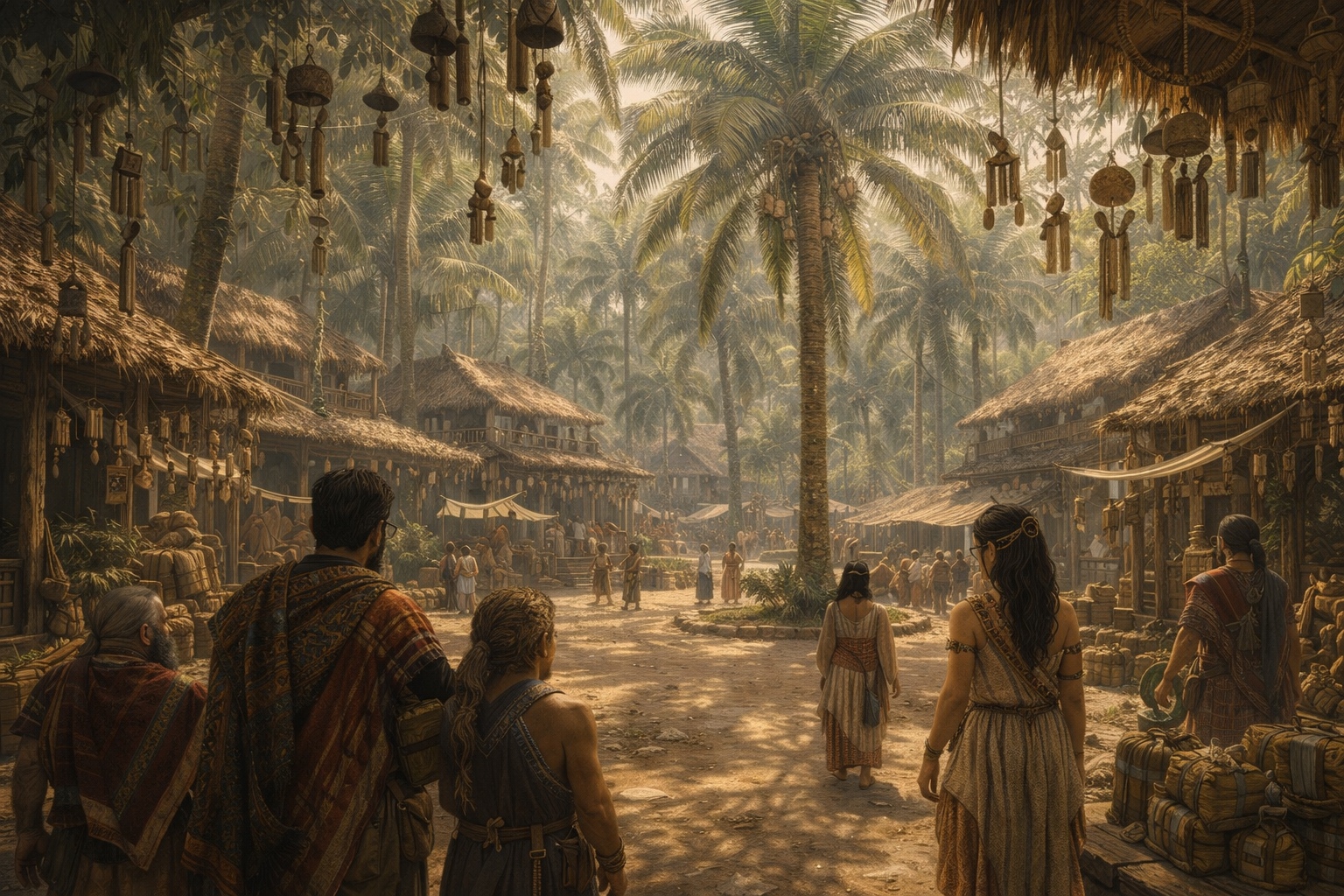
Caripi is heard before it is seen. The wind chimes hang from every significant building, from the entrance trees of the palm groves, and from the wooden poles at the dock approach: hundreds of them, made from dried palm frond material, tuned by the specific cutting and weighting techniques that the island's craftspeople have refined over generations. The sound on a still day is a murmur; on a windy day it becomes something that visitors consistently struggle to describe in their journals without reaching for language that embarrasses them afterward.
The town itself is low and dense: timber-framed structures with palm-thatch roofs, built close enough together that the lanes between them are cool even at midday. The wood and palm construction gives the buildings a warmth of color that the bright Sea of the Heavens light picks out in ways that change through the day. The oldest palm tree in the settlement stands at the center of the main square, its trunk wide enough that it would take four people to encircle, its height visible from the harbor approach.
The dock is the town's interface with the wider world and is managed with the specific attentiveness of a community that knows what it wants from trade and what it does not. Master Jorun is usually present when a vessel arrives.
Geography & Setting
The southernmost island in the Sea of the Heavens is small enough that its four towns know each other well and large enough that there is meaningful distinction between them. Caripi occupies the island's interior palm forest region (not the coast, though its dock is coastal) where the specific conditions of the interior produce the palm varieties that the oil and sugar trade is built on.
The tropical forest that surrounds and penetrates the town is managed rather than wild. The Council of Palms' primary function is the health of the grove system, and the distinction between managed and natural has been deliberately blurred over generations: the forest looks ancient and untended, but its species composition, spatial arrangement, and regeneration patterns reflect two hundred years of active stewardship. People who know what they are looking at can read it.
The dock connects Caripi to the island's coast and from there to the wider Sea of the Heavens trade. The approach to the dock through the palms is lined with the largest wind chimes, the ones made from the first fronds of each year's harvest, which creates an arrival experience that is not accidental.
The People
Demographics
Caripi's population is almost entirely human, which reflects the island's demographics broadly. The occasional non-human visitor passes through (traders, scholars with an interest in palm cultivation or wind chime acoustics), but the permanent population does not include a significant non-human community.
The social structure runs on family and work group. Trust is specific and layered: the innermost circle is family, the next is the work group one has labored alongside, the next is the wider palm-grove community, and the outermost (where visitors and newcomers exist) is polite without being open. Movement inward requires demonstrated contribution, and the contribution must be to the groves, which is the community's way of requiring newcomers to stake something on the town's future before being admitted to its present.
This is not a policy that was written down. It emerged from the community's experience with what happens when it is not observed.
Economy
The palm tree is the economy and also the culture and also the spiritual framework, which in Caripi is not a coincidence but a deliberate integration that the community has maintained for as long as anyone has been keeping records. The three products that sustain the town (oil, sugar, and structural material) come from different parts of the same trees, which produces both an efficiency and a symbolic coherence that the Council of Palms finds worth reinforcing.
The wind chimes are a secondary product that does not register as economically significant in formal trade accounts and that the community regards as economically secondary while treating it as primary in every cultural sense. The relationship between the commercial and the spiritual valuation of the chimes has been a tension in Caripi since traders from the northern islands started offering serious prices for them.
Primary Exports
- Palm oil: The highest-quality oil in this part of the Sea of the Heavens, produced from interior grove varieties not available on other islands
- Palm sugar: The reduced-sap product that the interior cultivation method optimizes; darker and more complex in flavor than coastal equivalents
- Palm building materials: Structural palm timber and processed frond material; used for construction and furniture across the island trade network
Primary Imports
- Metals: The island produces none; all metalwork comes from the mainland or the northern islands
- Grain: The palm-focused agriculture does not produce enough staple food for the full population; grain supplements the island's own yam and plantain production
- Specific spices and materials: The items the island's ecosystem does not produce and that the community's quality standards require
Food & Drink
Caripi eats what the island grows, cooked with the island's oil. The cuisine is good in the way that all food is good when it is made by people who have been cooking with the same high-quality base ingredients for generations and who have had centuries to refine their approach.
Palm oil is present in almost everything. The specific variety pressed from the interior groves gives the oil a flavor note that is recognizably different from what arrives in the markets of the northern ports, and the community's cooking has been calibrated to use that note rather than work around it. The sugar-based preparations, the confections and the preserved fruits that use the palm reduction, are the items visitors are most likely to remember and seek out again.
The communal gathering under the oldest palm tree is where the most significant meals happen: Council decisions, arrivals of trusted visitors, the Festival of Fronds celebration. The physical location and the food are inseparable.
Culture & Social Life
Social life in Caripi is organized around the grove work and the relationships it produces. The palm cultivation requires coordination across families (the harvest rotation, the maintenance schedule, the management of the regeneration zones), and the relationships formed in that coordination are the primary social tissue. People know each other through the work before they know each other otherwise.
The wind chime tradition is the most distinctive expression of this culture to outside eyes. Each chime is made from materials that have a specific provenance in the grove (this frond from this tree in this season), and the making is itself a semi-ceremonial practice that involves knowledge passed from maker to apprentice about which cuts carry what resonance. A chime from Caripi is not just an object; it is documentation of a particular tree at a particular time, which is information anyone who knows the tradition can read.
The culture of trust operates as it appears from the outside: genuine and slow. The community does not feel the slowness as coldness; it feels it as a reasonable precaution that prevents specific categories of harm. Visitors who have the patience to stay long enough to move through the outer circle almost universally report that what they found on the other side was worth the patience.
Festivals & Traditions
The Festival of Fronds
Once a year, around the winter dry season when the groves are quiet and the frond harvest is complete, Caripi observes the Festival of Fronds. The eldest palm fronds from each family's grove allocation are woven into pattern-work and hung throughout the town for the duration of the festival. The patterns are not random; each family's pattern is documented and maintained, and the combined display is a visual record of the community's participation that Scribe Elara's archive cross-references with the grove management records. The festival involves several days of communal cooking, story recitation under the oldest palm tree, and the formal hanging of the new wind chimes made from the previous year's fronds.
The Grove Opening
When the first rains of the wet season signal the beginning of the palm growing cycle, the Council of Palms performs a ceremony at the oldest tree that involves the dedication of the season's grove management decisions. This is not public in the way the Festival is (the ceremony is Council members and the grove workers, not the full town), but it marks the beginning of the period that the community's economy depends on, and the knowledge that it is happening is generally understood to be important.
Music & Arts
The chime-making is the art. Everything else is secondary, which is not to say that music and narrative are absent (the recitation tradition that the Festival of Fronds centers on is old and technically demanding, and the drum and flute forms that accompany outdoor gatherings are evolved and specific), but the chimes are the form that Caripi has made its own in a way that nothing else in its cultural life matches.
The weaving tradition (baskets, mats, the frond decorations) is the other significant art form, and the best of it operates in the same register as the chimes: functional objects made with a care that exceeds functional requirement, invested with meaning that only community members fully read.
Religion
Primary Faith
Kraut (the deity of farmers, of soil and plants and the relationship between human cultivation and the natural world) is the primary faith of Caripi in the direct sense that this is a community whose entire existence is organized around the cultivation of a plant. The theological fit is not a coincidence. Kraut's symbol, the outstretched hands holding the harvest, appears in Caripi in palm-specific forms: the motif carved into the entrance to the oldest grove, the pattern worked into the festival fronds, the gesture the Council members make at the opening of the grove ceremony.
The faith here is not organized in the formal temple sense of the northern continental cities. There is a shrine; there are practitioners; there are observances. The structure is the community itself rather than a separate religious institution.
Secondary / Minority Faiths
Ryujin has a following at the dock and among the island fishermen; the Sea of the Heavens is Ryujin's domain, and the people who cross it maintain the relationship accordingly. A small Zopha community exists among the town's scholars and record-keepers; the pursuit of knowledge as spiritual practice finds natural expression in a community where the archive is the Scribe's sacred responsibility. Talbar has a presence in the Council's dispute-resolution function, acknowledged when the Council opens formal mediation sessions.
Hesira, the deity of hearth and marriage, is observed among the grove-working families for whom the domestic unit is the fundamental structure of the palm cultivation economy. Work assignments, grove management zones, and the knowledge transmission that the chime-making and weaving traditions require all flow through family lineage. The Festival of Fronds' communal cooking and story recitation under the oldest palm tree are as much a celebration of the households that sustained the grove through the year as of the grove itself. Hesira's presence here is woven into daily life rather than centered in a formal temple.
Thulgard, the deity of community resilience and shared labor, holds particular significance in a settlement whose most formative historical event was a catastrophic storm that destroyed the outer grove ring and threatened survival. The replanting programs, the triage decisions, the inter-town food arrangements that got Caripi through the Year of the Raging Storm: all of these are the specific acts of collective endurance that Thulgard's faith names. The grove management protocols that the Council observes as institutionalized caution are, in this sense, Thulgard's living legacy: practices maintained against the possibility of needing that collective capacity again.
Caminus, the deity of craftspeople and skilled transformation of material, is honored among the wind chime makers for whom the relationship between material and meaning is the center of their practice. Nara's technically accomplished work (the specific cuts that carry specific resonances, the provenance documentation that makes each chime an artifact of a particular tree at a particular time) is exactly the craft mastery Caminus names: transformation of material through skill until the result exceeds the sum of its components. The weaving tradition's encoding of family and seasonal history in patterns that outsiders find beautiful without understanding shares this same impulse.
Nyxollox, the gentle deity of peaceful death and transition, is observed quietly in a community where the Year of the Raging Storm produced significant loss and where the older generation that survived it carries memory of what it cost. The community does not dwell on death (the grove orientation is toward life and growth), but the oldest palm tree, under which the Council meets and the Festival gathers, is also the place where the community marks its significant losses. Nyxollox's presence here is the counterweight to Kraut's emphasis on cultivation and increase.
Secret / Underground
Echo is worshipped by a small group within Caripi whose secrecy is maintained partly from genuine discretion and partly because the practice would be difficult to explain to outsiders without sounding like it supports everything they want to believe about the chimes. Echo's domain is sound and resonance. The chimes are said to carry messages if you know how to listen. The Echo worshippers believe they know how to listen and have been developing that knowledge for three generations.
History
Founding
The island was inhabited before the palms were the primary cultivated species; the earliest records describe a different ecology that the founding families found and recognized the value of converting. The conversion was not total: the interior forest is palm-dominant but not palm-exclusive, and the other species are maintained in specific proportions that the grove management protocols protect. What was here before the palm conversion is recorded in Scribe Elara's deepest archive in terms that the archive has not shared with the Council.
Key Events
The First Full Harvest (early founding period)
The first season in which the interior grove system produced enough palm oil, sugar, and material for both community use and significant trade surplus is understood as the founding moment in the practical sense, the moment when survival became prosperity. The Festival of Fronds commemorates this in structure if not in explicit narrative. The specifics of the first harvest year are recorded; the conditions that made it possible are also recorded and are more complicated than the festival's celebratory character implies.
The Year of the Raging Storm (approx. 80 years ago)
A storm season of exceptional severity destroyed a significant portion of the outer grove ring, disrupted the harvest cycle for a full year, and produced the most serious test of the community's resilience in its recorded history. The response (the triage management, the replanting priority decisions, the arrangements the Council made with the other three island towns for food supply during the recovery period) is the period that established several of the current grove management protocols and that the Council cites when explaining its current approaches. The community that came through the storm and rebuilt the groves is the community that exists today.
The Northern Trade Negotiations (ongoing for approx. 20 years)
The increasing interest from northern island and mainland traders in Caripi's palm products has been producing a recurring pressure on the Council to expand production beyond what the current grove management rotation supports. The negotiation between the economic opportunity and the grove health principle has been running for two decades without resolution. The current state is an equilibrium that all parties find unsatisfying: the traders want more, the Council wants to maintain the groves, and the tension between these positions is the defining political fact of Caripi's current situation.
Current State
Caripi is healthy in the grove sense and pressured in the governance sense. The palm economy is strong; the demand for the specific products that Caripi's interior cultivation produces continues to grow; the question of whether and how to meet that demand without compromising the grove management principles that produce the quality is the Council's primary ongoing challenge. Elder Liria's tenure has been defined by maintaining the equilibrium, which she has done. Her successor will inherit either a resolved version of the tension or a more acute one.
Leadership & Governance
The Council of Palms: Overview
Five elders govern by consensus, with Elder Liria serving as chair and primary mediator. Each elder represents a specific domain of community life (the groves, the trade, the spiritual practice, the community welfare, and the archive) though in practice the domains overlap and the distinctions are more organizational than jurisdictional. A decision cannot be made without consensus, which means that the Council's deliberative function is its primary function and is given the time it requires.
The oldest palm tree serves as the Council's formal meeting place for significant decisions, which has the practical effect of making the setting conducive to the kind of thinking the decisions require.
Elder Liria: Head of Council
Human, Female; sixties
Liria has led the Council for twelve years and has built her authority on a combination of deep practical knowledge of palm cultivation and an ability to find agreement between people who are approaching the same problem from different angles. She is not a political person in the sense that requires managing factions; she is a person who understands that the community's long-term interests are specific and that the short-term pressures that create disagreements usually look different from the long-term perspective.
Her specific concern is the succession question and the trade pressure question, which she has come to understand as the same question: the next generation of council leadership will face a more acute version of the trade pressure than she has, and whether they are prepared to manage it with the grove principles intact depends on decisions being made now.
Master Jorun: Harbor Master
Human, Male; fifties; the dock and harbor
Jorun is the interface between Caripi and the trade world that wants what Caripi produces. He manages the harbor with a practical efficiency and a specific social skill: he is genuinely welcoming to the traders who arrive while maintaining the community's standards for what is accepted and what is not. The distinction between welcoming and open, which the town's culture requires be maintained, he manages without visible effort. Liria consults him on any matter that involves the town's external relationships.
Scribe Elara: Town Historian and Archivist
Human, Female; forties; the archive building
Elara maintains the records that constitute Caripi's institutional memory: the grove management logs, the Council decisions, the genealogical records, the accounts of the storm and the recovery, the trade documentation. She also maintains a second archive that she has not described to the current Council in full: the pre-founding records that predate the palm conversion and that describe the ecology and the circumstances of the change in terms she has been trying to understand for six years without reaching a conclusion she is confident sharing.
Shaman Toren: Spiritual Guide and Healer
Human, Male; fifties; the grove shrine and the community dispensary
Toren's practice combines the herbal knowledge that the island's flora supports with a spiritual framework that the Council of Palms treats as complementary to its governance rather than separate from it. He is the person the community brings hard cases to: the illness that doesn't respond to straightforward treatment, the grief that doesn't lift, the decision that has no good options. His connection to the grove's spiritual dimension is what the community understands as his source of knowledge. What he understands as his source of knowledge he describes in terms that are specific and that take longer to explain than most conversations allow.
Notable Figures
Nara: Wind Chime Maker
Human, Female; thirties; the crafting workshop, grove margin
Nara is the most technically accomplished chime maker of her generation, the person whose work the traders want most and whose pieces the community's own sacred locations hold. She does not produce for export and has declined approaches from northern traders consistently. Her concern is not commercial; it is that the chimes she makes contain information that their recipients need to be able to read, and most potential buyers cannot. The Echo community considers her a practitioner whether she considers herself one or not.
Key Locations
Seat of Power
- The Council Grove: The space surrounding the oldest palm tree at the settlement's center; where formal decisions are made and serious disputes are mediated; no permanent structure; the tree is the structure
Houses of Worship
- The Kraut Shrine at the Grove Entrance: The primary religious site; not a building but a stone and living-wood structure at the oldest grove's entry point; maintained communally
- The Ryujin Dock Offering Point: At the dock's seaward edge; maintained by the harbor families; offerings before departure and on return
Inns & Taverns
- The Fronds Inn: The primary accommodation for visitors; well-maintained; uses local materials in ways that make it more aesthetically interesting than a simple description suggests; the food is good because the cook uses grove-source oil and the difference is immediate
- The Palm Shadow: The smaller establishment used by the dock workers and the traders who make regular runs; less formal than the Fronds; better for extended conversation
Shops & Services
- The Grove Market: The formal sale point for palm products; Jorun manages the allocation for export in coordination with the grove management families; not everything available for purchase is available for export
- Toren's Dispensary: Adjacent to the grove shrine; open by custom arrangement rather than fixed hours; the community knows to find him
The Market
- The Island Market: A weekly market that brings the other three island towns' goods into Caripi's trade space; the inter-town commerce that makes the island economy function at a scale beyond what any single settlement could sustain; the social dimension of the market is as significant as the commercial one for maintaining the inter-town relationships
Other Points of Interest
- The Oldest Palm Tree: At the settlement's center; the largest living thing on the island; the community's disputes are resolved beneath it and the most significant festival activities occur around it; the root system, which the grove maintenance records document, extends further than the canopy implies
- The Wind Chime Walk: The approach from the dock through the grove; the densest concentration of chimes; on a windy day the walk takes longer than the distance would suggest because people stop
Secrets, Rumors & Hooks
- Scribe Elara's pre-founding archive includes records of what grew on the island before the palm conversion. The records describe a specific species that the conversion replaced and that is now found in only one location on the island, a section of the interior grove that the management protocols mark as do-not-harvest. The reason the protocols protect it is in a Council decision from before the current records' scope. The species is also described in old navigation texts as a source of material with specific sound properties. Nara has found one of these plants.
- The Festival of Fronds chime display has, in the last three years, produced a convergent sound pattern on specific windy evenings that Toren has been documenting. The pattern is consistent enough that he has begun treating it as a signal rather than an acoustic accident. He has not told the Council and has told Nara. Nara has been listening for the same pattern in her workshop.
- One of the three other island towns has proposed a trade alliance structure that would formalize the inter-town commerce but that would require a shared governance component. Two Council members support it; two oppose it; Liria's position will decide the matter. She has been sitting with it for four months.
- The Echo community's three-generation project has produced a method for interpreting specific chime combinations as language equivalents. They believe, on the basis of recent sessions, that something has been using this language for longer than the community has existed. They are correct that the patterns predate the community. They are uncertain about the rest.