Chumbicha
Chumbicha: Where the Mountain Meets the Passage
"You want to move ore through the Canal? Then every bar of metal has to come through Chumbicha first. That's not a threat; that's geography."
Grothak the Trader, mineral broker
At a Glance
| Continent | Antaea |
| Region / Province | Eastern Foothills, Cordillera Sulana / Canal Agrietado |
| Settlement Type | Town |
| Population | ~2,800 |
| Dominant Races | Dwarves, Humans, Elves |
| Ruler / Leader | Lord Thrain Durin, Sapa of House Durin |
| Ruling Body | House Durin (hereditary trade dynasty) |
| Primary Deity | Talbar |
| Economy | Mining Support & Fishing |
| Alliance | Gran Floresta Compact |
| Known For | The only viable anchorage along the inside passage of the Canal Agrietado; gateway between the Cordillera Sulana mines and the wider sea lanes |
First Impressions
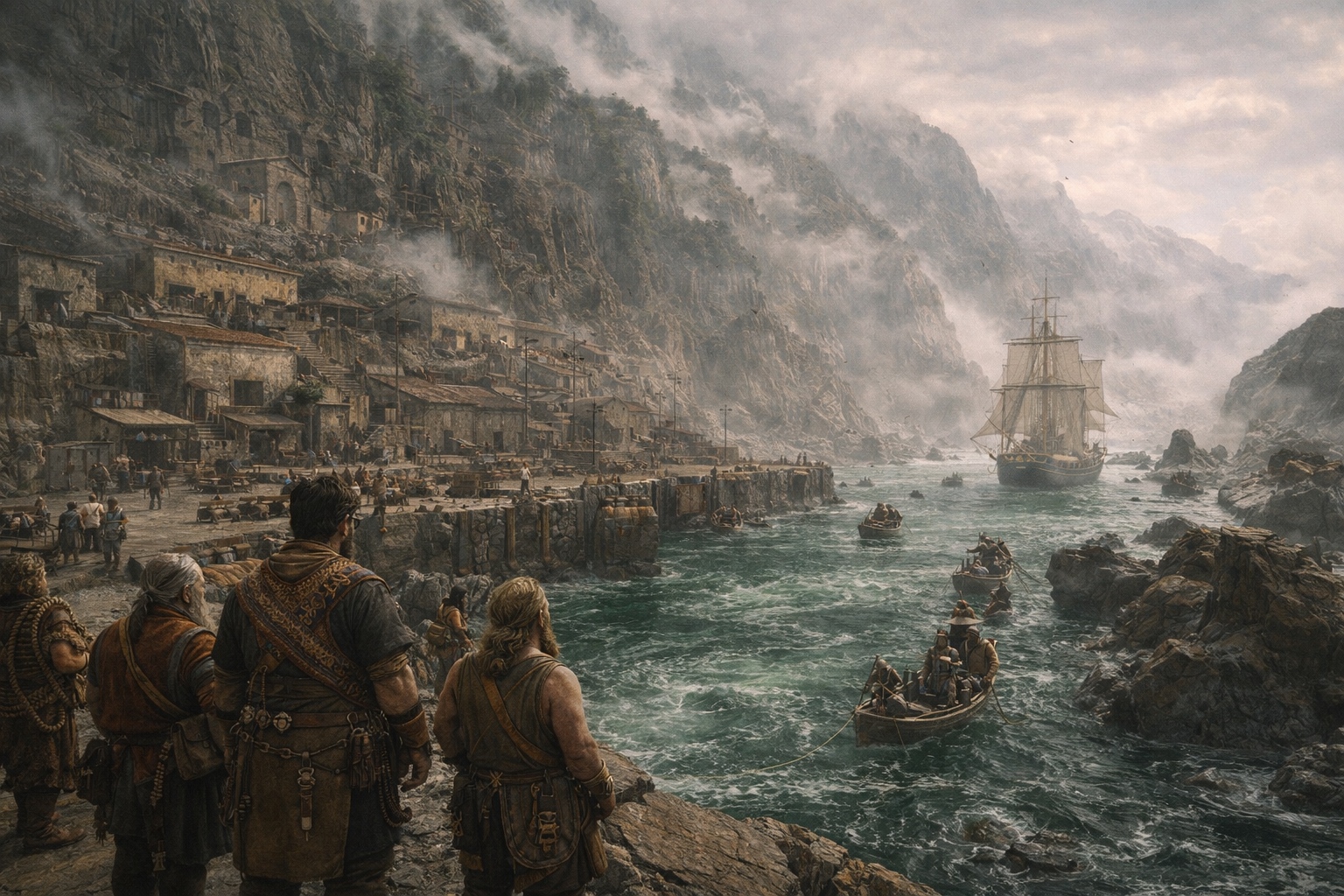
Arriving by sea, Chumbicha looks as though it was hammered into existence rather than built: stone warehouses pressed into the cliff face, salt-crusted docks jutting out over jade-colored water, and smoke rising from forges and cookfires alike. The Canal Agrietado narrows here to its tightest stretch, and the walls of rock rise on both sides with an oppressive closeness that makes even experienced sailors grip their rails. But the town itself fills that narrow shelf of land with surprising density: stacked buildings, rope-lashed cranes, and the endless creak of cargo hoists.
On shore, the smell hits first: salt air threaded with mineral dust and woodsmoke, and beneath it all, the rich iron scent of ore that has soaked into the very cobblestones. The streets are short and angular, following the contours of the cliff rather than any planner's grid. Dwarves in worn leather move purposefully between warehouses; Elven fishing crews mend nets on the lower docks; Half-Orc porters haul crates with mechanical efficiency. Nobody lingers without a reason.
The townspeople watch strangers with the particular wariness of a community that has learned its position makes it a target. Chumbicha is the only town on this passage, and everyone knows it: the miners upriver, the traders from the Compact, the ships trying to thread the canal. There is money in that position, and money attracts trouble. The people here are not cruel, but they are careful.
Geography & Setting
Chumbicha occupies a narrow coastal shelf on the eastern foothills of the Cordillera Sulana, where the mountain range meets the Canal Agrietado, the island-dense maritime corridor that runs through Amnyth's Sea. The town has no flat ground to spare. Buildings climb the lower cliff faces, and the docks extend over the water because there is nowhere else to put them.
The Canal Agrietado here is navigable but demanding. Tidal currents run fast and the rock formations below the waterline have claimed dozens of hulls over the years. Chumbicha's pilots, local sailors who guide ships through this stretch, are among the most sought-after maritime specialists in the region. No captain with sense attempts the passage without one.
The mountains above the town hold the mining villages that are Chumbicha's economic reason for being. Ore, gems, and granite come down via mule track and rope-lift to be warehoused, graded, and loaded onto outbound ships. The climate is mild alpine on the heights and salt-damp maritime at sea level; the combination produces thick morning fogs that burn off by midday and sudden squalls in the afternoon.
The People
Demographics
Dwarves make up the largest proportion of the population, descended from the original mining families who established the settlement. Humans are nearly as numerous and fill most of the fishing and dockworking trades. Elves are present in significant numbers, especially among the fishing fleet captains and canal pilots, where their patience and long sight are valued. Half-Orcs, Half-Elves, and Smalings make up the remainder, drawn here by trade opportunity and the particular freedom that comes from a town too busy to ask where you came from, as long as you pull your weight.
Outsiders are tolerated rather than welcomed. Chumbicha has learned that strangers sometimes come to study the passage, map the currents, or quietly assess the warehouses, and not all of them have benign purposes. New arrivals are watched until they establish a purpose that benefits the community.
Economy
Chumbicha is the logistical spine between the Cordillera Sulana mines and the rest of Antaea. Raw ore, refined metals, cut gems, and dressed granite arrive from uphill settlements and are sorted, stored, and shipped outward. The town charges warehousing fees, handling fees, and pilotage fees, and the fact that there is nowhere else to go means those fees are non-negotiable.
The fishing industry runs parallel and independent. The Canal's protected waters and the offshore reaches beyond it are rich, and Chumbicha's fleet supplies fish to both the mining settlements above and the island chains to the east. During lean mineral seasons, the fishing income keeps the town solvent.
Primary Exports
- Warehoused minerals, metals, and gems: The town doesn't mine, but nearly everything mined in the Cordillera Sulana passes through here before reaching a buyer
- Fresh and salted fish: Canal and open-water catches; dried fish is a key food export to inland mining villages
- Canal pilotage services: Skilled local pilots who guide ships through the Agrietado's most treacherous stretch
Primary Imports
- Mining tools and equipment: Pickaxes, rope, shoring timber; imported and resold uphill
- Grain and preserved foods: The cliff shelf doesn't support significant farming; staples come from the southern plains and Gran Floresta suppliers
- Finished textiles and goods: The town produces little luxury; everything decorative comes from outside
Key Industries
- Mineral warehousing and brokerage: The central economic engine; House Durin controls most warehouse space
- Deep-sea and canal fishing: Fleet of ~30 vessels operating under Captain Elira Windwhisper's coordination
- Canal pilotage: A licensed guild of pilots who guide ships through the passage; tightly regulated, well paid
Food & Drink
The table in Chumbicha is workman's food with occasional grace. Miner's Broth is the settlement's defining dish: a thick soup of root vegetables, dried herbs, and whatever mineral-rich water comes down from the mountain springs, with a flavor people either love or learn to tolerate. Fish is ubiquitous: grilled, salted, dried, smoked, stewed. The dockside stalls sell roasted fish on sticks at all hours. Grain flatbreads made from imported flour are baked in communal ovens every morning and go stale by afternoon.
The local drink is a rough distilled spirit called Cascote, made from fermented grain mash with a sharp mineral finish that Chumbicha natives claim is the mountain's taste working its way through. Outsiders usually prefer the decent wine that comes through on trade ships.
Culture & Social Life
Chumbicha's social order is organized around usefulness. Rank is acknowledged but the real currency is competence; a master warehouse grader outranks a noble's idle cousin every day of the week. The Dwarven founding heritage shows in the pragmatism: agreements are kept, debts are paid, and reputation is everything. Public disputes are handled through community arbitration before House Durin: not because people trust the system to be gentle, but because it is faster than violence and leaves everyone able to work the next morning.
Magic is viewed with cautious acceptance. There are mages who work the cranes and assist with ore assessment, but flashy or unpredictable casting makes people nervous. The Canal's tight quarters mean accidents spread.
Festivals & Traditions
The Festival of Scales and Stones
Held at the autumn equinox, lasting three days. The festival is the town's great communal celebration, honoring the dual heritage of mining and fishing. The central ceremony involves the construction of a large sculpture in the town square from fish scales and polished mountain stones brought down specifically for the occasion. Different workshops, fishing crews, and mining brokers each contribute materials and craftsmanship. The finished sculpture stands until the following year's festival, when it is ceremonially dismantled and the materials scattered back into the sea and the mountain roads. The festival includes competitive ore-grading contests, net-mending races, feasting, and an evening of music that runs until dawn.
Music & Arts
Music in Chumbicha is functional and communal. Work shanties for the docks, walking rhythms for the mule-track porters, and slow cadenced songs for the night watches are all part of the daily acoustic landscape. Instruments are typically stringed: lutes and fiddles made from local hardwoods and fishbone, with a sound that is raw and resonant. Art is overwhelmingly craft-integrated: elaborate knotwork on nets and rigging, carved tool handles, and the Chumbicha Chalice, a finely worked goblet of blended local metals set with small gems, produced by skilled Dwarven smiths and given as diplomatic gifts or offered to honored traders. They are considered the town's most refined cultural export.
Religion
Primary Faith
Talbar, deity of knowledge and commerce, is the primary faith of Chumbicha in the way that matters here: ledgers, weights, contracts, and the right to move goods through the passage. The town's power is not brute force; it's the fact that nearly every bar of ore and every cargo manifest becomes legible in Chumbicha before it becomes money elsewhere.
Talbar's temple is part counting-house, part arbitration hall. The clergy keep the canonical measures, witness major contracts, and maintain the town's most trusted registry of warehouse claims and pilotage fees. In disputes, Talbar's doctrine is simple and unforgiving: you may bargain hard, but you do not falsify the record.
Secondary / Minority Faiths
Ryujin has a strong presence among the fishing fleet and canal pilots. Shrines near the lower docks receive daily small offerings before any ship casts off.
Martus is popular among miners, porters, and traders who live with risk as a daily fact; the small spinning-coin shrines appear at dock gates and in warehouse offices where the next decision is always a wager.
Kraut has modest following among the small agricultural community on the lower plains south of town.
Solis attracts the town's scholars and assayers, those who believe careful knowledge is the truest fortune.
Caminus, the deity of craftspeople and the mastery that transforms raw material into something greater, has a natural home in a town whose most prestigious cultural export is the Chumbicha Chalice: a finely worked goblet of blended local metals set with small gems, produced by Deld Copperknuckle's Dwarven smiths and given as diplomatic gifts to honored traders. The forge tradition that produces these pieces, alongside the everyday ironwork that keeps the mining and canal economy running, is understood by the community's craftspeople as a vocation with spiritual weight. The Forge of the Deep maintains informal Caminus observance alongside its practical output.
Bronthe, the deity of stone, mines, foundations, and endurance, is observed throughout Chumbicha with a quiet ubiquity that reflects the physical reality of the town's existence: stone warehouses pressed into the cliff face, buildings that climb the lower cliff faces, the entire settlement hammered into a narrow coastal shelf of rock. The Dwarven founding families whose descendants still make up the largest population share understand Bronthe as the ancestor-faith that preceded Talbar, the mining identity that made the trading position possible. Shrines appear at mine-shaft entrances and at the foundation stones of the oldest buildings.
Morbina, the deity of disease and plague, is propitiated rather than worshipped in Chumbicha with a consistency that reflects the Miner's Plague's permanent place in community memory. The respiratory illness that struck the Dwarven workforce severely and halved mining output over two years left the town with a permanent culture of occupational health awareness and a deep institutional distrust of any illness that spreads quietly; in Morbina's terms, this is precisely the orientation of communities that have survived epidemic and choose propitiation over innocence. Small offerings against illness recurrence appear at workshops, warehouses, and in the homes of families who lost workers to the Plague.
Thulgard, the deity of community resilience and shared labor, is honored in memory of the two defining community survival events in Chumbicha's history. The Siege of the Sea Serpent, when Captain Elira Windwhisper organized fishing vessels and mining engineers into a collective expedition that drove the creature out, fused the two communities into a single civic identity. The Miner's Plague's management through economic diversification and emergency cooperation demonstrated the same collective capacity under a different kind of threat. Thulgard's faith names what those events required of ordinary people: not heroism but collective endurance.
Nyxollox, the gentle deity of peaceful death and transition, is invoked regularly in a community where daily work carries physical risk and the history includes both plague and sea-creature siege. The warehouse workers who handle the cargo of failed mining operations require a gentler death theology alongside the more transgressive one the Shinigami cult provides. Nyxollox's shrines appear in the lower dock areas and near the mining-supply warehouses, maintained by the families of those lost to the Canal and the mountains above.
Secret or Forbidden Worship
A small cult venerates Shinigami in private, concentrated mainly among warehouse workers who have spent years handling the remains of failed miners and drowned sailors. They believe that understanding death's calculus gives advantage in all transactions. House Durin suspects the cult exists but has not moved against it, lacking proof and unwilling to destabilize the warehouse workforce.
History
Founding
Chumbicha began as a seasonal storage depot established by Dwarven miners from the Cordillera Sulana who needed a sheltered place to transfer ore to waiting ships. The Canal Agrietado's natural harbor, the only one on this stretch of cliff coast, made the location obvious. Within a generation, Elven fishing crews discovered the same harbor's value, and a permanent settlement took shape through the practical alliance of two communities who needed the same dock space.
Key Events
The Siege of the Sea Serpent
In the town's early years, a massive sea creature took up residence at the canal's narrowest point, blocking passage for three months. The loss of trade revenue threatened the settlement's survival. Captain Elira Windwhisper, then a young fleet commander, organized a cooperative expedition of fishing vessels and mining engineers. The creature was driven out through a combination of underwater percussion, fire, and what locals diplomatically call "creative use of blasting powder." The event fused the fishing and mining communities into a single civic identity and formally established House Durin's leadership role, which had previously been informal.
The Expansion Era
Following the Sea Serpent event, Chumbicha's reputation for reliability drew new settlers and trade partners. Warehouse capacity tripled in a single decade. The pilotage guild was formally licensed, generating both revenue and safety improvements. Agricultural efforts on the southern shelf, led largely by Smaling settlers, reduced food dependency on outside imports.
The Miner's Plague
A respiratory illness of unknown origin, likely mineral dust disease, struck the Dwarven workforce severely over the course of two years. Mining output from the Cordillera Sulana dropped by nearly half. House Durin managed the crisis by diversifying into fishing exports and negotiating emergency grain credit through the Gran Floresta Compact. The Plague left Chumbicha with a permanent culture of occupational health awareness and a deep institutional distrust of any illness that spreads quietly.
Current State
Chumbicha is cautiously prosperous but under pressure. Canal traffic is increasing as eastern trade routes expand, and there are reports of foreign interests, including parties from outside Antaea, attempting to map and assess the passage. House Durin is quietly reinforcing its relationships with Gran Floresta Compact partners while maintaining strict neutrality in the ongoing Canal Agrietado political disputes. The pilotage guild has begun charging higher fees for non-Compact ships, which has caused friction.
Leadership & Governance
House Durin: Overview
Chumbicha is governed by House Durin, a Dwarven trade dynasty that has held authority since the settlement's consolidation. Leadership is hereditary but the House exercises power primarily through economic control: ownership of warehouse space, licensing of the pilotage guild, and brokerage relationships with the mining villages. There is no formal law code beyond common Antaean custom and House Durin's trade regulations. Justice is handled through arbitration. Serious crimes are rare; when they occur, punishment tends toward exile or loss of trading rights rather than execution.
Lord Thrain Durin
Dwarf, Male: A man in his middle centuries by Dwarven reckoning, carrying the weight of four decades of leadership
Thrain Durin is broad-shouldered and deliberate, with a grey-shot beard kept short by working standards and eyes that calculate costs automatically. He dresses practically: fine quality, but never showy. He speaks in short, complete sentences and does not repeat himself.
He is competent and careful, which in Chumbicha reads as wisdom. What drives him is legacy: he wants House Durin to hold this position for another three generations, which means no overreach, no scandals, and no provocations that invite outside interference. His blind spot is the assumption that stability is the same as safety; he has not fully reckoned with how desirable Chumbicha's position makes it as a target for more aggressive powers.
The people respect him without warmth. He has never betrayed them, which is the highest local standard of governance.
Merin Durin: House Steward and Heir
Dwarf, Female: Thrain's daughter, mid-seventies, manages the day-to-day warehouse operations and serves as de facto administrator. She is sharper than her father on detail and more willing to consider change. Some expect she will modernize the House's approach when she eventually leads.
Guard & Militia
The Canal Watch numbers about sixty full-time guards and forty reservists drawn from the warehouse and dock workforce. They are professional, weathered, and carry both blade and crossbow. Their primary role is cargo security and dock order rather than law enforcement; disputes among people are usually handled socially before the Watch gets involved. They are commanded by a senior Dwarf named Brek Ironbarrel, who spent twenty years on merchant vessels before settling here.
Law & Order
Common Antaean custom applies. Theft from a warehouse is treated as an attack on the whole community and is punished with permanent expulsion and trade blacklisting. Assault is handled case by case through arbitration. Debt evasion is treated more seriously than almost any violence; in Chumbicha, breaking your word about money is considered a form of murder.
Notable Figures
Captain Elira Windwhisper: Fleet Commander
Elf, Female: Lower docks, usually aboard or near the lead fishing vessel
Lean, salt-weathered, with silver-grey hair worn loose and eyes the color of the Canal at depth. She commands through competence rather than volume; a raised eyebrow from Elira ends arguments. She wants the fishing fleet expanded and resents House Durin's focus on mining revenue at the expense of fishing infrastructure. She knows the canal's currents better than anyone alive and has personally piloted ships through the passage in conditions that would make guild pilots refuse.
Grothak the Trader: Mineral Broker
Half-Orc, Male: The counting house near the central warehouse district
A barrel-chested Half-Orc with excellent arithmetic and a reputation for brutally fair dealing; he will not cheat you, but he will extract every possible margin within a legal agreement. Not a native of Chumbicha; he arrived as a journeyman trader and stayed because the position suited him. He wants a formal broker's license from House Durin, which Thrain has been declining to grant, possibly to maintain leverage. Grothak knows which mining villages are over-extended and which are hiding secondary ore deposits.
Alura Brightsong: Agricultural Innovator
Smaling, Female: The southern shelf farmlands below the town
Small even for a Smaling, with dirt perpetually under her nails and an earnest precision about farming that borders on religious. She has introduced crop rotation and terracing techniques from the Gran Floresta region that have materially improved the town's food self-sufficiency. She wants formal land title; currently she farms on license from House Durin and has no permanent tenure. She is quietly becoming a political figure among the town's non-Dwarven population.
Brother Ossat: Clerk-Priest of Talbar
Human, Male: Talbar's Counting-House Temple, warehouse district
A heavyset, middle-aged man with an accountant's mind and a negotiator's patience. He serves as the town's most trusted contract witness and keeps the most accurate public ledger records in Chumbicha, more accurate, some claim, than House Durin's own. He is devout in the pragmatic local way: bargains are sacred if they are honest, and the record is the thing that keeps the strong from rewriting the past. He has quietly flagged to Lord Durin his suspicion about the Shinigami cult.
Key Locations
Seat of Power
- Durin Hall: A three-story stone building embedded into the cliff face above the upper docks. The ground floor is a public counting house and trade hall; the upper floors are private family quarters and archive. Anyone with registered trade interests may enter the ground floor; the upper floors require an appointment or an invitation.
Houses of Worship
- Talbar's Counting-House Temple: In the warehouse district; part shrine, part notary hall. The canonical measures are kept here, major contracts are witnessed here, and the town's most trusted registry of warehouse claims and pilotage fees is maintained here.
- The Temple of Martus: Upper town, stone construction, deliberately unadorned. A large bronze spinning coin above the doorway. The interior is spare: offering bowls, simple benches, and a wall of carved "wagers", names of voyages, assays, and risks taken honestly.
- The Shrine of Ryujin: Lower docks, essentially a large covered alcove at the water's edge with a carved stone dragon-head submerged in a basin of seawater. Maintained by the fishing guild. Offerings left here before any voyage.
Inns & Taverns
- The Scales & Stones: Named for the Festival, this is the main gathering house for traders and arriving ships' captains. Stone floors, long tables, permanent smell of fish and Cascote. Run by a taciturn Human woman named Petra Graywharf who serves enormous portions and charges what the traffic will bear. The Miner's Broth here is excellent.
- The Pilot's Rest: Smaller, quieter establishment near the pilotage guild hall, catering to the pilots and senior dock officers. Better wine than the Scales & Stones, more discreet conversations.
Shops & Services
- Grothak's Counting House: Not a shop in the traditional sense: Grothak brokers mineral sales, arranges cargo valuation, and provides credit services. His rates are steep and his word is iron.
- Ironbarrel's Outfitting: Run by a younger relative of the Watch commander; sells mining equipment, rope, tools, and maritime supplies at honest prices.
- The Forge of the Deep: Dwarven smithy producing both practical ironwork and the renowned Chumbicha Chalices. The master smith is Deld Copperknuckle, who guards the chalice alloy formula as a trade secret.
The Market
- The Canal Market: Daily, open-air, in the flat plaza between the lower and upper docks. Primarily fish, grain flatbreads, preserved goods, and small trade items. Ships' crews off-load personal cargo here. Loud, crowded, and efficient.
Other Points of Interest
- The Pilot's Spire: A stone watchtower at the Canal's narrowest point, staffed around the clock. From here, licensed pilots coordinate ship movement through the passage; no vessel may enter the bottleneck without a signal from the Spire.
- The Scale-Stone Monument: This year's Festival of Scales and Stones sculpture stands in the central plaza, an elaborate construction of fish scale mosaic and polished mountain granite. Previous years' materials are worked into the base.
Guilds & Organizations
- The Canal Pilotage Guild: The most powerful trade organization in Chumbicha outside House Durin itself. Licenses pilots, sets passage fees, and maintains the Pilot's Spire. Nominally independent, practically essential; no shipping interests want to alienate them. Guild Master is an elderly Elven pilot named Soriath Deepcurrent.
- The Fishing Cooperative: A loose guild of fishing crews operating under Captain Windwhisper's general coordination. Controls dock priority for fishing vessels, manages the communal drying racks, and negotiates fish prices with external buyers. Has been quietly pushing for more political representation in town governance.
The Criminal Element
Canal Agrietado's contested status makes Chumbicha a natural transit point for contraband. Grothak knows about this; House Durin officially does not. Small quantities of restricted goods (narcotics from further east, weapons bound for island disputes, untaxed minerals from unlicensed mining operations) pass through the warehouse district in crates labeled as something else. The operation is not large enough to threaten civic order and is carefully kept below the threshold that would compel House Durin to act. Whether Lord Durin's ignorance is genuine or calculated is a matter of quiet debate.
Secrets, Rumors & Hooks
- The Shinigami cult operating among the warehouse workers is real. They have recently been approached by an outside party interested in using the warehouses for something that would require very specific discretion about what is stored and when.
- Grothak's refusal to accept lower brokerage fees is not stubbornness; he is quietly overpaying a specific mining village because he has a personal financial stake in their undisclosed secondary ore deposit, which he is trying to buy before House Durin discovers it.
- Captain Elira Windwhisper's knowledge of the Canal's currents comes from more than experience. She has maps (old ones, possibly pre-settlement) that show underwater geography the pilotage guild does not have. She has not shared them. She is not sure whether sharing them would help the town or destroy her guild's advantage.
- The Miner's Plague was not fully contained. A small number of Dwarven families carry a dormant form of the respiratory condition. A bad mining season (more dust, less rest) could trigger a new outbreak. Lord Durin knows this. The affected families do not.
- A foreign trading consortium (origin unclear, possibly Jazirah) has been quietly buying through intermediaries in Chumbicha, building what amounts to a majority position in certain warehouse contracts. They have not identified themselves. Their interest is in controlling Canal passage capacity, not the goods themselves.
- The Festival of Scales and Stones sculpture has become more than tradition. The current Year's monument contains a sealed compartment known only to Brother Ossat and one warehouse worker: a compartment where a certain very dangerous document is stored, one that would significantly embarrass House Durin if its contents were known.