Claragua
Claragua: The City at the Bay's Edge
"Other cities build walls against the sea. Claragua built a library. The sea, for its part, seems to have accepted the arrangement."
Eledrin Leafwhisper, founding address, the Arcane Lyceum
At a Glance
| Continent | Antaea |
| Region / Province | Western Antaea, Bahia de Mourayo coast |
| Settlement Type | City |
| Population | ~26,000 |
| Dominant Races | Human (majority), Dwarf, Elf, Smaling, Gnome |
| Ruler / Leader | Lord Renato Valerio |
| Ruling Body | House Valerio, hereditary governance as regional capital |
| Primary Deity | Bethsia |
| Economy | Maritime fishing, timber, agriculture, salt crystal harvesting, scholarly and cultural institutions |
| Known For | The Claraguan salt crystals harvested from the bay's reef edges, the Arcane Lyceum, a rare concentration of active temples for different deities, and a governance style that has made the city one of the more livable capitals in Antaea |
First Impressions
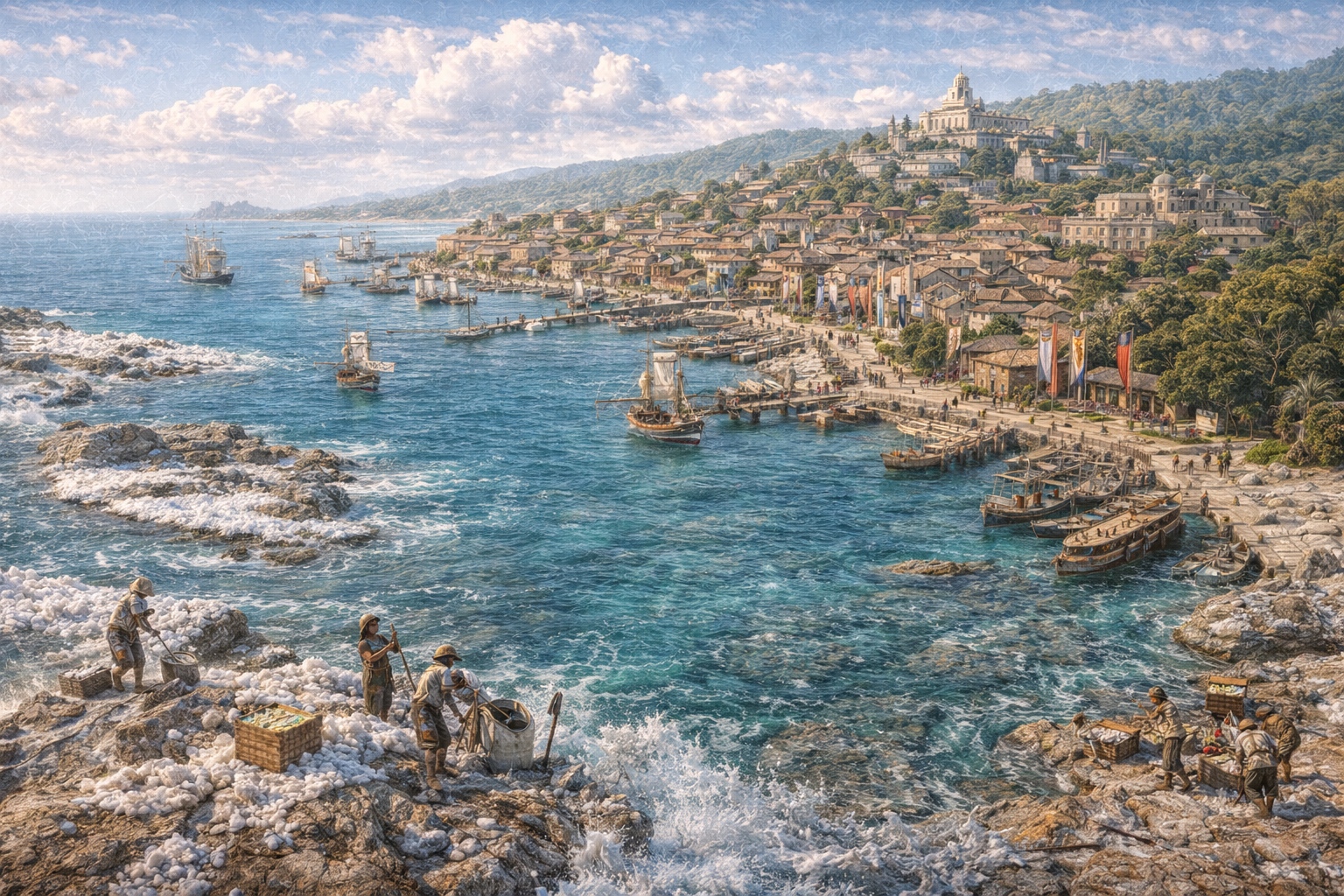
The bay announces the city before the city is visible. The Bahia de Mourayo is protected by a semicircular reef system that breaks incoming swells into something manageable, and ships approaching through the reef's navigable channel find the harbor inside almost eerily calm compared to the open water they left. The cliffs on either side of the entrance are white-streaked, stained by the salt crystal formations that have grown there for as long as anyone has recorded: layered, irregular, catching light differently at different hours of the day.
The city itself spreads back from the harbor along both sides of the Atuel River. The northern bank is the city proper: the market, the principal houses of worship, the administrative buildings of House Valerio, and the Arcane Lyceum's distinctive tower. The southern bank is quieter: smaller communities, fishing camps that haven't quite become neighborhoods, the people the northern bank tends to overlook. The Gran Floresta begins a few miles to the east, its edge visible from the upper city.
What visitors remark on most is the temples. The concentration of active religious buildings is unusual for a city of this size: five distinct faiths with real congregations, the temples often doing double duty as libraries, workshops, or weather stations. Claragua's relationship with its gods is practical. The sea is real, storms are real, the forest is real. Having multiple deities covering multiple domains is sensible.
Geography & Setting
Claragua sits at the mouth of the Atuel River where it empties into the Bahia de Mourayo. The river provides fresh water, irrigation for the agricultural zone upstream, and the shipping channel that connects the harbor to the inland regions. The bay provides the harbor.
The reef system is the city's primary natural defense and primary natural asset. It prevents large-scale naval attack from outside and makes the harbor one of the safest in Antaea. The salt crystals that form along the reef edges are the city's unique commercial product, specific to this particular water chemistry and growing conditions, and not successfully cultivated elsewhere.
The Gran Floresta to the east was heavily logged in an earlier period and is now managed under sustainable practices that have allowed significant recovery. The plains to the south support livestock herds and some grain production.
The People
Demographics
Claragua has been a mixed-race city since its founding by humans and Dwarves seeking a trade hub. The Elven community arrived with the development of the Arcane Lyceum and scholarly institutions; Smalings and Gnomes filled commercial and craft niches over subsequent generations. The current population is majority human but the non-human communities are large enough and established enough that the city's identity is genuinely shared.
The southern bank communities are primarily human and represent the older fishing and agricultural population that predates the city's scholarly reputation. They are not poorly treated but they are less visible in the civic narrative than the harbor and the Lyceum, a tension that House Valerio manages with funding rather than structural change.
Economy
The maritime economy is the foundation: fishing in sustainable volumes, harbor services for coastal and oceanic trade, and the river trade extending inland. Timber from the Gran Floresta is the second major product. Agriculture from the plains and river valley makes the city food-independent without surplus.
The salt crystals are the city's distinction. The harvesting method, developed by the fishing community originally and now under House Valerio oversight, produces a product used in culinary applications, alchemy, and medicinal preparations across Antaea and in export trade. The specific chemistry of the Bahia's reef-edge water is not replicable by formula; the crystals can only come from here. The method of final processing is not publicly known.
The Arcane Lyceum and Melodia Hall have begun generating economic activity through scholarly and artistic traffic: people who come to study, to perform, to consult specialists. This is not a major revenue category yet but it is growing.
Primary Exports
- Claraguan salt crystals: The unique product; sold for culinary, alchemical, and medicinal uses; significant premium value
- Timber: From the managed Gran Floresta; sustainable yield sold to timber-poor regions
- Preserved fish: Salted and dried; the traditional export
- Scholarly services: Consulting, copying, Lyceum enrollment; a non-material export with real economic impact
Primary Imports
- Exotic spices: The coastal trade brings goods not locally produced
- Arcane materials: For the Lyceum's research and teaching
- Fine textiles: The city produces practical cloth; luxury textiles are imported
Key Industries
- Atuel Fisheries: The largest organized fishing operation; Maris Swiftwater's family business
- Valerio's Maritime Co.: House Valerio's commercial shipping arm; the largest vessel owner in the harbor
- The Salt Harvest: Not a single business but a licensed practice; several families hold harvesting rights
- Thrain's Forge: The primary metalwork operation; serves both the practical and artistic markets
- The Arcane Lyceum: An educational and research institution; economically minor but culturally central
Food & Drink
Claragua eats seafood as a daily matter rather than a specialty: fresh fish from the morning's boats, shellfish from the reef's accessible edges, the brackish varieties from the river mouth. The preparation tradition involves longer cooking and more layered spicing than the interior towns of Antaea, possibly because the fishing community had time while nets were out to let things simmer.
The salt crystals appear in the city's own cooking. The specific crystal type used for culinary purposes is different from the export grade, and the locals use it in ways that visitors find difficult to replicate when they bring the crystals home. This is not coincidental.
The river valley grows enough fruit for a fermentation tradition, a soured fruit wine that is specific to the Atuel and not widely exported because it travels poorly. The communal drink of the festival season.
Culture & Social Life
Claragua's governing value is that knowledge is useful and worth pursuing across domains. This manifests in a city where the temples teach, the forge produces educational work alongside commercial output, and the Lyceum's courses are not restricted to scholars; working people attend lectures. This is not universal in Antaea and is one of the things the city is specifically proud of.
The social life divides along the river. The northern bank is cosmopolitan, institution-rich, oriented toward what the city aspires to be. The southern bank is older, more communal, oriented toward what the city has always been. The two populations know each other but don't often eat together. House Valerio has tried to address this with investment; it is a long-term project.
The treatment of outsiders reflects the city's commercial and scholarly identity: openness calibrated to what the visitor is bringing. Scholars, artists, and merchants are welcomed. People without obvious purpose are watched more closely, not from hostility but from the caution of a harbor city that has seen what unattended visitors can mean.
Festivals & Traditions
The Festival of Tides
The annual high-tide event is Claragua's most significant public occasion. On the day of the year's highest tide, the city gathers at the bay to release small boats loaded with offerings: food, handmade objects, written wishes. The ceremony involves Fujin's temple (which provides the blessing for sea travel) and the fishing community's own traditions in equal measure. It is not exclusive to any one faith and is not quite religious; it is civic and communal and very old.
The wishes inscribed on the boats are not kept private. The tradition is to read them aloud before release. This makes the ceremony an annual communal accounting of what the city hopes for, which is occasionally revealing.
The Forest Opening
When the logging season begins, the Gran Floresta's managed zones are opened with a ceremony that involves Bethsia's temple, the forestry workers, and a walk of the harvest boundaries by House Valerio's representative. The ceremony is partly practical (confirming that the agreed zones are correctly marked) and partly solemn. The timber crisis that occurred a generation ago is recent enough memory that no one treats this lightly.
Music & Arts
Melodia Hall is the anchor of Claragua's performing arts: a genuine venue with a programming calendar, not just a room where things happen. Fiona Songbird has built it into a place that regional musicians aspire to play, and the range of performance styles is wider than the city's size would normally support.
The visual arts tend toward the sea: painters working the harbor and reef light, woodworkers producing nautical-influenced decorative objects, the calligraphers in the Solis temple who have developed an illumination style that incorporates wave forms. The Arcane Lyceum's illustrated research documents are collected by scholars from other cities as objects in themselves.
Religion
Primary Faith
Bethsia is the city's primary deity, appropriate to a place that documents unusual phenomena with scholarly precision. The Bethsia temple here functions partly as a research library: natural anomalies reported from the surrounding region are catalogued and studied. The temple's archive is accessible to anyone with a demonstrated scholarly purpose, which is a more permissive policy than most Bethsia institutions practice.
The temple is the most architecturally unusual building in the city; the original structure was built around an observation void, open to the sky, where certain atmospheric phenomena can be watched. The subsequent additions are organized around preserving that void.
Secondary / Minority Faiths
- Fujin: The god of storms and warfare has a significant temple in the harbor quarter. The sailors and fishermen who regularly place their lives against the sea take a more active interest in Fujin than in any other deity. The temple is functional and practical; the clergy are not academic.
- Caminus: The god of craftspeople has a temple in the artisan district, adjacent to Thrain's Forge. The relationship between the temple and the forge is close enough that the forge functions partly as a training ground for the temple's teachings.
- Solis: The god of wisdom and light maintains a serene presence; the Solis temple is the quietest building in the city, full of reading alcoves and maintained natural light. The head of the Solis temple, Tessara Brightwell, is the person Claragua's scholars turn to for theological disputes that involve multiple faiths.
- Talbar: The god of trade has a small but active shrine near the harbor market. Merchants who work the harbor observe Talbar's practices as pragmatically as they conduct their other business.
- Vessikar: Present wherever weights and measures decide whether commerce stays peaceful. The market inspectors and warehouse clerks invoke Vessikar when shortages or price games could turn ugly.
- Nesara: Honored at the Atuel River mouth, in the well-keeping traditions, and by those who remember that a safe harbor still dies if fresh water fails.
- Sylira: A quiet patron of salons, lecture halls, and harbor taverns: reputation, rumor, and the early circulation of news are a second current through the city.
- Ryujin: The deity of saltwater seas, tides, and maritime navigation is the most conspicuous absence from Claragua's formal temple inventory given its identity as a harbor city. In practice the god is present: Maris Swiftwater's Atuel Fisheries and the southern bank fishing community maintain dockside offerings before boats depart, and Valerio's Maritime Co. skippers invoke Ryujin at the harbor's edge before any significant passage. The southern bank's religious life, less visible in the city's formal narrative, centers on Ryujin in the practical, direct way of people who regularly place their lives against the sea.
- Bridhel: The deity of music, dance, poetry, and all creative arts has an institutional home in Melodia Hall, Fiona Songbird's performing arts venue, which programs a range of performers broader than the city's own generation could produce and which has established itself as a genuine regional cultural institution. The calligraphers of the Solis temple who have developed a wave-form illumination style, the painters working the harbor and reef light, and the woodworkers producing nautical-influenced decorative objects all inhabit Bridhel's domain. The deity's presence in a city with both a performance hall and a scholarly institution that treats its illustrated research documents as art objects is not incidental.
- Raphma: The deity of arcane magic, twilight spaces, and hidden knowledge has an obvious home in the Arcane Lyceum, Eledrin Leafwhisper's institution of magical research and teaching. The restricted archive containing Amnyth materials that are studied rather than destroyed, the research that the Lyceum's illustrated documents represent, and Eledrin's cultivation of genuine intellectual independence from House Valerio's funding pressures are all expressions of Raphma's domain: arcane knowledge pursued for its own sake, in the liminal space between what can be said and what is not yet ready to be known.
- Nyxollox: The gentle deity of peaceful death and transition is quietly present in a city of twenty-six thousand where the sea claims fishermen, the timber crisis claimed lives in living memory, and the Amnyth cult's presence is a reminder that death in its darker forms also operates here. Nyxollox provides the counterweight: the faith that death's ordinary face is gentle and the transition is navigable. The southern bank maintains a small Nyxollox shrine that the fishing families have tended for generations.
Secret or Forbidden Worship
Amnyth, the deity of death and dying, has a following in Claragua that is not public. The exact membership is not known. Dark rituals have been reported twice in the past decade; the Watch investigated both times and found inconclusive evidence. The Arcane Lyceum's archive contains material on Amnyth that is restricted rather than destroyed, on the grounds that studied understanding of a threat is preferable to ignorance of it.
History
Founding
Claragua was established as a fishing village by the mouth of the Atuel River. The natural harbor was the deciding factor; the reef system makes the Bahia de Mourayo one of the safest anchorages on this coast, and the river provided fresh water. Early settlers were primarily human and Dwarf, practical people building a practical place. The scholarly character developed later.
Key Events
The Rise of House Valerio (approx. 200 years ago)
The Valerio family came to governance through scholarly reputation and diplomatic skill, not military force. Their distinguishing policy, funding education and building institutions, transformed the city's character over generations. The current emphasis on intellectual life is the cumulative product of that investment.
The Timber Crisis (approx. 80 years ago)
The Gran Floresta was significantly depleted by unregulated logging during a period of rapid construction. The crisis was addressed through sustainable forestry laws that Thrain Ironfoot's predecessor in the forge community advocated for, the practical craftspeople understanding the supply chain better than the administrators. The forest has largely recovered, and the crisis is used in civic education as the primary example of why the city's institutions exist.
The Lyceum's Founding (approx. 50 years ago)
Eledrin Leafwhisper arrived in Claragua with a proposal and enough personal resources to begin building before House Valerio formally committed to supporting it. The Arcane Lyceum started as a single building and has expanded to its current campus through a combination of House Valerio funding and the endowments of former students who did well.
Current State
Claragua is stable and, by its own assessment, successful. The salt crystal trade is healthy, the harbor is busy, the Lyceum is recognized across Antaea. The persistent concerns are the southern bank population's exclusion from the city's visible prosperity and the Amnyth activity that the Watch cannot quite locate. House Valerio manages both with patience and incomplete information.
Leadership & Governance
House Valerio: Overview
House Valerio governs as regional capital authority under Antaea's broader political structure. Their tradition is consultative; they seek input from scholars, clergy, guild representatives, and the fishing community, and they use it more than most noble houses would. The governance has a scholarly temperament: evidence matters, decisions are documented, and the reasoning for major choices is available on request.
The house's principal weakness is the same as its strength; the tendency to study a problem thoroughly before acting can be a form of delay.
Lord Renato Valerio
Human, Male; fifties
Renato is a man who clearly enjoyed being a scholar before he became a ruler and has not stopped being a scholar since. He funds scholarships personally, attends Lyceum lectures when the schedule permits, and asks more questions at council meetings than most lords ask in a year. He is well-regarded for this by the city's intellectual community and regarded with mild exasperation by the guild representatives who prefer direct decisions to extensive deliberation.
His practical instincts are better than they appear; the decisions that come out of his process are usually sound. The process is just longer than other people's patience.
Lady Isadora Valerio
Human, Female; fifties
Isadora runs the house's commercial operations: Valerio's Maritime Co., the salt crystal licensing, the harbor fee structures. She is considerably more decisive than her husband and considerably less interested in public scholarship. Her arts patronage has funded Melodia Hall's programming for a decade, which is the civic contribution she has chosen as her own. She and Lord Renato divide responsibilities by disposition rather than formal role division.
Notable Figures
Eledrin Leafwhisper: Founder, the Arcane Lyceum
Elf, Male; age indeterminate, appears mid-fifties; the Lyceum
Eledrin founded the Lyceum fifty years ago and has been running it since, which is unusual longevity for an institution head and is partly explained by the fact that he remains the most interesting person in his own institution. He is curious about everything, writes prolifically, and has opinions about magical theory that he does not keep to himself. His relationship with House Valerio is warm but independent; he has declined funding arrangements that came with strings.
Tessara Brightwell: Head of Solis Temple
Human, Female; sixties; the Solis temple
Tessara has been the Solis temple's head for twenty years and is the person other clergy come to when a theological question crosses denominational lines. She is precise in her distinctions and kind in her delivery, which makes her effective at conversations that would otherwise become arguments. She privately suspects the Amnyth activity involves someone from one of the other temples but has no evidence.
Thrain Ironfoot: Master Blacksmith
Dwarf, Male; age uncertain, appears fifties; Thrain's Forge
Thrain's work ranges from the agricultural to the ceremonial; he produces tools that farmers need and weapons that nobles display, and he has opinions about both categories. His advocacy for sustainable resource practices grew out of watching the timber crisis unfold and observing that the metal supply chains faced the same structural risks. He is consulted on resource management matters by House Valerio more often than a blacksmith might expect.
Maris Swiftwater: Owner, Atuel Fisheries
Smaling, Female; fifties; the southern harbor
Maris runs the city's largest fishing operation out of the southern harbor and is the most effective representative of the southern bank community in the city's economic life. Her smoked fish is the city's most widely exported food product. She is direct in the way of people who have spent their lives managing physical risk and has less patience than most for the northern bank's elaborate deliberations.
Fiona Songbird: Owner, Melodia Hall
Gnome, Female; age uncertain, appears young; Melodia Hall
Fiona has run the hall for twenty years and has programmed it in a way that reflects her conviction that music is a universal access point rather than a specialized taste. The range of performers she books is wider than the city would generate on its own, which means the hall consistently brings in people from outside Claragua. She is fond of this effect.
Key Locations
Seat of Power
- House Valerio's Hall: A building that reflects the family's scholarly temperament more than its authority: substantial but not imposing, with a public reading room on the ground floor that anyone can use. The formal reception spaces are above.
Houses of Worship
- The Bethsia Temple: The observation void at its center; the archive; the most visited religious building in the city by non-believers
- Fujin's Harbor Temple: Functional stone construction, built to withstand what it's positioned near; the sailors' place
- The Caminus Temple: Adjacent to the forge quarter; doubles as a craft training facility
- The Solis Temple: Reading alcoves, maintained natural light; the city's quietest building
- The Talbar Shrine: Near the harbor market; working rather than impressive
Inns & Taverns
- The Atuel Rest: The principal inn for visitors to the northern bank; used by scholars, merchants, and anyone with legitimate purpose
- The South Pier House: The southern bank equivalent; smaller, older, a better representation of the city as it was before the institutions
Shops & Services
- Thrain's Forge: The primary metalwork operation; ceremonial pieces alongside everyday production; apprentice training
- Atuel Fisheries: Maris Swiftwater's operation; fresh fish and smoked fish; wholesale and retail
- The Lyceum Booksellers: A cluster of shops adjacent to the Lyceum campus; the most comprehensive book and manuscript market in the region
- The Salt Crystal Office: Where licensed harvesters file their yields and buyers can acquire the crystals directly; House Valerio operated
The Market
- The Harbor Market: Daily; divided between fresh catch from the morning boats, agricultural produce from the river valley, and a craft goods section that is genuinely varied. The best concentration of Claraguan salt crystals available for retail purchase.
Other Points of Interest
- The Arcane Lyceum: The tower is visible from the harbor; the campus includes lecture halls, laboratories, and the library that Eledrin Leafwhisper is most proud of
- Melodia Hall: The city's primary performance venue; the calendar is posted at the harbor gate
- The Reef Edge Walk: The accessible portion of the bay's reef system can be walked at low tide; the salt crystal formations are visible and impressive. The harvesting areas are marked and off-limits.
Secrets, Rumors & Hooks
- The specific chemistry that produces the Claraguan salt crystals is understood only by the three oldest harvesting families, who have a mutual agreement not to document it. Maris Swiftwater knows the outline of it from her fishing experience (she has worked those waters her whole life) but has not made the full connection. Someone trying to replicate the process would need information from at least two of the three families, and each family believes the others don't know the complete formula.
- The Amnyth cult activity has a connection to the Arcane Lyceum that Tessara Brightwell suspects but cannot prove: specifically, that the restricted archive's Amnyth materials have been accessed by someone who did not file the required request. Eledrin has reviewed the access logs and found no anomaly, which he believes means either the logs are accurate or whoever accessed the material knew how to avoid leaving a record.
- Isadora Valerio has been quietly funding an investigation into the southern bank's exclusion from the city's prosperity: not through House Valerio's official channels but through a merchant intermediary. She has not told Lord Renato because she knows he will want to study the question for two years before acting, and she wants action.
- Thrain Ironfoot's most recent ceremonial commission, a weapon for a noble family, required metal that he sourced from a supplier he had not previously used. The metal has properties he cannot account for by any standard material description. He has been testing it for three months. He has not told the commissioner.