Cumane
Cumanè: The Reluctant Crossroads
"We don't hate the Jazirans. We just prefer they worship their gods quietly, trade their goods honestly, and leave before dinner."
Serafina the Seer, local mystic
At a Glance
| Continent | Antaea |
| Region / Province | Northwest Coast, Souther Strait |
| Settlement Type | Town |
| Population | ~3,100 |
| Dominant Races | Humans, Dwarves, Elves |
| Ruler / Leader | Lord Elric Veridale, Sapa of House Veridale |
| Ruling Body | House Veridale (hereditary farming dynasty) |
| Primary Deity | Echo |
| Economy | Farming, Fishing & Carambola Export |
| Alliance | Gran Floresta Compact |
| Known For | The finest Carambola fruit in Antaea, and a cautious, complicated relationship with Jaziran merchant culture |
First Impressions
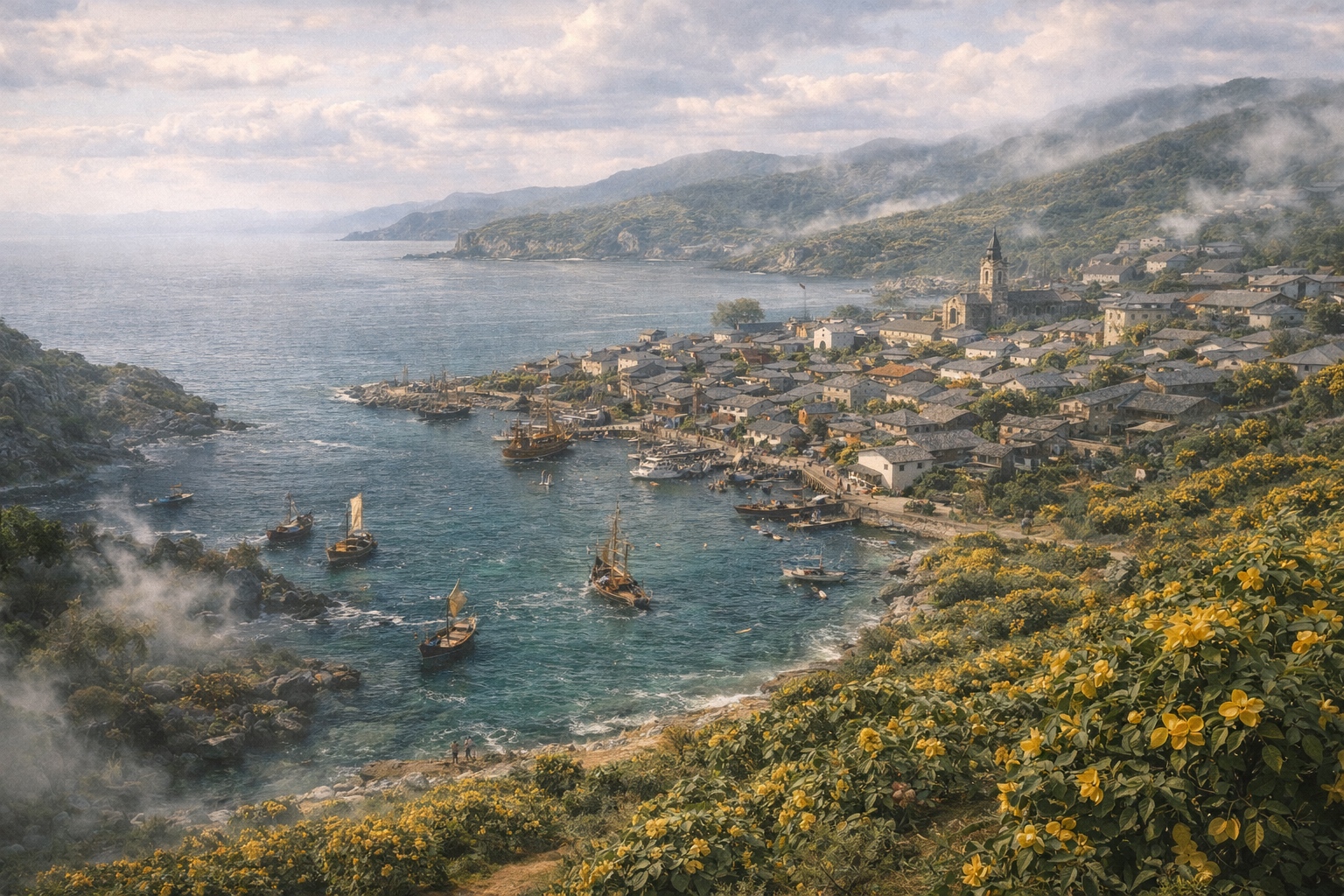
Cumanè announces itself gently: a low skyline of slate-roofed buildings stepping down toward the water, fishing boats rocking in a sheltered bay, and fields of star-shaped yellow fruit visible from the hillsides above town. The Souther Strait lies to the north and west, its waters quieter here than in the open sea, and the town's port is modest but well-maintained. The smell is particular: salt air with something sweeter underneath, the fragrant Carambola ripening in the coastal orchards.
The streets are cobblestone and narrow, with houses built from the local grey-green slate that gives the town its distinctive color. Craftsmen's stalls line the market quarter, and the sounds of flutes and drums drift from the plaza on most evenings. The people here are not cold, but they hold themselves with the watchfulness of a community managing tensions they did not invite. Visitors are met with honest hospitality and quiet assessment in equal measure.
The Jaziran influence is visible if you know where to look: prayer beads of a foreign style, a shrine tucked in an alley, occasional linen dyed in colors not from any Antaean dye-house. The town has technically permitted Oshala worship but the permission is measured and the restrictions are enforced. Arguments about this arrangement surface at market, at table, and in council chambers with reliable frequency.
Geography & Setting
Cumanè sits on the northwest coast of Antaea along the Souther Strait, west of the Orinokia plateau. The terrain is coastal lowland: flat to gently rolling, with the water on the western flank and fertile plains extending to the east. River access is limited; the town draws freshwater from several springs and small seasonal streams rather than a significant river. The bay is protected enough for fishing and small trade vessels but does not accommodate the deep-draft ships that use Claragua's more substantial harbor to the south.
The climate is temperate maritime: mild winters, warm summers, regular rain from the strait. The Carambola orchards thrive in this environment, and the fishing waters are productive year-round. To the east, the land rises gradually toward the plateau, and the hills provide slate for local construction, giving the town its characteristic grey-green palette.
Cumanè's position on the strait makes it a natural stopping point for ships moving between the Perian Sea and more southerly coastal routes: not a great port, but a useful one, with reliable provisioning and honest scales.
The People
Demographics
Humans form the large majority, with a heritage rooted in the farming families who settled the Carambola-growing highlands. Dwarves make up a significant minority, concentrated in the crafting trades: smithing, slating, and woodwork. Elves are present mainly in the fishing fleet and as traveling traders. In recent years, Jaziran migrants have begun settling in a small but visible quarter of the town, drawn by the trading opportunities and the cautious Oshala permission granted by Lord Veridale. Their presence is a source of ongoing social friction.
Smalings pass through in numbers as itinerant traders and herbalists but few settle permanently. The general attitude toward outsiders is one of calibrated welcome: curiosity about trade, wariness about allegiance.
Economy
Carambola is Cumanè's crown jewel. The star-shaped fruit (golden when ripe, tart and sweet in almost equal measure) is cultivated in the coastal orchards above town and exported throughout Antaea and into broader trade networks. The fruit travels well when dried or preserved, and Cumanè has developed a cottage industry of jams, chutneys, and Carambola wines that command premium prices.
Fishing and livestock farming support local food needs and provide secondary exports. Goats and chickens are kept in numbers, and the slate quarries provide both local building material and a modest export. The distinctive Cumanè slate carvings, intricate decorative pieces made by skilled artisans, are a craft export of note.
Primary Exports
- Carambola fruit, preserves, and wine: The settlement's defining product; dried fruit travels to distant markets, fresh fruit to regional ones
- Slate carvings: Decorative artisan pieces prized for their distinctive grey-green color and fine detail work
- Fish and goat products: Modest exports of salted fish, goat cheese, and wool
Primary Imports
- Spices and specialty goods: Imports via the Jaziran trade connection bring flavors and goods not locally produced
- Grain: The coastal lowlands produce fruit well but grain inadequately; staple cereals are imported
- Tools and metals: Ironwork beyond what local smiths produce comes from inland Compact partners
Key Industries
- Carambola cultivation and processing: The cornerstone industry; orchards extend across the hillside above town
- Fishing: Small fleet working the Souther Strait; primarily for local consumption with modest surplus for trade
- Slate craftsmanship: A skilled artisan tradition producing both construction material and decorative goods
Food & Drink
The table in Cumanè leans heavily on what grows well here. Carambola appears in almost everything: raw as a snack, dried in trail mix, turned into chutney alongside goat stew, fermented into a sweet-tart wine that locals drink with meals. Fish arrives fresh from the boats and is most commonly pan-fried with herbs or baked in clay with lemon and garlic. Goat meat shows up roasted at festivals and stewed in winter. The local spices, supplemented by Jaziran imports, give Cumanè's cooking a range of flavor broader than a coastal farm town might suggest.
The Carambola wine is the town's proudest beverage: light, slightly acidic, drunk young. Older vintages are considered more valuable than they are necessarily drinkable, but locals argue the point.
Culture & Social Life
Cumanè's social life revolves around the farming cycle, the fishing season, and the management of its complicated civic identity. The people are hospitable in the Antaean tradition: guests are fed, questions are answered, deals are struck with handshakes that mean something. The Dwarven craft community holds a strong social position through guild membership and reputation; their festivals and work ethic set a standard the rest of the town measures itself against.
The presence of Jaziran settlers has created an unmistakable social seam. Not hostility exactly, but a careful mutual navigation. Cumanè's culture of cautious openness, Lord Veridale's byword, has prevented open conflict but has not produced integration. The two communities shop at the same market and do not eat at the same tables.
Festivals & Traditions
The Slate Festival
Held in early autumn, one week in duration. The Festival is Cumanè's annual celebration of craftsmanship and community identity. Artisans from across the region present their slate carvings in a public competition judged by a panel of master craftspeople. The winner's piece is installed in the town hall as a permanent fixture. Beyond the competition, the Festival includes markets, music, and the ceremonial pressing of the first Carambola wine of the season. It is deliberately and emphatically a celebration of the original town identity; the Veridale family has never invited Jaziran artisans to compete, and the omission is never officially acknowledged.
Music & Arts
Music in Cumanè is communal and outdoor; the plazas fill with flutes, drums, and string instruments on warm evenings, and harvest songs accompany the Carambola picking season. The art tradition is dominated by slate carving: highly detailed relief images of coastal scenes, farming life, and religious symbols cut into local stone. Some of the most skilled pieces take months to complete and are regarded as significant heirlooms. Textile craftsmanship runs alongside; embroidered linens in coastal-inspired patterns are a local specialty.
Religion
Primary Faith
Echo holds the primary place in Cumanè's public life, not as a grand state religion, but as the patron of the thing this town is constantly trying to maintain: a functional, fair, non-explosive community in the presence of trade pressure and cultural friction. Echo's clergy (and lay-counselors) are embedded in civic routines: hearing disputes, maintaining the seasonal registers, and keeping the town's agreements legible.
The main civic shrine doubles as the record hall for land rights and seasonal agreements. The theology is practical: stability is work, fairness is work, and if you don't do it, someone else will do something worse.
Secondary / Minority Faiths
Caminus has a large temple in the artisan district, doubling as the official hall of the craftsmen's guilds. Smiths and carvers make offerings before significant projects.
Talbar is revered by the town's traders and has a modest temple near the market that serves as an informal arbitration hall.
Ryujin has a small coastal shrine maintained by fishing families.
Jaziran settlers quietly maintain Oshala worship in a permitted but restricted shrine; no active recruitment among Antaean-born residents is the stated condition of the arrangement.
Kraut, the deity of abundance through cultivation and the sacred relationship between human labor and the harvest, is perhaps the most naturally present deity in a settlement whose entire identity is organized around a specific cultivated fruit. The Carambola orchards that terrace the hillside above town have been tended by the same families for generations, and the seasonal rhythm of the harvest (the picking, preserving, and pressing that produces the town's exports) is the spiritual calendar the farming community actually observes. Kraut's presence is informal and rooted: in the harvest songs, in the orchard offerings before the first pressing, in the way Mira Saltwind's workers treat the best vintage as something more than commercial.
Jula, the deity of peace and measured reconciliation, is observed by those who understand most clearly the work that Cumanè's current equilibrium requires. Lord Elric's decision to permit Oshala worship (resisted by many, accepted by none with enthusiasm) was, in Jula's terms, exactly the kind of costly, incomplete peace that prevents worse outcomes. Captain Aeliana's desire for clearer rules enforced evenly is also a Jula aspiration, from a different angle. A Jula shrine in the civic quarter is frequented by the militia officers, the market supervisors, and the council members who mediate daily between communities that share a market without sharing a table.
Itha, the deity of prophecy, fate, omens, and destiny, has a specific human institution in Cumanè: Serafina the Seer, whose herbalist practice and intuitive readings have made her the town's most reliable source of hidden information about what is actually happening in its hidden social spaces. She has now seen Cumanè's future twice in her readings without sharing it with Lord Veridale. The farming families who consult her before significant decisions, and the community members she helps with problems that cannot be acknowledged officially, are Itha's congregation in practice. The faith follows Serafina's hillside cottage rather than a formal temple.
Hesira, the deity of hearth, marriage, and domestic continuity, is observed among Cumanè's farming families with the quiet constancy of communities whose entire economy depends on the domestic unit's stability. The orchard families who have worked the same land for generations maintain their tradition through household structure (the knowledge of which grove sections produce which fruit, the preservation methods, the seasonal rhythms), and the blessing of new households is taken seriously as an agricultural matter as much as a personal one.
Secret or Forbidden Worship
Mamaxa, goddess of pain and pleasure, has a small secret following among certain circles in Cumanè: specifically some of the more isolated farming families in the hillside orchards. Their rituals are private and have not caused civic disruption, but they are known to Serafina the Seer and are not reported to the House.
History
Founding
Cumanè was established as a fishing village by Human and Dwarven settlers drawn to the sheltered bay and the fertile coastal plain. The discovery that the specific combination of maritime air, moderate rainfall, and local soil conditions produced exceptional Carambola fruit transformed the settlement's economic character within two generations. Farming families, including the ancestors of House Veridale, built the orchards and the town around them.
Key Events
The Oshala Decision
The most divisive event in recent Cumanè history was Lord Elric Veridale's decision to formally permit the worship of Oshala within town limits, a concession to Jaziran merchant interests who argued their community required spiritual accommodation to continue trading. The decision was not popular. Skirmishes between locals and some Jaziran newcomers became a monthly occurrence for several years. The current arrangement (permitted worship, restricted proselytizing) represents an uneasy peace that has held for nearly a decade but satisfies no one fully.
The Slate Carving Slump
An earlier generation faced a significant economic setback when demand for Cumanè slate carvings collapsed, partly due to cheaper imitation products from inland workshops and partly due to a run of poor harvests. The recovery came through quality standardization (the craftsmen's guild began certifying authentic pieces) and the diversification into Carambola wine, which opened new export markets. The Slump left Cumanè with a deep instinct for economic diversification.
Current State
Cumanè is prosperous but socially tense. The Carambola orchards are producing well, the slate market has recovered, and trade with Gran Floresta Compact partners is steady. But the question of Jaziran integration (how far it goes, on whose terms) is unresolved. A second generation of Jaziran-born residents now lives in town, some of whom have never seen Jazirah. They are neither fully accepted nor interested in leaving. Lord Veridale is aging and has not clearly named his preferred successor, which adds political uncertainty to social uncertainty.
Leadership & Governance
House Veridale: Overview
Cumanè is governed by House Veridale, a lineage of farming nobility with roots as deep as the oldest Carambola orchards. Their authority rests on land ownership, the trust of the farming families, and a reputation for calibrated pragmatism. There is no standing army; law is enforced by Captain Aeliana's militia, and disputes are resolved through a combination of civic arbitration and social pressure. Antaean custom governs serious matters; House Veridale's own word governs the rest.
Lord Elric Veridale
Human, Male: A man in his late fifties, grey-haired, careful in his movements and his words
Elric Veridale is a wide-set, weathered man who looks most comfortable in an orchard rather than a council chamber, which, his staff suggests, is precisely where he spends half his time. He is pragmatic, deliberate, and deeply attached to the idea that Cumanè can hold contradictory things together without breaking. His decision to permit Oshala worship came from genuine trade pragmatism, not idealism; he is not a romantic about tolerance.
His flaw is his reluctance to make the hard choices that would actually resolve the Jaziran tension: either full integration or a formal renegotiation of the Oshala terms. He keeps hoping the problem will sort itself out, and it will not.
His people respect him as a fair man, though the more traditionalist farming families are losing patience with his caution.
Captain Aeliana: Militia Commander
Elf, Female: A lean, grey-eyed elf in her mid-centuries, never quite at rest. She commands the militia with the efficiency of someone who has seen how quickly small towns can unravel. She does not share Lord Veridale's patience with the Oshala arrangement and has made that clear to him in private. She wants clearer rules enforced evenly: not the informal selective tolerance the current system produces.
Guard & Militia
The Cumanè Militia numbers around fifty active members and sixty reservists drawn from the farming and fishing communities. They are not warriors in the military sense but are capable of handling civil disorder and the occasional maritime threat. Captain Aeliana runs them with professionalism that exceeds their resources.
Law & Order
Cumanè follows Antaean common custom. Lord Veridale's standing orders add one notable constraint: any religious recruitment activity beyond permitted worship spaces is treated as a civic violation, punishable by a substantial fine and potential expulsion. This law applies officially to all faiths but is most actively enforced against Oshala recruiters. Whether this is equitable enforcement or selective persecution is a matter of heated local debate.
Notable Figures
Master Thrain Ironfoot: Master Blacksmith
Dwarf, Male: The forge at the edge of the artisan district
A broad, soot-stained dwarf in his third century, with hands that could bend an iron rod and an eye for quality that misses nothing. He is a devout follower of Caminus and runs the craftsmen's guild certification program for slate carvings with the kind of rigor that makes substandard pieces impossible to pass off as authentic Cumanè work. He is not interested in the Jaziran question (he considers it Lord Veridale's problem), but he is firmly opposed to any foreign artisan being allowed to sell uncertified work as local craft.
Serafina the Seer: Mystic and Healer
Smaling, Female: Her cottage on the hillside above the Carambola orchards
Small, bird-quick, with the particular stillness of someone who has learned to listen more than she speaks. She is a herbalist and intuitive healer whose plant knowledge is formidable; she is also, quietly, the town's most reliable source of information about what is actually happening in the hidden social spaces: who is worshipping what, who is sleeping with whom, which merchant is over-extended. She doesn't trade in gossip, but she helps Lord Veridale with problems he cannot acknowledge publicly.
Elder Verisal: Lord Veridale's Cousin and Traditionalist Voice
Human, Male: The Veridale family estate
Lord Elric's older cousin, a farmer of the old school who has never forgiven the Oshala decision. He is not violent or dangerous, but he is the voice of the farming community's discontent, and his opinion moves votes in the informal councils of the major landholding families. He wants a clear reversal of the Oshala permission, or at minimum, the Jaziran settlers formally categorized as temporary residents rather than townspeople.
Mira Saltwind: Carambola Wine Maker
Human, Female: The winery above the eastern orchard
Cumanè's most celebrated vintner, a sharp-tongued woman in her early forties who has turned Carambola wine from a local novelty into a recognized export product. She is entirely uninterested in town politics and entirely interested in quality control. Her winery employs a mixed workforce including some Jaziran settlers, a fact she mentions to deflect political pressure while genuinely not caring about the politics involved.
Key Locations
Seat of Power
- Veridale House: A large stone manor at the center of the town's civic quarter, set back from the market by a courtyard of Carambola trees. The public hall is accessible to any citizen with a registered concern; the family quarters are private.
Houses of Worship
- Echo's Hall: Central position in the civic quarter, the largest public religious building in town. Grey stone, high windows letting in coastal light. Houses the town's land records and seasonal registers alongside its altar. Open to all; the attendants are expected to know the names of most farming families.
- The Forge-Chapel of Caminus: In the artisan district, embedded in the craftsmen's guild hall. Half workshop, half temple; offerings are made in the form of skilled labor rather than coin. The best Cumanè chalices are kept on the altar as evidence of what the deity values.
- Talbar's Arbitration Niche: Near the market, modest but busy; where disputes are mediated and major bargains are witnessed.
- The Oshala Shrine: A small permitted structure in the Jaziran residential quarter. One room, unassuming exterior, restricted to registered community members. Militia checks in periodically. No proselytizing materials kept on the premises, officially.
Inns & Taverns
- The Starred Fruit: The main tavern, named for the Carambola. Warm, lively, usually smelling of something frying. Run by a gregarious human named Torrin Wavewatch who serves Carambola wine by default and barely tolerates requests for anything else. Known for the best fish stew on the northwest coast.
- The Slate Table: A quieter establishment near the artisan district, preferred by merchants and craftsmen who want to talk without being overheard.
Shops & Services
- Ironfoot's Forge: Master Thrain's smithy, producing ironwork, horseshoes, tools, and the guild certification stamps for slate carving.
- Saltwind Winery: Tours are possible on market days; Mira Saltwind usually declines to conduct them personally but her apprentices are informative.
- Serafina's Cottage: Not a commercial establishment exactly; you bring payment of your own choosing and she decides whether to help. She usually helps.
The Market
- The Coastal Market: Open daily except holy days, in the central plaza near Veridale House. Carambola in season dominates everything. Fish, crafts, livestock goods, and Jaziran imported spices fill the stalls. The Jaziran merchants have the eastern end of the market; the arrangement was not formally negotiated and is never formally acknowledged.
Other Points of Interest
- The Carvings Gallery: A civic building displaying prize-winning Festival pieces from the past forty years. Free to enter. One of the few places in Cumanè where visitors from anywhere are genuinely welcomed without social complexity.
- The Cliffside Orchards: The Carambola orchards terraced into the hillside above town are a sight worth seeing when in fruit. Lord Veridale will occasionally invite visiting dignitaries to walk them with him.
Guilds & Organizations
- The Craftsmen's Guild of Cumanè: Controls slate carving certification and quality standards; sets apprenticeship terms and maintains the artisan registry. Master Thrain Ironfoot is the senior voice, though not formally the guild master. The guild is explicitly Antaean membership only, a fact they do not advertise but do enforce.
- The Fishing Cooperative: A loose coordination body for Cumanè's fishing fleet. Sets departure times, maintains shared equipment, and represents fishing interests in civic disputes. Less formal than the Craftsmen's Guild and more ethnically integrated.
The Criminal Element
Minor smuggling exists along the Souther Strait, small quantities of goods that skip tariff inspections. The militia knows and is mildly corrupt about it; the volume is low enough to be tolerable. Of more concern to Lord Veridale is the quiet funding network some Jaziran settlers are believed to maintain, channeling money back to religious organizations in Jazirah in exchange for future settlement support. This has not been proven and he has not ordered an investigation, because he does not want to know the answer.
Secrets, Rumors & Hooks
- The Mamaxa cult in the hill orchards is real, and it is older than the current generation knows. One of the founding Veridale family members was an initiate. There are records, if anyone knew where to look.
- A Jaziran merchant who recently settled in Cumanè is not a simple trader. He is mapping the Souther Strait approaches in detail: not for trade routes, but because someone in Jazirah is planning something that requires understanding Antaea's northwest coastal defenses.
- The Carambola orchards have a section that produces fruit of unusual potency; the flavor alone is almost narcotic to certain non-Human races. House Veridale knows about it. The section is kept as a private reserve and none of that fruit ever reaches the market.
- Elder Verisal has been in contact with Gran Floresta Compact leadership about forcing Lord Elric's hand on the Jaziran question. He is not acting in treason (his loyalty to Antaea is genuine), but he is building a political coalition to create a crisis.
- Serafina the Seer knows something about Cumanè's future that she has not told Lord Veridale. She has seen it twice now in her readings. She is not sure whether telling him would help or accelerate what she saw.