Dolega
Dolega: The Guava Capital of the River Road
"You come for the guavas and stay for the iguanas. Or you come for the iguanas and stay because the guavas are better than you expected. Either way, Dolega does not let you leave without eating well."
Lila Quickfoot, proprietor of the Swift Harvest trading post
At a Glance
| Continent | Antaea |
| Region / Province | Southeast Antaea interior, middle Veladano River valley |
| Settlement Type | Town |
| Population | ~4,500 |
| Dominant Races | Human (majority), Elf, Dwarf, Half-Elf |
| Ruler / Leader | Chief Eldrin Veldano, House Veldano |
| Ruling Body | Hereditary chieftaincy; House Veldano; consultative with community elders |
| Primary Deity | Thulgard |
| Economy | Guava cultivation and export, iguana hunting, root crop agriculture, iguana-skin craftsmanship |
| Known For | The guava orchards whose fruit is exported as far as Matarrel and the northern settlements; the iguana-skin artifacts that are the town's most distinctive craft product; and the annual Iguana Festival that draws visitors from the surrounding region |
| Alliance | Eastern Lowlands / River Kingdom |
First Impressions
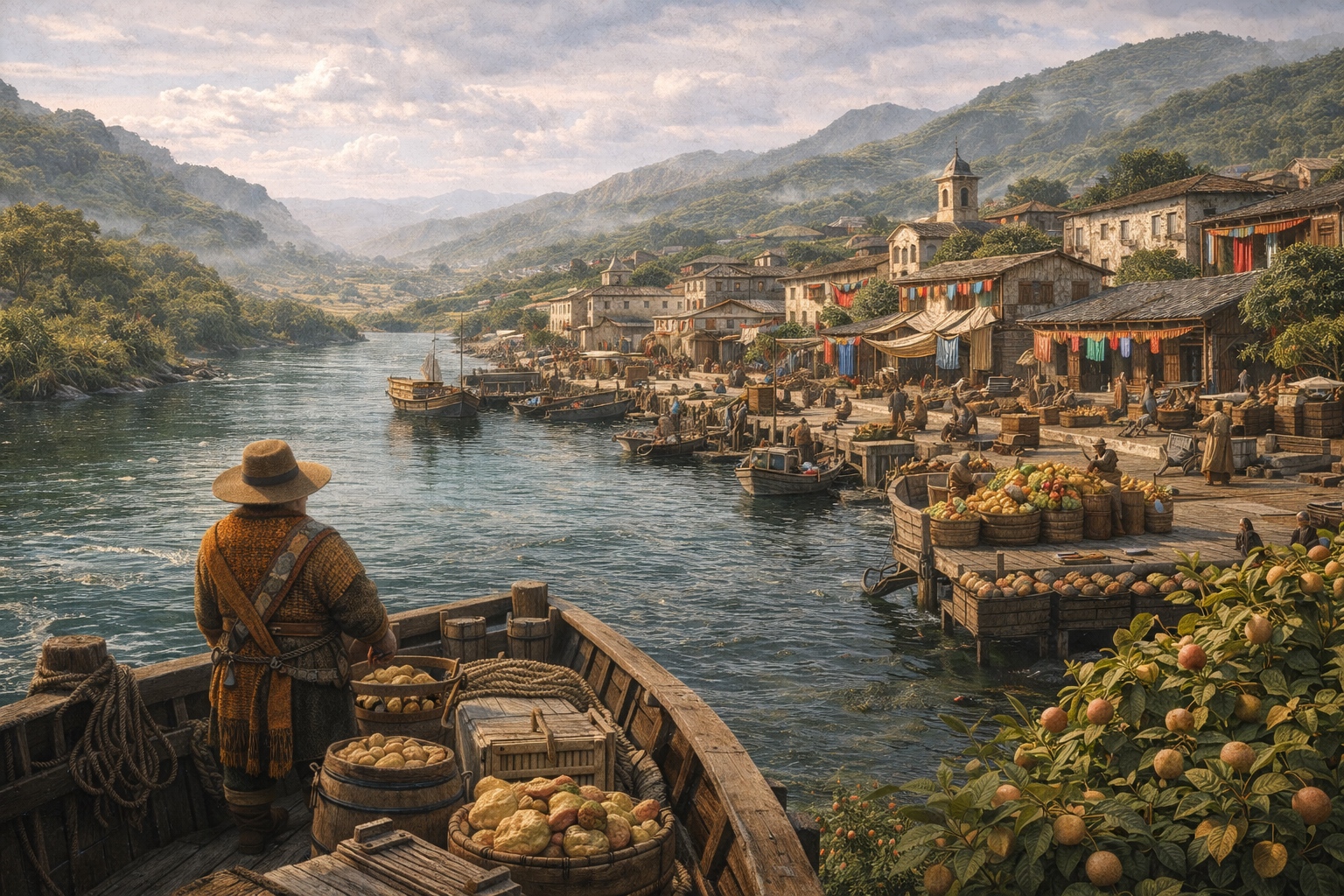
The approach to Dolega along the Veladano River is a pleasant exercise in sensory layering. The smell of ripe guava comes first, carried downriver from the orchards that line the northern bank, a sweetness that mixes with the river's cool earthiness in a way that prepares the traveler for what the town actually is. Then the sounds: the percussion of the market, the hammer from Elira Stonehand's forge, the distant calls of the hunters returning through the hilly terrain to the east.
Dolega itself is a town built along the river bend, its streets narrow and full of the kind of accumulated character that comes from generations of practical construction and occasional artistic intervention. The human buildings are decorated with the vibrant textile hangings that are the town's visual signature: woven patterns in the specific color palette of the guava orchards, which creates a visual harmony between the town and its primary industry that may be deliberate or may simply be inevitable. The elven-designed public spaces (the communal grove at the town center, the carefully maintained river walk) introduce an ordered serenity that contrasts pleasantly with the market's organized chaos.
The market is the heart. The iguana hunter coming in with the morning's catch, the orchard family bringing their guava surplus to the packers, Lila Quickfoot's Swift Harvest trading post with its improbable range of goods for a river town, all of it converges in the central square around Thulgard's temple, which is larger than the town's size would normally warrant and maintained with corresponding care.
Geography & Setting
Dolega sits on the middle Veladano, between the river's alpine headwaters near Masagua to the south and the coastal city of Matarrel to the northeast where the river empties into the Hatcona Ocean. This position makes Dolega a natural intermediary: goods from the mountains flow downriver through the town, goods from the coast flow upriver and stop here before the river narrows toward the Sierra de Verno foothills.
The river valley is fertile in the specific way of river valleys fed by mountain snowmelt: rich soil, reliable water, the kind of agricultural productivity that does not require exceptional effort to achieve once the cultivation patterns are established. The guava orchards on the northern bank have been producing for at least five generations of the families that tend them, and the character of the soil here has developed the specific flavor profile that makes Dolegan guavas distinctly themselves.
The hilly terrain to the east is the hunting country: dense secondary forest and scrub where the iguana population that provides the town's protein staple and craft materials has thrived alongside the human presence rather than retreating from it. The root crop fields occupy the flat river margin. The town's topography keeps everything reasonably accessible from the central market.
Climate is temperate and humid; the river valley holds moisture and the hills to the east moderate the wind. The growing season is long; the harvest cycles for the orchards and the root crops overlap enough that there is rarely a period of genuine food scarcity.
The People
Demographics
Dolega's population reflects the river valley's demographic character: predominantly human, with an elven community that arrived in the town's formative period and contributed the design sensibility visible in the public spaces. The dwarf presence centers on the forge and the town's construction maintenance. Half-elves are more common here than in most comparable-sized towns (the result of several generations of integration between the human and elven communities), and they occupy a range of roles that reflects their position as the genuinely integrated element of a mostly integrated town.
Outsiders are met with cautious but genuine hospitality, as the existing records describe. The expectation is not formal (there are no requirements to state your purpose or register your stay), but the community notices strangers and watches them with the attentiveness of a place that values its customs and expects visitors to respect them. Those who do are welcomed; those who do not find the welcome cooling rapidly.
Economy
The guava is the economic identity. The orchards on the northern bank produce a fruit with a specific flavor profile (darker, more complex, with a sweetness that preserves well) that has made Dolegan guavas the preferred variety for the preservation and export market from Matarrel to the northern settlements. The packing tradition here is old enough that the preservation methods have been refined to maintain quality through the transportation that the trade requires.
The iguana hunting is the second industry: both for the food supply (iguana meat is the primary protein staple) and for the craft industry that processes the hides into the artifacts that are Dolega's most distinctive trade good. The iguana-skin pouches, belts, and decorative objects that come out of Dolega's craft workshops are recognized throughout the eastern Antaea trade network, and the best pieces command prices that their utilitarian origins would not predict.
Root crops (yams, sweet potatoes, cassava) provide the agricultural base that the more commercially focused guava and iguana economies depend on. The Veldano River's fishing supplements this without constituting a significant trade industry.
Primary Exports
- Guavas: Fresh and preserved; the specific variety of the northern bank orchards; the preserved form ships as far as the northern settlements while maintaining quality
- Iguana-skin artifacts: The craft industry's output; pouches, belts, decorative objects; the best pieces are collected items with premium pricing
- Iguana meat: Salted and dried; sold downriver to Matarrel's provisioning market and upriver to Masagua's mining communities
- Root crops surplus: When the harvest exceeds local consumption; primarily traded within the river valley
Primary Imports
- Metal goods: Tools, hardware, weapons; the forge produces but cannot cover the full demand
- Textiles: The town's weaving tradition produces the decorative hangings but not the practical cloth for everyday clothing
- Specialized goods: The variety of items that Lila Quickfoot's trading connections bring through the Swift Harvest from points far beyond the river valley
Key Industries
- The Orchard Families: Several extended families managing the northern bank orchards; not formally organized; coordinated through the market's seasonal calendar and Chief Veldano's land management
- The Hunter's Guild: The organized hunting community; manages the iguana territories, the seasonal hunting rotations, and the apprenticeship that ensures the knowledge transfers
- The Craft Workshops: The iguana-skin craftspeople; several independent operations producing across the quality range from utility items to collectible pieces
- Stonehand's Forge: Elira Stonehand's metalwork operation; serves the full range from agricultural tools to the specialty items the hunters need
Food & Drink
Dolega eats with the confidence of a community that produces ingredients others want. The guava is present at almost every meal in some form: fresh as the morning fruit, as the preserve that goes on the flatbread, as the reduction that provides the sweet element in the stews. The iguana meat is the protein foundation, grilled or slow-stewed with the root vegetable combinations that the town's culinary tradition has been refining for generations.
The river fish appears regularly enough to provide variety without being a primary source. The root crops are the staple base: boiled, roasted, or mashed according to the preparation tradition of the household. The overall character of the cuisine is hearty and specifically flavored, with the guava and the particular herbs of the hill slopes creating a taste profile that visitors from the coast or the mountains find immediately recognizable as Dolegan.
The guava fermentation tradition produces a fruit wine that is not widely exported but that is the town's celebratory drink. Chief Eldrin serves it at formal occasions; the festivals make significant use of it. The Festival particularly is the occasion for the family recipes that are not part of everyday cooking.
Culture & Social Life
Dolega's culture is built on shared reliance (on the land, the river, and each other), and the governance structure reflects this. Chief Eldrin's hereditary authority is real but functions consultatively; decisions that affect the community are brought to the community before they are made. The system works because the House Veldano has governed this way for as long as anyone remembers, and the community has enough historical experience with what consultative governance produces to prefer it.
The chieftains are "viewed with a mix of respect and familial warmth," as the town's own self-description puts it, and this is accurate in the sense that the formality of the title coexists with the informality of a town where the chief is also the neighbor. Eldrin knows most of his five thousand residents by name; most of them know his. The governance is personal in a way that the equivalent-sized cities to the south and north are not.
The traditions that outsiders notice most are the textile hangings (the vibrantly colored woven patterns that decorate every significant building) and the river walk that the elven community maintains as a public space for deliberate leisure. The social norms around the river walk, the communal grove, and the market square are the informal governance of daily life: spaces maintained by collective expectation rather than formal rule.
Festivals & Traditions
The Iguana Festival
The annual festival that defines Dolega's public identity for the surrounding region. The celebration runs for two days around the peak of the iguana hunting season, combining the communal feast that the Hunter's Guild prepares from the season's accumulated catch with the competition elements that display the hunters' skills. The competition is not violence as entertainment; it is demonstration of the specific techniques that make a good hunter: trap-setting precision, tracking across the hill terrain, the processing skills that produce the quality hides that the craft industry requires.
The feast is genuinely communal: the Guild provides the meat, the orchard families contribute the guava preparations, and the town provides everything else through the cooperative provisioning that the festival has always used. Visitors from Masagua, Matarrel, and the intermediate communities along the Veladano attend regularly; the festival has become a regional gathering as well as a local celebration.
The Guava First Harvest
When the northern bank orchards come into their first significant yield of the season (the timing varies by three to four weeks around a general mid-season expectation) the orchard families mark the occasion with a shared meal that is private in the sense of being limited to the orchard workers and their families, and public in the sense that the town treats the day's first produce arriving at market as a community event. The sweetness of the first-harvest guavas is noticeably different from the mid-season fruit; the regulars at the market know this and plan for it.
Music & Arts
Music in Dolega is primarily percussive and wind-based; the drum and flute tradition that the existing records describe as "mimicking the sounds of the river and the rustling of the forest" is accurate, and the best performances of it achieve something in the acoustic space between natural sound and musical form that visitors find unexpectedly moving. The elven musicians maintain a separate melodic tradition that performs at the communal grove on specific evenings; the two traditions occasionally meet at the festival and produce something that is neither but draws from both.
The woven textile art is the dominant visual tradition. The specific patterns on the decorative hangings are not random; they encode family and seasonal history in a vocabulary that the town's residents read and that outside observers find beautiful without understanding. The craft workshops' iguana-skin work occupies a related aesthetic space: functional objects made with a care that exceeds function, which is the town's characteristic artistic impulse expressed through its primary material.
Religion
Primary Faith
Thulgard, the god of peace and order, is the appropriate patron for a community whose governing aspiration is the stability that allows its agricultural and craft economy to function. His temple, the largest building in the town's central square, is maintained with the same consistent care that the community brings to everything it values, and functions as the community center in the literal sense: the dispute resolution that Chief Eldrin does not personally handle happens at the temple, and the clergy are involved in most significant community decisions.
The theology here is practical: Thulgard's domain of peace and order is valued because it is the precondition for the harvests, the hunts, and the craft production that the community's survival depends on. The faith is not abstract. It is the recognition that the arrangement that keeps the community functioning requires maintenance.
Secondary / Minority Faiths
Zopha has a following primarily among the town's naturalists and those who document the local flora and fauna; the existing records' description of Zopha-aligned scholars as "active in documenting and studying the unique flora and fauna around Dolega" is accurate, and the study-shrine functions as the closest thing to a scholarly institution the town has.
Talbar and Caminus have smaller establishments whose function parallels what they provide elsewhere in Antaea.
Nesara, the deity of freshwater (rivers, rain, springs, and irrigation) is the faith most naturally suited to a town that exists because of the Veladano River and would not exist without it. The river's position makes Dolega an intermediary between the mountains and the coast; its water irrigates the guava orchards; its fish supplement the protein supply; its channel carries the trade that sustains the town's commercial identity. The orchard families who depend on the river's seasonal flow and the traders whose boats use its current observe Nesara at the river walk and at offering points near the ferry dock, where the character of the water changes perceptibly between rain and dry season.
Kraut, the deity of abundance through cultivation and the sacred relationship between human labor and the harvest, is observed among the guava orchard families whose stewardship of the northern bank's specific microclimate has been producing a distinct fruit for five generations. The orchard work (maintaining the conditions that make Dolegan guavas distinctly themselves, the packing traditions that preserve quality through transport, the First Harvest gathering that marks the season's beginning) is the kind of deliberate, generational relationship with cultivated land that Kraut's faith names as sacred. The root crop farmers who maintain the food security base share the faith.
Oruka, the deity of beasts, hunting, and the sustainable relationship between human communities and wild populations, is central to the Hunter's Guild's practice even where it is not formally organized as temple worship. Oren Cascara's forty years of iguana territory knowledge, the Guild's seasonal rotation protocols that keep the resource healthy, the apprenticeship system that ensures the knowledge transfers intact, all of this represents the careful, respectful predation that Oruka names as different in character from mere taking. The Iguana Festival's demonstration of precision hunting skills and the Guild's formal management of the hill terrain are the closest thing to an Oruka congregation the town has.
Amador, the deity of love, desire, and the transgression of social boundaries through connection, has a specific reason to be present in Dolega: half-elves are more common here than in most comparable-sized towns precisely because the human and elven founding communities did not merely share commercial space but built cross-racial families across several generations. This is the social boundary-crossing that Amador's faith names and celebrates: not merely tolerated difference but actual integration at the household level. The elven communal grove and the human market are not separate worlds in Dolega; the half-elf population that lives between them is Amador's most visible legacy.
Nyxollox, the gentle deity of peaceful death and transition, marks the losses that Dolega's outdoor economy produces: the Storm Seasons' orchard damage came with human cost, the hill hunting carries ongoing risk, and the river valley's occasional illness seasons sustain Morbina's clandestine following. Nyxollox addresses the same mortality from a different direction: not propitiation against disease but the quiet acknowledgment that death comes and that the community's framework for receiving it, gathered at the communal grove under the elven trees the founding settlers planted, is part of what makes the town whole.
Secret or Forbidden Worship
Demergat, the deity of storm-ridden islands, has a small following among the river fishers and some of the hunters who operate in the hill terrain in severe weather: people who deal with tempestuous conditions regularly and who have found that the mainstream faith's framework does not adequately address what they encounter. The worship is kept private less from fear of official response than from the community's general preference for not discussing the darker aspects of the natural world that the Thulgard faith prefers to address through order and stability. Morbina, the goddess of disease and plagues, has a clandestine following among people who have had personal encounters with the kinds of illness that the river valley occasionally produces; their practices are quiet and not well understood even by those who know they exist.
History
Founding
Dolega began as a fishing camp on the Veladano bend, the specific location where the river widens enough to be productive for both the catch and the flat-bottom boat traffic that river trade requires. The early settlers were human and elven, drawn by the fertile valley floor and the accessible hunting terrain. The guava orchards were established in the second generation, when the farming families recognized that the northern bank's specific soil and light conditions produced a fruit of unusual quality. The foundation of the Hunter's Guild formalized what had been an informal cooperative arrangement among the hunters of the hill country.
Key Events
The Guava Revolution (approx. 80 years ago)
The discovery of the guava's export potential, specifically that the preserved form maintained quality through river transport in ways that other fruits did not, transformed Dolega's economic character. The period of rapid expansion that followed the first successful export contracts to Matarrel is what the records call the Guava Revolution: the orchards expanded, the packing operations were established, and the trade relationships that currently sustain the town were built during this period. The House Veldano's management of the expansion, maintaining the community's agricultural base while developing the commercial infrastructure, is cited by the current chief as the governance model he attempts to follow.
The Storm Seasons (approx. 40 years ago)
The tropical storms that periodically affect the Veladano valley reached exceptional severity over two consecutive seasons, damaging the orchards significantly and disrupting the town's economic rhythm for three years. The recovery required the community's full cooperative capacity: the orchard families' replanting programs, the Hunter's Guild's increased contribution to the food supply during the reduced harvest period, the trade arrangements that Chief Eldrin's predecessor negotiated to maintain supplies during the shortage. The experience produced the current community's strong emphasis on maintaining agricultural diversity and the food-security protocols that the town's governance considers non-negotiable.
The Iguana Festival's Growth (ongoing for approx. 25 years)
The festival began as a strictly local celebration and has grown into a regional event through the combination of the Hunter's Guild's improved competition structure, the orchard families' increasing festival provisioning, and the word-of-mouth that the river trade routes distribute efficiently. The current format (two days, regional attendance, the specific competition structure) crystallized about fifteen years ago and has been stable since.
Current State
Dolega is prosperous in the specific way of a community that has found the balance between its commercial output and its food security and is maintaining that balance with deliberate attention. The guava trade is healthy; the Iguana Festival brings regional visibility that supports the craft export business; the river trade position keeps the town commercially connected without requiring it to manage the complexity that Matarrel's harbor produces. Chief Eldrin's current focus is succession (his two adult children have different views on how aggressively to develop the guava export market) and the question of how much commercial growth the community's governance tradition can manage without changing it.
Leadership & Governance
House Veldano: Overview
The House Veldano has governed Dolega since the town's formal establishment, through a hereditary chieftaincy that is patrician in structure and consultative in practice. The chief sets the land management rules, manages the trade relationships, adjudicates disputes that the community's informal resolution mechanisms cannot resolve, and provides the ceremonial governance presence that the town's cultural traditions require. The elder council that advises formally has no veto but has real influence; the House Veldano tradition is to seek consensus before acting, and chiefs who have departed from this tradition have found the costs instructive.
Chief Eldrin Veldano
Human, Male; late forties
Eldrin has governed for sixteen years with the diplomatic skill and landscape knowledge that the town's records describe as his defining characteristics. He is large enough to be physically imposing without using the imposition; the authority in his governance comes from the track record, not from the person's presence, though the presence does not hurt.
His current challenge is the guava export pressure and its governance implications: the larger commercial players from Matarrel who want to formalize supply agreements that would require expanding the orchard capacity beyond what the current land management supports. He has been declining these approaches for three years, which has made him cautious allies among the orchard families and commercial rivals in the harbor city.
High Priest Thalindor Leafwhisper: Thulgard's Temple
Elf, Male; apparent mid-fifties, actual age unknown; the Thulgard temple, central square
Thalindor has been the temple's head for longer than the current chief has governed, which in Dolega means his institutional memory is the longest in formal service. His spiritual guidance and community mediation have made him the person the town brings its genuine disputes to: the ones where the chief's authority is insufficient or where the parties cannot accept a governance resolution that is not also a spiritual one. His relationship with Chief Eldrin is collegial; they have managed the town together long enough to know each other's approaches thoroughly.
Notable Figures
Elira Stonehand: Master Blacksmith
Dwarf, Female; the forge, eastern market edge
Elira's reputation extends well beyond the town's borders; the tools and weapons that come out of her forge are sought by buyers from Masagua to Matarrel, and the specialty hunting equipment she produces for the Hunter's Guild has contributed to that organization's effectiveness in ways that the Guild is happy to credit. She is direct, opinionated about the quality of her materials, and has no patience for buyers who do not know what they want. Visitors who know what they want find her completely approachable.
Lila Quickfoot: Owner, the Swift Harvest
Smaling, Female; the Swift Harvest trading post, market square
Lila runs the largest and most connected trading operation in Dolega with a commercial network that reaches considerably further than the town's size would suggest she needs. Her contacts in Matarrel, in the settlements along the upper Veladano, and in the trade routes between them give the Swift Harvest an inventory range that regularly surprises visitors. She is direct about prices, generous about information regarding trade routes and market conditions, and considered by Chief Eldrin to be the most commercially reliable person in the town's external relationships.
Oren Cascara: Hunter's Guild Master
Human, Male; fifties; the Guild Hall, eastern district
Oren has led the Guild for twenty years and has been hunting the hill terrain for forty. His knowledge of the iguana populations, the seasonal patterns, and the sustainable harvest limits that keep the resource healthy is the institutional knowledge the Guild's protocols are built on. He is the person who taught Chief Eldrin's predecessor the practical limits of iguana harvest expansion (the lesson that has shaped the town's current equilibrium), and he remains the voice that the current chief listens to most carefully on questions of resource management.
Key Locations
Seat of Power
- The Veldano Hall: Adjacent to the central grove; stone-and-timber construction with the decorative textile hangings that are the town's visual identity; the formal council chamber and Chief Eldrin's governance administration; the records here go back to the town's founding
Houses of Worship
- The Thulgard Temple: The largest structure in the central square; the community meeting point; Thalindor's establishment; the dispute resolution chamber in the lower level is accessible by appointment
- The Naturalist Annex (Zopha-aligned): On the river walk, eastern end; maintained by the naturalist community; the specimen records and documentation archive occupy the adjacent building
- The Zopha Study-Shrine: Near the Swift Harvest; functions as the town's informal library
Inns & Taverns
- The River Bend Inn: The primary accommodation for visitors; the view of the Veladano from the dining room terrace is the establishment's best feature; the food runs on the town's ingredients at their most comfortable
- The Guava Press: The market-side tavern; primarily the trading community and the orchard workers; the guava wine here is the freshest available outside someone's private cellar
Shops & Services
- The Swift Harvest: Lila Quickfoot's establishment; the most varied inventory in the river valley; trading post, commercial information exchange, and occasional surprise item availability
- Stonehand's Forge: Elira's operation; tools, hunting equipment, hardware; the specialty pieces require advance commission
- The Hunter's Guild Hall: Where the Guild conducts its business: licensing of hunting territories, coordination of the seasonal rotations, sale of iguana products to the export market
The Market
- The Veladano Market: Open daily in the central square; the guava section is the market's identity, with the preserved-form export packers operating alongside the fresh-fruit sellers; the iguana-skin craft section is the premium goods area; the root crops occupy the outer ring
Other Points of Interest
- The Communal Grove: The central meeting space maintained by the elven community; the oldest trees are those that the founding elven settlers planted; formal community gatherings, the festival's storytelling component, and the informal social life of the town's evenings all happen here
- The Orchard Walk: The northern bank path through the guava orchards; accessible to visitors during the growing season; the scent during the harvest period is the most frequently cited first impression of Dolega among travelers who arrived by river
Secrets, Rumors & Hooks
- The iguana population of the hill terrain has been declining slightly over the past five seasons in a pattern that Oren Cascara has been documenting privately. The cause is not hunting pressure; the Guild's rotation protocols are being observed. Something in the hill terrain's ecology has changed, and Oren has a theory about what it is but not the evidence to support it. The theory involves the section of the eastern hills where no hunting party has operated in twenty years, for reasons that the Guild records describe as "the Veldano accord with the territory."
- Lila Quickfoot's trading network connects Dolega to a buyer in the Heavens islands who has been specifically requesting iguana-skin items of a very old design, a pattern that the craft workshops have not produced in at least two generations. Lila has shown the pattern to two of the senior craftspeople; neither recognized it as a known tradition. One of them, before declining to reproduce it, was seen copying the design into a private notebook.
- Thalindor Leafwhisper's actual age is significantly greater than the town's records account for. He was present at the Guava Revolution: not as an observer but as an active participant. The role he played in the period's decision-making is not in the community records. His version of those events differs from the official history in a specific way that he has mentioned to Chief Eldrin once, in a conversation Eldrin has not repeated.
- The guava orchards' specific flavor profile, what makes Dolegan guavas distinctly themselves, is not primarily a function of soil chemistry, as the commercial convention holds. Elira Stonehand knows this because she has seen the root systems of the oldest trees; what she found there is outside her expertise to explain, and she has declined to share it because she is not certain whether the information would help or harm.