Huasco
Huasco: The River's Edge Community
"You want to join us? Then prove it. We don't care where you're from. We care what you'll do when the forest turns against us."
Chieftain Elara, on the Ritual of Trust
At a Glance
| Continent | Antaea |
| Region / Province | Castano River Valley, Central Antaea |
| Settlement Type | Town |
| Population | ~1,800 |
| Dominant Races | Humans, Elves, Dwarves |
| Ruler / Leader | Chieftain Elara, Head of the Chieftain Council |
| Ruling Body | Chieftain Council |
| Primary Deity | Raphma (twilight, arcana; the between-place) |
| Economy | Hunting, Gathering & River Trade |
| Alliance | Zulie River Confederation |
| Known For | Self-reliant hunter-gatherer community on the Castano River; a community that is nearly impossible to join and deeply loyal once you are in |
First Impressions
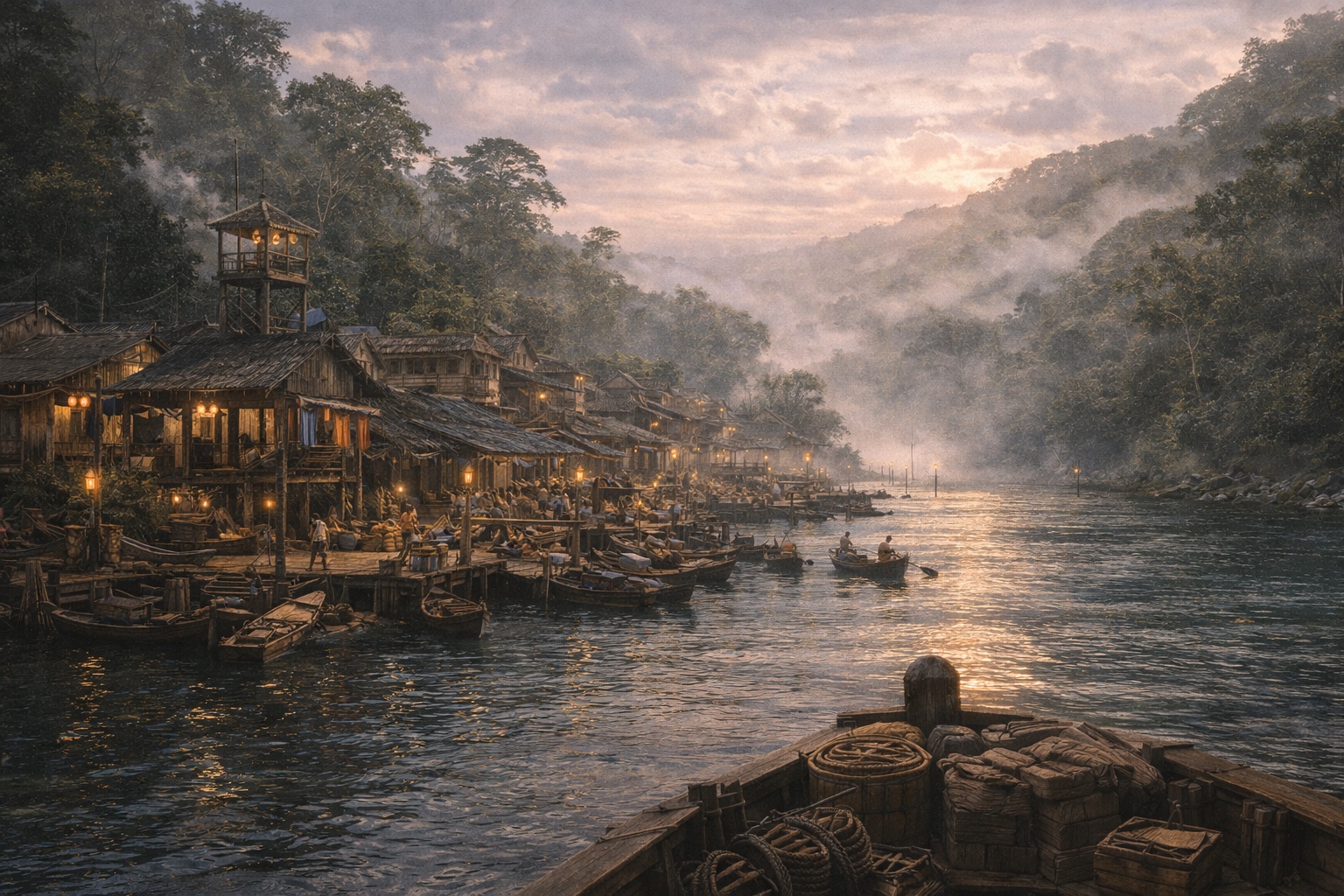
Huasco appears out of the riverside forest like something the trees decided to tolerate rather than something built against them. The settlement sits on the north bank of the Castano River where the current slows around a bend and the bank widens into a flood terrace; the wooden huts are set back from the water's edge, and the forest begins immediately behind the last building. There are no grand approaches, no market roads leading in from distant towns. The paths that reach Huasco are narrow, deliberately unmaintained, and in some cases actively misleading.
The settlement smells of woodsmoke, river mud, and drying game. Stone houses cluster near the hills to the south where mining is done; the majority of buildings are thatched-roof timber, built to be repaired rather than to endure. The central plaza is a tamped-earth clearing that hosts everything from daily markets to ritual ceremonies, usually both at once. People move with purpose and quiet efficiency.
Visitors are watched from the moment they arrive. Not with hostility (the welcome is genuine if you approach correctly) but with the total situational awareness of a community that has survived by knowing exactly what is happening at its borders at all times. If someone walks out of the forest to greet you before you reach the first house, that is not coincidence.
Geography & Setting
Huasco occupies a river terrace on the Castano River, positioned between Orinokia to the northwest and Zulie to the east, a natural intermediate stop on the river trade corridor that both cities depend on. The river is the settlement's highway, fresh water source, and primary food supply; every aspect of Huasco's layout reflects this dependency.
To the west, dense forest rises close to the settlement's edge, offering hunting grounds, timber, and herbs in abundance, and cover for everything that hunts back. To the south, rolling hills give way to terrain rich in building minerals and occasional deposits of precious metals and gems, which provide a secondary income when forest resources are lean.
The climate is temperate river valley: warm summers with significant humidity from the river, cold winters moderated by forest cover. Flooding is a seasonal risk, which is why the settlement sits on the terrace rather than the bank. The Castano here is broad, navigable, and reliable; river craft from both Orinokia and Zulie use this stretch regularly, which is the main source of outside contact and Huasco's connection to the wider Confederation.
The People
Demographics
Humans form the core of Huasco's population, descended from the original hunting and gathering bands who established the settlement. Elves are present in significant numbers (Chieftain Elara's extended family alone accounts for a notable portion) and are highly regarded for their forest knowledge, patience, and long sight in both the literal and figurative sense. Dwarves concentrate in the mining activities and smithing trades, their expertise in the southern hills making them indispensable.
Smalings are present in smaller numbers, primarily as herbalists and small-scale farmers working the river terrace. Half-Orcs occasionally settle after passing through as traders, usually those who find the self-reliant culture preferable to more complex settlements. Gnomes are rare.
The population is small and stable by design. The Ritual of Trust means that the community grows through genuine integration rather than absorption, which has kept Huasco relatively isolated but internally coherent. Outsiders who visit without intent to join are handled politely but efficiently; trade is conducted at the settlement's edge, not inside it.
Economy
Hunting and gathering are the economic foundation, and they are taken seriously as skilled professions rather than primitive defaults. The forests around Huasco hold game, medicinal herbs, wild fruits, and building materials in genuine abundance, and Huasco's people are among the most skilled forest-economy practitioners in this part of Antaea. Varian Swiftarrow's hunting parties supply more than enough protein for the community with enough surplus for trade.
The Castano River provides fish that supplements the forest diet, and small-scale farming on the terrace adds root crops and seasonal vegetables. The southern hills produce modest but valuable quantities of precious metals and gems, extracted by Thorgar Ironfoot's mining operations and sold to traders from Orinokia and Zulie.
River trade with the Confederation partners is Huasco's main outside economic contact. They export surplus game meat, preserved fish, forest herbs, and raw ore; they import metals, tools, and specialist goods the forest cannot provide.
Primary Exports
- Preserved game and fish: Dried and smoked meats prepared to Huasco's exacting standards; highly valued by inland traders
- Forest herbs and remedies: Lysandra Willowbark's preparations and raw herb exports are sought by healers across the Confederation
- Precious metals and gems: Modest quantities extracted from the southern hills, sold to Confederation partners
Primary Imports
- Metal tools and weapons: Beyond what Thorgar's forge produces; specialized ironwork from Zulie and Orinokia
- Grain and preserved foods: To supplement during lean hunting seasons
- Specialized medicines and materials: Items Lysandra cannot produce from local flora
Key Industries
- Hunting and forest gathering: The primary industry; skilled, organized, and conducted under strict protocols to maintain forest health
- River fishing: Consistent daily supplement; the Castano here is productive year-round
- Mineral extraction: Small-scale but valuable; Thorgar Ironfoot's mining operations in the southern hills
Food & Drink
The table in Huasco is honest and substantial. Game meat (deer, boar, birds of various kinds) appears at every meal, most commonly smoked or slow-cooked with river herbs. Fish is the everyday staple: grilled fresh from the morning catch, or preserved in salt or smoke for travel. Root crops from the terrace farms add starch. Wild fruits from the forest provide sweetness and variety through the growing season. Guava grows near the river and is both eaten fresh and turned into a fermented drink that is Huasco's closest equivalent to a local specialty spirit.
The cooking tradition emphasizes preservation and versatility; the same ingredients might appear as a morning stew, a midday cold pack, and an evening broth. Waste is culturally unacceptable.
Culture & Social Life
Huasco operates on a trust architecture that is unusual in Antaea: deep, absolute internal loyalty paired with deep, calibrated external caution. Within the community, the social bonds are strong enough that conflict is rare and resolved quickly when it occurs, usually through the chieftain system without formal arbitration. The community's shared identity as people who have proven themselves worthy of belonging gives everyday interactions a particular quality of mutual respect.
Magic is not feared but it is assessed carefully: the forest has enough things in it that require genuine skill to manage; a mage who can supplement that skill is valuable, while one whose casting creates unpredictable effects in dense woodland is a hazard. Practical magic (healing, weather reading, communication) is welcomed. Flashy magic raises concerns.
Outsiders go through a formal social protocol before any serious interaction is possible. Trading at the settlement's edge is straightforward commercial hospitality; actual community engagement requires the Ritual of Trust.
Festivals & Traditions
The Ritual of Trust
Performed as needed, whenever a new member wishes to join the community. The Ritual is a multi-day series of tests tailored to the individual; what they are asked to prove depends on what they are asking to be. A hunter proves hunting skill; a healer demonstrates knowledge of local herbs; a craftsperson shows their craft. The tests are designed not just to assess capability but to demonstrate that the candidate understands and embraces the community's values: self-reliance, loyalty, and the careful relationship with the forest that sustains everything else. Successful completion is followed by a communal feast that marks the new member's full belonging. The community takes the Ritual seriously; it is not performative, and failures are respectfully but firmly told they need to try again in a year.
Music & Arts
Music in Huasco is rhythmic and haunting: the sounds of the forest worked into percussion and wind instruments made from local materials. Drum patterns mimic river currents and animal movements; reed flutes produce melodies that blend into the ambient forest sound. Music serves both entertainment and functional purposes: specific rhythms signal hunting party coordination, specific songs mark transitions between seasons or community rituals. Visual art appears primarily on functional objects: carved hunting tools with intricate symbolic patterns, talismanic objects that protect homes, and the occasional painted ceremonial object used in Raphma observances.
Religion
Primary Faith
Raphma, goddess of twilight and arcana, holds the primary position in Huasco; the twilight hours between day and night mirror the settlement's position between civilization and wilderness, and her domain of learning and knowledge resonates with a community whose survival depends on deep understanding of its environment. Her symbol, a sun half-darkened by the moon, appears in homes and at the borders of the settlement rather than in dedicated temples; worship is woven into daily practice rather than concentrated in formal spaces. The settlement's most knowledgeable hunters and herbalists are considered Raphma's most devout followers.
Secondary / Minority Faiths
Zopha has a quiet following among those who tend the farming terraces and manage the forest edge, not as abstract philosophy, but as practical natural knowledge: soils, seasons, animal behavior, and the careful observation that keeps a self-reliant community alive.
Kraut is observed by the Smaling farming community in small household shrines.
Fujin is respected rather than loved; offerings are made to acknowledge storm power, not to seek companionship with it.
Echo has a small but growing presence among the younger members who see the Ritual of Trust and communal loyalty as Echo-like virtues: stability earned by collective work.
Secret or Forbidden Worship
Qvalnx, the void deity, has a whispered following among a very small number of Huasco residents: specifically those who have spent time in the forest's deeper reaches and encountered things that do not follow natural laws. The worship is private, not organized, and regarded by those who know of it as a private response to private fears rather than a civic concern. Chieftain Elara is aware of it and has chosen not to act.
History
Founding
Huasco was established by a band of hunters and gatherers who followed the Castano River upstream from lower settlements and found the river terrace an ideal combination of water access, forest resource, and defensible position. Early generations built the hunting protocols and gathering territories that still define the settlement's relationship with its land. The discovery of metals in the southern hills, which attracted outside prospectors, created the first significant tension between the community's self-contained values and the outside world's interest in their territory.
Key Events
The Castano Confluence
The discovery of precious metals and gems in the southern hills brought an influx of outside prospectors and traders. This period was Huasco's most difficult; the community was not equipped for the social pressure of a minor gold rush, and several incidents of trust-breaking by outside parties cemented the cultural values of caution and the formal Ritual of Trust. Most prospectors were eventually excluded. The mineral operations were brought under community control under Thorgar Ironfoot's ancestors.
The Shadow of Distrust
A series of incidents over several generations in which outsiders (some well-intentioned, some not) broke the trust protocols and damaged community relationships left Huasco with an institutional memory of why caution is necessary. The current community does not discuss these incidents in detail with strangers; their legacy is visible in the protocols rather than the stories.
Current State
Huasco is stable, self-sufficient, and somewhat isolated even within the Zulie River Confederation. The Confederation relationship is valued primarily for the trading access it provides; Huasco's actual civic engagement with Confederation partners is minimal. The community is currently healthy, the forest is well-managed, and the mining operations are producing. The main pressure point is the question of Confederation asks: as the eastern trade routes expand, there is more pressure on Huasco to provide consistent mineral supply, which pushes against the community's instinct to control the pace of extraction on their own terms.
Leadership & Governance
The Chieftain Council: Overview
Huasco is governed by a Chieftain Council whose members represent the major spheres of community life: hunting, gathering, mining, healing, and spiritual practice. Chieftains are selected through demonstrated expertise and community consensus; there is no hereditary principle, though exceptional families produce multiple chieftains across generations. The current head, Chieftain Elara, has held the position for over sixty years and is widely regarded as one of the most capable leaders in Huasco's history.
Chieftain Elara
Elf, Female: An elf in her late centuries, with the particular quality of presence that comes from deep knowledge and long experience
Elara is slender, dark-eyed, and moves through the forest with the unhurried precision of someone who has spent centuries learning to read it. She is the undisputed head of the Council: not because she commands, but because her judgment has been consistently right in ways that matter. She is warm with people she trusts and entirely opaque to those she doesn't. The transition between those two modes is invisible until you are already on one side of it.
She carries two concerns that she has not fully articulated to the Council: the increasing pressure from Confederation partners on mineral supply, and a recent observation from Varian Swiftarrow about changes in the forest's southern edge that she cannot yet explain. She is not alarmed (she has managed hard things before), but she is paying attention.
Thorgar Ironfoot: Mining Operations Lead
Dwarf, Male: A compact, practical dwarf who has run the southern hills operations for four decades. He is less a politician than an engineer and prefers it that way. He represents mining on the Council but his primary interest is in getting the extraction done efficiently and sustainably; he has no patience for outside pressure to increase output beyond the hills' natural pace.
Guard & Militia
Huasco does not maintain a standing guard force in the conventional sense. Instead, the hunting parties double as the community's defense; every skilled hunter is a potential defender, and the settlement's early warning system (scouts at the forest edge, patterns of bird and animal behavior) is more sophisticated than walls. The settlement can mobilize forty capable fighters within minutes of an alert. Chieftain Elara coordinates defense directly.
Law & Order
Huasco follows Antaean custom supplemented by the community's own internal protocols, which are unwritten but universally understood. The most serious community offense is betrayal of trust: whether that means breaking the Ritual of Trust obligations, providing information about the community to outside parties, or acting against collective welfare for personal gain. Such violations are tried before the full Chieftain Council and almost invariably result in exile.
Notable Figures
Lysandra Willowbark: Herbalist and Healer
Smaling, Female: Her herb garden at the settlement's eastern edge, adjacent to the forest
One of the most respected people in Huasco despite her small stature and gentle manner. Lysandra has an encyclopedic knowledge of the local flora that represents decades of systematic study; she knows which plants heal, which harm, which combinations are safe, and which are not. Her preparations are exported through the Confederation and are her own significant contribution to Huasco's economy. She is the community's primary healer and the person most people go to before they approach the Chieftain with a problem.
Varian Swiftarrow: Chief Hunter
Human, Male: The forest, primarily; the central plaza when he is between trips
A tall, laconic human with a hunter's economy of motion and expression. He has led the primary hunting parties for fifteen years and knows the forest around Huasco better than any human alive. He recently brought Chieftain Elara a report about changes in the southern edge of the forest, specific animal behavior shifts that suggest something is altering the ecosystem, which she has not yet shared with the full Council. He is not an alarmist; his concerns should be taken seriously.
Mira Castano: River Fishing Lead
Human, Female: The river docks and fishing platforms
A broad-shouldered woman in her late forties who runs the settlement's fishing operations with the same systematic efficiency that Varian applies to hunting. She is cheerful, blunt, and consistently the first person new arrivals meet; she tends the community's most open-facing operations. She has a side interest in the natural history of the Castano River itself and maintains careful records of fish population changes that have proved useful for predicting seasonal yield.
Gorak Stonecrest: Council Representative for Newcomers
Half-Orc, Male: The settlement's edge, where newcomers first arrive
Huasco's unofficial liaison to the outside world, a Half-Orc who went through the Ritual of Trust twelve years ago and whose experience navigating between cultures has made him the natural first contact for those approaching the settlement. He is trusted by the community and speaks multiple languages. He manages initial contacts with the particular skill of someone who genuinely understands both what Huasco is and what outsiders are likely to misunderstand about it.
Key Locations
Seat of Power
- The Council Fire: Not a building but a permanent fire pit in the central plaza, surrounded by carved stone seats. The Council meets here in open air for ordinary sessions; in exceptional weather, they move to the adjacent timber hall. The Fire is kept burning at all times as a symbol of continuity; tending it is a position of significant responsibility.
Houses of Worship
- The Twilight Clearing: A clearing at the forest's edge, used for Raphma observances at dawn and dusk. No building; the worship space is defined by a circle of standing stones with Raphma's symbol carved on the largest. Open to all members of the community; outsiders are not invited.
- The River Shelf Shrine: A carved wooden structure at the river terrace's edge, small and well-maintained. Agricultural offerings are left here at planting and harvest; the older animist practice and the Zopha-aligned "knowledge of the living world" tradition overlap here without anyone insisting on a single name.
Inns & Taverns
- The River Terrace Hall: The settlement's main communal space and the closest thing to a tavern. A long timber building open to community members and vetted guests; Gorak Stonecrest manages access for newcomers. The food is excellent; Huasco's preservation techniques applied to game and fish produce meals that surprise visitors accustomed to rougher frontier fare.
Shops & Services
- Lysandra's Herb Garden: Open to traders who have established trust; not a shop in the conventional sense. You bring what you want to trade for what she is willing to provide.
- Thorgar's Smithy: Practical ironwork and mining equipment. Thorgar will also buy and assess raw ore samples if you explain where you found them.
- The Exchange Point: A designated trading area at the settlement's edge where outside merchants may conduct business without requiring community access. Gorak or another community member is always present.
The Market
- The Morning Market: Held at the central plaza on alternating days. Primarily internal community exchange: game, fish, herbs, crafted goods. Outside traders access it only with escort.
Other Points of Interest
- The Ritual Ground: A specific location in the forest, known only to community members, where the Ritual of Trust tests are conducted. Its location is not shared with outsiders.
- The Southern Hills Mining Sites: A cluster of working excavations and one semi-permanent camp in the hills south of the settlement. Thorgar's domain; visitors require specific permission.
Guilds & Organizations
- The Hunters' Brotherhood: Not a formal guild, but a defined group of oath-sworn hunters who operate under Varian Swiftarrow's coordination. They set hunting territories, manage the forest edge monitoring, and respond to threats. All adult males and many females belong.
- The Healers' Circle: Lysandra Willowbark coordinates the settlement's healers and herb-gatherers. The Circle maintains knowledge records and training for the next generation of healers; this is one of Huasco's most carefully guarded institutional assets.
The Criminal Element
Organized crime does not exist in Huasco; the community is too small and too socially integrated for it to operate. What does exist is a small category of community members who occasionally trade information about Huasco's resources or location to outside parties for personal gain. This has happened twice in living memory. Both times, the person was identified, tried before the Council, and exiled. The names are known and remembered.
Outside Huasco, at the trading exchange point, there is occasional friction with merchants who attempt to probe for information they have not been given permission to have. This is managed rather than punished; Gorak Stonecrest is very good at redirecting conversations.
Secrets, Rumors & Hooks
- Varian Swiftarrow's observations about the southern forest edge are correct and significant. Something is moving through the deeper forest, something large enough to alter animal behavior across a wide area. It has not yet come near the settlement. Whether this is a natural migration, something magical, or something else, Varian does not know, but he is tracking it, alone, on nights when he tells the community he is hunting.
- The Ritual of Trust has been manipulated once. A person who failed the Ritual genuinely was accepted anyway, through the intervention of a Council member who believed the candidate was worth the exception. That person is now one of Huasco's most trusted community members. The Council member who intervened has never admitted it. Lysandra Willowbark knows.
- There is a cache of Raphma-related arcane knowledge in the Twilight Clearing, not widely known, and not visible unless you know where to look. It was left by a traveling scholar who passed through three generations ago and requested permission to hide something sacred in a place of Raphma's worship. Chieftain Elara knows of it. She has not opened it.
- The Castano River at this stretch holds something below the water that is not natural, a feature that the community's fishers have noticed but do not discuss publicly. Mira Castano's records contain observations about it that she has not shared with the Council.
- The Confederation pressure for increased mineral output has a political origin that Chieftain Elara does not yet know about; there is a specific project in Zulie that requires a specific metal compound only found in the Huasco hills, and the project is time-sensitive in ways that make the request more urgent than the Confederation's representatives have admitted.