Masagua
Masagua: The Blue Mountain Stronghold
"The Blapura doesn't grow anywhere else. Believe me, I've tried. Something in the mountain air, the specific altitude, the particular cold that comes off the Sierra de Verno at night, or maybe it's the people who tend them. Either way, you want the real thing, you come here."
Elira Stonefoot, master distiller, on the limits of replication
At a Glance
| Continent | Antaea |
| Region / Province | Southeast Antaea highlands, northern face of Sierra de Verno; upper Veladano headwaters |
| Settlement Type | Town |
| Population | ~5,800 |
| Dominant Races | Human (majority), Dwarf, Elf, Smaling |
| Ruler / Leader | Lord Hector Verno, House of Verno |
| Ruling Body | House of Verno; hereditary governance; stern and practical |
| Primary Deity | Fujin |
| Economy | Mineral extraction (precious metals, gems), Blapura fruit cultivation and distillation, fortification maintenance, highland hunting and timber |
| Known For | The Blapura alcohol (a fermented blue-fruit spirit whose production method is a closely guarded secret) and as the southernmost fortified settlement on Antaea's inhabited highland belt; consistently under humanoid raid pressure and consistently standing |
| Alliance | Eastern Lowlands / River Kingdom |
First Impressions
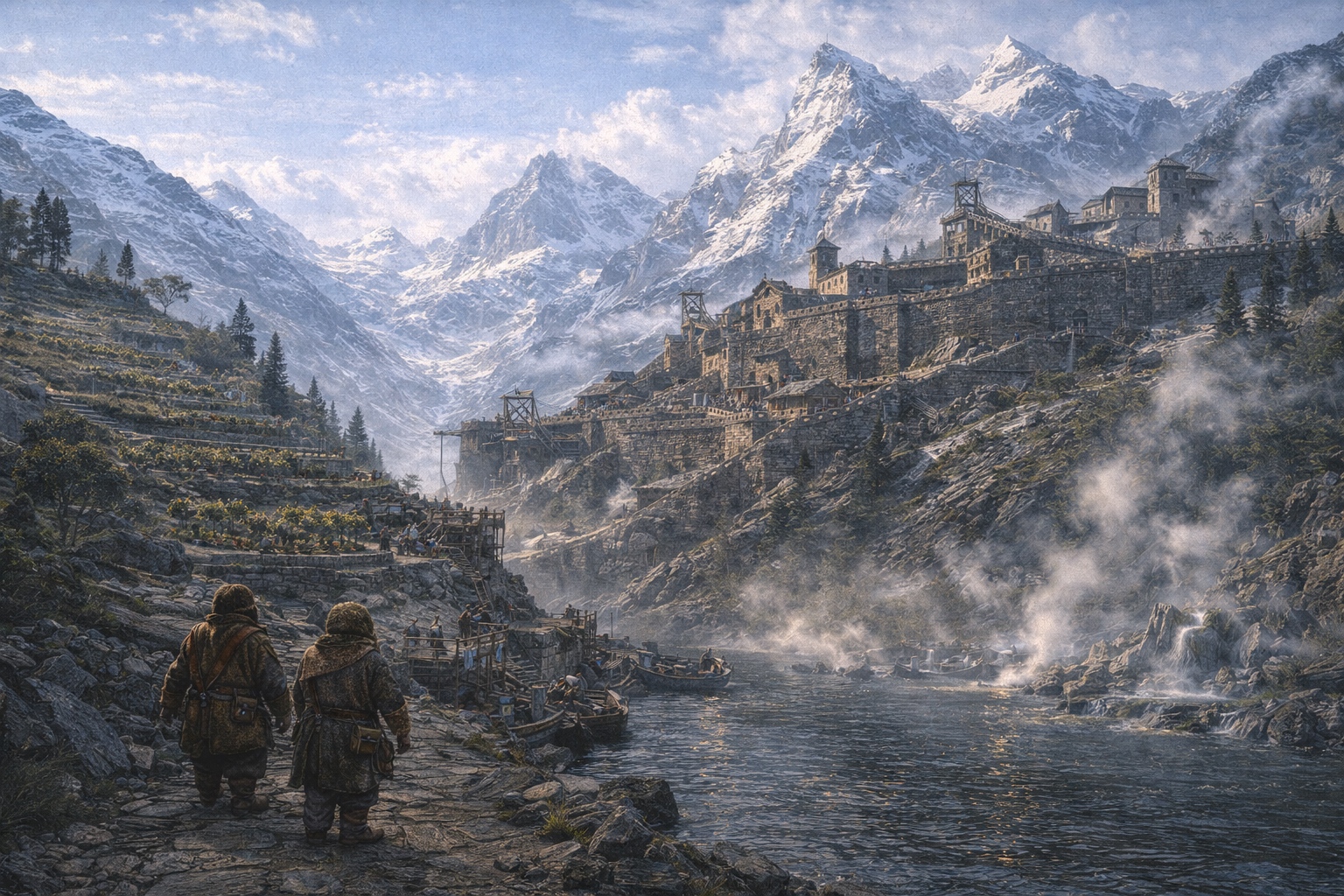
Masagua announces itself through its walls. The approach through the Sierra de Verno foothills brings the traveler gradually upward through terrain that is increasingly severe (the trees thinner, the rock more prominent, the temperature noticeably cooler than the valley below) until the walls appear on the rise ahead, stone-and-timber construction of serious quality, showing the marks of repair and reinforcement that a hundred years of intermittent attack has produced. The gates are guarded. The guards are professional.
Inside the walls, the atmosphere is surprisingly warm. The houses are built for the cold (low-pitched roofs, thick stone, the specific compact architecture that mountain settlements develop) but decorated with the carved blue-fruit motifs that are Masagua's visual language. The Blapura orchards step up the western slope in managed terraces, the distinctive blue-apple fruit visible in season from anywhere in the settlement. The mineral processing facilities occupy the southern quarter, the sounds of the mill and the smelter a constant background presence.
The Martus temple in the central square is smaller than a city's would be but maintained with the specific care of a community that understands its relationship with fortune to be active and requiring attention. The spinning coin symbol is everywhere: carved into doorframes, worked into the ironware of the market stalls, pressed into the Blapura alcohol seals that mark genuine Masaguan production. The town's relationship with luck is not the gambler's hope; it is the miner's knowledge that underground, the next strike is always one decision away.
Geography & Setting
Masagua sits on the northern face of the Sierra de Verno range, at an elevation that places it firmly in the alpine climate zone while remaining connected to the river valley below. The upper Veladano begins here (or close to here, at the snowmelt sources that feed the river's upper reaches), and the route downstream through the foothills toward Dolega and eventually Matarrel is the town's primary trade connection to the lower world.
The Sierra de Verno immediately to the south is the defining geographic feature: the source of the mineral wealth that the mining industry extracts, the origin of the cold mountain air that the Blapura cultivation requires, and the barrier that separates Masagua from the southern tundra that begins on the range's far side. The mountain terrain to the east and west provides the secondary hunting and timber resources that supplement the primary industries. The humanoid populations that periodically raid the settlement come from the mountain gaps to the southwest, the specific passes that the southern approaches offer.
The Blapura orchards on the western terrace require the exact altitude, temperature, and soil conditions that the Sierra de Verno's northern face provides. The cultivation has been attempted in lower, warmer terrain and has consistently produced a fruit that looks correct and tastes wrong. The specific conditions here are not replicable; the product is not replicable; this is the foundation of Masagua's commercial identity.
Climate is alpine: cold winters with significant snowfall, cool summers, the specific temperature cycle that the Blapura cultivation requires. The geothermal moderation from the mountain's internal heat (which the mining operations encounter regularly) produces localized warmth that the settlement uses strategically, including in the distillery's year-round operation.
The People
Demographics
Masagua's population has the composition of a mountain mining and agricultural town that has been maintaining its own defense for generations. The human majority includes both the farming and orcharding families who have tended the Blapura terraces for as long as the settlement has existed and the mining families whose work in the Sierra de Verno's mineral deposits has been the town's second economic pillar. The dwarf community is numerically smaller but disproportionately influential in the mining and fortification industries; their expertise is the technical foundation of both. The elven community concentrates in the botanical and healing functions. Smalings occupy the commercial and militia roles with a versatility that the town's size requires.
The town's attitude toward outsiders carries the specific wariness that a settlement under intermittent attack for a century develops toward people it does not know. This is not hostility; it is the product of having learned, more than once, that not all visitors are what they represent themselves to be. The scrutiny is professional and the welcome, once extended, is genuine.
Economy
The Blapura alcohol is the commercial crown. The specific blue apple, the Blapura fruit that grows only on these terraces at this altitude, ferments into a spirit with a flavor profile that has made it known and sought across Antaea and into the Hatcona trade routes. The production method is held by the Stonefoot family, who have refined it over four generations and whose specific combination of fermentation timing, temperature management, and the geothermal processing step that they describe only as "the mountain's contribution" has resisted all attempts at replication. The rearing-blue-fruit seal on a genuine Masaguan bottle is its own authentication.
The mineral extraction is the harder work and the more financially reliable one. The Sierra de Verno's deposits are not the richest in Antaea, but they are consistent: precious metals, gem-grade stones, and the specific mineral variety that the metallurgical industry elsewhere in Antaea uses in applications that Masagua does not need to understand to supply. The mining families have been working the same veins for five generations; the current depth of the operations requires the technical competence that the dwarf community provides.
Primary Exports
- Blapura alcohol: The premium spirit; sold in sealed bottles with the authentication mark; distributed through the Veladano river trade to Dolega, Matarrel, and beyond
- Precious metals and gems: The mining industry's output; sold to the metalwork and jewelry markets across the region
- Blapura fruit: The fresh fruit in season; the preserved form for the off-season; less valuable than the alcohol but traded regularly
- Fortification expertise: The knowledge built from a century of defensive development; occasionally sold as consultation to other settlements facing similar pressures
Primary Imports
- Foodstuffs: The alpine agriculture covers the Blapura but not the grain, the staple vegetables, or the protein variety that comes from downriver; Dolega's guava and iguana meat are regular imports
- Textiles: The cold climate requires heavy clothing that the local production cannot fully supply
- Specialized mining equipment: Certain tools and hardware that the local forge cannot efficiently produce at scale
Key Industries
- The Stonefoot Distillery: Elira Stonefoot's family operation; the Blapura production; the town's commercial identity
- The Mining Operations: Several family-based mining operations working different sections of the Sierra de Verno deposits; coordinated through the House of Verno's resource management
- Greta Ironfist's Militia: The organized defense force; technically a public institution but managed with the efficiency of a professional operation
- The Blapura Orchards: The terraced cultivation on the western slope; managed by the farming families under House Verno's land protocols
Food & Drink
Masagua eats like a mountain town with one exceptional ingredient and a commitment to making the rest work. The Blapura appears at almost every meal in some form: fresh as a morning fruit, as the reduction that serves as the cooking medium for the sweet preparations, as the specific liqueur that appears at formal occasions. The protein staple is game from the mountain hunting (deer, mountain goat, the occasional larger game from the higher terrain) supplemented by the downriver imports that the trade with Dolega provides.
The miners' cuisine is the heartiest. The underground work requires caloric density, and the traditions that have developed around the miners' midday meal, carried in sealed containers to retain heat through the morning descent, produce specific food forms that the surface population has adopted for its own heavy-work occasions. The stewed preparations with mineral-rich mountain water have a flavor note that Masaguan food has everywhere and that visitors from the lower settlements find distinctive and difficult to name.
The Blapura spirit is drunk at the end of the working day and at celebrations. The town produces enough that the export market is sustained without the domestic supply being restricted, which is a calibration that Elira Stonefoot monitors and manages with the same precision she applies to the fermentation process.
Culture & Social Life
Masagua's culture is shaped by two persistent facts: the mountain is generous if you work it correctly, and people periodically try to take what the mountain provides. The vigilance that the defensive situation requires has become cultural in the way that sustained pressure always becomes cultural: not as trauma but as the specific competence and attentiveness of a community that knows what happens when it relaxes.
The House of Verno governs with the combination of "stern and fair" that the town's records consistently attribute to them, and this characterization is accurate in both its components. Stern means that the governance enforces its decisions and does not revisit them under pressure. Fair means that the decisions are made with the full community's welfare in view. The two combine into a governance style that the population respects more than it warms to, which Lord Hector understands and accepts.
The Ritual of the First Harvest is the community's most important cultural expression: the annual ceremony that marks the Blapura season's beginning, involves the entire community, and reaffirms the specific relationship between the settlement and the resource that defines its identity.
Festivals & Traditions
The Ritual of the First Harvest
The annual ceremony marking the beginning of the Blapura harvest season is the oldest continuous tradition in Masagua. By custom, the eldest member of the community (currently a dwarf woman named Berda Coppervein, age approximately two hundred) plucks the first ripe Blapura fruit from the oldest tree on the terrace. This fruit is used to begin the first fermentation batch of the season, which is the Stonefoot family's formal opening of the production year. The ceremony involves the full community: the orchard workers in the terraces, the miners released from their morning shift, the militia standing at parade rest on the walls. The formality of the occasion is not religious in the institutional sense (Martus' blessing is invoked but the ceremony precedes his establishment here), but it is deeply sacred in the community's own understanding.
The day's work stops for the ceremony and the shared meal that follows. What the meal consists of is specific to family tradition (each household brings its own preparation), and the gathering under the oldest Blapura tree for the communal component is the closest thing to a mandatory event in Masagua's calendar.
The Battle of Blue Dawn Commemoration
Once a year, on the anniversary of the battle that repelled the most significant raid in the settlement's recorded history, the militia conducts a public demonstration of the defensive capabilities that held the walls. The demonstration is not celebratory in the conventional sense; it is training, conducted publicly, with the specific form that it takes only on this anniversary. Greta Ironfist leads it personally. The population attends as witnesses. The specific purpose is remembrance and preparation simultaneously: the community does not let itself forget what held and why, because the situation that required it has not changed.
Music & Arts
Music in Masagua is percussion and brass: the instruments that carry through the mountain air and through the walls, which is both aesthetic preference and practical history. The specific rhythms that the militia uses for communication between wall sections have been absorbed into the folk music tradition to the point where the two are no longer clearly distinct. Visitors find the music driving and unexpectedly complex; the rhythmic language has more information in it than they initially register.
The visual art tradition centers on the carving work in the stone architecture: the blue-fruit motifs that appear on every significant surface, the commemorative carvings of the major defensive events that document the settlement's history on the walls of its public buildings. The mining families maintain a separate tradition of geological illustration (precise, beautiful drawings of the mineral formations encountered underground) that serves a practical documentation function and has been recognized by scholars from outside the settlement as an art form in itself.
Religion
Primary Faith
Fujin, deity of warfare and storms, is the primary faith of Masagua because Masagua is, at its core, a fortress that became a town. The same wind that drives alpine squalls also drives raiders down the passes, and the militia culture here treats readiness as a form of devotion: drills as liturgy, maintained walls as prayer, and the refusal to be surprised as the settlement's highest virtue.
The Fujin temple is not a place of gentle comfort. It is where patrols are blessed before going out, where the names of the dead are read without theatrics, and where the community acknowledges a truth the mountains teach bluntly: survival is earned.
Secondary / Minority Faiths
Amador has a temple that serves the community's need for the private space that the public defensive culture does not easily provide. His teachings on the complexity and beauty of human connection resonate with a community under sustained stress in the specific ways that sustained stress creates.
Martus is widely observed among miners and traders: not as a frivolous gambling cult, but as an acknowledgment that even the best-prepared crew still lives with chance underground and on the road.
Jula has a following among those members of the community who tend toward the contemplative and who find the constant defensive posture emotionally exhausting.
Echo has a small community of the committed.
Nesara is honored at wells and river shrines, and in irrigation councils: water held in trust for everyone downstream. Caldrin is honored at gates, bridges, and caravan yards for safe passage, true directions, and upheld guest-right. Vessikar has shrines near weighhouses and market courts; honest measures are treated as civic peacekeeping. Sylira keeps whisper-shrines in inns and social halls: places to trade news, manage reputation, and pretend it isn't politics. Hista gathers devotees in bathhouses and beauty salons where appearance is treated as power (and envy is treated as prayer).
Secret or Forbidden Worship
Demergat has followers among the mining families who work the deepest sections of the Sierra de Verno's deposits, the sections where the geological conditions are most extreme and least predictable. Their observance is quiet and specifically related to the underground environment rather than the surface world. Shinigami, the deity of death and the grave, is followed by a subset of the militia community: people who have been through enough defensive actions to have developed a specific relationship with mortality that the mainstream Martus framework does not fully address. Their practices are private and their membership is understood but not acknowledged publicly.
History
Founding
Masagua was founded as a fortified position: not a village that became a fort, but a fort that developed into a village. The initial settlers came specifically for the mineral deposits in the Sierra de Verno, understood the raid pressure from the humanoid populations of the mountain passes, and built accordingly. The Blapura fruit was an early discovery (the fruit trees were present when the settlers arrived), and the cultivation of them was begun in the second decade of the settlement's existence by the ancestor of the current Stonefoot distilling family. The combination of mineral wealth and the unique agricultural product made the settlement worth defending and the fortification investment worth maintaining.
Key Events
The Battle of Blue Dawn (approx. 50 years ago)
The most significant defensive action in Masagua's recorded history involved a coordinated raid by a large force (goblins and hobgoblins, in the records' description) that penetrated the outer perimeter and reached the secondary wall before being repelled. The defense was led by Greta Ironfist's predecessor in the militia command, and Greta herself, then a junior militia member, was involved in the wall section that held the final breach point. The tactical decisions made during the battle have since been incorporated into the militia's training protocols. The raid's repulsion solidified Masagua's external reputation as a settlement that does not fall.
The Winter of Discontent (approx. 25 years ago)
A period of declining mineral yields from the primary Sierra de Verno mining operations, the specific veins that had been the settlement's primary extraction targets for two generations beginning to show the diminishing returns of sustained harvest. The economic disruption lasted three years and was resolved by the discovery of secondary deposits in the eastern section of the mountain terrain, which the dwarf mining community had been arguing for exploring for a decade before the primary yields declined. The House of Verno's response to the crisis, the support of the secondary exploration while maintaining the community's food security through trade with Dolega, is cited in the current governance records as the foundational precedent for how the House manages economic challenges.
The Blapura Export Formalization (approx. 15 years ago)
The Stonefoot family's commercial success with the Blapura spirit had grown to the point where the production volume required formal trade agreements with the downriver settlements rather than informal market presence. The formalization, negotiated by Lord Hector's predecessor with the trading networks in Dolega and Matarrel, established the distribution system that currently operates and the authentication seal that distinguishes genuine Masaguan production from the imitations that the spirit's reputation has prompted.
Current State
Masagua is stable and defensive in the specific sense of a community that has learned not to confuse stability with safety. The mineral yields are healthy from the secondary deposits; the Blapura production is at the upper limit of what the orchard terraces can sustainably produce; the militia's readiness is at its usual high standard. The current concern is the humanoid pressure from the southwestern passes, which has been at elevated levels for the past two years: not yet raid-level, but the activity patterns that Greta Ironfist's scouts are reporting are consistent with the early indicators that preceded the Battle of Blue Dawn. Lord Hector is managing this information carefully.
Leadership & Governance
House of Verno: Overview
The House of Verno is named for the mountains that are the settlement's reason for existence, and the naming reflects the governance's relationship with the terrain: the House governs the settlement as the mountains govern the land, with fixed parameters, within which life is productive, and beyond which nothing survives. The governance is stern because the environment is unforgiving, and fair because the community's survival depends on a social contract that strict impartiality maintains. Lord Hector has governed for eighteen years and has not deviated from this tradition.
Lord Hector Verno
Human, Male; middle fifties
Hector governs with the combination of strategic intelligence and personal restraint that the settlement's situation requires. He understands the mining economics, the raid pressure dynamics, and the commercial implications of the Blapura trade with the depth of someone who has been managing all three simultaneously for two decades. His decisions are deliberate and once made, held. He does not second-guess himself publicly, which the community reads as confidence; the private record shows more doubt than the public facing.
His current situation, the elevated humanoid pressure from the southwest, is his most acute immediate challenge. He has increased the militia's patrol frequency without announcing the reason publicly, which Greta Ironfist has been supporting by maintaining the patrols' reported results at the level that does not trigger community alarm while privately briefing Lord Hector on the actual pattern.
Greta Ironfist: Militia Commander
Smaling, Female; fifties; the militia headquarters, northern wall section
Greta is the settlement's hero in the specific sense that her actions in a specific past crisis have become the reference point for what Masaguan defense represents. She commands the militia with complete competence and a specific personal quality, the kind of calm under pressure that the people around her find stabilizing, that is more valuable than any tactical skill. Her relationship with Lord Hector is professional and confidential; the information she is currently holding about the southwestern patrol data is the most significant trust in their arrangement.
Notable Figures
Elira Stonefoot: Master Distiller
Dwarf, Female; the Stonefoot Distillery, western terrace level
Elira is the fourth-generation keeper of the Blapura production method and the most technically accomplished distiller the family has produced. Her innovations in the past decade, specifically the temperature management protocols that have extended the production season without compromising the flavor profile, have increased the export volume while maintaining the quality that the authentication seal guarantees. She is not publicly known outside the settlement, but every serious buyer of Masaguan Blapura knows her name.
Thavin Crestrock: Chief Mining Engineer
Dwarf, Male; the secondary deposit operations, eastern mountain section
Thavin manages the eastern mining operations that the House of Verno's crisis-period investment opened, and he is the person whose technical competence the mining community's current productivity depends on. He is underground as much as he is above it, which has produced a specific kind of knowledge about the Sierra de Verno's geological character that he considers more valuable than any surface-level assessment. His relationship with Lord Hector is the most practically important in the settlement's governance, and both of them know it.
Berda Coppervein: Elder, First Harvest Ceremonial Lead
Dwarf, Female; the elder's residence, central district
Berda is approximately two hundred years old and has been performing the First Harvest ceremony for the past forty of those years. She is not a governance figure in the formal sense (she has no formal role in the House Verno's administration), but she is the settlement's most visible connection to its founding period, and the authority that comes from that is real in its own right. She knows things about Masagua's early history that the records do not contain, and she shares them selectively with people she considers ready for the information.
Key Locations
Seat of Power
- House Verno Hall: The governance center; stone construction of the mountain variety, thick walls, functional rather than impressive; the formal council chamber and the records archive; the records here extend back to the founding period with a consistency that reflects the House Verno tradition of documentation
Houses of Worship
- The Martus Temple: Central square; the spinning coin motif on every surface; the clergy are the settlement's most practiced assessors of probability, which is a function they perform for the mining community as regularly as the spiritual one
- The Amador Temple: Off the central square; the private space that the community needs; the clergy are counselors as much as priests
- The Fujin Pillar: On the northern wall; a monolithic stone marker at the point where the wall was last breached; maintained by the militia as both a devotional object and a tactical reminder
Inns & Taverns
- The Blue Fruit: The primary inn; named inevitably; the Blapura spirit available here is the genuine article at the producer's price; the food is hearty and specifically mountain in character
- The Miner's Rest: The working establishment adjacent to the mining district; the clientele is the underground community; the hours extend past when the other establishments close, following the shifts rather than the sun
Shops & Services
- The Stonefoot Distillery: The production facility and retail point for Masaguan Blapura; sealed bottles sold here carry the authentication mark; visitors who want to see the process are occasionally permitted tours, which tell them approximately nothing about the method
- The Mining Supply Office: Where the House Verno manages the mining licenses, the equipment supply, and the production reporting; the most commercially significant administrative office in the settlement
- The Militia Armory: Not a public shop, but the quality of the weapons maintained there is an ongoing demonstration of what the settlement invests in its defense
The Market
- The Mountain Market: Open on the days when the mining shift timing allows the most participation; primarily the food and goods trade between the mining and agricultural communities; the Blapura fruit in season is sold here direct from the orchards; downriver goods from Dolega arrive on the specific days when the river trader runs its schedule
Other Points of Interest
- The Blapura Terraces: The western slope cultivation; accessible to visitors during the non-sensitive periods of the cultivation cycle; the oldest trees are marked by the settlement's age records and are treated with corresponding care
- The Battle Wall: The section of the outer fortification where the Battle of Blue Dawn's defensive actions occurred; the commemorative carvings document the action; the militia trains here specifically on the anniversary
Secrets, Rumors & Hooks
- The southwestern patrol data that Greta Ironfist and Lord Hector have been managing carefully is consistent with a coordinated movement rather than the opportunistic raiding that the settlement has experienced historically. Someone, or something, is organizing the humanoid pressure, which implies a goal beyond the immediate acquisition of the raid targets. Greta has a theory about what that goal is and has not shared it with Lord Hector because the theory implies a problem inside the walls.
- The Stonefoot family's production method has a step that Elira describes as "the mountain's contribution", a temperature cycle that uses the geothermal heat from the mining operations' deepest section. What the mining operations at that depth have been encountering for the past three years is something that Thavin Crestrock has been documenting in his private engineering records with increasing specificity and decreasing comfort. The temperature there is rising, and the direction of the rise does not correspond to any geological explanation he has found.
- Berda Coppervein was present at the founding of Masagua in the sense that she was alive and present in the region when the settlement was established. Her records of that period (which she keeps in a form that is readable only by those who know the notational system she was trained in during her youth, two centuries ago) describe the specific circumstances of the founding in terms that differ from the official history in one significant way: the founding families did not choose the location. They were brought to it.
- The Blapura fruit's unique flavor properties are not a function of the altitude, the soil, or the temperature cycle alone. The oldest trees' root systems extend into the same geological formation that the deep mining operations are encountering. The geothermal heat that Thavin is tracking is related to the same source. What that source is, and what the relationship between the trees and the formation represents, are questions that the settlement has been inadvertently approaching for a century.