Matarrel
Matarrel: The City Where the River Meets Its Reckoning
"Other ports ask your business. Matarrel asks if you intend to cause trouble. The distinction tells you everything about what kind of place it is."
Captain Morga "Sea Serpent" Vrykul, at the Pirate Accord signing ceremony
At a Glance
| Continent | Antaea |
| Region / Province | Southeast Antaea, mouth of the Veladano River on the Hatcona Ocean |
| Settlement Type | City |
| Population | ~19,000 permanent; significant transient maritime population |
| Dominant Races | Human (majority), Dwarf, Elf, diverse others drawn by trade |
| Ruler / Leader | Lord Hector Valeros, House of Valeros |
| Ruling Body | House of Valeros; hereditary governance with merchant guild advisory council |
| Primary Deity | Caminus |
| Economy | Shipbuilding, maritime trade, craftsmanship, harbor services, sanctioned pirate commerce |
| Known For | The Pirate Accord (the arrangement that made Matarrel a legal sanctuary for privateers under strict conditions), the finest shipbuilders on the Hatcona coast, and the Seasonal Bacchanalia whose reputation has spread further than the city might prefer |
| Alliance | Eastern Lowlands / River Kingdom: lead city |
First Impressions
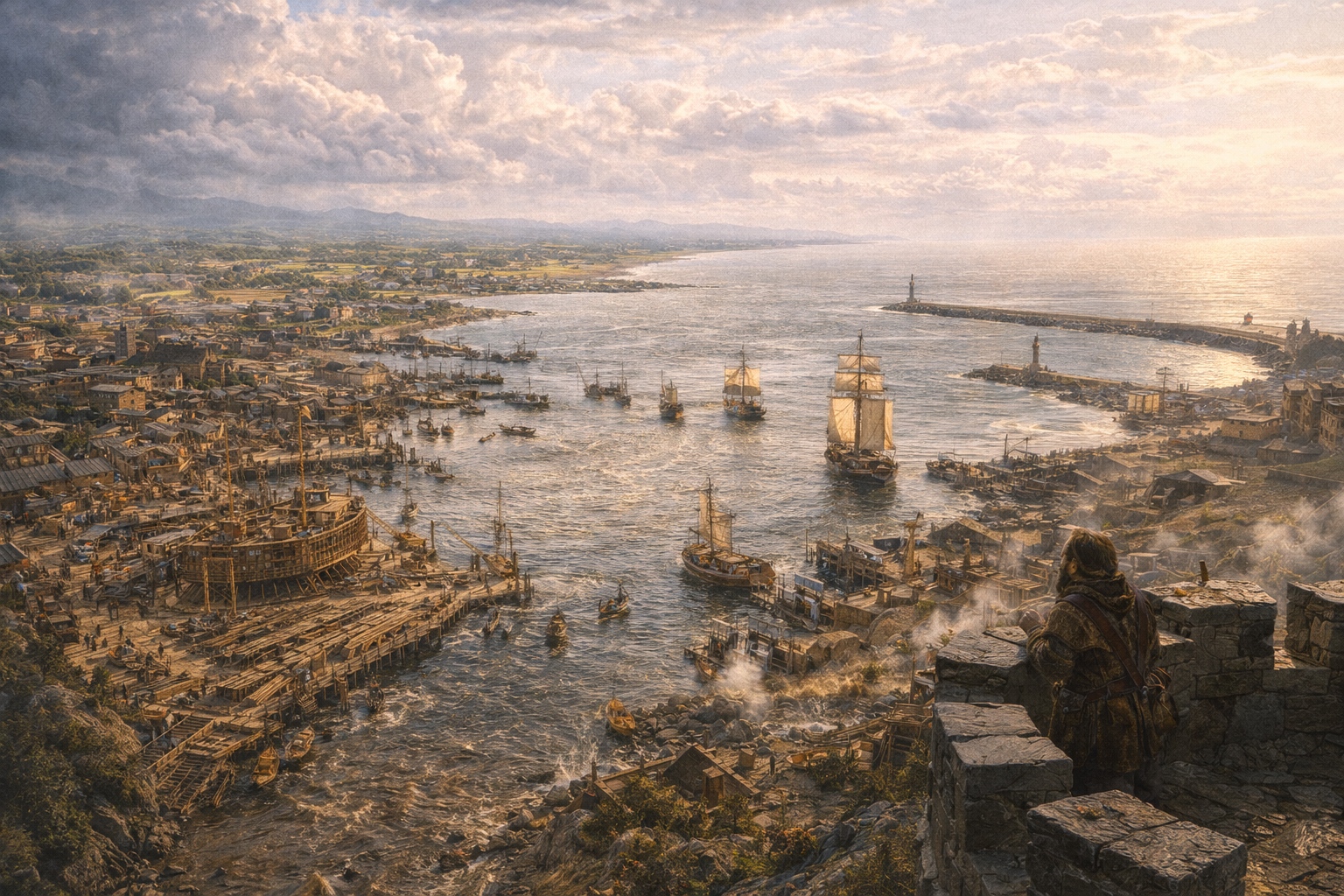
The Veladano River announces Matarrel before the city does. The river runs wide and brown through the coastal plain, and the vessels working its mouth (the fishing boats, the river barges, the deep-ocean traders making port) are visible from a considerable distance as the traveler approaches from the interior. The smell that reaches you is layered: salt water, cut timber, fish, tar, and woodsmoke from the forge district. This is a working city and it advertises the fact.
The harbor is the city's face. The shipyard infrastructure dominates the southern waterfront (the dry docks, the timber staging yards, the rigging lofts), and the commercial docks run north from there in a progression from the heavy maritime trade to the river commerce to the fishing fleet. The pirate vessels, when present, moor in the designated sector of the southern harbor with the specific administrative arrangement the Accord requires: flagged for identification, subject to the harbor watch's inspection, and fully aware of what happens to any crew member who violates the covenant within city limits.
The city proper climbs from the harbor along cobblestone streets laid by craftspeople who understood that a city built on commerce and craft should at least have decent roads. The temples cluster in the central district (five distinct establishments representing the city's genuine religious diversity), and the market spreads around them. House Valeros' estate occupies the northern prominence above the harbor, large enough to communicate authority without being so elevated as to suggest the family has forgotten where the wealth comes from.
What visitors notice last but remember longest is the atmosphere of practical tolerance. The city contains people who would be enemies in any other port. The arrangement that keeps them civil is not sentiment; it is the mutual recognition that Matarrel's value to everyone depends on everyone maintaining it.
Geography & Setting
Matarrel sits at the Veladano River's mouth, where three centuries of sediment have built a natural harbor and the river's last kilometers provide navigable access to the interior. The Hatcona Ocean stretches south and east: open-ocean trade routes to the continental south and eventually to the Second Lands approaches. The Sierra de Verno mountains are visible on clear days to the northwest, the source of the Veladano's headwaters and the mineral wealth that comes downriver.
The coastal plain immediately surrounding the city is productive agricultural land (the river's flood history has enriched it), and the forests inland provide the timber that the shipbuilding industry requires. The hills to the east carry smaller game and the herbs that figure in the city's culinary tradition.
The harbor's natural depth accommodates the largest ocean-going vessels that the Hatcona trade produces, which is a significant commercial advantage over competing ports where the draft requirements limit what can dock. The river channel is maintained by the harbor watch to ensure the commercial depth that the city's prosperity depends on.
Climate is warmer than most of Antaea; the southern latitude and the Hatcona's moderating influence keep the winters mild and the summers long. The seasonal storms that occasionally hit the coast are the city's primary natural threat; the Storm Years in the city's history are its most traumatic memory.
The People
Demographics
Matarrel is one of the most cosmopolitan cities on Antaea's southern coast, and the mix reflects the Pirate Accord's consequences as much as the trade routes'. The permanent population is majority human, with a well-established dwarf community that dominates the shipbuilding and metalwork industries. The elven community is smaller but culturally prominent, concentrated in the naval command, the performing arts, and the merchant guild's senior membership. The transient population is by definition unpredictable in composition; on any given day, the harbor might contain vessels whose crews represent a dozen races and as many languages.
The city's attitude toward outsiders is the Accord distilled: open to those who have something to offer and willing to abide by the terms, watchful toward those who have not yet demonstrated which category they occupy.
Economy
Shipbuilding is the foundation, the craft that made the city's reputation and that everything else is built on. The timber from the inland forests, the metalwork from the dwarf forges, the rigging and sail craft from the specialized workshops, all of it feeds into the shipyards that produce vessels commissioned from across Antaea and as far as the Hatcona's trade routes reach.
The Pirate Accord creates an economic layer that functions as openly as it sounds: pirate vessels dock for repair and resupply, the goods they carry pass through the city's markets in ways that formal trade would not normally accommodate, and the fees and commissions on this traffic represent a significant revenue stream for the city's merchant infrastructure. The arrangement is legally anomalous and the city does not advertise it to foreign governance structures. Within Antaea, it is an open secret.
Primary Exports
- Ships: Built-to-commission across the full range from fishing vessels to warship-class ocean traders; the premium Matarrel construction carries a regional reputation for longevity and workmanship
- Crafted goods: Furniture, metalwork, carved timber products; the artisan guilds that serve the shipbuilding industry produce a surplus of high-quality goods for the broader market
- Lumber: The managed inland forest yield; sold to timber-poor coastal settlements to the north
- Processed goods: The variety of goods that pass through the Accord arrangement; resold to the regional market without scrutiny of provenance
Primary Imports
- Specialized woods: Specific timber varieties that the local forests do not produce, required for particular ship construction components
- Metals and hardware: Iron and bronze in volumes beyond local production capacity; the forge district runs at scale
- Exotic goods: The luxury market that the city's commercial success generates; spices, textiles, and the variety that concentrated wealth creates demand for
Key Industries
- The Valeros Shipyards: The House's commercial arm; the largest shipbuilding operation; manages the major contracts and employs the majority of the shipwright guild
- The Artisan Guilds: The collective of craftspeople whose work ranges from functional ship hardware to the high-quality goods that the export market values
- The Harbor Commerce: The commercial infrastructure of the port; warehousing, brokerage, chandlery, and the specialized services that a sanctuary port generates
- The Accord Trade: Not formally named; the commerce that flows through the pirate sector of the harbor; managed by the harbor watch and the merchant guild with practiced pragmatism
Food & Drink
Matarrel eats like a city with excellent ingredients and an obligation to feed everyone from the harbor watch captain to the pirate lord taking a meal ashore. The seafood is the Hatcona Ocean's full range (fish, shellfish, the occasional deep-water catch that comes in with the ocean traders), and the cooking tradition has developed enough variety to keep the diversity of palates that pass through reasonably satisfied.
The inland herbs and the river valley produce combine in a cuisine that is heavier and more spiced than the northern coast of Antaea typically offers. The forge district eats differently from the harbor district, which eats differently from the noble quarter: not in quality but in form. The Bacchanalia festival's specific foods are the one occasion when the city's various populations eat the same thing in the same place.
The local spirit, distilled from grain and flavored with the coastal herbs, is the city's drinking contribution to regional culture. It has a following that extends well beyond Matarrel and that the merchant guild has been gradually formalizing into an export product.
Culture & Social Life
Matarrel's culture has been shaped by the Accord in ways that run deeper than the economic. The fundamental premise of the arrangement, that people who would normally be adversaries can maintain a shared space under agreed terms, has become the city's governing social principle more broadly. The city is not sentimental about this; it is practical. What keeps the cobbler and the pirate lord from conflict in the market square is not shared values but shared interest in the arrangement's continuation, and everyone involved understands this.
The House of Valeros governs with the celebrity quality that the existing records note; the family is popular, seen as the architects of the arrangement that made the city prosperous. Lord Hector is known by name to most of the city's residents, which is unusual for a noble and which he cultivates deliberately. The public appearances at the Bacchanalia, the accessible governance style, the reputation for honoring commitments, these are political choices as much as personality.
The Seasonal Bacchanalia is the city's most famous export, reputation-wise. The day-and-evening structure (family-appropriate during daylight, progressively less so after dark) reflects the city's dual nature. It functions as a social equalizer, the one occasion when the barriers between the city's various populations are temporarily suspended. The pirates, when present, follow this understanding. The arrangement holds because it has always held.
Festivals & Traditions
The Seasonal Bacchanalia
The annual festival that defines Matarrel's external reputation. During the day, it is a civic celebration: parades of decorated ships in the harbor, performances by the city's musicians and visiting entertainers, games and competitions in the market square, food stalls representing the full range of Matarrel's culinary tradition. The harbor fills with vessels that have timed their arrival for the occasion; the city's permanent population is joined by visitors from the region and by the pirate captains who find reasons to be in port.
As evening progresses, the character of the festival changes in ways that the city has come to treat as simply a feature of itself. The transition began under governance that is now a generation removed and has become tradition. The social norms that apply in other contexts are understood to be suspended during the festival's evening hours, and this understanding is so thoroughly distributed through the city's population that enforcement is not required. The pirates who attend respect this arrangement, understanding as well as anyone that Matarrel's value to them depends on its continued functioning.
The Accord Anniversary
Each year, on the date the Pirate Accord was originally signed, the harbor watch conducts a public ceremony confirming the terms of the arrangement and the city's continued adherence to them. The pirate captains currently in port are represented; the merchant guild attends; Lord Hector or his representative reads the terms. It has the quality of a ritual more than a legal proceeding (the terms have not changed in memory), but the city treats it seriously. The Accord's continuation is not assumed; it is chosen, annually and publicly.
Music & Arts
Matarrel's music reflects its population: varied, technically accomplished in multiple traditions, and most interesting when the traditions meet. The elven musical tradition (formal, complex, focused on precision) and the coastal folk tradition (rhythmic, social, built for tavern acoustics) have been in contact long enough to produce hybrid forms that neither parent tradition would claim. The harbor taverns at night are the best place to hear what this produces.
The visual arts concentrate on the sea and the ship: marine painting is the city's most developed fine art tradition, and the best examples from Matarrel's marine painters are collected in cities across the Hatcona trade routes. The shipbuilding craft's decorative elements (the carved figureheads, the painted hull designs) have their own aesthetic tradition that overlaps with the fine arts without quite becoming them.
Religion
Primary Faith
Caminus, the god of craftspeople and artisans, is the appropriate deity for a city whose identity is built on the quality of what it makes. The Caminus temple here is exactly what the city's character would produce: an architectural statement about what craft can achieve, built with the best materials from the best craftspeople in the city, and continuously maintained and improved by the artisan guild that treats the temple's upkeep as both devotion and demonstration. The temple functions as a training facility as well as a place of worship; apprentices in the artisan trades spend time here, and the clergy are themselves working craftspeople.
Secondary / Minority Faiths
- Echo: The god of unity and knowledge has a significant temple whose high priestess, Yara, is among the city's most respected public figures. Echo's emphasis on rest, stability, and community resonates with a city that needs these things more than most, and the temple functions as a neutral ground for disputes that cannot be resolved through the merchant guild's arbitration.
- Anansi: The god of storytelling and trickery has a specific following among the city's performers and bards, and among the pirate community, who find his domain more relevant than most. His shrines are in the taverns and the theaters, informally maintained.
- Amaterasu: The goddess of sun and the universe has followers among the fishing community and the farmers of the coastal plain. Her temple is practical and frequently visited.
- Talbar: The god of commerce is present in the harbor district with a temple that doubles as a commercial arbitration center. The merchant guild considers this a convenience rather than a coincidence.
- Martus: Luck and gambling find natural expression in a city where the Accord arrangement is itself a kind of long-odds bet. Shrines to Martus are everywhere in the harbor district.
Secret or Forbidden Worship
Demergat, the deity of storm-ridden islands, is secretly observed by a segment of the pirate community who associate the storms that devastated the city in the Shadow Years with his displeasure at the Accord. The worship is kept private because its public acknowledgment would raise questions the city's arrangement does not want raised. Amnyth has a cult following whose rituals remain concealed; the harbor watch is aware of the existence of both hidden followings and has chosen not to pursue them, on the reasoning that what the Accord can tolerate determines what gets tolerated.
History
Founding
Matarrel began as a fishing village at the Veladano's mouth: the harbor was natural and deep, the river provided fresh water, and the fish were abundant. The House of Valeros arrived in the settlement's early expansion phase, recognized the potential of the strategic position, and invested in infrastructure that transformed the fishing settlement into a port. The shipbuilding industry developed from this: the available timber inland, the harbor's capacity, and the trade routes that the Hatcona opened were the elements; Valeros capital was the catalyst.
Key Events
The Pirate Accord (approx. 120 years ago)
Lord Hector's predecessor (the first Hector Valeros, for whom the current lord is named) offered the pirate fleets of the Hatcona a formal arrangement: sanctuary in Matarrel's harbor, access to the city's repair and resupply services, freedom to sell their goods through the city's markets, in exchange for strict prohibition of criminal activity within city limits. The pirates who enforced the Accord's terms among their own kind did so initially through naked self-interest; the arrangement was too valuable to allow any one crew's misconduct to end it. The enforcement mechanism has since been internalized into the culture of the pirate community that uses the port.
The Shadow Years (approx. 60 years ago)
A sequence of storms of exceptional violence (attributed by some to Demergat's displeasure, by others to the Hatcona's natural cycle) damaged the harbor infrastructure severely over three consecutive seasons. The city's recovery required the goodwill of the pirate captains whose support and materials contributed to the reconstruction, which has been interpreted in different ways by different Matarrel historians. What is not disputed is that the Accord held through the crisis and was strengthened by doing so.
The Generational Escalation of the Bacchanalia (ongoing)
The transformation of the festival from its original modest form to its current character happened incrementally over multiple governance generations, each building on what the previous established. The current form, which would surprise the first Hector Valeros considerably, is now sufficiently embedded in the city's identity that reversing it is understood to be neither practical nor desired by the majority of the population.
Current State
Matarrel is the dominant commercial city on Antaea's southeastern coast and has been for two generations. The shipbuilding contracts are solid, the harbor is busy, the Accord arrangement is stable. The current concerns are the increasing attention from governance structures elsewhere in Antaea that regard the Accord arrangement as legally anomalous (which it is) and the question of whether the arrangement can survive external pressure if such pressure arrives. Lord Hector's long-term project is legitimizing what the city does sufficiently that it can survive scrutiny without requiring the scrutiny to look away.
Leadership & Governance
House of Valeros: Overview
House Valeros governs as regional authority under Antaea's decentralized structure, with a governance style that is popular; the family maintains its reputation through demonstrated competence and the cultural currency of the Bacchanalia and the Accord, both of which the population understands as Valeros initiatives. The merchant guild advisory structure means that commercial interests have formal input into governance decisions, which both constrains the house and gives it cover for unpopular economic choices.
Lord Hector Valeros
Human, Male; fifties
Hector governs in the tradition of the name he carries: visible, personally charismatic, oriented toward the commercial and diplomatic dimensions of the city's management rather than its military or craft functions. He understands the Accord's mechanics thoroughly and navigates the arrangement's legal sensitivity with the practiced ease of someone who has been doing it his entire adult life. His principal current concern is the external legitimacy question, and his diplomatic outreach to other Antaean cities has been quiet and consistent for a decade.
His popular reputation rests on the Bacchanalia and on the accessibility he has cultivated; he is known in the harbor, in the craft district, and in the forge quarter by sight, which is not universal among Antaean nobles. Whether this is genuine character or effective governance theater is a question the city's residents consider and do not resolve.
Captain Elira Windstrider: Commander, Matarrel Naval Forces
Elf, Female; the harbor command post and the naval dock
Elira commands the city's formal naval force with the tactical sophistication that her decades of Hatcona experience have built. She maintains the enforcement side of the Accord (the harbor watch, the inspection regime, the response capacity for Accord violations) with complete professionalism and a specific contempt for sentiment about the arrangement's participants. She enforces the terms impartially, which the pirate captains regard as the correct approach. Her relationship with Lord Hector is professional and respectful; her relationship with the pirate lords is formal and clear.
Notable Figures
Master Artisan Bromli Stoneforge: Master Craftsman, Artisan Guild Head
Dwarf, Male; apparent fifties; the guild workshops, Caminus temple
Bromli's work defines the upper range of Matarrel's craft output: the ceremonial commissions, the decorative ship components, the exhibition pieces that demonstrate what the artisan guild can produce. He manages the guild's formal structure with the same attention he brings to his work: precise, principled, intolerant of shortcuts. His influence extends well beyond his craft domain; Lord Hector consults him on anything touching the artisan community's interests and increasingly on matters that touch the city's governance character.
High Priestess Yara: Head of Echo's Temple
Human, Female; fifties; the Echo temple, central district
Yara has led the temple for fifteen years and has made it the city's institutional neutral ground: the place where disputes between parties who cannot resolve them through commercial or legal channels come to be mediated. Her method is patient and thorough; she considers the rushed resolution worse than a slow one that holds. She is the person other clergy come to when their denominations' interests conflict, and she is one of the few figures in the city whom both the permanent establishment and the pirate community regard with genuine respect.
Captain Morga "Sea Serpent" Vrykul: Pirate Lord, Hatcona Ocean
Drakin, Female; the harbor's pirate sector, The Leviathan's Grasp
Morga is the most senior of the pirate captains who maintain regular Matarrel presence. Her reputation in the Hatcona is built on her ship's unusual capabilities and her specific focus on vessels carrying magical artifacts, a pattern that the Matarrel harbor watch has noted and chosen not to investigate too closely, as long as the activities occur outside city waters. She was present at the Accord anniversary ceremony as the pirate community's representative for the past seven years and takes the arrangement's maintenance seriously.
Captain Gruff "Ironbeard" Boulderchest: Pirate Lord, Hatcona Ocean
Dwarf, Male; the harbor, The Stoneheart
Gruff's unusual focus, challenging other pirates for their hauls rather than attacking commercial shipping, makes him a specific kind of presence in the harbor. His vessel, The Stoneheart, has a reputation for indestructibility that is either accurate or sufficiently believed to function as accurate. He is the least ceremonially inclined of the senior pirate captains and the most likely to simply agree to things without requiring explanation.
Key Locations
Seat of Power
- House Valeros Estate: The northern prominence above the harbor; substantial stone construction; the formal governance functions; the public reception hall where Lord Hector maintains his accessible reputation; the private quarters where the governance's less public dimensions are managed
Houses of Worship
- The Caminus Temple: Central district; the most impressive building in the city after the shipyards; functions as craft training facility and guild hall as well as place of worship
- The Echo Temple: Central district, adjacent to the market; High Priestess Yara's establishment; the city's formal mediation center
- The Amaterasu Temple: Harbor district, eastern edge; open-air design; primarily the fishing and farming community's place
- The Talbar Shrine: Harbor market vicinity; commercial arbitration as well as worship; maintained by the merchant guild
Inns & Taverns
- The Valeros Arms: The principal establishment for commercial travelers and official visitors; the dining room has harbor view; the kitchen represents the city's cuisine at its most ambitious
- The Accord House: The pirate captains' preferred establishment when ashore; maintained under the same terms as the harbor arrangement; the proprietor, a retired privateer named Corvin Aldas, runs it with the practiced neutrality the clientele requires
- The Forge Bell: The craft district's tavern; the artisan guild effectively operates it as their informal meeting space; the food is secondary to the conversation
Shops & Services
- Valeros Shipyards: The primary shipbuilding operation; the dry docks, the timber yard, the rigging lofts; the front office where commissions are placed is adjacent to the main yard entrance
- Stoneforge Workshop: Bromli's establishment; the full range of artisan metalwork and decorative craft; commissions require waiting time
- The Harbor Chandlery: The comprehensive provisioning establishment for vessels of all kinds; the one place in the harbor where no distinctions are made about what kind of ship is being supplied
The Market
- The Veladano Market: Daily; the central market around the temple district; full range of goods plus the specific variety that the harbor traffic generates: goods from the Hatcona trade network, goods from the pirate vessels, goods from the interior river trade all meet here, and the market's character reflects the collision
Other Points of Interest
- The Pirate Sector: The designated harbor area where Accord vessels moor; visually distinct from the commercial harbor in the character of the vessels; marked by the harbor watch's checkpoint
- The Shipyard Viewing Platform: A public viewing area above the main dry dock; maintained by House Valeros; visitors who want to see Matarrel's primary industry at work come here
Secrets, Rumors & Hooks
- Captain Morga's specific focus on vessels carrying magical artifacts has a destination the Matarrel harbor watch does not know: a location in the southern Hatcona that Morga has been building toward for fifteen years. The collection is nearly complete. What happens when it is complete is the question Morga has not shared with anyone.
- The Caminus temple's foundation was laid over an older structure, something that predates the city's founding by several centuries. Bromli Stoneforge discovered evidence of this during a restoration project and has been researching it privately. The older structure's purpose does not align with any craft or trade function he can identify.
- High Priestess Yara's mediation records, which she maintains in a private archive, contain documentation of disputes that, taken together, reveal a pattern of organized activity within the city that does not correspond to any of the known guilds or groups. She has been compiling this pattern for three years and has not yet determined whether it is intentional organization or coincidence.
- The Accord's terms include a clause that has never been invoked: a provision for the pirate captains to contribute armed vessels to the city's defense in the event of an external threat. Lord Hector has never needed to call on it. Several of the senior pirate captains have informally discussed what they would do if he did, and the discussion has not been uniformly enthusiastic.