Maxan
Maxan: Moon's Edge and Forest's Whisper
"El Saqueador doesn't care if you believe in it. Belief is not what it requires."
Elara Morada de la Luna, Matriarch of Maxan
At a Glance
| Continent | Antaea |
| Region / Province | Southern Edge, Moriche Rainforest / Castano River |
| Settlement Type | Village / Fortified Settlement |
| Population | ~1,200 |
| Dominant Races | Humans, Elves, Dwarves, Smalings |
| Ruler / Leader | Elara Morada de la Luna, Matriarch of House Morada de la Luna |
| Ruling Body | House Morada de la Luna |
| Primary Deity | Lunis |
| Economy | Hunting, Gathering & Elixir Trade |
| Alliance | Zulie River Confederation |
| Known For | The Elixir de Moriche, a forest-derived healing preparation of legendary effectiveness; and the entity that walks the forest at the full moon |
First Impressions
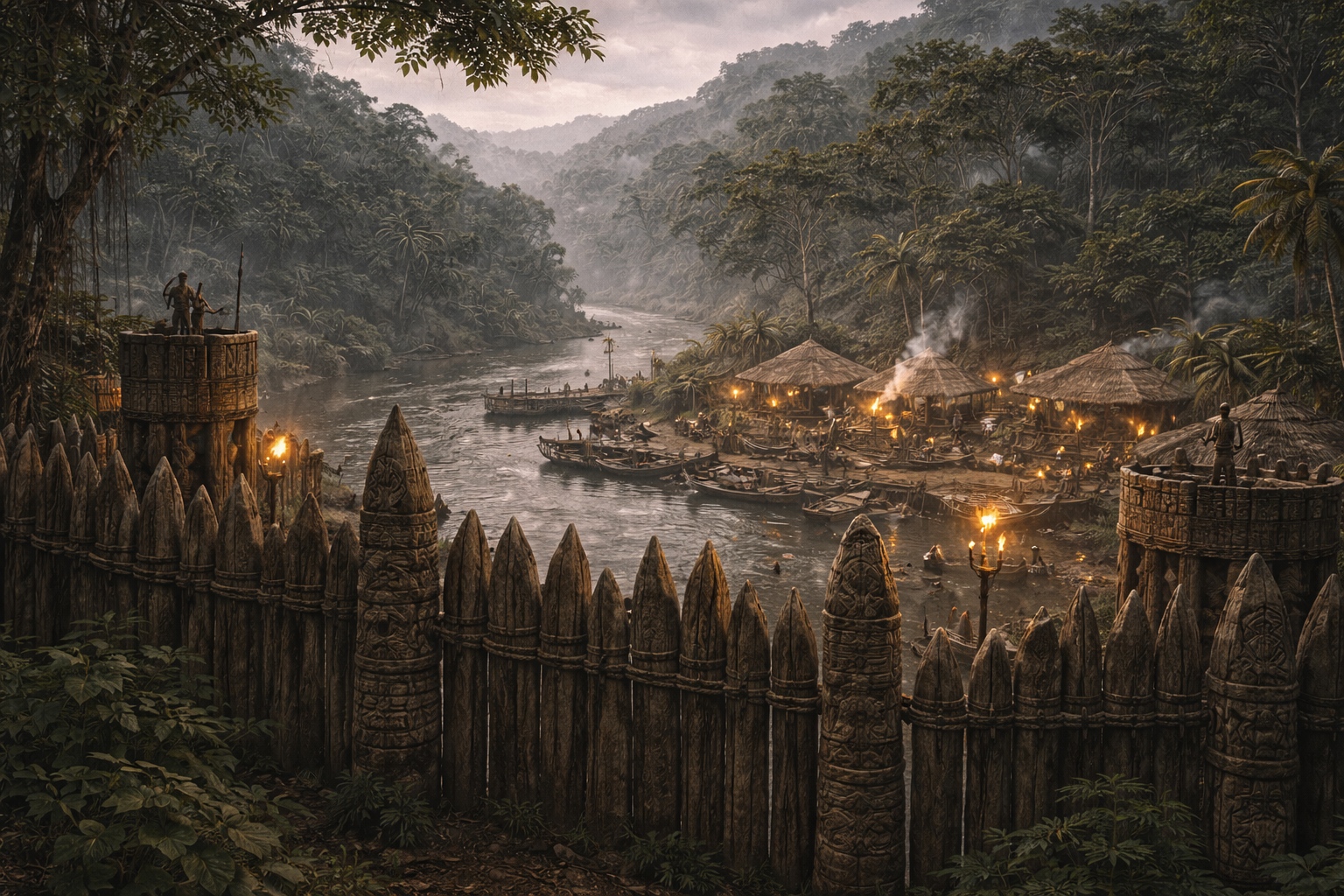
The palisade is the first thing you see: sharpened logs twice a person's height, hung with carved totems at regular intervals, the boundary between the Moriche Rainforest and the human space within. The forest presses right up to the wall's exterior edge, dense and dark even in daylight, alive with the sounds of birds and something that may or may not be birds.
Inside the palisade, Maxan is organized and human-scaled. Wooden huts with thatched roofs stand in rows along packed-earth paths, each with a small garden plot and a carved symbol above the door: the crescent moon of Lunis, or one of several protective glyphs that the community has used for generations. The Castano River runs along the settlement's eastern edge, accessible through a guarded opening in the palisade wall, and its sound is a constant background to everything.
The marketplace is the center of social life: woven baskets, dried fruits, bundled herbs, carved tools, and always the small dark bottles of Elixir de Moriche that experienced travelers seek specifically. The people are watchful but not unfriendly; they assess newcomers with the efficiency of people accustomed to rapid evaluation. Maxan does not waste trust, but it does not withhold it from those who demonstrate reasonable intentions.
The full moon nights are different. You will be told, politely but firmly, that visitors do not remain outside the palisade after dark when the moon is full.
Geography & Setting
Maxan occupies the southern edge of the Moriche Rainforest where it meets the Castano River, in the lower reaches of the forest before it gives way to more open terrain toward Zulie to the east. The settlement is positioned at a natural chokepoint; the forest thins here, and the river bends to create a natural boundary on the east. The palisade closes the perimeter.
The Moriche Rainforest to the north and west is the community's primary resource zone: hunting grounds, gathering territory for the medicinal herbs and palm fruits that are Maxan's economic specialty, and a landscape of genuine complexity and danger. The Castano River provides fresh water, fish, and the trading route that connects Maxan to the wider Confederation.
The climate here is humid: the forest holds moisture, the river adds to it, and the temperature rarely drops below warm. The days are bright when the canopy breaks; the nights are dark in the way only deep forest nights are dark. The full moon, when it rises above the canopy, transforms the cleared ground inside the palisade with silver light.
The rolling hills visible to the south and west mark the transition toward drier, more open terrain, but Maxan's world is the forest, the river, and the cleared space it has carved between them.
The People
Demographics
Maxan's population is diverse, drawn here by the forest's resources or kept here by the community bonds that form around shared challenge. Humans are the plurality; Elves are deeply woven into the community's identity through House Morada de la Luna's lineage; Dwarves bring smithing and fortification expertise that is essential to maintaining the palisade and defensive capability. Smalings have found a natural place in the gathering and herbalism work, their nimble hands and patience perfectly suited to the delicate work of preparing Elixir de Moriche.
Half-Orcs like Gorak Bloodfang occupy a particular role; respected for physical capability and tracking skill, their presence is a mark of how Maxan integrates people on the basis of contribution rather than background. Gnomes are rare but not unwelcome.
Outsiders are assessed rather than welcomed. The community's wariness is genuine and earned; the forest has enough external threats without adding human ones.
Economy
Hunting and gathering are the economic foundation, conducted with a systematic skill that transforms what would be mere survival in the hands of others into something closer to a managed industry. The forest around Maxan holds a specific abundance that Elara Morada de la Luna's house has spent generations learning to harvest sustainably without depleting.
The Elixir de Moriche is the settlement's most valuable product. Made from the fruit of the Moriche palm (a recipe that involves specific harvesting timing, preparation techniques, and combinations with other forest plants that the community guards closely) it has genuine healing properties documented across the Confederation and beyond. The exact preparation method is known only to the senior herbalists of Maxan and is not shared.
Secondary exports include dried fruits, preserved meats, woven baskets, and the forest-craft goods that Maxan's artisans produce. The community imports metal tools, textiles, and specialist goods that the forest cannot provide, trading through Confederation partners via the Castano River.
Primary Exports
- Elixir de Moriche: The signature product; carefully bottled, limited in supply, highly sought after for its documented healing properties
- Dried and preserved forest fruits: Guava, passion fruit, and forest berries in various preserved forms
- Woven craft goods and herbal preparations: Secondary exports of genuine quality
Primary Imports
- Metal tools and weapons: Essential for defense and forest work; Thrain Ironfoot's smithy supplements but cannot produce everything needed
- Textiles and clothing materials: The forest provides fiber but not in forms that scale to community clothing needs
- Grain and preserved staples: To supplement during lean seasons
Key Industries
- Forest gathering and Elixir production: The defining industry; the most carefully controlled aspect of the settlement's economy
- Hunting: Primary protein supply; conducted under protocols that balance yield against forest health
- Palisade craft and fortification: The ongoing maintenance of the settlement's primary defense; treated as a skilled trade
Food & Drink
Forest cuisine in Maxan is interesting; the Moriche Rainforest produces a range of ingredients that most Antaean settlements never encounter. Wild game stews seasoned with forest herbs, fish from the Castano prepared in methods adapted to tropical ingredients, palm fruits both fresh and fermented, roots and tubers that appear in everything. Guava is used everywhere: fresh as snack, turned into drinks, cooked into stews. Passion fruit appears in ceremonial food contexts particularly.
The local drink is a fermented palm wine called Chicha de Moriche: sweet, mildly alcoholic, made from the same palm as the Elixir but through a different process. It is not for export; the community considers it a sacred social drink, not a trade commodity.
Culture & Social Life
Maxan's culture is built around the forest: not as backdrop but as active participant. The community's survival depends on reading the forest accurately, and this shapes everything from interpersonal communication (clear, direct, no wasted words in situations that matter) to social hierarchy (governed by demonstrated knowledge and skill, not birth). The house structure matters primarily as institutional memory; Elara Morada de la Luna's value is not just leadership but the accumulated knowledge of generations.
The full moon ritual is the community's most important social event: a gathering that combines protective purpose with communal bonding, combining the practical (warding against El Saqueador Nocturno) with the spiritual (Lunis observance). The ceremony is not performed for outsiders and is not described in detail to those who ask.
Magic exists in Maxan in a particular form: woven into the gathering practices, the protective glyphs, the ceremonial aspects of the Elixir preparation. It is not flashy magic but the kind of persistent, ambient practice that requires decades to understand.
Festivals & Traditions
The Full Moon Ritual of El Saqueador Nocturno
Performed every full moon, without exception. The community gathers at dusk when the full moon rises. Specific protective chants and dances are performed, led by Elara and the senior herbalists. Carved masks depicting forest spirits are worn by the ritual participants. Offerings of food and crafted items are left at the palisade's outer edge in specific locations that shift slightly each month according to an algorithm that Elara keeps in her memory. The night passes inside the palisade. The offerings are gone by morning. No one discusses what removes them.
Music & Arts
Maxan's music is rhythm-first; drums carved from hollowed logs produce the base beat around which other instruments layer. Reed flutes and simple string instruments built from forest materials provide the melody. The full moon ritual has its own specific musical patterns that are reserved for that context; daily music is more informal, reflecting the community's warmth when not on guard. Visual art is craft-integrated: woven patterns in baskets carry symbolic meaning, carved tool handles bear protective glyphs, and the palisade totems are genuinely skilled sculptural objects.
Religion
Primary Faith
Lunis, goddess of night, moons, and celestial bodies, is the primary deity of Maxan; the alignment is immediate and logical. The full moon defines the community's most important ritual, the night is both beautiful and dangerous here, and the celestial rhythm provides a framework for the agricultural and gathering calendar. Open-air worship spaces decorated with moon-phase stones receive regular observance, and meteorite fragments found in the forest are treated as sacred relics. The most devout followers are the senior herbalists, who track lunar phases in relation to plant potency.
Secondary / Minority Faiths
Fujin, deity of storms, is respected in a settlement where the Moriche's weather can turn severe: not beloved, but acknowledged. Offerings at tree-base shrines before storms. Cael, goddess of weather, has a practical following among the farmers and gatherers who depend on accurate weather reading. Solis and Tempus are observed in the agricultural calendar tracking.
Secret or Forbidden Worship
Demergat, deity of storm-ridden islands, has a whispered following among a small number of Maxan's more extreme protectionists: those who have spent the most time at the forest's edge and have formed the darkest views of what lies beyond. The worship is secret because its implications (strict loyalty to a dark deity, potentially using that relationship for tactical advantage against threats) are considered incompatible with the community's cooperative values. Friedhof, deity of the grave, is venerated privately by those who have lost people to the forest's dangers and seek peace in that loss.
History
Founding
Maxan was established by a coalition of Human, Elven, and Dwarven settlers who recognized the forest's edge as both a resource and a boundary. The founding families negotiated their initial territory carefully with the surrounding ecosystem; the protocols for sustainable harvest and the palisade design both date to the earliest period. House Morada de la Luna emerged as the primary leadership lineage through the quality of the elven family's forest knowledge, which proved genuinely superior in managing the community's relationship with the Moriche.
Key Events
The Night of the Crescent Moon
The first documented encounter with El Saqueador Nocturno, the entity the community now ritually wards against, occurred early in the settlement's history, during a night when the moon was crescent rather than full. The encounter was devastating: significant damage to the settlement, loss of life, and material destruction that set the community back by years. The study of what had happened, and the development of the protective ritual, became the defining project of Elara Morada de la Luna's great-great-grandmother. The ritual has not failed since it was established.
The Growth of the Elixir Trade
The discovery that the Moriche palm fruit could be combined with specific other forest herbs to create a preparation with genuine healing properties transformed Maxan's economic position within the Confederation. Elara Morada de la Luna (the current matriarch's grandmother) developed the refinements that made the Elixir reliable enough to trade. The formula has been passed down through the family's oral tradition, and protecting it is considered equivalent to protecting the community itself.
The Shadow Years
A period of sustained pressure from neighboring goblin and orc tribes, combined with two poor harvest seasons, created the "Shadow Years" that tested Maxan's resilience. The palisade was expanded and reinforced; the hunting parties were reorganized for defense as well as food supply; and Gorak Bloodfang's ancestors were among those who arrived during this period as refugees who proved their worth through combat contribution. The community that emerged from the Shadow Years was harder and more strategically organized than the one that had entered it.
Current State
Maxan is in a cautious equilibrium. The Elixir trade is profitable and stable, the palisade is sound, and the Confederation relationship provides a buffer against the most serious external threats. The community is watchful about the full moon, professionally alert to the goblins and orcs at the forest's edge, and quietly concerned about something Gorak Bloodfang has been noticing in the forest's deeper reaches: an absence where there should be presence, a silence in sections that should not be silent.
Leadership & Governance
House Morada de la Luna: Overview
Maxan is governed by House Morada de la Luna, an elven-founded dynasty whose authority rests on multi-generational accumulated knowledge of the Moriche Rainforest that no other community member can match. Leadership is autocratic in structure but consultative in practice; Elara makes final decisions, but she solicits counsel widely before doing so. The House's primary obligation, beyond governance, is maintaining the Elixir formula and the full moon ritual. Without those two things, Maxan's identity and safety both dissolve.
Elara Morada de la Luna
Elf, Female: An elf in her middle centuries, carrying the weight of leadership and the forest's knowledge with the same body
Elara is lithe, dark-haired, and rarely still. She moves through Maxan and the forest edge with the same fluid ease, and the distinction between the two spaces is less significant to her than to most people. Her eyes are large and adapted to low light in ways that become obvious in the evenings. She is warm when warmth is appropriate and absolutely precise when precision is required.
She leads through demonstrated knowledge; there is nothing about Maxan's situation that she does not understand at a level deeper than anyone else's understanding. Her flaw is the weight she carries: she has not been able to fully trust anyone else with the most significant elements of what she knows, which means the Elixir formula and the ritual knowledge are dangerously concentrated in one person. She is aware of this and is slowly working toward a solution.
Thrain Ironfoot: Smithy and Fortification Lead
Dwarf, Male: A compact, dependable dwarf who has been responsible for Maxan's palisade and metalwork for three decades. He is as much an engineer as a smith and treats the palisade's maintenance with the same systematic care he applies to ironwork. He participates in full moon rituals without ever having fully accepted what the ritual is for; he is pragmatic, not superstitious, but he has seen enough to know that the ritual works.
Guard & Militia
Maxan's defense is integrated into daily life rather than separated into a guard force. The hunting parties are the primary defensive structure; everyone in Maxan who goes into the forest is equipped and trained for the threats they may encounter. Gorak Bloodfang coordinates the active scout and perimeter monitoring. In serious threat situations, the entire adult population is the militia.
Law & Order
Antaean custom governs serious violations. Community custom governs everything else, and the most important community law is: the Elixir formula stays in Maxan. Information about the formula, about the ritual, or about the forest's specific layout is considered community property, and sharing it with outsiders is treated as the most severe form of betrayal.
Notable Figures
Lila Swiftfoot: Lead Herbalist
Smaling, Female: The gathering paths and the preparation workshop
The most skilled herb-gatherer in Maxan and the primary preparator of the Elixir de Moriche outside the Elara herself. She knows the forest gathering routes better than anyone except Gorak Bloodfang, and she knows the preparation process better than anyone except Elara. She is cheerful, methodical, and quietly terrifying in her precision with medicinal plants; she knows what kills as well as what heals. She is the person most likely to be Elara's eventual successor in the Elixir knowledge, and both of them know it.
Gorak Bloodfang: Chief Scout
Half-Orc, Male: The forest perimeter, the scout camp, and wherever the most recent threat is
Maxan's most feared fighter and most effective early-warning system. Gorak's familiarity with the Moriche's deep forest is unusual even by Maxan's standards; he goes places that others consider too risky and comes back with information that has saved the community more than once. He has a calm, deliberate manner that does not match his appearance and a personal code that is absolute about protecting Maxan. He is currently worried about the deep forest silence and has told Elara. She told him to keep watching.
Brother Orlin Moontrack: Lunis Observant
Human, Male: The moon-phase stone circle at the settlement's center
The community's primary Lunis practitioner and the keeper of the ceremonial calendar. He is not quite a priest in the formal sense but maintains the practice with disciplined consistency. He is a scholar by temperament; his records of lunar cycles, Elixir potency variations, and full moon incident history are detailed and valuable. He has noticed a correlation between specific lunar configurations and El Saqueador's level of activity that he has been developing a theory around for two years.
Key Locations
Seat of Power
- The Morada Hall: A timber longhouse at the settlement's center, the largest building in Maxan. Public hearings, community gatherings, and formal decisions happen here. The Elixir preparation workshop is in an adjacent secured annex.
Houses of Worship
- The Moon-Phase Circle: A cleared space at the settlement's heart with carved standing stones marking the lunar phases. Open to community members for daily observance; the full moon ritual transforms it into the primary ceremonial space.
- The Storm Post of Fujin: A single large post at the forest-facing wall of the palisade, carved with Fujin's storm symbol. Offerings are left here before major weather events.
Inns & Taverns
- The Forest's Edge: The settlement's communal gathering space, technically an inn only in the sense that vetted travelers can stay the night on its floor. Food is communal and good; the Chicha de Moriche appears in evenings as a shared drink. Run by a Human woman named Teya Rootbark who is the most enthusiastic host in a settlement that is generally watchful.
Shops & Services
- Lila's Preparation Workshop: The Elixir is sold here, in limited quantities, at prices that reflect its rarity. No negotiation on the formula, the preparation methods, or the sourcing locations.
- Thrain's Forge: Standard smithy products and palisade maintenance work. Thrain also makes tools specifically designed for forest gathering work that cannot be found elsewhere.
- The Basket Weavers' Collective: A cluster of artisan workshops producing the woven goods that are Maxan's secondary craft export.
The Market
- The Settlement Market: Daily in the central clearing. Game, gathered forest produce, herbs, crafted goods. Outside traders access the market through a guarded secondary gate and conduct their business in the outer ring of the plaza, not the inner community space.
Other Points of Interest
- The Palisade Totems: The carved protective figures mounted at intervals along the palisade exterior are collectively one of the most significant artistic achievements in this part of Antaea. Each one was carved by a community elder and represents a specific protective concept.
- The Offering Locations: The specific spots along the palisade exterior where full moon offerings are left rotate according to Elara's algorithm. Outside the full moon context, the locations are not marked.
Guilds & Organizations
- The Gathering Circle: The organized herbalists and forest-gatherers working under Lila Swiftfoot's coordination. Manages sustainable harvest quotas, trains new gatherers, and maintains the knowledge records for forest plant locations. Membership requires demonstrated forest competence and community trust.
- The Hunter's Watch: Gorak Bloodfang's informal organization of scouts and hunters. Not officially structured but functionally the community's primary defensive and intelligence operation.
The Criminal Element
Maxan's criminal concern is singular: the Elixir formula. There have been three attempts in living memory by outside parties to obtain the formula through bribery, theft, or manipulation of community members. All three were identified and stopped, though one came closer than anyone discusses publicly. The perpetrator of that attempt is not known to be dead, which is a current concern.
Internal crime is minimal. Petty theft happens occasionally and is handled communally. Violence within the palisade is extremely rare and dealt with through the House Morada de la Luna's judgment.
Secrets, Rumors & Hooks
- Gorak Bloodfang's deep forest observations have revealed something he has not yet told Elara: a series of markings on trees in the forest's deepest section that are not natural, not animal, and not any glyph system he recognizes. They appear to be moving: new ones appear, old ones vanish. He is copying them.
- The Elixir de Moriche has a version that Elara has not put into trade. The standard version has documented healing properties. The concentrated version, prepared under specific lunar conditions, does something else. Lila Swiftfoot has seen it prepared once. She is not sure "healing" is the right word for what it does.
- The third attempt to steal the Elixir formula, the close one, involved a community member who was not expelled but was given a choice: loyalty, under permanent observation, or exile. They chose loyalty. They are still here. Only Elara knows who it was.
- Brother Orlin Moontrack's correlation theory is correct, and he is weeks away from realizing what the implications are: the pattern he has identified means El Saqueador Nocturno is not an entity that arrives from outside. It is an entity that emerges from inside the forest, specifically from the grove at the forest's center that the community has avoided since the settlement's founding.
- The palisade totem carved by Elara's grandmother contains something inside it, a sealed object that was placed there at the time of carving. The grandmother's instructions were: do not open it unless the ritual fails for the first time. No one alive knows what is inside.