Moramora
Moramora: The Island Where Everything Has a Price
"Sirena named the plant after herself. That should tell you everything you need to know about Moramora."
Seraphina Brightsong, merchant
At a Glance
| Continent | Antaea |
| Region / Province | Sea of the Heavens (island) |
| Settlement Type | City |
| Population | ~9,000 |
| Dominant Races | Humans, Dwarves, Elves, Smalings |
| Ruler / Leader | Lord Elion Marisole, Sapa of House Marisole |
| Ruling Body | House Marisole (hereditary trade dynasty) |
| Primary Deity | Amador |
| Economy | Trade, Agriculture & Maritime Commerce |
| Alliance | The Heavens Sphere |
| Known For | The most cosmopolitan trade hub in the Sea of the Heavens; the Sirena's Tear contraband trade; a civic culture of pleasant opacity |
Geographic Note: The original settlement records occasionally referenced "the Zatcoria Ocean"; this name does not correspond to any recognized body of water. Moramora sits in the Sea of the Heavens.
First Impressions
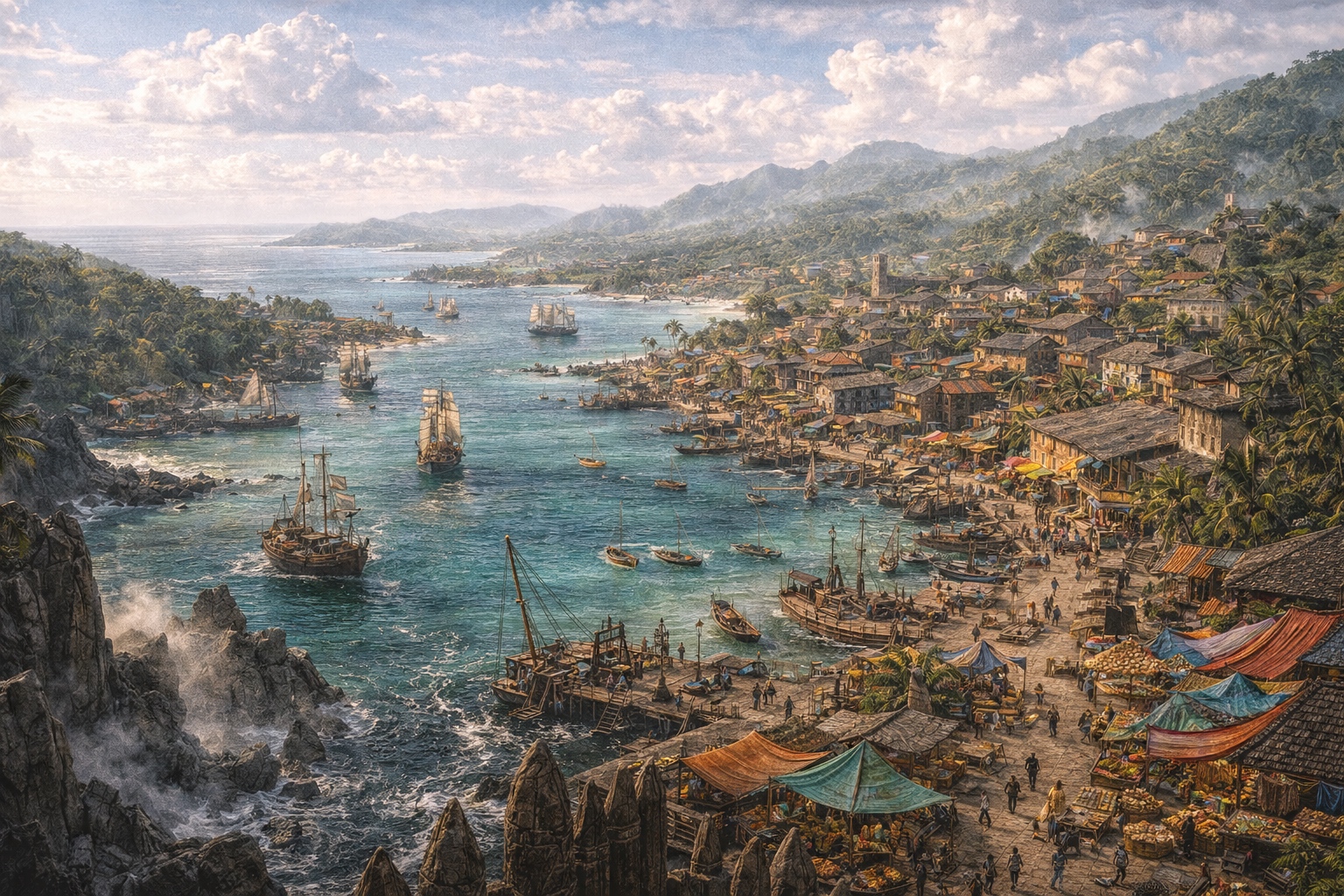
Moramora's harbor is a cascade of gentle bays, each one shimmering in shades of azure and emerald, with ships from distant lands riding at anchor while their crews unload cargoes that smell of spice, salt, and somewhere else. The docks lead into cobbled streets that widen into plazas, narrowing again into alleys that turn without warning. Buildings are built from the island's abundant timber, their rooftops visible through palm canopy. Further in, the town climbs rolling hills that give views of the sea in every direction.
The market runs on a near-continuous basis; it never fully closes, it only quiets. Everything is available here, officially or otherwise, and the distinction between the two categories is a matter of persistence and price rather than genuine impossibility. The people are warm and transactional in equal measure, polished by generations of contact with traders from every culture Antaea and beyond has produced. They are pragmatic rather than cynical, welcoming rather than trusting, and they understand that their town's value lies in being the place that facilitates the exchange of things that other places won't.
The temples are the most beautiful buildings on the island, and the most visited after the market. Moramora takes its religion seriously in the way that a town takes seriously anything that is also economically useful. The priests are respected, the festivals are spectacular, and the private chapels behind certain trading houses exist for purposes that the public temples do not officially acknowledge.
Geography & Setting
Moramora occupies one of the larger islands in the Sea of the Heavens, positioned within the Heavens Sphere's maritime network. The island's topography is varied: the harbor coast on the west and south, the rolling hills of the interior, and the lush valleys where farming operations produce the tropical fruits and sugarcane that are Moramora's agricultural wealth. The forest that edges the northern and eastern coasts provides both lumber and the specific conditions under which the Sombraleaf (better known by its trade name, Sirena's Tear) grows.
The Sea of the Heavens provides the maritime connections that make Moramora viable as a trade hub. Ships from mainland Antaea, from The Heavens, and from the broader island chains pass through regularly, and the harbor's natural depth accommodates significant vessels. The island's self-sufficient food production reduces its dependence on imports and allows it to host large numbers of traders without straining food supply.
The climate is tropical maritime: warm, humid, reliable rainfall. The conditions that produce exceptional fruit and rich fishing grounds also produce the Sombraleaf's growth, which is why attempts to transplant the plant to other locations have consistently failed.
The People
Demographics
Moramora's population reflects its role as a trade hub; it is more diverse than any other settlement in the Sea of the Heavens, with Humans, Dwarves, Elves, and Smalings in roughly equal proportions, supplemented by every other race that passes through and some that decided to stay. The merchant class is cosmopolitan and polyglot; the farming and fishing communities are more homogeneous and more rooted. Gnomes have a notable presence in the artisan and scholar communities.
Outsiders are welcomed with genuine warmth in Moramora, tempered by the specific wariness that comes from a community that has learned to be cautious about the Sirena's Tear question. New arrivals who demonstrate legitimate commercial or social purpose find Moramora one of the more genuinely open cities in the region.
Economy
Trade is the primary economic engine. Moramora's harbor connects agricultural production, maritime commerce, and the island's unique product line in a system that makes the city the natural node for an enormous range of commercial activity. House Marisole has built its authority primarily through commercial expertise; the Marisoles are respected because they keep Moramora's market running honestly.
Agriculture is the second pillar: tropical fruits, sugarcane, cacao, and coconut produced in the island's valleys generate both direct export revenue and the raw materials for processed food and drink products Moramora is known for. Fishing supplements food supply and provides a modest additional export.
The Sirena's Tear trade occupies a separate economic category that House Marisole officially does not acknowledge, operating through a network of intermediaries.
Primary Exports
- Tropical fruits, sugarcane, and processed food products: Mangoes, pineapples, coconuts, sugarcane syrup, cacao; the volume and quality of Moramora's agricultural exports are matched nowhere else in the Sphere
- Fish, particularly snappers and groupers: A consistent and high-quality maritime export
- Sirena's Tear (Sombraleaf): The island's most lucrative illicit export; highly addictive for certain populations, particularly in Irna; prohibited but persistent
Primary Imports
- Fine textiles and luxury goods: Moramora's cosmopolitan merchant class demands luxury it cannot produce locally
- Specialized tools and shipbuilding materials: The island has limited ore; everything metal comes from outside
- Exotic goods from distant markets: The entrepôt role means Moramora also imports things it immediately re-exports
Key Industries
- Maritime trade and entrepôt commerce: The defining industry; Moramora makes money on the movement of goods as much as the goods themselves
- Tropical agriculture: The agricultural backbone; the island's climate produces products nobody else can match
- Sombraleaf cultivation and trade: Officially nonexistent; functionally significant to certain trading houses' revenue
Food & Drink
Moramora's food is the finest in the Sea of the Heavens, a genuine fusion of maritime abundance and tropical agriculture. Fish stews with coconut milk and island spices, grilled snapper served with mango chutney, goat prepared in half a dozen ways. Fresh fruit is available year-round. The signature social drink is a cane spirit aged in local hardwood casks: smooth, slightly sweet, produced in small batches. Quality varies enormously, which is considered cultural richness rather than a problem.
Culture & Social Life
Moramora's culture is built around pragmatic hospitality and the management of complexity. The people are charming because charm is useful, and honest because dishonest trades eventually damage the market that sustains everyone. There is genuine warmth to the social fabric (the festivals are spectacular, the food is excellent, and the communal identity is real), but it coexists with a civic talent for not knowing things that it would be expensive to officially know.
Festivals & Traditions
Sirena's Feast
Held annually, in the month of the full summer moon. The Feast traces its origin to Sirena herself. Wealthy families make public donations to community institutions, the feast is open to everyone, and the day features a genuine loosening of the social hierarchies that govern the rest of the year. The symbolic content involves the sea, gratitude for abundance, and the complicated legacy of the woman who named the plant that both benefits and burdens the island.
The Festival of Tides
Held twice yearly, at the major tide changes. This festival honors Ryujin and the sea, with boat parades decorated with flowers and fruits, communal fishing, and evening ceremonies on the waterfront. Musicians, particularly the Smalings who specialize in lute and flute, fill the harbor district. The Festival is more explicitly spiritual than Sirena's Feast.
Music & Arts
Music in Moramora is everywhere and varied: sea shanties, formal ceremonial compositions, folk music of the market and streets. Visual art depicts the city's history, the sea, and mythological subjects. The tradition of intricate ship models, developed by artisans as commercial samples, has evolved into a collected art form.
Religion
Primary Faith
Amador, deity of love and passions, holds the primary place in Moramora's spiritual life. The Temple of Amador is the most architecturally elaborate building in the city, offering private spaces for intimate encounters alongside public worship halls. His holy symbol, the Entwined Hearts, appears on household doors, market stalls, and the prows of trading vessels. The clergy serve as counselors in both personal and commercial relationships, and their role in mediating disputes is substantial.
Secondary / Minority Faiths
Echo is revered by the farming community and the port-side families who want the city to remain pleasantly functional despite its temptations: stability, fairness, and the civic discipline that keeps Moramora from sliding into open criminal rule.
Caminus has a strong following among the artisans, with a temple that is architecturally spectacular and serves as both workshop and worship space.
Fujin is respected by the maritime community.
Zopha is observed by the scholarly community, especially those studying the island's ecology and the Sombraleaf question.
Secret or Forbidden Worship
Demergat, deity of storm-ridden islands, is worshipped in secret by certain seafarers who believe his patronage provides practical advantage. Martus, god of gambling and fortune, is secretly observed by gamblers and risk-takers who prefer their luck private.
History
Founding
Moramora was established by Human seafarers who found the island's welcoming bays and rich waters ideal for settlement. The construction of the citadel fort by Lord Althor the Wise, an elf of great renown, marked the transition from village to city and established the governance frameworks that House Marisole would later inherit.
Key Events
Sirena and the Discovery of the Sombraleaf
Several centuries ago, a merchant's daughter named Sirena, a botanist as much as a trader, discovered that the Sombraleaf plant had highly addictive properties particularly affecting the residents of Irna. She established clandestine cultivation and a trade network, naming the plant "Sirena's Tear." She also established the public Feast that bears her name, partly to redistribute wealth and partly to manage her public reputation. Sirena's legacy remains genuinely contested.
The Shard of Ix
A legend persists about a relic shard from Ix, an artifact of divine power, said to be guarded by a formidable demon in the forest's depths. A group of adventurers led by a dwarf named Thrain Ironfoot attempted to find it and was defeated. The shard's location is believed to shift, and the story is both cultural myth and genuine unresolved question.
The Year of the Red Moon
A period of natural disasters (failed crops, poor fishing seasons) devastated Moramora's economy. A Smaling sage named Mira Goodbarrel guided the community's recovery, developing the agricultural diversification that characterizes Moramora's current farming economy.
Current State
Moramora is prosperous but navigating competing pressures. The Heavens Sphere's political complications create uncertainty in trade relationships; the Sombraleaf question continues to generate external diplomatic friction with Irna; and Lord Elion Marisole is managing an aging governance structure that the city's increasing complexity may be outgrowing.
Leadership & Governance
House Marisole: Overview
Moramora is governed by House Marisole, a lineage of Human nobles with deep roots in the island's trading history. Their governance style is diplomatically autocratic; Lord Marisole makes final decisions, but he maintains an open-door policy for citizen consultations. The Marisoles have built power through economic prosperity and a reputation for keeping the market fair.
Lord Elion Marisole
Human, Male: A man in his sixties, still vigorous, accustomed to complexity
Elion Marisole is a weathered, compact man with the hands of someone who has worked on ships and the eyes of someone who has spent decades in negotiation. He is shrewd, diplomatically capable, and committed to Moramora's prosperity. He is also aware that the Sombraleaf question is a ticking political clock; Irna's frustration is growing, and his posture of plausible deniability will not hold indefinitely.
His challenge is that any serious move to suppress the Sombraleaf trade will create economic disruption and political enemies within Moramora, while failing to act will eventually bring external pressure that damages the legitimate trade. He is looking for a third option.
Captain Mirna Stonefoot: Patrol Fleet Commander
Dwarf, Female: Commander of the vessels that maintain maritime security in Moramora's waters. Tactical, direct, and professionally insulated from the political dimensions of the Sombraleaf question; she enforces the law she is asked to enforce. She is aware of the gap between her mandate and the full situation.
Guard & Militia
The city watch is professional and substantial: several hundred active guards for a city of nine thousand. The watch's relationship to the Sombraleaf trade is the same as the city's: managed non-engagement rather than genuine ignorance.
Law & Order
Moramora follows Antaean custom. House Marisole's additional regulations govern market conduct, cargo declarations, and certain civil disputes. Justice is administered through a circuit of judges drawn from the leading merchant families: generally fair in commercial matters, generally opaque in political ones.
Notable Figures
Priestess Althea Moonshade: High Priestess of Amador
Half-Elf, Female: The Temple of Amador, central city
The spiritual leader of Moramora's primary faith and one of the most personally trusted figures in the city. She is known for genuine kindness and practical wisdom; people bring her problems they cannot take to Lord Marisole or the market arbitrators, and she handles them with discretion and care. She knows more about the city's hidden social dynamics than almost anyone and uses that knowledge primarily for pastoral care. She would be a formidable political figure if she chose to be; she has chosen not to.
Scholar Elarion Leafwhisper: Historian and Naturalist
Elf, Male: The educational center, upper city
A historian and naturalist whose scholarly work focuses on Moramora's natural and social history. He runs one of the island's educational institutions and maintains the most complete accessible record of local history. He is a devotee of Zopha, earnest in his scholarship, and perpetually uncertain about what to do with what his research keeps revealing about the Sombraleaf's origins. He has significant evidence that the Sirena legend is more complicated than the official version, and he is sitting on it.
Seraphina Brightsong: Merchant
Smaling, Female: The merchant quarter, wherever the best deals are
One of the wealthiest merchants in Moramora, with trade connections spanning the Sea of the Heavens and mainland Antaea. She specializes in exotic fruits and processed food products, the legitimate exports that are the public face of Moramora's commerce. She is charming, commercially brilliant, and has been Lord Marisole's informal commercial advisor for twenty years.
Key Locations
Seat of Power
- House Marisole Citadel: The administrative center, descending from the original fort built by Lord Althor. Public halls are accessible for the regular citizen consultation days; private governance spaces are restricted.
Houses of Worship
- The Temple of Amador: The city's most beautiful building, a compound of private spaces and public halls serving both intimate worship and large ceremonial gatherings. The clergy provide counseling, mediation, and the social lubricant that keeps a city of traders functioning.
- The Workshop Temple of Caminus: Half manufacturing space, half sacred hall; offerings made here take the form of completed craftsmanship. The building is structurally a masterpiece.
Inns & Taverns
- The Tidal Feast: Moramora's premier establishment, aimed at traders and visitors with means. Excellent food, excellent imported wine, the best cane spirit in the city.
- The Market Rest: More accessible, bustling, always full of information. The place where deals are initiated even if they are finalized elsewhere.
Shops & Services
- The Fruit Merchant's Quarter: A dense cluster of agricultural trading houses near the harbor, where the island's produce is sold wholesale and retail.
- Elarion's Educational Center: Open to students and scholars; archives available to serious researchers with proper introduction.
- Seraphina's Trading House: Handles export contracts for the island's premium fruit products and operates as an informal market intelligence service.
The Market
- The Grand Market of Moramora: Continuous operation, the largest market in the Sea of the Heavens outside The Heavens itself.
Other Points of Interest
- The Sombraleaf Grove: The section of northern forest where the plant grows wild. Officially unmanaged; the paths to it are well-worn.
- The Storm Pillars of Fujin: Monolithic stone columns erected at sites of historical storm damage around the harbor, serving as both religious offerings and tide markers.
Guilds & Organizations
- The Merchant's League of Moramora: Sets market standards, mediates commercial disputes, and represents mercantile interests to House Marisole. Seraphina Brightsong has been on its steering council for a decade.
- The Cultivators' Association: Represents the farming community's interests and manages the agricultural protocols that have made Moramora's fruit production so successful.
The Criminal Element
The Sombraleaf trade is the city's defining criminal enterprise, run by a network of Gnomes and Half-Elves who have accumulated substantial wealth and maintain the operation through political protection and genuine commercial skill. Lord Marisole's non-engagement policy depends on both parties understanding where the lines are. Secondary criminal activity (theft, fraud, extortion) exists at the level typical for a city of Moramora's size.
Secrets, Rumors & Hooks
- Scholar Elarion Leafwhisper has found evidence in old Marisole family records that the original Sirena was not an independent discoverer of the Sombraleaf. She was introduced to it by a Marisole family contact who saw the commercial opportunity and needed a public face. If accurate, House Marisole's moral position on the Sombraleaf trade is considerably worse than its current stance implies.
- The Shard of Ix is real. The demon is real. The Shard moves not because of magic but because the creature carries it; it is the demon's anchor to this world. The reason it has never been permanently defeated is that nobody has asked what happens to the Shard if the demon is destroyed. The answer is relevant and not comfortable.
- Lord Marisole has been approached by an Irnan diplomatic mission offering a specific arrangement: complete suppression of the Sombraleaf trade in exchange for Irna's support in a Heavens Sphere political realignment that would significantly benefit Moramora's commercial position. Seraphina Brightsong has informed him privately that certain of her clients have interests in the Sombraleaf network and is watching this negotiation carefully.
- Priestess Althea Moonshade knows the identity of the person who coordinates the Sombraleaf network's protection payments to the city watch. She learned it through her pastoral counseling role and cannot use the information without violating the trust that makes her effective. She is the only person who knows and is not in the network.
- The Year of the Red Moon was not natural disaster. The agricultural failures were triggered by deliberate contamination of the island's irrigation water, commercial sabotage by a trading house since absorbed into Seraphina Brightsong's commercial empire. Mira Goodbarrel knew this. Her descendants still know.