Morrito
Morrito: Where Justice is a Luxury
"The Varkari Codex has a law for everything. What it doesn't have is a reason."
Elysia, secret follower of Amaterasu
At a Glance
| Continent | Antaea |
| Region / Province | Southern Glacial Foothill, South of Lake Chojil |
| Settlement Type | Fortified Town |
| Population | ~3,400 (including approximately 800 in forced labor) |
| Dominant Races | Ice Elves, White Dwarves, Humans |
| Ruler / Leader | Lord Valthrun Varkari, Sapa of House Varkari |
| Ruling Body | House Varkari |
| Primary Deity | Mamaxa |
| Economy | Forced Labor, Mineral Extraction & Livestock |
| Alliance | Southern Cold Marches |
| Known For | Its penal labor system, the authority of House Varkari, the Wizard's Tower, and the whispered legend of a savior who has not yet come |
Geographic Note: Some older records reference "Lake Cubajil"; the correct name is Lake Chojil.
First Impressions
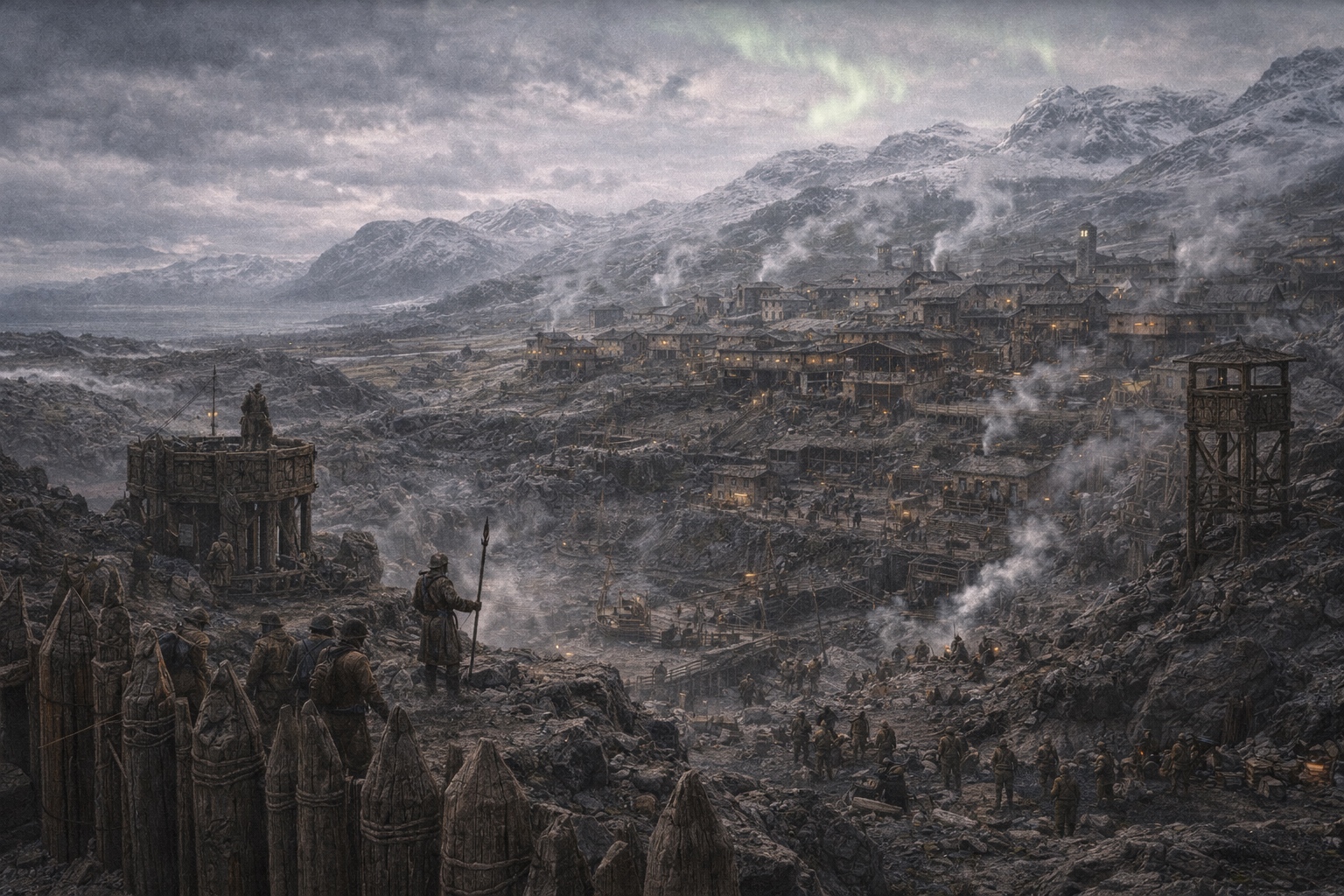
The cold reaches you before the town does. South of Lake Chojil, the climate hardens from the already austere tundra of the Southern Cold Marches into something that feels less like weather and more like the landscape's opinion of you. The settlement is visible as a cluster of stone and timber buildings against a grey hillside, the Wizard's Tower rising above everything else: tall, dark, and architecturally inconsistent with the rest of the town in a way that suggests it was built by someone whose primary interest was not fitting in.
The walls around Morrito are functional rather than ceremonial. The guards at the gate are professional and cold in both senses; they check arrivals, ask pointed questions about purpose and provenance, and wave through those with acceptable answers without warmth. Inside, the town is organized and prosperous in the particular way that settlements built on coerced labor are prosperous: the infrastructure is maintained, the market is supplied, and the people who matter have what they need.
The people who do not matter (the forced labor population, working in shifts on the mineral extraction operations and the construction projects that are always somehow ongoing) are present but peripheral to civic life in the official sense. They eat, sleep, and work in designated areas. They do not visit the good taverns. The free population of Morrito manages a kind of systematic inattention to this arrangement that visitors sometimes find more disturbing than the arrangement itself.
Geography & Setting
Morrito sits on the glacial foothill south of Lake Chojil, where the terrain transitions from the lake's northern tundra into the harsher southern cold that precedes the full glacial zones. The lake's southern shore provides fresh water and modest fishing; the hills behind the settlement hold the mineral deposits that are Morrito's economic backbone.
The Sierra Vo Vento mountains frame the northern horizon with awe-inspiring peaks, their glacial runoff feeding both Lake Chojil and the smaller streams that run through the settlement. To the south, the land continues its descent into colder, starker terrain that only the most determined travelers or the most desperate refugees venture into.
The climate is subarctic: long, brutal winters, brief summers that barely qualify as warm. The town is built to handle cold: thick stone walls, covered passages between key buildings, centralized heating in the larger structures. The forced labor population works regardless of temperature, which is considered a feature of the system rather than a problem.
The People
Demographics
Ice Elves constitute the upper class and nearly all of House Varkari's family and retainers; their cold-climate adaptation and natural resistance to the region's conditions gives them practical advantages that have translated into social dominance. White Dwarves form the skilled labor and professional class, running the smithing, engineering, and specialized trades that keep the settlement functional. Humans occupy most other positions: free workers, minor traders, and a significant portion of the forced labor population.
The forced labor population is drawn from convicted criminals, failed debtors, and people who made the mistake of offending someone with political connections. Their origins are diverse; their current status is unified.
Outsiders are viewed with the same calculation applied to everything else in Morrito: useful people are welcome, useless people are redirected. Refugees from the deeper south occasionally arrive; House Varkari assesses them individually and assigns them to appropriate categories.
Economy
Morrito's primary economic engine is forced labor. The convicted workers extracted from the justice system form a captive workforce that performs the mineral extraction, construction, and heavy labor that would otherwise require expensive free workers. This is not a secret; it is official policy and is described in the Varkari Codex as a service to the settlement and a contribution to rehabilitation.
Mineral extraction is the industry the forced labor supports: the hills produce useful metals and building stone that are exported to other Southern Cold Marches settlements and occasionally to northern markets willing to pay for quality despite the source. Livestock (sheep and cattle on the edges of the tundra, supplemented by Lake Chojil fishing) provides food supply.
The Wizard's Tower's elixirs represent a separate, premium economy. The dark mage produces magical preparations sold to the nobility, criminal networks, and anyone else with the means and the need. They command significant prices.
Primary Exports
- Minerals, metals, and building stone: Extracted from the surrounding hills through forced labor; quality is high, provenance is not discussed
- Wool, leather, and livestock products: From the tundra-edge herds
- Wizard's Elixirs: High-value magical preparations produced by the tower's occupant; sought by nobility and criminal interests across Antaea
Primary Imports
- Grain and preserved foods: The climate limits agricultural production; staples come from the north
- Manufactured goods and luxury items: For the Ice Elf and White Dwarf upper class
- Tools and specialist materials: For the extraction operations
Key Industries
- Forced labor mineral extraction: The primary economic engine; efficient in output, invisible in official accounting
- Livestock and fishing: The food supply base; sheep herds in the tundra margins, Lake Chojil fishing
- The Tower Elixirs: A unique and lucrative commodity; the dark mage's relationship with House Varkari is valuable to both parties
Food & Drink
The table in Morrito is hearty and designed for survival. Trout and salmon from Lake Chojil form the freshwater protein base; mutton and beef from the herds supplement it. Root vegetables (potatoes, carrots, parsnips) are the primary starch, usually appearing boiled or in thick stews. The town is known for its strong, spiced ales brewed in small quantities by local taverns; the alcohol content is high relative to flavor, which is considered appropriate for the climate.
The forced labor population receives adequate nutrition by the Varkari Codex's standards, which are calibrated to maintain working capacity. What constitutes "adequate" and what constitutes "sufficient for dignity" are different questions that Morrito's governance does not distinguish between.
Culture & Social Life
Morrito's culture is organized around competence, hierarchy, and the careful management of visible power. The people are not cruel in any casual sense; most free residents of Morrito are simply people doing their jobs in a difficult climate under a demanding governance structure. What they have collectively developed is the ability to maintain the system's boundaries without looking directly at what maintains them.
Conflict is resolved through bribery and negotiation within the upper classes; through the Varkari Codex's provisions for the general population; and through violence, of the official kind, for those who cannot access the other two methods. The Watch functions as the enforcement arm of House Varkari's will rather than as a neutral justice institution, and everyone knows this.
The children's legend of the Savior, a prophesied hero who will one day overturn the corrupt system, persists despite being dismissed by adults as a childish fantasy. Among adults, particularly in the lower quarters, it resurfaces during the town's darkest moments.
Festivals & Traditions
Morrito has no joyful community festivals in the conventional sense. There are official observances: the anniversary of the Varkari House's founding, the dedication ceremonies for new extraction sites, the quarterly review of the Codex provisions. These are civic functions rather than celebrations. The de facto festivals are the days when a particularly large mineral haul is brought in or a successful Elixir batch sells at premium prices: the free population receives small bonuses, the taverns stay open longer, and a brief warmth enters the social temperature before things return to normal.
Music & Arts
Art and music in Morrito reflect the environment with uncomfortable accuracy. Art is often macabre, depicting themes of struggle, betrayal, and endurance. The better work is honest rather than propagandistic; the Ice Elf carvers and the White Dwarf craftspeople produce work of genuine quality that simply happens to engage with dark subjects. Music runs in minor keys, slow and discordant, more cathartic than entertaining. There are folk songs about the Savior legend; they are never sung when Watch members are in hearing.
Religion
Primary Faith
Mamaxa, Lawful Evil goddess of pain, pleasure, and ritual punishment, holds the primary position in Morrito; the alignment is unmistakable. Her elaborate temples are designed for the ritualistic application of pain within consensual frameworks, and her theology provides an intellectual structure for Morrito's relationship with suffering: pain has meaning when it serves law, consent is the boundary that separates justice from cruelty. The theology is internally consistent and deeply uncomfortable when applied to a population that did not actually consent to its circumstances.
Secondary / Minority Faiths
Shinigami, deity of death and the grave, has an established presence among the town's necromancers and those who have philosophically made their peace with death's proximity. Amnyth, chaotic deity of death and vengeance, attracts those for whom Shinigami's approach is too orderly. Qvalnx, the enigmatic void deity, has a following among the genuinely unstable: primarily in underground spaces, primarily not discussed.
Secret or Forbidden Worship
Amaterasu, Neutral Good goddess of light and life, is secretly venerated by a small, growing sect who believe her light can cleanse the town. Elysia leads this sect without formally organizing it; it is less a cult than a distributed hope, shared in whispered conversations and small household rituals. Raphma, goddess of twilight and balance, has secret scholarly following among those who seek equilibrium rather than revolution.
History
Founding
Morrito was founded millennia ago by a coalition of Ice Elves and White Dwarves fleeing persecution, seeking refuge in the icy wilderness. The founders, led by the Ice Elf matriarch Elira Frostveil and White Dwarf chieftain Borin Ironshard, chose the location for its natural defenses and the mineral wealth of the surrounding hills. The early settlement was genuinely a refuge, built on the principle of shared hardship and mutual protection.
Key Events
The Rise of House Varkari
The transition from refuge to stronghold was not abrupt. House Varkari rose through a combination of political maneuvering, strategic alliances, and the willingness to make decisions that other families would not. The shift to forced labor came incrementally: first for the most dangerous crimes, then for debt, then for an expanding range of offenses that the Varkari Codex defines with considerable flexibility. By the time anyone considered pushing back, the economic dependency on the labor system was complete.
The Construction of the Wizard's Tower
The Tower's construction was commissioned by an early Varkari patriarch who wanted both the magical prestige and the practical advantage it represented. The current dark mage is not the first occupant; the Tower has seen a succession of practitioners who understood that the arrangement, autonomy and resources in exchange for Elixirs and occasional consultation, was valuable to them. The current occupant has been in residence for forty years and is known to be conducting work of increasing complexity that House Varkari has stopped asking detailed questions about.
The Great Frost
A harsh winter that lasted for years decimated crops and livestock and triggered an economic crisis that drove many residents to crime, which conveniently expanded the labor pool for the extraction operations. The period is remembered as a disaster; the economic structure that emerged from it is more robust than the one before it, which is considered a silver lining in official Morrito history.
Current State
Morrito is stable and grimly prosperous. The mineral operations are productive, the Elixirs sell well, the Codex maintains order, and House Varkari's position is unchallenged, officially. Below the surface, several forces are in motion: Elysia's growing secret following, Thog's criminal operation which is increasingly difficult for even House Varkari to fully control, and the Wizard's work in the Tower, which has become less transparently transactional over the past decade.
Leadership & Governance
House Varkari: Overview
Morrito is governed by House Varkari, an Ice Elf dynasty that has held power through three centuries of continuous manipulation and force. Their governance is autocratic and law-coded; the Varkari Codex provides the legal framework that makes the system appear orderly and gives enforcement actions a veneer of procedural legitimacy. Lord Valthrun rules through calculated fear and the occasional demonstration of what the Codex's punitive provisions actually look like applied.
Lord Valthrun Varkari, the Iron Warden
Ice Elf, Male: The Varkari Keep, the highest structure after the Wizard's Tower
Lord Valthrun is tall, silver-haired, and constructed on precise lines; his demeanor has the geometric quality of someone who has eliminated all unnecessary motion and expression. He is intelligent and dangerous, a combination that has served House Varkari's interests for the full forty years of his rule. He understands that power maintained through terror alone is fragile; his version includes a layer of predictability (the Codex will be applied consistently, deals will be honored) that makes Morrito function.
His concern is succession. He has no heir of suitable quality, which he has not publicly acknowledged but which is known in the upper circles. The question of what happens to the Varkari system without a Varkari to run it is one he approaches with more anxiety than he shows.
Grommash: Chief Executioner
White Dwarf, Male: Grommash is the physical face of Morrito's punitive justice. Broad, unhurried, with an axe that is maintained with the same care other people apply to ceremonial objects. He is the most visible symbol of what happens when the Codex's punishments are applied, and he is good at his work in the most literal sense. He is not cruel by temperament; he is professional, which in his role produces the same results.
Guard & Militia
The Watch in Morrito numbers approximately one hundred and fifty, organized along military lines. They enforce Codex provisions, manage the forced labor population, maintain the town's external security, and serve as House Varkari's private enforcers when the occasions arise. They are experienced and disciplined; their loyalty is to the House through their commanders, not to any abstract concept of law. Bribes work if offered to the right person at the right level; there are informal price structures.
Law & Order: The Varkari Codex
The Varkari Codex is the settlement's legal foundation, a comprehensive set of laws that covers everything from commercial disputes to criminal behavior to the specific provisions governing the forced labor system. The Codex is rigorous in its internal logic and heavily tilted in its practical application. Crimes against House Varkari are defined broadly; crimes against commoners are defined narrowly. The forced labor provisions include detailed specifications about hours, conditions, and feeding schedules that are followed precisely enough to maintain legal defensibility without providing actual dignity.
Notable Figures
Lady Seraphine: High Priestess of Mamaxa
Ice Elf, Female: The Temple of Mamaxa, inner town
Lady Seraphine is Lord Valthrun's closest advisor and the theological voice that gives the Morrito system its framework of meaning. She is intelligent, cold, and genuinely devout in her worship; she believes that Mamaxa's framework, properly applied, provides a legitimate structure for society. She is not entirely wrong, which makes her more dangerous than someone who was simply rationalizing cruelty. She knows things about Lord Valthrun's succession concern that she has not shared.
Thog: Underworld Kingpin
Half-Orc, Male: The lower quarters, various locations
The criminal element that House Varkari tolerates because suppressing it completely would be more expensive than managing it. Thog controls a significant portion of the informal economy: contraband movement, protection arrangements, certain services that the Watch officially does not provide. His relationship with House Varkari is transactional: he keeps his operations from destabilizing the town; the Watch maintains a calibrated blindness. The arrangement has held for fifteen years. Thog is now wealthy enough and well-connected enough that the calibration is harder to maintain.
Elysia: The Hopebearer
Smaling, Female: Various; she moves around
Small, mild-mannered, and the most quietly dangerous person in Morrito in a specific way; she represents the possibility of a different relationship between people. Her acts of kindness and charity to the forced labor population are technically legal because the Codex doesn't prohibit them, but they are conducted with the careful invisibility of someone who knows that visibility would make them prohibited. Her following is growing. The Watch has begun to notice her.
The Dark Mage: The Wizard's Tower Occupant
Identity unknown: The Wizard's Tower
The current occupant of the Tower has been there for forty years and has declined to provide a name to anyone who did not already know it. The Elixirs are delivered on schedule; the arrangement continues. What the mage is actually working on in the upper levels of the Tower, the floors House Varkari does not visit, is unknown to everyone outside the Tower and, possibly, to several people inside it as well.
Key Locations
Seat of Power
- The Varkari Keep: A fortified stone structure in the settlement's center, deliberately imposing. The Keep's lower floors hold administrative functions including Codex hearings; the upper floors are private Varkari family space. Lord Valthrun conducts formal audiences in a specific hall whose design is intended to produce specific emotional responses in visitors. It works.
Houses of Worship
- The Temple of Mamaxa: An elaborate, law-abiding establishment in the inner town. The ritual spaces are sophisticated in their design and purpose. The temple serves as both spiritual center and legal consultation hall; the clergy provide official interpretations of the Codex provisions that govern the punitive system. Open to all free residents.
- The Shrine of Shinigami: In the lower quarter, near the facilities that house the forced labor population. A practical shrine that serves people who work near death professionally. No formal clergy; self-administered.
Inns & Taverns
- The Iron Table: The establishment for free residents of means; decent food, expensive ale, and the warm discretion that expensive establishments provide. The most important unofficial decisions in Morrito are made here.
- The Frost Cellar: The lower-quarter tavern where free workers and lower-class residents drink. Cheaper, louder, and the closest thing to genuine social warmth in the settlement.
Shops & Services
- The Varkari Trading Post: House Varkari's official commercial operation; minerals, metals, and wool are bought and sold here. The prices are fair in the specific sense of fair meaning "non-negotiable."
- Grommash's Supply: Not a blacksmith's shop in the conventional sense; Grommash's nephew runs a tool and equipment supplier adjacent to the extraction operations. Reliable quality, no questions.
The Market
- The Morrito Market: Operates three days a week. Food, tools, minor luxury goods, and the variety of small commercial transactions that a settlement of three thousand generates. The forced labor population does not access the market; their needs are managed through the Codex's provisioning system.
Other Points of Interest
- The Wizard's Tower: Visible from everywhere in Morrito and architecturally foreign to the rest of the town. The lower section serves as the delivery point for Elixir orders; the upper section is inaccessible to anyone who does not enter through the tower's own means. Something glows in the highest windows on certain nights.
- Lake Chojil Shore: The frozen and semi-frozen southern shore of Lake Chojil, a short walk north of the settlement. The fishing operations are run here in season; it is also the point where certain informal transactions take place outside Watch surveillance range.
Guilds & Organizations
- The Extraction Supervisors' Guild: The licensed overseers of the forced labor operations; they are responsible for the Codex-compliant management of the labor population and are technically the first line of accountability for conditions violations. In practice, accountability flows upward to House Varkari rather than across to the workers.
- The Smith-Crafters' Assembly: The White Dwarf craftspeople's professional organization; controls quality standards and wages for skilled work. One of the few organizations in Morrito that functions with genuine independence from House Varkari, because the smiths' skills are too valuable to antagonize.
The Criminal Element
Organized crime in Morrito is Thog's operation, and it is understood. Petty theft, black-market trading, and the occasional serious crime occur at rates appropriate to a settlement where desperation is systematically generated. The Watch handles the crimes that come to its attention; the ones that benefit from Watch inattention are assessed by a different metric.
The actual criminal operation that matters, the systemic extraction of coerced labor from a population without meaningful legal recourse, is not classified as crime in Morrito. This is what the Codex is for.
Secrets, Rumors & Hooks
- The Wizard's Tower's upper floors contain something that the mage began forty years ago and has been working toward ever since. It is nearly complete. Lord Valthrun does not know what it is. Lady Seraphine does not know what it is. The mage has been very careful about this. The completion will have effects that extend beyond the Tower, possibly beyond Morrito.
- Elysia is not simply a kind Smaling who performs acts of charity. She is the focal point of the most organized resistance movement Morrito has ever produced, organized precisely by being invisible. Her network currently includes twelve Watch members, four Temple clergy, and Lord Valthrun's own household steward. She does not know about the steward yet.
- Lord Valthrun's succession concern is more acute than known: his preferred heir died three years ago under circumstances officially classified as a hunting accident. He knows it was not a hunting accident. He does not know who arranged it, and he is afraid of acting on the suspicion without certainty.
- The Varkari Codex has a provision on page 847, a provision most people have never read, that, under specific conditions involving three consecutive years of extraction below threshold and a formal petition from the Extraction Supervisors' Guild, authorizes the forced labor population to elect a representative to the Codex hearing process. The conditions have been met for the past two years. The Supervisors' Guild is unaware of the provision. Elysia is not.
- Thog's operation recently came into possession of something he does not fully understand: a document that came through his network from outside Antaea, addressed to Lord Valthrun, describing a business arrangement that would significantly expand Morrito's forced labor operations in exchange for certain political concessions. The document's origin suggests a party that should not have direct commercial interest in Morrito. Thog is trying to decide what it is worth and to whom.