Orinokia
Orinokia: The City That Has Always Had to Fight for Beautiful Things
"The walls are what keep you alive. The temples are why it's worth it."
Common saying among Orinokia's garrison
At a Glance
| Continent | Antaea |
| Region / Province | North-central plateau (elevated highland basin) |
| Settlement Type | City |
| Population | ~11,000 |
| Dominant Races | Human (majority), Dwarf, Elf |
| Ruler / Leader | Lord Eamon Amorvale |
| Ruling Body | House of Amorvale, hereditary governors and patrons of the Temple of Amador |
| Primary Deity | Amador |
| Economy | Defensive engineering, viticulture, olive production, specialty hunting |
| Known For | The Orinokian Ballista (the most imitated siege engine in Antaea) and a city that has been under intermittent siege for centuries without ever being taken |
First Impressions
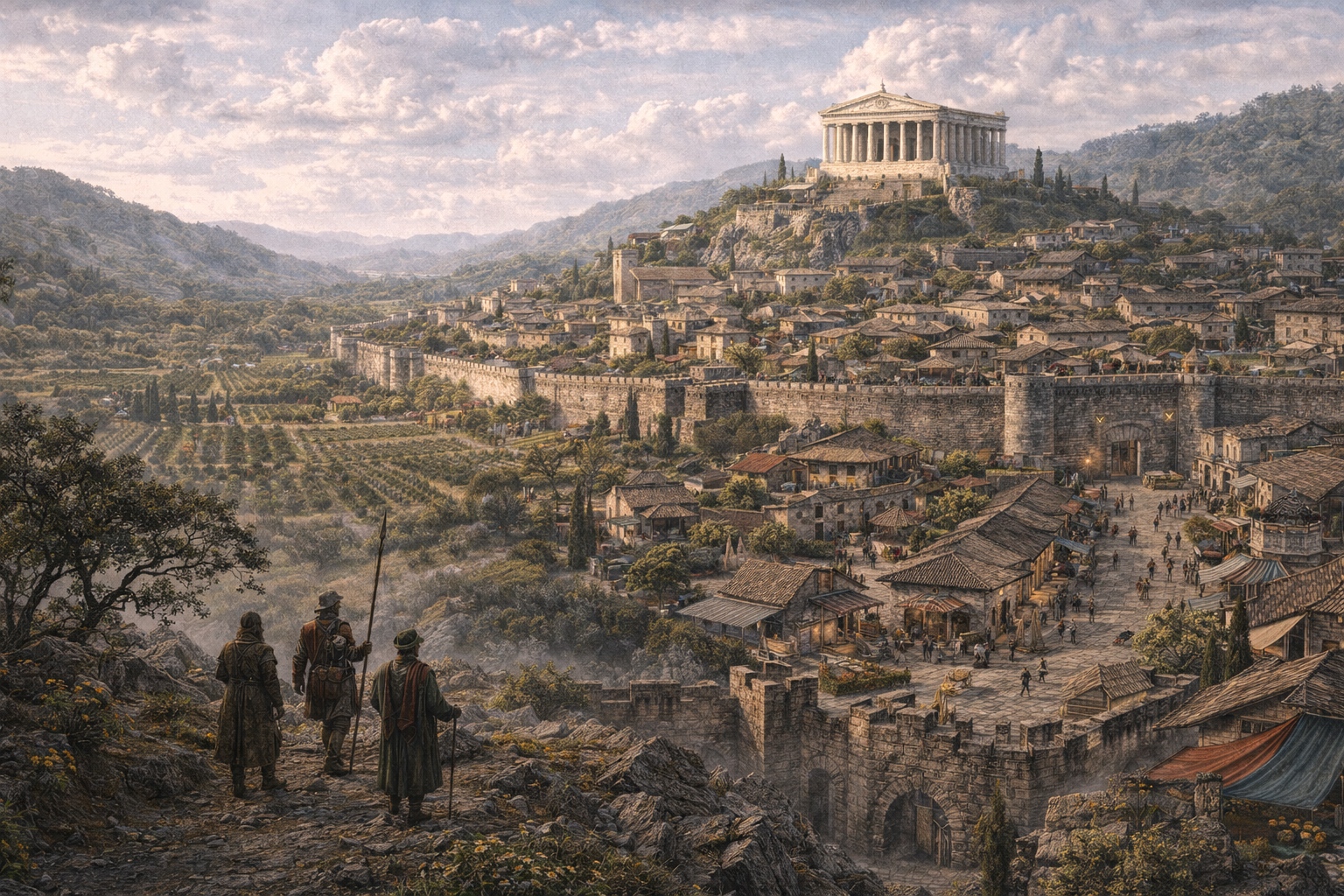
Orinokia is visible from the valley approaches long before you reach it: not the city itself, but the Temple of Amador, white marble on the hillcrest, its columns catching the morning light above everything else. The approach road runs through olive groves and the occasional vineyard, the valley warm and slightly sheltered from the surrounding highland winds. It feels more peaceful than it is.
The city's outer walls are functional rather than decorative: stone, thick, with the marks of repair visible at regular intervals. Inside, the contrast is what stays with you. The streets are paved in pale stone and kept clean. The buildings are stone and dark hardwood, decorated with the carved motifs of Amador's teachings: entwined forms, flowers that bloom year-round in the private gardens visible over courtyard walls. The river Serenade cuts through the lower third of the city, crossed by several bridges, its banks planted with trees maintained by the temple. There is music coming from somewhere, usually more than one somewhere.
The thing that takes longer to notice is the positioning. The city's major buildings are placed defensively: the angle of the streets limits approach sightlines, the district walls create internal choke points, and the ballista mounts on the outer wall are maintained and serviced, not ornamental. Orinokia is beautiful and it knows how to stay that way.
Geography & Setting
Orinokia occupies an elevated basin on Antaea's north-central plateau, where the land gathers into a broad highland bowl before the rivers cut their way down toward the lower country. The River Serenade runs through the basin south to north, providing freshwater, irrigation, and a natural defensive line along the city's eastern quarter. The surrounding terrain is a mix of open highland, wooded hills, and scattered forest margins: beautiful and strategically inconvenient, since anything that can hide in trees has used those trees as cover for generations.
The basin provides a degree of shelter from the worst weather and is productive enough for the viticulture and olive cultivation that form the city's agricultural base. The hills above the basin are used for hunting and for the quarrying of the stone that keeps the walls repaired.
Climate runs to warm and humid in the lower areas, cooler and drier on the hilltops. Rain is reliable throughout most of the year. The growing season is long.
The People
Demographics
Orinokia is predominantly human, as most of northern Antaea is, with a well-established dwarf community that has been present for at least four generations, drawn originally by the engineering and construction work on the defenses, and now thoroughly integrated. Elves are present in smaller numbers, concentrated in the arts and religious communities. The occasional rare race passes through or settles; the city is tolerant by Antaean standards, partly because a city that has had to defend itself since its founding understands the value of useful people regardless of origin.
Outsiders are received with cautious hospitality. The city's defensive situation means that strangers are noted and assessed, not aggressively, but the city has a practiced awareness of who is within its walls.
Economy
Orinokia's primary export is expertise. The city's engineers and craftspeople have developed methods of defensive construction (walls, fortifications, siege engines) that are unmatched in Antaea and sought after by settlements that can afford to commission them. Teams from Orinokia have worked on the defenses of cities across the northern part of the continent, and the income from these contracts represents the city's most significant revenue stream.
The Orinokian Ballista, developed here over several generations of refinement, is the most visible product of this expertise. It can be purchased, at considerable expense, or rented along with a crew that knows how to operate it. Several of Antaea's northern settlements owe their survival in part to Orinokian hardware.
The agricultural industries support the population and generate modest export income. The city's wine has a regional reputation; it's not exceptional but it's consistent, and consistency has value in a region where supply can be disrupted.
Primary Exports
- Defensive engineering services: Teams, plans, and consultation for fortification projects across Antaea
- The Orinokian Ballista: Built-to-commission; a significant weapon platform
- Wine: Consistent quality, regional distribution
- Olive oil: Staple export to the northern coastal towns
Primary Imports
- Metals: For the engineering workshops; the local stone quarries cover construction needs but not metalwork
- Textiles and finished goods: The city produces art but not cloth in significant quantity
- Exotic ingredients: The culinary tradition imports spices and specialty items from Antaea's trade networks
Key Industries
- Amorvale Engineering: The formal arm of the city's defensive technology business; managed by House Amorvale, staffed by the engineering guild
- The Wall Guilds: The collective of construction and masonry craftspeople who maintain the city and take exterior contracts
- The Vineyard Cooperatives: Several family operations on the valley slopes; not Amorvale-owned
- The Hunt: Organized hunting of the highland game; both for local consumption and for the substantial market in highland creature parts (hides, bones, specific glands with medicinal application)
Food & Drink
Orinokia eats heartily and practically, but not without sophistication. The olive oil that goes into export also goes into everything cooked in the city; it is the cooking medium, the condiment, the base. Legumes, beans and lentils especially, are the protein staple alongside game meat. The wine is drunk with dinner by everyone who can afford it, which is most of the population. Local flatbread is made in the central market ovens and sold from the first morning hour.
The city's distinctive dish is a slow stew of game meat and legumes cooked with herbs from the hill slopes; every household has a version, and evaluating the versions is a form of social bonding. The temple kitchens prepare a public meal twice a week that is open to all citizens, a practice that began as charity and has become a community ritual.
Culture & Social Life
Orinokia's culture is built on a tension that the city has learned to live with: the requirement to maintain serious defensive capability and the genuine devotion to Amador's teachings of love, beauty, and artistic expression. These are not opposites here; they are understood as mutually reinforcing. The walls exist so that the gardens can exist. The ballista crews train every week so that the bards can perform every evening.
Public life centers on the temple and on the river walks, which are the social space of the city. Evenings, when the work day ends, people gather along the Serenade's banks for conversation, performance, and the community meals that the temple provides. It is a city that makes time for this, which visitors from more commercial cultures sometimes find disorienting.
The Southern Fort is the exception to the city's general social coherence. Built in the upper residential district by the wealthier families as a private refuge in the event of a serious breach, it is an open acknowledgment that if the walls fall, not everyone will have equal access to safety. This is known by everyone, resented by many, and not resolved.
Festivals & Traditions
The Serenade Festival
Each spring, when the river rises with snowmelt from the higher ground, the city celebrates its patron deity with three days of performance, public declaration, and the ceremonial renewal of partnerships, both romantic and civic. Vows are made at the river's edge. Lord Eamon and Lady Elira make the same vow to each other and to the city every year in public, which is either moving or theatrical depending on who you ask, but either way the attendance is full.
The Wall Count
At the start of each fall, before the hostility from the surrounding forest typically increases, the entire garrison conducts a formal inspection of every section of the city's defenses: every stone of every wall, every mount, every mechanism. This takes three days and involves most of the population in some capacity. Children are assigned sections of wall to inspect alongside adults. The result is a city that knows the condition of its defenses down to the individual stone, and a population that has a physical relationship with the things that protect them.
Music & Arts
Orinokia is the most artistically active city in northern Antaea by some margin. The temple of Amador is also a conservatory; it maintains a school for music, poetry, and performance, and the graduates of this school are found throughout northern Antaea's cultural life. The evening performances along the river are a genuine tradition, not a tourist attraction: the city's residents attend them, critique them seriously, and have strong opinions about quality.
The visual arts run to narrative stone carving; the city's defensive structures are decorated with carved scenes from Orinokia's history, which means the walls are also a public history of the city. The elven artisans maintain a separate tradition of detailed illuminated manuscript work that has found buyers in Lahale and Gwajin.
Religion
Primary Faith
Amador, god of love and passions, is the patron of Orinokia and the center of the city's cultural identity. His temple is the largest building in the city and the visual anchor of its skyline: white marble, prominent hilltop position, maintained with the same seriousness that the walls are maintained. The temple is an active space: worship, marriage ceremonies, the conservatory school, the public meals, counseling for those in conflict or distress. Lady Elira Amorvale is the High Priestess, and the temple under her management is as much a social institution as a religious one.
The theological emphasis here is on love not as sentiment but as the foundation of community: love of place, love of people, the connection between individuals that makes collective defense possible. This framing has allowed Orinokia to maintain its devotion to a god of love while also maintaining one of the most formidable defensive military capacities in northern Antaea, which would otherwise seem incongruous.
Secondary / Minority Faiths
Amaterasu, goddess of sun and life, has an open-air temple on the eastern bank of the Serenade, sunny by design, used for healing and for quiet reflection. The clergy cooperate with the Amador priesthood.
Thulgard, patron of protection and fortified settlements, is followed primarily by the engineering guild and the wall crews, who see his domain as aligned with their work. His temple is in the engineering district and doubles as the guild's formal meeting space.
Bridhel, goddess of music, dance, and poetry, shares space with the Amador conservatory: technically a separate shrine, practically the same institution.
Secret or Forbidden Worship
Amnyth, god of death, has a small following among those who have lost people to the ongoing perimeter conflicts. Their rituals are private and not formally sanctioned. The priesthood of Amador is aware and has chosen not to act, on the reasoning that grief needs somewhere to go.
Mamaxa, known as the Mistress, has followers among a segment of the population that the temple of Amador officially ignores. Her following is known to exist; it is considered a private matter as long as it remains private.
History
Founding
Orinokia was established by a group of settlers who had survived the early violent period of Antaea's colonization by finding a defensible valley position and holding it. The founding generation were not particularly interested in love and art; they were interested in not dying. The devotion to Amador developed in the second generation, when the immediate survival crisis had passed and the question of what to build became relevant. The Amorvale family's rise to leadership and their adoption of Amador as the city's patron deity happened simultaneously, and whether the religion shaped the family or the family shaped the religion is a question the city's historians debate without resolution.
Key Events
The Legend of the Cursed Founders
A persistent piece of folklore holds that Orinokia's perpetual siege situation is the result of a curse, born from a transgression by the founding family in the city's earliest years. The specific transgression varies by telling. What is consistent is the implication that the city's suffering is deserved. This is not officially endorsed by House Amorvale or the temple, but it persists, and in a city that has been defending itself from hostile forces for as long as anyone can remember, it provides a narrative that, however unjust, explains why.
Development of the Orinokian Ballista (approx. 200 years ago)
The siege engine that bears the city's name was developed over three generations of the engineering guild's work. The specific innovation, a counterweight mechanism that allows significantly greater range than the standard torsion ballista, was the work of a dwarf engineer named Orik Stonegate who spent twenty years refining it. The ballista's first significant use in city defense repelled an attack that most people had expected to be fatal to Orinokia. The event is celebrated annually by the engineering guild, which has maintained a portrait of Stonegate in their hall ever since.
The Southern Fort (approx. 30 years ago)
The construction of the private refuge in the upper residential district was commissioned by a consortium of the city's wealthier families and built without public announcement during a period when the city's attention was on an extended perimeter conflict. When it was discovered, the response was significant enough that Lord Eamon's father spent the final years of his life managing the political fallout. The fort exists, it is functional, and it is the most reliable source of social resentment in the city. Eamon has proposed opening it as a public refuge in the event of breach. The families who funded it have not agreed.
Current State
Orinokia is stable and in mild expansion. The engineering guild has more contract work than it has capacity for. The temple's conservatory school is drawing students from farther than it used to. The perimeter conflict is in a relatively quiet phase, though the garrison does not use the word "peace." The Southern Fort remains unresolved. Lord Eamon is a careful, long-game administrator, and his long game involves resolving the fort question before he passes governance to the next generation, which he is not yet certain how to do.
Leadership & Governance
House of Amorvale: Overview
House Amorvale has governed Orinokia since the city's early period. Their authority is both political (they hold the formal title and manage the engineering business) and religious, since Lady Elira's position as High Priestess makes the family the center of both institutional pillars. This concentration of authority is not without its tensions; some of the city's residents find the overlap between governance and religion too complete. In practice, the House governs with genuine investment in the city's welfare, and the city is loyal enough that abstract concerns about checks on power remain abstract.
Lord Eamon Amorvale
Human, Male; late fifties
Eamon is a diplomat's build: average height, attentive face, the kind of man who appears to be fully present in any conversation. He has been governing for twenty-five years and it shows in a good way: he is patient, does not react to provocation, and has a long memory for both favors and debts. He understands the city's engineering business well enough to supervise it and the religious dimension well enough to leave it to Elira.
His defining challenge has been the Southern Fort: not because he didn't know it existed, but because resolving it requires taking something from people with enough power to resist. He is not afraid of the conflict; he is calculating when and how to have it. The calculation has been running for fifteen years.
Lady Elira Amorvale: High Priestess of Amador
Human, Female; early fifties
Elira is the more publicly visible of the two. She appears at the temple ceremonies, the public meals, the Serenade Festival: the face of the city's devotion. She is an effective speaker, warm in public settings and precise in private ones. Her management of the temple is genuinely skilled: the institution is well-funded, well-staffed, and serves functions that the city would notice immediately if they stopped.
Her theological position (that love is what makes defense possible, that community is the real armor) is not performative. She believes it, and it guides her decision-making in ways that occasionally put her at odds with her husband when the calculus favors the human cost of defensive decisions over the emotional cost of policy ones.
The Garrison
Orinokia's garrison numbers approximately two hundred, a significant force relative to the city's population. They are commanded by a human woman, Commander Desta Osei, who came from the southern part of Antaea and has been with the garrison for eighteen years. The garrison is professional, well-trained, and operates the ballista emplacements in regular rotation. The engineering guild and the garrison are closely linked; the same people who maintain the weapons maintain the city.
Law & Order
Orinokia's justice system is conventional by Antaean standards, with one notable feature: crimes of violence against civilians within the city walls carry enhanced penalties calibrated to the city's self-understanding as a place of sanctuary. The logic is that if you are inside the walls, you are theoretically safe, and violence that violates that safety is treated more seriously than it would be elsewhere.
Notable Figures
Commander Desta Osei: Garrison Commander
Human, Female; mid-forties; the garrison headquarters at the eastern wall
Desta is direct, decisive, and has more practical authority in the city's daily security than the formal structure suggests. She and Lord Eamon respect each other; she and Lady Elira are friends, which was not expected by either of them. She has strong opinions about the Southern Fort; she considers it both morally wrong and tactically stupid, since a population that knows its elite have a separate exit is a population that will not hold the walls in a true emergency.
Thrain Ironfoot: Master Smith and Ballista Builder
Dwarf, Male; age uncertain, as with most dwarves who won't say; the engineering guild workshops
Thrain's family has been in Orinokia for four generations. He is the current head of the ballista construction program and the most technically knowledgeable person in the city regarding how the weapon actually works. He is compact, intense, and speaks very little outside his domain. Inside his domain, he will explain anything at length. He follows Caminus and regards the forge as a form of prayer.
Eolande Swiftleaf: Conservatory Director
Elf, Female; age unknown, has been in Orinokia for approximately eighty years
Eolande runs the conservatory school that the Amador temple hosts and is the city's most prominent performing artist. Her bardic work is the standard against which the city's other performers are measured, and she is a genuinely kind teacher, which is less common than her skill level would require. She has a relationship with the city that goes beyond residency; she has seen three generations of the Amorvale family govern and has opinions about all of them.
Grizzle Snagtooth: Trader and Information Broker
Goblin, Male; fifties; the market quarter, various
Grizzle is the most unusual figure in Orinokia's public life: a goblin in a city where goblins are categorically not trusted, who has nonetheless built a commercial presence and a reputation for reliability that has outlasted most people's initial assumptions. He trades in unusual goods and in information, often simultaneously. He follows Talbar and treats commerce as genuinely sacred. He has been useful to House Amorvale on multiple occasions and is treated accordingly, which does not resolve the tension of being what he is where he is, but makes it manageable.
Key Locations
Seat of Power
- Amorvale Hall: The family's seat of governance in the lower city, separate from the temple. Stone, well-maintained, with carved reliefs of the city's history on the exterior. The formal governance functions happen here; the symbolic authority lives in the temple.
Houses of Worship
- The Temple of Amador: White marble, hilltop, the dominant visual element of the city. Houses the conservatory school, the public meal program, the marriage ceremony hall, and the High Priestess's residence. Open to the public from dawn to after dark.
- Shrine of Amaterasu: East bank of the Serenade, open-air, used for healing. The clergy are healers first, priests second.
- Temple of Thulgard: In the engineering district, stone, functions also as the guild hall. The clergy are technical in their orientation.
Inns & Taverns
- The River Hall: On the Serenade's western bank, the best inn in the city. The dining room faces the river. The kitchen does the slow stew better than most private households, which is the local standard for restaurant quality.
- The Garrison Rest: Near the eastern wall, frequented by soldiers and the working class. Honest food, the wine is rough, the company is usually interesting.
Shops & Services
- Amorvale Engineering Office: Where defensive construction contracts are placed and engineering consultations arranged. There is a display of scale models of the city's defensive systems in the waiting room, which is both demonstration and sales tool.
- Stonegate Arms: Named for the dwarf who invented the ballista; sells weapons, repairs armor, and can be commissioned for custom metalwork. Run by Thrain Ironfoot's extended family.
- Snagtooth Trading: Grizzle's establishment, which has no fixed inventory and never looks the same twice. He will tell you he can find anything. He is more right about this than he should be.
The Market
- The Valley Market: Open daily in the lower city plaza. Standard goods plus a specialized section for hunting products: game meat, highland herbs, the medicinal preparations made from highland creature materials. The medicinal section is the most unusual market in northern Antaea.
Other Points of Interest
- The Southern Fort: In the upper residential district. Stone, well-constructed, clearly of a different quality than the surrounding neighborhood. The entrance is not marked. The city's residents know exactly where it is. Visitors are sometimes confused by the social tension that surrounds a building that no one appears to be discussing.
- Orik's Platform: A viewing platform on the outer wall from which the original Orinokian Ballista's range was first demonstrated. The actual ballista is in the engineering guild's collection. The platform is used by garrison trainees for orientation and by everyone else for the view.
Secrets, Rumors & Hooks
- The Southern Fort's interior contains something beyond a defensive refuge. The families that funded it have never given a full accounting of what was built there or why two levels are locked even to the families' own members. Commander Desta has asked. She has not been answered.
- Eolande Swiftleaf's eighty years in Orinokia are longer than most people have thought to count. She was present for the founding of the Southern Fort and for three different versions of the "cursed founders" story. She believes she knows which version is true. She has not volunteered this.
- The Cursed Founders legend has a specific version that circulates only among the city's oldest dwarf families. It differs from the human versions in one material way: it names the nature of the transgression. Thrain Ironfoot knows this version. He considers it an internal community matter.
- Grizzle Snagtooth received a request last month from a buyer in the Heavens who wants something specific from Orinokia's collection of battlefield artifacts. The request described the item with enough precision that Grizzle is fairly sure the buyer has already been inside the city. He has accepted the commission. He has not decided whether to report it.