Punta Seca
Punta Seca: The Equestrian Crown of Antaea
"The horses here do not belong to us. We belong to them. We simply haven't admitted it yet."
Thalia of the Golden Bridle, master trainer
At a Glance
| Continent | Antaea |
| Region / Province | Northeast tip of mainland |
| Settlement Type | Town |
| Population | ~3,500 |
| Dominant Races | Humans, Smalings, Dwarves, Elves |
| Ruler / Leader | Lord Marek Equestor, of House Equestor |
| Ruling Body | House Equestor (hereditary equestrian dynasty) |
| Primary Deity | Caminus |
| Economy | Horse breeding & training, fishing, coastal agriculture |
| Alliance | Independent |
| Known For | The finest horse stock in Antaea; the Night of the Wild Stallion; equine statues that balance on hind legs alone |
Geographic Note: Earlier settlement records placed Punta Seca on the Perian Sea. The canonical record shows the town's coast opens onto Amnyth's Sea (northeast); references to the Perian Sea in older documents do not correspond to the town's actual position.
First Impressions
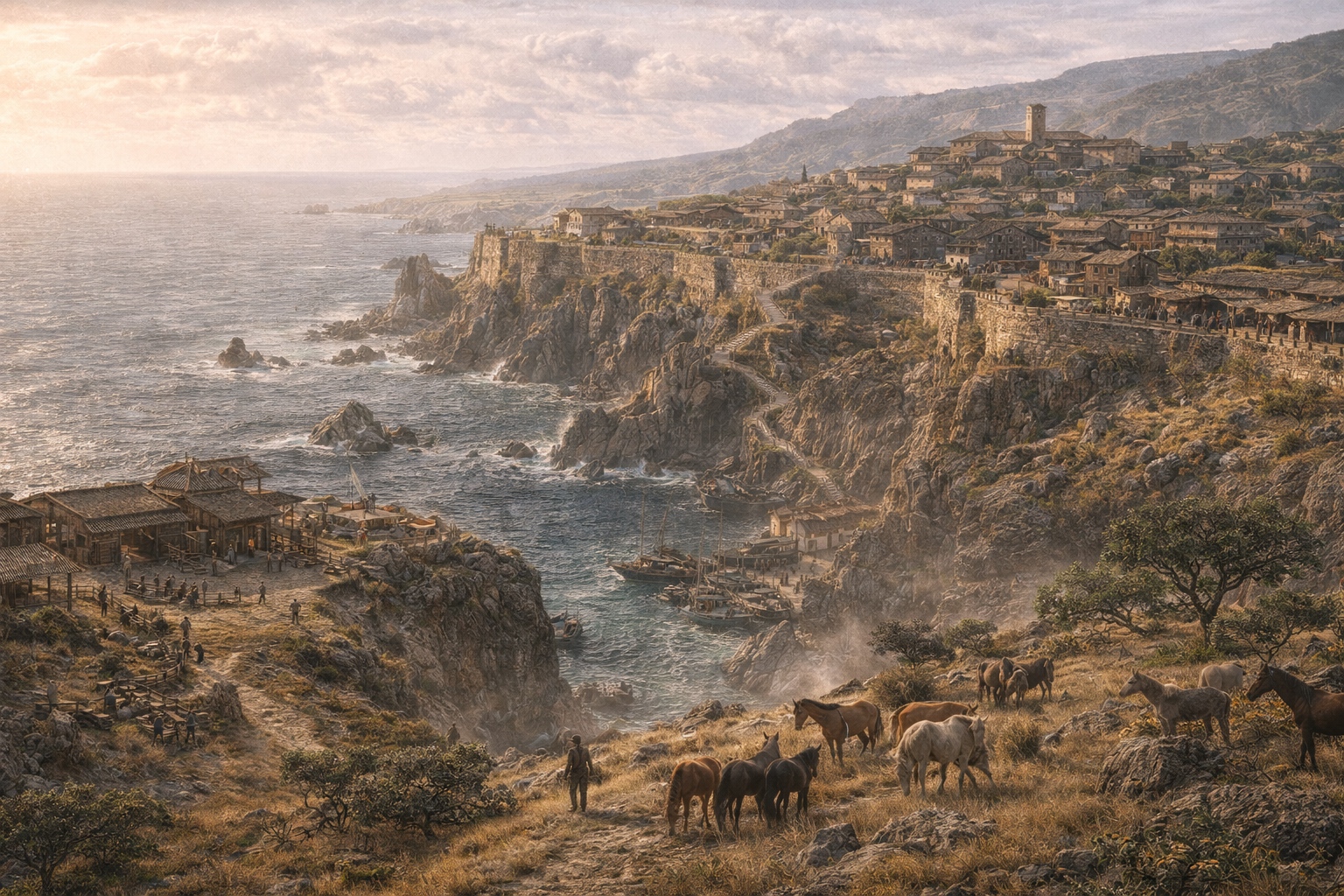
The road into Punta Seca runs along the coastal bluffs, and visitors smell the town before they see it: salt air and horse and the particular sweetness of drying grass from the plains that stretch south and west. The cliffs drop sharply to coves where fishing boats rock at anchor; behind them, the town rises in levels of pale stone and packed-earth yards, open stables threading between buildings like veins. The main street is wide enough for a horse and cart to pass comfortably in both directions at speed, because it has been designed for exactly that purpose.
The equine statues mark the entrance. Two of them, each a rearing stallion balanced impossibly on hind legs alone, carved from local sandstone with a precision that seems to defy the material. Visitors from larger cities sometimes stop to look for hidden supports. There are none. The craft is Punta Seca's most famous export that cannot be bought.
The town's pace follows the horses more than the calendar. Early mornings are for training; midday for the market and harbor; evenings for the stables and the long communal meals that end when the fires burn low. The people are direct, warm in the particular way of communities that work with animals: patient, practical, and unhurried without being slow.
Geography & Setting
Punta Seca occupies the northeast tip of mainland Antaea, its cliffs overlooking Amnyth's Sea where the maritime corridor that feeds into Canal Agrietado begins. The bluffs provide natural elevation; the town sits above the waterline, with a switchback track descending to the harbor coves below. The harbor is modest compared to major ports; it accommodates fishing vessels and small to mid-sized traders rather than the deep-hulled ships of oceanic commerce.
Behind the town, the dry coastal plateau extends south, transitioning into the open plains of northeastern Antaea. This terrain (dry, wind-swept, firm underfoot) is precisely what produces Punta Seca's exceptional horses. Animals raised here develop dense bone structure, efficient cardiovascular systems, and temperament shaped by variable sea winds and open country. Breeders from across the continent recognize the physical type immediately.
The climate is warmer and drier than most of Antaea's northeast coast, moderated by sea winds rather than driven by them. Rainfall is seasonal and reliable enough for the grain and vegetable cultivation that supplements the horse economy. The scrub that covers the plateau is low and tough; in spring it flowers in brief gold and white before the heat sets in.
The People
Demographics
Punta Seca is predominantly Human, with a substantial Smaling population concentrated in the racing, joinery, and fishing trades. Dwarves occupy the blacksmith and farrier guilds almost exclusively. Elves are fewer but disproportionately represented in horse training; the patience and precision the work demands suits them, and several of the town's founding training families are of elven lineage. Gnomes have a foothold in the fishing and navigation communities.
The town receives traders and horse buyers from throughout Antaea and beyond. Wealthy visitors arrive for breeding contracts and to commission the equine statues; scholars of animal husbandry come to study the breeding programs. The welcome is genuine but calibrated: Punta Seca has learned to spot horse thieves and agents of rival breeding operations with a practiced eye.
Economy
The horse industry is the economic spine of Punta Seca. Breeding programs, training services, and the sale of certified bloodstock generate the majority of the town's wealth. A horse from Punta Seca commands premium prices across the continent for military use, agricultural work, sport, and elite companionship; the Equestor brand mark on a horse's documentation is accepted as a quality guarantee in most major markets.
Fishing provides the town's food security and a steady secondary export; the coves produce snapper, grouper, and shellfish in volume. Coastal agriculture on the plateau yields grain, hardy fruits, and vegetables adapted to the drier conditions. The equine statues are not exported in volume but occasionally commissioned for wealthy buyers at significant individual price.
Primary Exports
- Horses, military, agricultural, and racing stock: The defining export; Punta Seca bloodlines are recognized across Antaea and sought by armies, farms, and racetracks alike
- Fish and seafood: Consistent, high-volume maritime export from the harbor coves
- Grain and hardy fruits: Plateau agriculture produces drought-adapted crops with reliable yields
- Commissioned equine statuary: Rare, expensive, and sought-after by collectors and institutions
Primary Imports
- Fine textiles and luxury goods: The town's equestrian elite demands quality it cannot produce locally
- Metals and specialized tools: Ore is absent from the plateau; iron, steel, and worked metal come by sea
- Spices and preserved goods: Maritime trade brings variety to a diet otherwise dominated by local production
Key Industries
- Horse breeding and training: The defining industry; the plateau terrain, wind conditions, and generations of accumulated expertise combine to produce stock found nowhere else
- Fishing and maritime trade: Secondary but significant; the harbor coves are among the most productive on the northeast coast
- Blacksmithing and farriery: The horse industry demands constant metalwork; the Dwarf smithing families of Punta Seca are specialists of regional reputation
Food & Drink
The food in Punta Seca is robust and seaside: fish stews with local herbs, bread from plateau grain, grilled shellfish from the coves, and the communal roast that marks festival days. Game from the plains appears seasonally. The town's signature celebratory dish is slow-roasted kid goat, prepared over open fires during festivals. Wine is imported; the local drink is a light grain spirit that the taverns serve warm in winter.
Culture & Social Life
Punta Seca's culture is built around the horse and the disciplines it requires: patience, consistency, and the understanding that authority must be earned rather than imposed. The people carry these values into governance, commerce, and social interaction. Disputes are frequently resolved through competitive demonstration rather than arbitration (a racing challenge, a training contest, a test of skill) because the community trusts observable outcome over verbal argument.
The relationship between the horse-working families and the fishing community is collegial; both trades are understood as foundational, and neither considers itself the lesser. The Dwarf blacksmithing families occupy a position of essential respect; no horses work without their shoes, and no training proceeds without their equipment.
Festivals & Traditions
The Night of the Wild Stallion
Held annually, on the night of the midsummer full moon. The founding custom of Punta Seca's equestrian culture. The legend holds that the town's bloodlines trace to a mythical uncatchable stallion who sired the first exceptional foals when the original settlers left their mares on the plains as an offering. On this night, the finest mares are led to the plateau's edge and left unguarded until dawn, in formal re-enactment of that offering. The night features communal fire, storytelling, and the year's best cane spirit. By morning, the mares are returned. Whether the ritual produces exceptional offspring is debated; the community prefers the mystery to resolution.
The Festival of the Forge
Held in early spring. In honor of Caminus, the festival opens the new training season with a public demonstration of the previous year's finest metalwork: horseshoes, tack fittings, and tools displayed for community evaluation. The best work earns the Caminus Mark, a stamp carried on the smith's work for the following year. Competitive in tone but communal in feeling; the evening ends with collective feasting in the forge district.
Music & Arts
Music in Punta Seca is rhythmic and physical: drums and low string instruments that echo the gait of horses, sea shanties from the fishing community, and the ceremonial compositions reserved for festival days. The town's signature art form is the equine statue: sandstone figures of horses, typically rearing, balanced on hind legs alone through a structural technique the carving families guard closely. The work takes years of apprenticeship to master and cannot be rushed. Buyers who commission pieces wait eighteen months to three years for completion.
Religion
Primary Faith
Caminus, deity of craftsmen and artisans, is the primary faith of Punta Seca. The temple doubles as a working studio; offerings take the form of completed work, and worship is indistinguishable from the act of skilled creation. The clergy are practicing craftspeople, and the temple's walls display the finest pieces made in the deity's honor over generations. The forge families and the carving families are the most devout; the training community maintains a secondary devotion that is nonetheless genuine.
Secondary / Minority Faiths
Amador, deity of love and passion, is revered fervently; the town's strong familial culture and the emotional relationship between trainer and horse both fall under his domain. Bridhel, goddess of music, dance, and poetry, holds the artistic community. Talbar, deity of knowledge and commerce, is respected in the trading community; his balance scales appear over the market stalls and on contract documents. Cael, goddess of weather, is observed by farmers and fishers alike; her signs in the sky are read seriously, and her festivals mark the seasonal turning points.
Secret or Forbidden Worship
Amnyth, deity of death and dying, is worshipped in private by a small sect who have linked equestrian excellence to themes of mortality: the horse as companion through life's threshold. The association with poison and necromancy keeps this worship genuinely hidden. Mamaxa, known as The Mistress, is secretly observed by a smaller group still, whose rituals involve pain and endurance framed as devotional discipline. Both cults maintain strict secrecy and have not intersected, to each other's knowledge.
History
Founding
Punta Seca was established by Human seafarers who recognized the northeast bluffs' strategic position and the plateau's unusual suitability for animal husbandry. The first settlements were mixed fishing and pastoral communities. The discovery that the plateau terrain and sea winds produced horses of exceptional quality was gradual, a generation of accumulated observation before the breeding programs formalized. House Equestor emerged as the leading family in that formative period and has maintained governance since.
Key Events
The First Bloodline
Three generations after founding, a trainer of the Thalia lineage, the ancestor of the current Thalia of the Golden Bridle, documented the plateau's specific effects on equine development and codified the first formal breeding protocols. This systematization transformed Punta Seca from a town that happened to produce good horses into the continent's recognized center of equestrian excellence. The Thalia lineage has trained horses here without interruption since.
The Night of the Wild Stallion: Origin
The custom originates from a genuine historical crisis: a generation of failed foal seasons that threatened the breeding program. A group of trainers, despairing of solutions, left their finest mares on the plateau overnight in something between prayer and desperation. The foals born from those mares the following year were exceptional by every measure. Whether this was coincidence, recovery from an unrelated disease cycle, or something else is not recorded. The custom preserved the story without resolving it.
The Canal Agrietado Trade Era
When Canal Agrietado became a contested naval corridor, Punta Seca briefly considered seeking alliance with the Zulie River Confederation for protection. Lord Marek's father declined on grounds that alignment would subordinate the horse trade to Confederation commercial interests. The decision preserved economic independence and created the tensions with maritime powers that Punta Seca still manages carefully.
Current State
Punta Seca is stable and prosperous, though aware that its independence is a negotiated condition rather than a guaranteed one. The horse trade generates enough wealth to maintain meaningful neutrality. Lord Marek Equestor governs with confidence and tends to manage external relationships personally. The one unresolved pressure is succession; Marek has no direct heir, and House Equestor's lateral lines are complicated. This is known and quietly watched.
Leadership & Governance
House Equestor: Overview
House Equestor is a lineage of Human nobles whose authority derives entirely from equestrian expertise and a multi-generation record of economic stewardship. They govern as trainers govern horses: with clear expectation, consistent application, and genuine investment in the outcome. Lord Marek conducts regular public consultations and is frequently seen on the training grounds rather than in the administrative halls.
Lord Marek Equestor
Human, Male: A man in his fifties, still fit, with the long hands of a lifelong rider and the watchful patience of someone accustomed to reading animal and human behavior simultaneously
Marek Equestor has governed Punta Seca for twenty-two years and shows no signs of diminishing capacity, but he is aware that his lack of direct heir is a political liability that grows each year. He is charismatic, diplomatically capable, and genuinely beloved in the horse community. He has navigated Punta Seca's independence through maritime political pressures with considerable skill.
His current concern is not external; it is internal. One of House Equestor's lateral claimants has begun cultivating relationships with a Zulie River Confederation trade delegation. Marek has noticed. He has not yet acted.
Guard & Militia
Punta Seca's guard is a mounted force: small by city standards, but highly mobile and skilled. Their primary responsibilities are plateau patrol, harbor security, and the enforcement of horse trade law. A separate watch handles town security. Horse theft is the capital crime in Punta Seca's legal framework, and enforcement is without exception.
Law & Order
Punta Seca follows Antaean common law, supplemented by House Equestor's trade regulations governing horse sales, bloodline documentation, and training certification. Justice is administered by a rotating panel of senior guild members and town elders. The system is practical and relatively swift; it has strong community confidence.
Notable Figures
Thalia of the Golden Bridle: Master Trainer
Elf, Female: The training grounds, most mornings
The heir of the founding Thalia lineage, she is the finest horse trainer in Antaea by the consensus of anyone in the trade. Her methods are studied, imitated, and never quite replicated. She is quiet in public and formidably direct in the stable. She has trained three of Lord Marek's personal horses and is one of the few people whose opinion he solicits before making significant decisions. She finds politics exhausting and the horses not so.
Durnan Ironfoot: Master Blacksmith and Farrier
Dwarf, Male: The forge district, forge quarter of town
Punta Seca's senior blacksmith and the head of the Ironfoot farriery family. His horseshoes are the standard against which others in the region are measured; his custom training equipment is commissioned by serious facilities across Antaea. He is gruff, loyal, and has maintained the same pricing structure for thirty years because he has decided it is correct.
Hal Windrider: Racing Jockey and Horse Reader
Smaling, Male: The track, the taverns, wherever the odds are interesting
Hal Windrider's racing record is exceptional by any measure. His real gift, however (poorly understood and quietly famous), is the ability to read a horse's temperament and predict race outcomes with accuracy that borders on the uncanny. Several wealthy buyers consult him before purchasing Punta Seca bloodstock. He does not explain his method. He is cheerful, irreverent, and owes Durnan Ironfoot a sum of money that neither of them discusses.
Gwendolyn Shorecaster: Harbor Master and Fisher
Gnome, Female: The harbor, the docks, the market stalls
Gwendolyn manages Punta Seca's harbor and fishing operations with a precision that the horse families respect and the fishing community requires. Her knowledge of Amnyth's Sea weather patterns and fish movements is encyclopedic. She is the town's de facto liaison with visiting maritime traders and has more knowledge of Canal Agrietado's current political situation than Lord Marek's official intelligence network.
Key Locations
Seat of Power
- House Equestor Hall: Administrative center and official residence, built from plateau sandstone. The public consultation room has large windows overlooking the training grounds; it is said Lord Marek designed it that way deliberately.
Houses of Worship
- The Temple-Forge of Caminus: Half sacred hall, half working studio. Offerings displayed on the walls span three generations. The forge fires burn continuously; the sound of hammers during worship is considered devotional expression.
- The Chapel of Amador: A quieter, more intimate space in the residential quarter, serving the town's familial and emotional needs.
Inns & Taverns
- The Rearing Mare: The primary establishment for visitors with means. Horse-themed décor, excellent grilled fish, imported wine, and a wall of racing records dating back six generations.
- The Farrier's Rest: Favored by craftspeople and locals. Rougher, louder, and considerably more informative if one wants to know what is actually happening in the town.
Shops & Services
- The Ironfoot Forge: Durnan's operation, the center of the blacksmithing and farrier trade. Not open to casual visitors; commissions by appointment through the guild.
- The Thalia Training Yard: The most prestigious training facility in Punta Seca, maintained by the Thalia lineage for generations.
- Gwendolyn's Harbor Office: Manages berthing, cargo declarations, and trade documentation for all vessels.
The Training Grounds
- The Open Plateau Circuit: The working track where horses are trained and assessed, stretching south along the bluff edge. Visitors may observe from a designated line; encroaching on working sessions is a social offense.
Other Points of Interest
- The Rearing Stallion Gate: The two sandstone equine statues at the town's primary entry, balanced on hind legs. A genuine feat of structural carving; the technique is not fully documented anywhere outside the carving families' oral tradition.
- The Harbor Coves: Three natural coves below the bluffs, accessed by the switchback track, where the fishing fleet moors and small trader vessels dock.
Guilds & Organizations
- The Equestor Breeders' Guild: Oversees bloodline documentation, breeding certification, and the standards that maintain Punta Seca horses' market reputation. Membership is a professional credential recognized across Antaea.
- The Farrier and Smith Brotherhood: The Dwarf-led craft organization governing metalwork standards for horse equipment. Operates its own quality certification parallel to Caminus temple recognition.
- The Harbor Traders' Association: Gwendolyn Shorecaster's organization, handling maritime trade standards and the protection of fishing rights in the local coves.
The Criminal Element
Horse theft is the only crime Punta Seca treats as existential, and it is enforced accordingly. The secondary criminal element (smuggling through the harbor coves from Canal Agrietado, minor fraud in the horse documentation trade) is managed with the same practical non-engagement policy that characterizes most small independent settlements: known, bounded, and monitored rather than eliminated. The Amnyth and Mamaxa cults operate without awareness of each other or the watch's quiet knowledge of their existence.
Secrets, Rumors & Hooks
- The Night of the Wild Stallion is not legend. A creature, not precisely a horse, has been documented in the plateau's far eastern reaches by three independent trackers over the last century. The most recent report, made to Thalia of the Golden Bridle six years ago, was not passed to Lord Marek. Thalia went to the plateau alone afterward and has not spoken of what she found. The exceptional foal rate in the years following each sighting is, she maintains, coincidence.
- Hal Windrider's ability to predict race outcomes is not intuition. He found, twelve years ago, a series of documents in an estate sale that describe a system of reading equine physiological stress markers developed by a Punta Seca trainer four generations past. The system was deliberately suppressed by House Equestor because it made horse racing outcomes too predictable for the betting economy. Hal has pieced together roughly sixty percent of the original method.
- The Amnyth cult and the Mamaxa cult are both aware, separately, that Lord Marek has no heir. Both have approached the same lateral claimant, the one cultivating Confederation ties, through different intermediaries. Neither knows the other has done so. The claimant is playing all three conversations simultaneously.
- Gwendolyn Shorecaster has been passing detailed harbor records (vessel movements, cargo manifests, trader identities) to a contact in Canal Agrietado for four years. She believes the contact represents a neutral maritime intelligence operation. The contact represents the Zulie River Confederation's naval expansion planning office. Gwendolyn has not asked questions she does not want answered.
- The structural technique used to carve the rearing horse statues, balanced solely on hind legs, was originally developed not as an artistic tradition but as a load-bearing engineering solution for a specific structural problem in the original Equestor Hall. The carving families do not know this history. The solution involves a counterweight embedded in the statue's base that is invisible from the outside. The technique works only with Punta Seca sandstone of a specific composition found in one quarry that is nearly exhausted.