Santo Rey
Santo Rey: The Holy Island
"Every treaty signed here holds. Every treaty signed elsewhere eventually finds its way here to be witnessed."
Legate Aldric Goldenseal, Keeper of the Sacred Texts
At a Glance
| Continent | Antaea |
| Region / Province | Sea of the Heavens (island) |
| Settlement Type | City |
| Population | ~5,500 |
| Dominant Races | Humans, Elves, Half-Elves, Smalings |
| Ruler / Leader | High Consecrate Veyara Dawnmantle |
| Ruling Body | The Consecrated Council (religious-civic theocracy) |
| Primary Deity | Amaterasu |
| Economy | Pilgrimage, religious services, fishing, sacred trade goods |
| Alliance | The Heavens Sphere |
| Known For | Sacred neutrality; the Oracle of the Gilded Flame; treaty arbitration for the entire Sea of the Heavens |
First Impressions
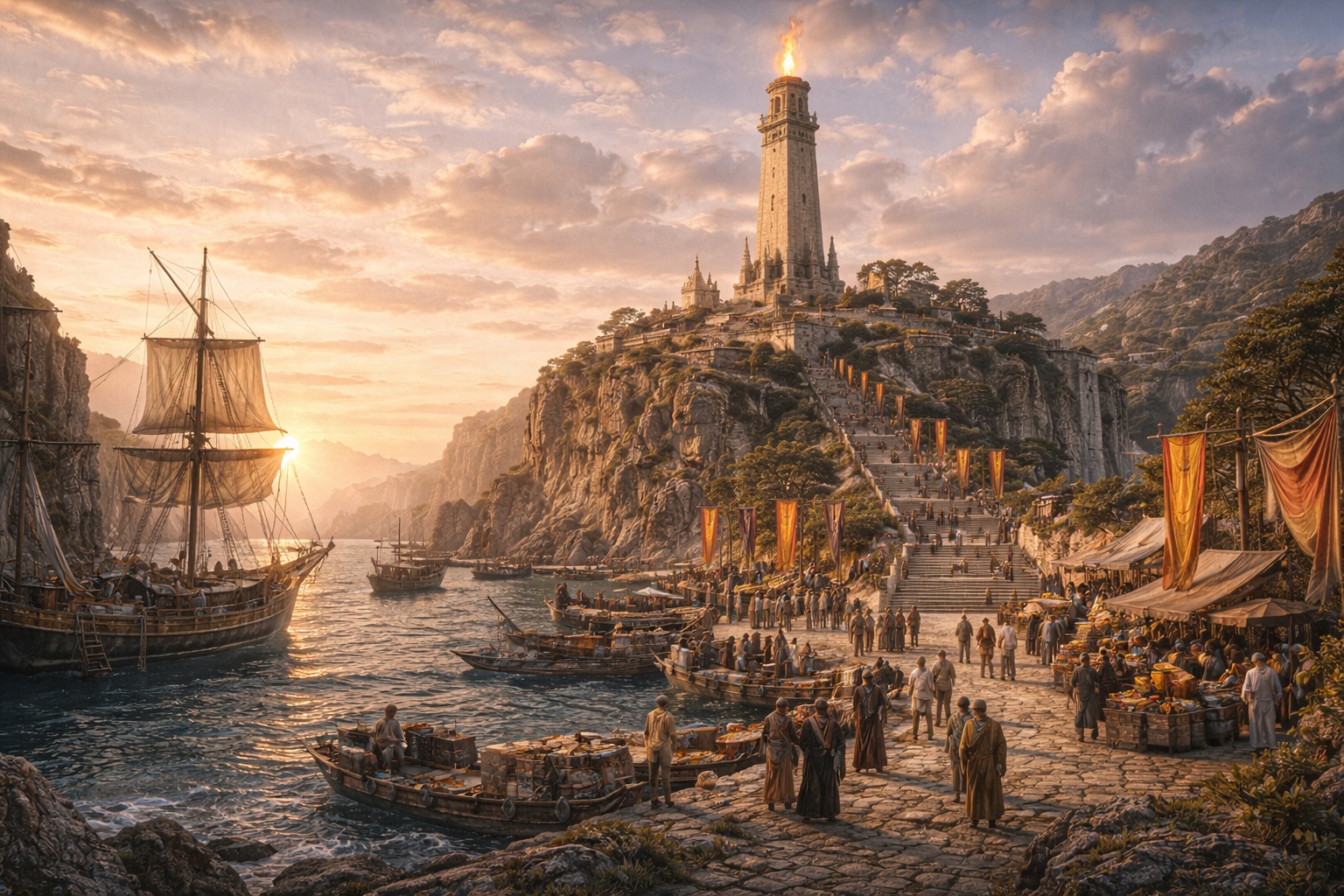
Santo Rey's harbor is visible before the island itself; the Spire of Dawn rises from the clifftop above the bay, its flame-crown lit day and night, a navigation beacon and religious monument in one. Ships approaching from any direction orient on it. The sight of it produces a distinct response in sailors: they lower their voices.
The harbor town at the base of the cliffs is orderly and quiet in the way of places where commerce operates under formal constraint. No weapons are drawn on Santo Rey: not in the streets, not in disputes, not for any reason. This has been the law for four centuries and has been violated twice; both violators are recorded by name in the Temple archives as cautionary text. The streets climb from the harbor in broad switchbacks toward the Temple complex above, lined with guest houses, pilgrim hostels, and the trading posts that serve the constant religious visitors. At the summit, the Temple grounds occupy the entire clifftop, open to any visitor who approaches in peace.
The people of Santo Rey are not particularly devout by personal measure; they live too close to the institution to romanticize it. They are, however, genuinely proud of what the island represents, and fiercely protective of its neutrality. The sacred character of the island is also their economic security and their political insurance; they maintain it accordingly.
Geography & Setting
Santo Rey occupies one of the larger islands in the Sea of the Heavens, positioned at a roughly central point within the Heavens Sphere maritime network. The island is dominated by a single elevated plateau, a flat clifftop above which the Temple complex was built, accessible by road from the harbor below. The island's interior is forest and farmland; the western and southern coasts have the fishing coves and small villages that provide food security.
The island's geographic centrality within the sea routes of the Heavens Sphere made it a natural choice for neutral diplomatic ground. Ships from any of the major island settlements can reach Santo Rey within a day's sail. This has been a deliberate consideration in the island's historical role; the Consecrated Council has maintained policies that preserve navigational neutrality (no tolls, no interdictions, unrestricted access) as part of the sacred compact.
The climate is maritime temperate, with mild summers and wet, windy winters. The forest that covers the island's lower slopes provides timber, game, and the plants used in the Temple's ritual preparations.
The People
Demographics
Santo Rey's permanent population is substantially mixed; Humans are the plurality, with Elves, Half-Elves, and Smalings in significant numbers. The temple service draws from all races, and the island's history as neutral diplomatic ground has produced a cosmopolitan residential population that reflects the entire Heavens Sphere. Gnomes have a notable presence in the archival and scholarly communities attached to the Temple.
The visitor population (pilgrims, diplomats, petitioners, and traders who come specifically because of Santo Rey's neutrality) swells the effective population significantly during the sailing season. The infrastructure of the harbor town has been built around this reality.
Economy
The primary economic driver is the island's religious and diplomatic function. Pilgrims bring offerings, purchase sacred goods, pay for accommodations, and commission the religious services the Temple provides. The diplomatic function generates revenue through arbitration fees, treaty witnessing services, and the hosting of formal negotiations.
Fishing and limited agriculture provide food security. The island exports small quantities of high-value sacred trade goods: blessed oils, ceremonial items crafted by Temple artisans, and the seeds of certain plants grown in the Temple's sacred garden that are believed to improve crop yields when mixed into planting soil. The latter is expensive enough that it supplements the fishing economy significantly.
Primary Exports
- Sacred goods and ceremonial items: Temple-certified oils, blessed instruments, and ritual materials sought throughout the Sea of the Heavens
- Diplomatic services: Treaty arbitration, oath witnessing, neutral hosting; these are fee-based services with long-established rates
- Fish and preserved seafood: The island's fishing coves produce consistent catch for local use and modest export
Primary Imports
- Grain and staple foods: The island's agriculture cannot feed the full permanent-plus-visitor population alone
- Fine materials for Temple craftsmanship: Gold, worked silver, specific dyes and resins
- Luxury goods for diplomatic hosting: The Council maintains high standards for receiving dignitaries
Key Industries
- Temple services and pilgrimage economy: The defining industry; the entire harbor town economy is upstream from pilgrimage
- Diplomatic and arbitration services: Unique regional function; no other settlement in the Heavens Sphere provides neutral ground with comparable credibility
- Artisan sacred crafts: Temple-affiliated workshops produce items that command premium prices throughout the region
Food & Drink
The food on Santo Rey is better than the island's agricultural base would suggest, because generations of diplomatic hosting have elevated local culinary standards. Fish is exceptional; the island's coves produce varieties found nowhere else in the Sea of the Heavens, and the Temple's cooks have developed preparations across centuries of practice. The pilgrim hostels range from austere to comfortable; the diplomatic guesthouses are excellent. The sacred wine, a white made from island-grown grapes tended by the Temple's agricultural workers, is available only on the island and cannot be purchased in ordinary commerce; it is offered, not sold.
Culture & Social Life
Santo Rey's culture is shaped by proximity to the sacred and the pragmatic necessity of managing enormous flows of visitors. The islanders are formally polite, carefully neutral in their expressed opinions about outside political matters, and quietly judgmental about violations of the island's codes. The prohibition on weapons in the streets is the most visible of these codes; the less visible ones govern speech (no public accusations, no public arguments about theology) and commerce (no price gouging of pilgrims; rates are publicly posted and monitored).
The relationship between the permanent population and the Temple hierarchy is respectful but not reverential; the islanders benefit from the institution, police its abuses informally, and maintain the cultural assumption that the High Consecrate governs only because the island's people permit it.
Festivals & Traditions
The Festival of the Dawn Flame
Held at midsummer solstice. The Spire's flame is extinguished at sunset and relit from a new source at sunrise, a ceremony performed publicly, attended by every resident and visitor who can reach the clifftop. The ritual represents renewal of the covenant between the island, the deity, and the maritime community it serves. No diplomatic work, no commerce, and no navigation is conducted on this day; it is absolute rest.
The Concordat Day
Annual observance marking the signing of the Concordat of Islands, the foundational agreement that established Santo Rey's neutral status. The day features a public reading of the Concordat's text, which is longer than most people expect and surprisingly specific about fish tariffs. The reading is treated as both sacred obligation and communal entertainment.
Music & Arts
Music on Santo Rey serves ritual function; choral compositions developed over centuries for Temple ceremonies are the island's most sophisticated art form. Secular music exists in the harbor district but takes a back seat to the ceremonial tradition. Visual art in the Temple complex is extensive and ancient; the mosaics on the Temple's inner walls document the history of the Sea of the Heavens from the island's particular observational vantage.
Religion
Primary Faith
Amaterasu, deity of the sun and divine sovereignty, is the primary faith of Santo Rey. The Temple of the Gilded Flame is the largest and most elaborate religious structure in the Sea of the Heavens, a complex of terraces, gardens, and inner sanctums that has been expanded over four centuries. The Oracle of the Gilded Flame is the central religious mechanism: a chamber within the inner sanctum where, according to tradition, genuine divine responses to specific questions can be received. Access to the Oracle requires formal petition, significant offering, and approval of the Consecrated Council.
Secondary / Minority Faiths
Bridhel, goddess of music and poetry, is deeply honored through the ceremonial choral tradition. Talbar, deity of knowledge and commerce, is the patron of the archival function and of the arbitration services. Zopha, deity of knowledge, is revered by the scholarly community attached to the Temple library. Most major Antaean deities have at minimum a chapel on Santo Rey, a recognition of the island's role as neutral ground for all faiths.
Secret or Forbidden Worship
Demergat, deity of storm-ridden islands, is secretly observed by certain fishers who believe his worship is more practically effective for their specific circumstances than the official Temple position acknowledges. The Consecrated Council is aware of this and chooses not to address it, as it is confined to the fishing community and generates no political complications.
History
Founding
Santo Rey was settled by a mixed group of refugees from a conflict that no longer has living memory; the historical record identifies only that they arrived, found the island uninhabited, and established a sanctuary community under a covenant of mutual peace. The flame that became the Spire's beacon was lit at the founding and has been maintained continuously since, which the Temple considers one of Amaterasu's ongoing gifts to the island.
Key Events
The Concordat of Islands
Two centuries after founding, following a period of maritime conflict between several Heavens Sphere island settlements, Santo Rey's High Consecrate at the time proposed the island as neutral ground for peace negotiations. The resulting agreement, the Concordat of Islands, established formal neutrality protocols, the arbitration function, and the weapons prohibition that still governs the settlement. It is the document that transformed Santo Rey from a religious settlement into a regional institution.
The Year of the Silent Oracle
Fifty years ago, the Oracle of the Gilded Flame went silent: no responses, no signs, no divine indication of any kind for an entire year. The Consecrated Council managed the episode through careful public communication, maintaining that the silence was itself a message. Diplomatically, the year was managed without obvious crisis. Privately, it produced the most significant theological crisis in the island's history. The Oracle resumed responses the following year without explanation. The Council's documentation of the episode is sealed.
The Theft of the Relics
A century and a half ago, three of the Temple's primary sacred relics, physical objects believed to carry direct divine significance, were stolen by a visiting diplomatic delegation. The theft was discovered after the delegation departed. The Council commissioned replicas and did not publicize the loss; the original relics were never recovered. The replicas have, over time, accumulated a documented history of observable effects that the Council finds theologically challenging to explain.
Current State
Santo Rey is at a delicate institutional moment. The Heavens Sphere's political complications (realignment pressure, the Sombraleaf question from Moramora, tensions between island settlements) are generating more arbitration requests than the Consecrated Council has managed in a generation. High Consecrate Veyara Dawnmantle is an excellent administrator but is navigating a personal challenge: the Oracle's most recent readings, which she has received and not shared with the full Council, appear to predict significant disruption in the Heavens Sphere's structure within a generation.
Leadership & Governance
The Consecrated Council: Overview
Santo Rey is governed by the Consecrated Council, a body of seven senior Temple officials who collectively hold civic authority in addition to their religious function. The High Consecrate serves as first among equals and has final authority in matters of treaty arbitration. The Council's governance style is deliberate and procedural: decisions are documented, precedent is consulted, and the island's history of peaceful operation is understood as a living institutional argument for the current system.
High Consecrate Veyara Dawnmantle
Half-Elf, Female: The Temple complex, Inner Sanctum, Council chamber
Veyara Dawnmantle has served as High Consecrate for eighteen years, the first half-elf to hold the role in three generations. She is a careful, highly intelligent administrator with genuine spiritual conviction and an understanding of the island's political function that is more nuanced than most of her predecessors'. She is also sitting on Oracle readings she has not shared, a decision she revisits nightly and has not resolved.
Her public face is measured and authoritative. Her private concern is that what she has been told would, if released, destabilize exactly the political structures she has spent her career maintaining. She does not know if withholding is the right choice. She knows it is the choice she has made.
Legate Aldric Goldenseal: Keeper of the Sacred Texts
Human, Male: The Temple archives and library
The senior archivist and the institutional memory of Santo Rey. Aldric has served under four High Consecrates, knows where every document in the archive is filed, and has read most of them. He is deeply loyal to the institution rather than to any individual, which makes him both reliable and, in certain circumstances, a source of constraint on the High Consecrate's authority. He is aware the relics are replicas. He believes the Council does not know he knows.
Guard & Militia
The Temple Guard is small, ceremonial in appearance, and serious in function. Their primary responsibility is the enforcement of the weapons prohibition and the physical security of the Temple complex. An armed visitor who arrives in good faith and surrenders weapons at the harbor checkpoint is welcomed; one who does not is returned to their vessel by the harbor watch.
Law & Order
Santo Rey operates under its own legal code, the Concordat Provisions, supplemented by Antaean common law. The prohibition on weapons is absolute; violations are handled with immediate deportation from the island. Other disputes are handled by the Council's lower magistrate function, which applies strict procedural standards. The commercial rate controls are enforced by a dedicated inspector, whose position was created three centuries ago after a particularly egregious episode of pilgrim price gouging.
Notable Figures
Sister Mara Tideborn: Head of the Healing Order
Elf, Female: The Temple's medical wing and the harbor district
The Temple's senior healer and the administrator of the island's medical services, which are provided to all visitors regardless of ability to pay. Mara Tideborn is beloved; she has a gift for making people feel cared for that transcends technique. She is Aldric Goldenseal's closest confidante and is aware of considerably more institutional complexity than her public role suggests. She has not been told about the Oracle readings.
Merchant Tobin Lightfoot: Senior Trader's Council Member
Smaling, Male: The harbor market district
The most successful trader on the island and the informal voice of the commercial community in Council discussions. Tobin is sharp, practical, and has no patience for what he considers institutional self-indulgence, which means he occasionally clashes with the Council over the trade regulations, though he respects the neutrality framework that makes his business possible. He has recently noticed that a disproportionate number of arbitration requests are coming from one direction: parties connected to the Moramora-Irna political situation.
Key Locations
Seat of Power
- The Temple of the Gilded Flame: The civic and religious center combined; the Council chamber is within the Temple complex, and governance and worship are architecturally inseparable. The Oracle chamber is in the innermost sanctum, accessible only through the Council's formal process.
- The Spire of Dawn: The beacon tower above the Temple, its flame visible for twenty miles at sea. The maintenance of the flame is the most sacred ongoing obligation of the Temple's service staff.
Houses of Worship
- The Temple of the Gilded Flame (primary): The main complex serves Amaterasu but contains chapels for all major Antaean deities within its outer precinct.
- The Garden of Silence: An outdoor contemplative space within the Temple grounds, open at all hours; the most visited space on the island by volume.
Inns & Taverns
- The Pilgrim's Lantern: The primary establishment for well-resourced visitors; comfortable, clean, and priced accordingly.
- The Harbor Rest: Aimed at sailors and modest pilgrims; full almost year-round.
- The Concordat House: The formal diplomatic guesthouse operated by the Temple for official delegations; not available to the general public.
Shops & Services
- The Sacred Goods Marketplace: Adjacent to the Temple's lower precinct; the certified vendors of Temple-associated sacred goods, under the price control regulations.
- The Temple Archives: The most complete library in the Sea of the Heavens; access is by invitation for outside scholars, automatic for pilgrims seeking doctrinal guidance.
Other Points of Interest
- The Witnessing Stone: A large flat stone at the harbor entrance where oaths and treaties are formally signed and witnessed. The inscriptions of major historical agreements are cut into its surface.
- The Replica Reliquary: The inner sanctum chamber where the Temple's primary sacred objects are displayed. Visitors are not informed they are replicas.
Guilds & Organizations
- The Consecrated Council: Both religious governing body and civic government; the most powerful institution in the island.
- The Traders' Council of Santo Rey: Commercial self-governance body operating under Council oversight; Tobin Lightfoot is its current chair.
- The Healing Order: Temple-affiliated medical service; operates island-wide and is funded by a dedicated portion of pilgrimage offering revenue.
The Criminal Element
Santo Rey's criminal element is unusual: it is almost entirely white-collar. The weapons prohibition and the Temple Guard's active enforcement make physical crime rare. What does occur is fraud in the sacred goods trade (counterfeit or misrepresented ceremonial items sold to pilgrims) and the quiet commerce in information generated by the island's diplomatic function. Visiting delegations have historically attempted to bribe Temple staff for access to opposing parties' negotiating positions. A discreet but effective counterintelligence function has operated within the archive staff for approximately a century.
Secrets, Rumors & Hooks
- The Oracle of the Gilded Flame's most recent cycle of readings, received by High Consecrate Veyara Dawnmantle over the past eight months, describes a series of events that collectively indicate the imminent political collapse of the Heavens Sphere. She has shared them with no one. The readings continue each week, and they are consistent. She is running out of reasons to believe she has misunderstood them.
- The sacred relics in the Replica Reliquary are not the originals. Legate Aldric Goldenseal knows this from archive records and believes he is the only current Council member who does. He is wrong: Veyara Dawnmantle found the same archive reference in her first year of tenure. Neither of them knows the other knows. The replicas have documented effects that the originals, from surviving historical description, did not. The replicas may be more powerful than the originals.
- The diplomatic delegation that stole the relics a century and a half ago was connected to a trading house that has since been absorbed into Seraphina Brightsong's commercial empire in Moramora. The archive reference that establishes this connection has not been noticed by the current archivists. Merchant Tobin Lightfoot has recently begun researching Moramora's trading house history for unrelated commercial reasons.
- There is a sealed room in the lower precinct of the Temple that has not been opened in sixty years. The archive records indicate it contains "materials relevant to the Year of the Silent Oracle; restricted by order of High Consecrate [NAME REDACTED]." Veyara Dawnmantle has the key. She has not opened the room.
- The weapons prohibition has been enforced consistently for four centuries with two documented exceptions. A third exception has occurred and is not documented: three months ago, a member of a visiting diplomatic delegation from a mainland faction drew a concealed blade in the Council chamber during a negotiation. The matter was resolved before it escalated. No record was made. The Council member who made that decision, not Veyara, is uncertain whether the non-recording was the correct choice.