Sendere
Sendere: The Cold Shore
"Lake Chojil does not forgive carelessness. Neither do we."
Elder Brona Icecroft, Sendere Elder Council
At a Glance
| Continent | Antaea |
| Region / Province | Southern glacial basin |
| Settlement Type | Village |
| Population | ~1,800 |
| Dominant Races | Humans, Dwarves, Gnomes |
| Ruler / Leader | Elder Council (Elder Brona Icecroft, presiding) |
| Ruling Body | Elder Council (three-seat rotating governance) |
| Primary Deity | Fridon |
| Economy | Ice fishing, ice harvesting, fur trapping |
| Alliance | Southern Cold Marches (loose affiliation) |
| Known For | The clearest ice on the continent; the coldest winters; a people who have survived both longer than anyone expected |
First Impressions
The road to Sendere, such as it is, exists only in the warmer months. The rest of the year, the route across the tundra is a matter of knowing the landmarks: a certain rock formation, the angle of the ridge, the place where the ice of Lake Chojil changes color from grey to blue. Visitors who have been told this description generally find that it is correct and also not very helpful.
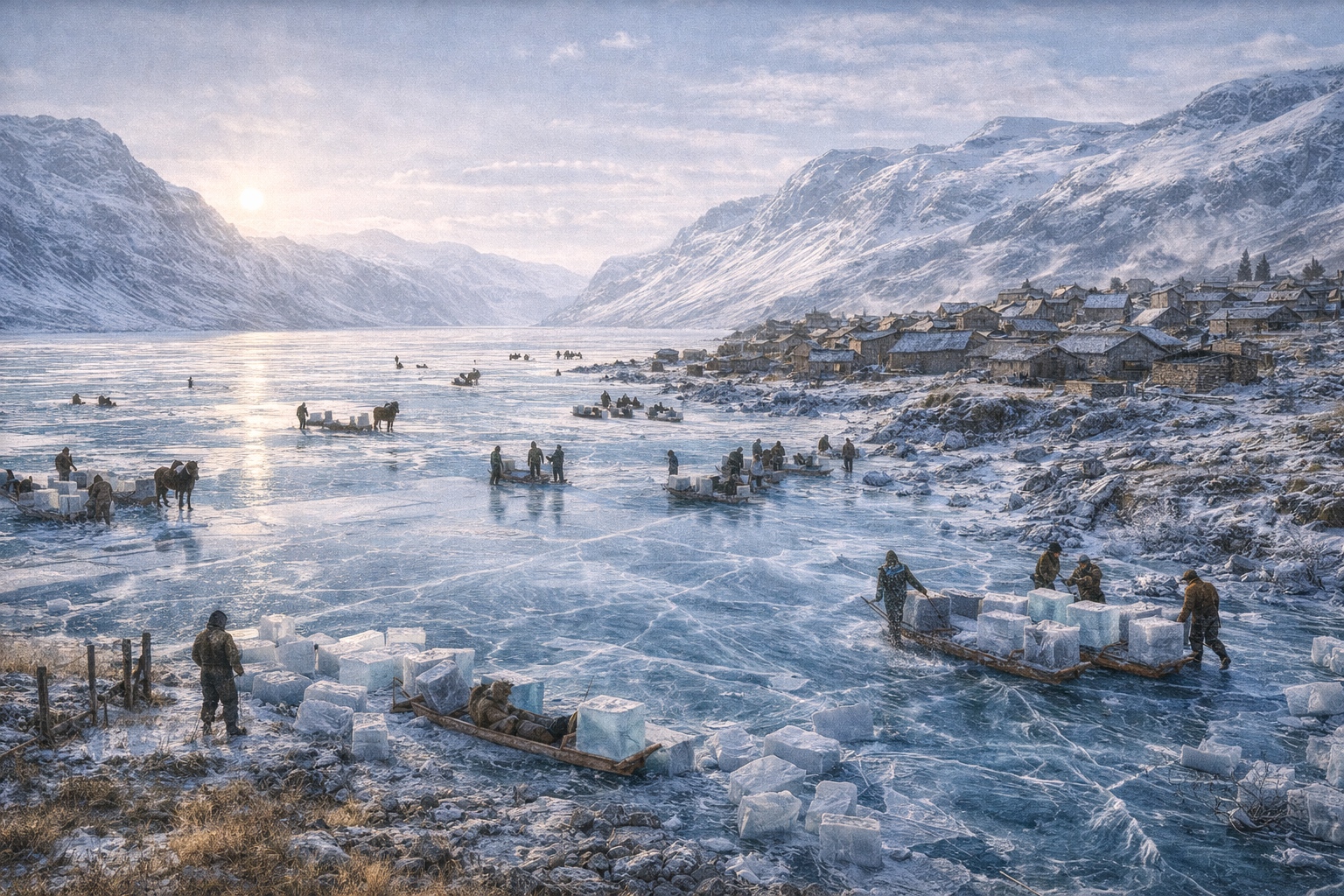
The village sits on the western shore of Lake Chojil: low stone buildings, turf roofs, smoke from every chimney regardless of season. The harbor is a simple affair of cut-stone piers extending into the lake's shallows, where the fishing boats rest in ice-free water through the summer and are hauled onto shore through the winter. Everything about Sendere is built for endurance rather than impression: thick walls, low profiles, doors that seal against wind that comes from three directions simultaneously.
The people match the architecture. They are not unfriendly, but warmth here is expressed differently than in warmer places: offers of food rather than words, practical help rather than reassurance. Strangers are watched carefully before they are welcomed. The proximity of Morrito, whose reputation for forced labor and state violence is well known in every Southern Cold Marches settlement, has made Sendere permanently cautious about strangers with official-looking purposes.
Geography & Setting
Sendere occupies the western shore of Lake Chojil, a glacial lake in the southern tundra basin west of Morrito. The lake is deep, cold, and remarkably clear; visibility to significant depth in the winter ice is the characteristic that defines Sendere's primary export. The surrounding terrain is low tundra, with the glacier-cut valley walls rising to the north and the open plateau extending to the west and south.
The climate is cold tundra: long winters, short summers, no period that could be described as warm. Snowfall begins in early autumn and does not fully clear until late spring. The lake freezes from November through April; during those months, the village transitions from open-water fishing to ice fishing and ice harvesting, using the frozen surface as both workplace and highway.
The relationship between Sendere and Morrito is governed by geography and reputation. Morrito sits south of Lake Chojil and maintains a presence that Sendere's population regards with consistent wariness. Trade between the two settlements is limited and conducted at arm's length; Sendere sells ice and fish to Morrito's market and buys tools and goods that cannot be produced locally, and the interaction ends there. No Sendere family voluntarily travels to Morrito, and the Varkari Codex's provisions for labor impressment are a topic of quiet anxiety in every Sendere household.
The People
Demographics
Sendere is predominantly Human, with a substantial Dwarf population concentrated in the ice-cutting and stonework trades. Gnomes are present in the village's small scholarly and healer community; their precision suits the work of ice quality assessment and the botanical knowledge that makes the tundra's limited medicinal plants accessible. Other races appear occasionally, typically as travelers or traders who stayed.
Outsiders are welcomed on a probationary basis. The village's experience with outsiders who arrived claiming official purposes has been uniformly unpleasant; the Elder Council maintains a formal waiting period before any new arrival is given access to the lake's working areas. This is not hostility but institutional caution developed over generations.
Economy
Ice fishing is the primary food source and a significant export; the cold-water species in Lake Chojil, particularly the pale-fleshed deepwater trout unique to the lake's lower levels, are considered a delicacy in warmer settlements willing to pay for transport. Ice harvesting is the secondary industry: the lake's exceptional clarity makes Sendere ice a premium product for preservation and display in wealthy households across Antaea. The ice is cut in large blocks, packed in sawdust, and transported by sled during winter and by pack animal in summer. Fur trapping rounds out the economy, providing the pelts that are Sendere's most consistent long-distance trade good.
Primary Exports
- Deepwater lake trout: A cold-water species found only in Lake Chojil's lower depths; premium delicacy in distant warm markets
- Clear ice: The lake's exceptional clarity makes Sendere ice a luxury preservation and display product; sold in large blocks to wealthy buyers throughout Antaea
- Tundra furs: Arctic fox, snow hare, and occasional wolverine; traded to Sulaco's market for redistribution
Primary Imports
- Grain and preserved foods: The tundra produces no significant agriculture; all staple carbohydrates come from outside
- Metalwork and tools: Iron and steel tools, particularly ice-cutting equipment and fishing gear, sourced through Morrito's market or via the Sulaco trade route
- Timber: The tundra is treeless; all structural wood comes from south of the Sierra de Verno via the Southern Cold Marches trade network
Key Industries
- Ice fishing: The year-round food source and primary protein export
- Ice harvesting: The premium commercial product; the ice cutting season is the village's most economically intensive period
- Fur trapping: The reliable trade good; less volatile than fish prices, more consistent than ice
Food & Drink
Sendere's food is sustaining and monotonous to outside palates, deeply comforting to those who have grown up on it. Fish is the foundation: prepared smoked, dried, salted, fresh-boiled, and in a dozen variations using the limited spice and herb trade available. Rendered animal fat is used in cooking in ways that outsiders find surprising. The one luxury is a strongly brewed hot drink made from dried tundra herbs that serves as both stimulant and social ritual; sharing it with a visitor is a meaningful gesture of acceptance. There is no wine; the cold spirit produced locally is effective and not pleasant.
Culture & Social Life
Sendere's culture is structured around collective survival. Individual distinction exists but is expressed through contribution to community outcomes rather than personal status. The finest ice-cutter is respected because the ice pays for the tools; the best trapper is respected because the furs pay for the grain. The Elder Council model reflects this: three rotating seats, no individual authority, all major decisions made collectively and publicly explained.
The awareness of Morrito produces a specific cultural sensitivity: Sendere people are hyperaware of signs of external authority claiming rights over their labor or their community. Anything that resembles official impression (travelers asking about community able-bodied members, unfamiliar documents with House Varkari references) is reported to the Elder Council immediately.
Festivals & Traditions
The Ice Opening
Held each spring, when the lake surface first breaks. The day the lake ice shows its first cracks is the day the village collectively exhales. The Ice Opening is celebrated with the first open-water fishing of the year, a communal meal of the catch, and the formal acknowledgment of everyone who survived the winter. The names of those who did not are read aloud. It is neither a joyful nor a somber celebration but a specific thing: an accounting, and a beginning.
Fridon's Dark Night
Held at midwinter, on the longest night. A night of prayer and stillness, observed with the village's fires reduced to coals. No work is done; no travel is attempted. The meaning is direct; the deity who holds the ice is acknowledged, and the community declares itself still present to be held.
Music & Arts
Music in Sendere is primarily vocal, unaccompanied or accompanied by simple percussion, performed during communal meals and on festival occasions. The songs are long, repetitive, and designed to be remembered without instruments, which suits a community where instruments may be lost to weather. Ice carving is the primary art form: functional objects (cups, bowls, architectural elements) carved with a precision and aesthetic sense that reflects generations of practice. The finest pieces are made during the ice-cutting season when the material is abundant and the nights are long.
Religion
Primary Faith
Fridon is the village's governing deity, the keeper of frozen water and winter-lake life. The formal center of his faith lies elsewhere, but Sendere's practice is local and intimate: prayers at the shore, offerings at the ice edge, and the belief that a lake that freezes cleanly is a blessing that must be treated with respect.
There is a single Keeper, not quite a priest, who maintains the small stone shrine in the village center and leads the midwinter observance. The current Keeper is Yelna Frostwhisper.
Secondary / Minority Faiths
Cael receives attention during storms and whiteout weather, less as a philosophical devotion and more as acknowledgment that routes, visibility, and survival belong to her.
Echo is quietly present as a household faith: a patron for fair rationing, mutual aid, and the kind of stability that keeps a small lake village alive through bad winters.
A few trappers and fishers keep a practical reverence for local animal and place-spirits in the older tundra animist tradition, without formal temples.
Secret or Forbidden Worship
None documented. The village is too small and too internally transparent for secret worship to be practical; everyone knows what everyone else is doing, more or less. Certain individuals pray privately to Amnyth when deaths come in the winter, which the Keeper politely ignores.
History
Founding
Sendere was established by families who fled the initial period of the Varkari Codex's enforcement in Morrito; they walked north around Lake Chojil until they found a location where the lake was accessible and the Varkari authority was too distant to enforce labor claims. The founding families were predominantly Human and Dwarf. The original settlement was minimal; the current village has grown through natural population increase and occasional arrivals of additional refugees from Morrito's sphere of influence.
Key Events
The First Varkari Incursion
Forty years after founding, a Varkari authority party arrived in Sendere claiming labor rights under the Codex. The Elder Council of the time produced documentation, carefully assembled over years on advice from an Orinokia-trained legal scholar who had settled in the village, establishing that Sendere predated the Codex's current territorial provisions. The Varkari party withdrew. The documentation is the village's most carefully maintained record.
The Winter of the Black Ice
Eighty years ago, a fungal contamination in Lake Chojil's shallows discolored the ice along the shore and killed the fish in the eastern coves for three seasons. The village survived through the fur trade and through a mutual aid arrangement with a nomadic trapping group whose identity the Elder Council does not discuss in specifics. The memory of the Black Ice is the community's reference point for collective hardship and collective response.
The Scholar's Arrival
Twelve years ago, a gnome scholar named Yelna Frostwhisper arrived in Sendere claiming to study tundra ecosystems. She stayed. She became the Keeper. Her reasons for staying are her own business, as far as the village is concerned.
Current State
Sendere is stable within its narrow parameters. The ice trade has been more profitable than usual for three consecutive years. The Elder Council is managing a quiet tension: there are rumors that House Varkari in Morrito is considering a new legal interpretation of the Codex that would extend its labor provisions to settlements within a specific distance of Lake Chojil. If accurate, Sendere falls within the range. The documentation that protected the village forty years ago may not survive the new interpretation.
Leadership & Governance
The Elder Council: Overview
Sendere is governed by a three-seat Elder Council with rotating membership: each seat serves a three-year term, staggered, with one seat turning over each year. The presiding Elder holds the casting vote in tie situations. The system was designed to prevent the kind of accumulated personal authority that the founding families had fled in Morrito. It works as intended, which sometimes makes it slow.
Elder Brona Icecroft: Presiding Elder
Human, Female: In her second term; a former ice-cutter in her fifties
Brona Icecroft became Presiding Elder through competence, persistence, and the community's recognition that she is genuinely uninterested in personal power; her pre-Council work was ice-cutting, and she still takes shifts when the season demands. She is direct, patient, and more aware than she lets on. She is the one who has been quietly researching the potential new Codex interpretation, and she has not yet told the full Council because she wants to understand the scope before producing panic.
Elder Thoric Deepdrift: Council Member
Dwarf, Male: Master ice-cutter; currently in first term
The voice of the Dwarf community on the Council and the technical authority on ice-harvesting operations. Thoric is practical, conservative in resource management, and deeply unhappy about the Varkari rumors, which he considers existential. He is building informal alliances with the nomadic groups that share the plateau, against the possibility that movement will be necessary.
Guard & Militia
Sendere maintains a militia of fifteen working adults who rotate responsibility for border watch and village security. The watch is primarily oriented toward notification: early warning of approaching parties, not combat. The village's defensive doctrine is evacuation across the lake ice in winter, or north along the western shore in summer, rather than confrontation.
Law & Order
Sendere follows community consensus law; disputes go to the Elder Council, which hears both parties and decides based on established precedent and common sense. There is no codified law beyond the founding principles (no impressment, no individual authority over collective resources) and practical working rules about resource sharing and responsibility. Punishments are social and economic rather than physical; expulsion is reserved for genuinely dangerous situations and has been applied twice in the village's history.
Notable Figures
Yelna Frostwhisper: Keeper of the Shrine and Botanical Scholar
Gnome, Female: The village shrine, the tundra margins, wherever her specimens are
Yelna arrived as a scholar and became necessary. Her botanical knowledge of the tundra's medicinal plants has made her the village's de facto healer; her role as Keeper has made her its spiritual anchor. She is quiet, precise, and privately carrying something she has not told the village, the reason she came here rather than anywhere else. She has identified a specific botanical compound in the Lake Chojil margin plants that she believes may be significant, but she is not yet certain enough to publish, and she is aware that certainty may bring attention from interests she would prefer not to attract.
Thoric Deepdrift: Elder and Ice Master
Dwarf, Male: Also listed under Elder Council
Thoric's double role as Council member and the village's senior ice-cutting authority creates occasional tension when policy and practice need to align. He manages it through the simple method of treating both roles with equal seriousness and refusing to let either compromise the other.
Mira Coldstream: Lead Fisher
Human, Female: The lake, the piers, the smoking house
The village's most productive fisher and the informal authority on Lake Chojil's behavior: where the trout run, when the deepwater species move, how to read the ice for the ice fishing season. She is not political, not interested in the Varkari question except insofar as it might affect her ability to work the lake, and considerably more respected by the fishing community than any council member.
Key Locations
Seat of Power
- The Elder Hall: A larger-than-average stone building in the village center; functions as council chamber, community meeting space, and emergency shelter. The founding documentation is stored here under the hearthstone, wrapped in oilskin.
Houses of Worship
- The Shrine of Fridon: A standing stone encircled by smaller stones in the village square. Simple, permanent, unroofed; exposure to the elements is considered appropriate for an ice deity.
Inns & Taverns
- The Ice Hearth: The only establishment that serves visitors; essentially a large room in Mira Coldstream's extended household that has been formalized into a guest function. Basic, warm, and welcoming to vetted visitors.
Shops & Services
- The Ice House: The communal ice storage facility and cutting workshop; operates as the coordination point for the ice trade.
- Yelna's Workshop: The Keeper's combined shrine administration office and botanical workroom; available to visitors seeking medical attention or information about the local environment.
Other Points of Interest
- The Lake Piers: The stone extensions into Lake Chojil where the fishing boats work and the ice is loaded for transport; the operational heart of the village.
- The Winter Road: The flagged route across the lake's frozen surface that connects Sendere to the southeastern shore during the ice season; the fastest winter access to Morrito's trade market.
Guilds & Organizations
- The Ice Cutters' Collective: Manages the communal ice harvesting operation, coordinates labor, and negotiates ice trade contracts. Functionally led by Thoric Deepdrift.
- The Fishers' Circle: Informal organization that manages fishing territory allocation and the smoking house rotation. Mira Coldstream is the acknowledged voice.
The Criminal Element
Crime in Sendere is functionally absent at any organized level; the village is too small and too internally transparent for organized criminal enterprise. Individual theft has occurred; it is handled by the Elder Council with a severity that the community considers appropriate and outsiders find disproportionate. The more significant concern is external: the Varkari Codex's potential expansion represents an institutional criminal enterprise aimed at Sendere's foundational freedom, and the Elder Council's counter-preparation is the settlement's primary ongoing security concern.
Secrets, Rumors & Hooks
- The documentation that protected Sendere from Varkari labor impressment forty years ago was partially fabricated. The legal scholar who assembled it, working from genuine founding records, added two dates that were not in the original documents to establish the settlement's predating of the Codex's territorial provisions. The fabrication has never been discovered. Elder Brona Icecroft found the discrepancy in her research of the founding records last year and has told no one. If House Varkari conducts a thorough archival review under the new Codex interpretation, the fabrication may be detectable.
- Yelna Frostwhisper left a significant research position in Orinokia under circumstances that the Gnome academic community describes as "a professional disagreement." The disagreement was about the ownership of a botanical discovery: specifically, who discovered a useful compound in a high-altitude plant, and who first filed the academic record. The person who filed against her is now in a position of institutional authority. Yelna believes the compound she has identified in Lake Chojil's margins is related. She has not been in contact with Orinokia about it.
- The nomadic group that provided food support during the Winter of the Black Ice has an ongoing informal relationship with Sendere that the Elder Council has never formally acknowledged. The group conducts intelligence about Morrito's patrol patterns and shares it with Sendere's militia watch. They do this because they have their own reasons for wanting early warning of Varkari movement and consider Sendere a useful forward position. Neither party has discussed the asymmetry.
- Lake Chojil's deepwater trout population has declined noticeably over the past three years. Mira Coldstream has documented the decline in her personal records and is not sure what is causing it. The decline correlates with increased geothermal activity southeast of the lake, the same activity associated with the Vroa Hot Springs area, which is slowly warming the lake's lower thermal layers. Mira does not have the scientific vocabulary for this. Yelna Frostwhisper would, if she were asked.