Sonoro
Sonoro: The Northern Watch
"Five days out, the patrol comes. One gold, and you pass. Argue, and they make you wait another five."
Common knowledge among Perian Sea traders
At a Glance
| Continent | Antaea |
| Region / Province | Temperate coastal plain, northern Perian Sea coast |
| Settlement Type | Town |
| Population | ~6,200 |
| Dominant Races | Humans, Dwarves, Smalings, Elves |
| Ruler / Leader | Governor Aelric Northband |
| Ruling Body | House Northband (hereditary civic governance) |
| Primary Deity | Fujin |
| Economy | Fishing, northern maritime trade, shipbuilding, patrol toll collection |
| Alliance | Zulie River Confederation |
| Known For | The northern Perian Sea patrol fleet; the 1-gold transit toll; the finest cold-water fish in Antaea; proximity to Jazirah's maritime border |
First Impressions
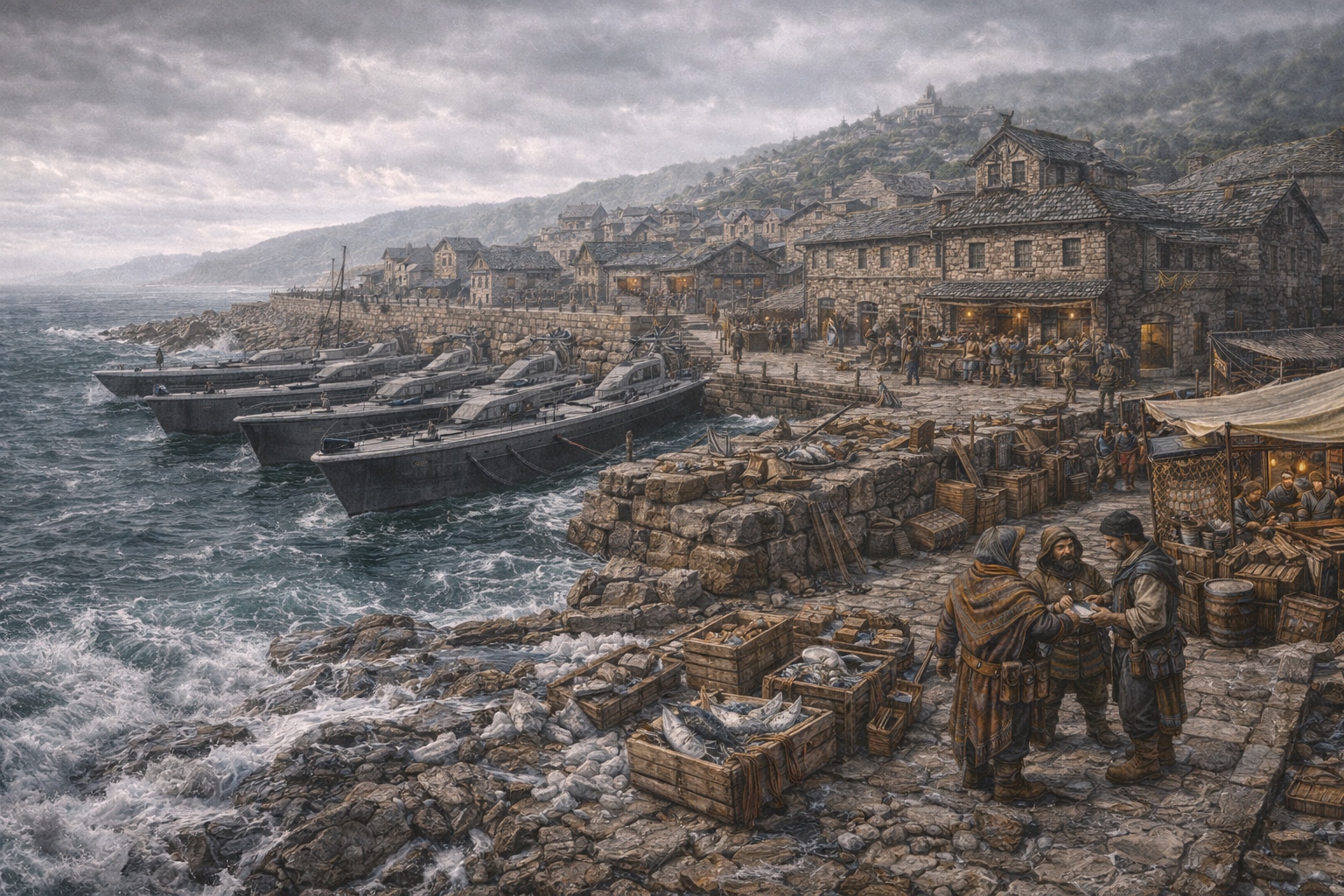
The approach to Sonoro from the sea announces itself through the patrol vessels before the harbor becomes visible. They are not large ships (quick cutters, built for speed and maneuverability rather than combat), and they approach any vessel transiting the northern Perian corridor with efficient purpose. The question is standard: vessel name, origin, cargo, destination. The toll is standard: one gold piece, per vessel, per transit. The receipt is a stamped document that serves as safe passage for the next four days in the corridor. The cutters are polite. They are also armed, and the patrol crews know the waters here better than anyone.
Sonoro itself is a coastal town built for weather. The buildings are stone and heavy timber, low-profiled against the northern winds that come off the Perian Sea for eight months of the year. The harbor is sheltered by a stone breakwater that the community spent forty years building and maintains as its most important infrastructure. The market runs along the harbourfront: fish vendors, ship provisioners, a rope and sail chandlery, the offices of three small trading companies, and the Governor's Patrol Administration building where the transit toll revenue is processed and logged.
The people are northern coastal: direct, practical, good in weather, and possessed of the particular local pride of a community that knows it is strategically important and has been underappreciated about it for most of its history. Relations with Zulie are respectful and occasionally strained; the Confederation values the patrol function, but the fiscal arrangements around toll revenue have been a recurring subject of negotiation.
Geography & Setting
Sonoro sits on the northern Perian Sea coast, at the point where the coast begins to angle east toward the Jazirani maritime border. This position puts the settlement at the natural western boundary of the northern Perian corridor, the maritime route that connects the Perian Sea's northern trade lanes to the Amnyth's Sea approaches. Any vessel transiting this corridor passes through Sonoro's patrol coverage area.
The terrain behind the town is temperate coastal plain: flat, productive, and subject to the northern weather systems that come off the Perian Sea. Agriculture is possible and practiced; the farms behind the town provide grain, vegetables, and livestock that supplement the fishing economy. The coastal scrubland that borders the plain produces the low-growing medicinal herbs that Sonoro's healers use and occasionally export.
The Moriche Rainforest's northern edge begins approximately two days' travel south of Sonoro: close enough to be a presence in trade and ecology, not close enough to directly affect the town's character. The forest settlement of Maxan sends occasional trade goods north through Sonoro's market.
The People
Demographics
Sonoro's population is Human-majority, with Dwarves concentrated in the shipbuilding and maritime engineering trades. Smalings are the dominant presence in the commercial and information sectors; their natural aptitude for networks of relationship makes them effective traders, pilots, and intelligence gatherers in a town where knowing who is in the harbor and why is economically significant. Elves appear in the patrol fleet's officer and navigator roles, where their long sight and pattern recognition suit the work.
The town receives a constant flow of maritime traders who stop for resupply, weather shelter, and the patrol toll documentation. These visitors are the secondary economic driver and are managed by the infrastructure of the harbor district with practiced efficiency.
Economy
Fishing is the foundation; the northern Perian's cold-water species, including several varieties found only in this stretch of coast, produce catches that are highly valued in warm-water markets. The patrol toll is the second most significant revenue source; the one-gold-per-vessel charge generates substantial annual income from the volume of traffic through the corridor, distributed between the Patrol Administration (for fleet maintenance and crew wages) and the Confederation's general fund (per the current fiscal arrangement, which Sonoro considers insufficiently generous).
Shipbuilding, specifically the quick cutter design used by the patrol fleet, is a specialized local industry. The Sonoro cutter has been iterated over three generations into a highly capable coastal patrol vessel; the design has been commissioned by other maritime communities, which produces additional revenue.
Primary Exports
- Cold-water fish: Northern Perian species including the prized silver eel and the deep-water rockfin, dried and salted for distant markets
- Patrol cutter vessels: The Sonoro-design cutter; commissioned by other maritime communities for coastal patrol and fast dispatch functions
- Transit documentation services: The patrol toll and safe passage system generates revenue both directly and through the ancillary services (harbor use, provisioning) that tolled vessels purchase while in port
Primary Imports
- Grain and agricultural goods: Local production supplements but does not fully supply; regular import from Confederation interior settlements
- Iron and specialized metal components: Shipbuilding requires metalwork that the town's limited smithing capacity cannot fully produce
- Luxury and specialty goods: The northern trade corridor brings variety to the market that Sonoro's own production cannot provide
Key Industries
- Fishing: The food base and primary export; the cold-water species are the town's most distinctive product
- Patrol operations: The strategic function; revenue-generating and politically significant beyond its commercial value
- Shipbuilding: The specialized cutter production; not high-volume but high-value
Food & Drink
Sonoro's food is northern coastal and excellent by any standard applied honestly. The fish is the best available on the continent in this category; the silver eel in particular, prepared smoked or in the traditional northern broth with coastal herbs, is a dish that visitors from warm-water settlements describe with a surprise that the locals find gratifying. The bread is good, the ale is local and better than most northern towns manage, and the provisioning market maintains the quality standards that repeat maritime visitors expect.
The town has two taverns of note and a half-dozen establishments of varying quality that serve the transit traffic. The Governor's banquet table, reserved for significant visiting dignitaries and Confederation delegations, is reportedly exceptional; Governor Northband employs a cook who came from Zulie under circumstances that remain a subject of minor local legend.
Culture & Social Life
Sonoro's culture is organized around the sea and the patrol function. The weather governs everything: the fishing fleet's schedule, the patrol fleet's routing, the harbor's capacity. The people read weather with the automatic competence of those for whom it is not academic. Social relations are structured by the maritime hierarchy (patrol rank, fishing seniority) and the commercial hierarchy (merchant success, shipbuilding reputation), with the two hierarchies in ongoing low-level competition for civic status.
The relationship with Jazirah (the nearest significant external power, whose maritime border is within the patrol zone) is the defining external relationship. Sonoro's patrol function exists largely as a response to Jazirani maritime pressure; the toll is as much a declaration of territorial management as a commercial operation. The relationship is formally correct and practically tense. Most of what the patrol fleet does day-to-day is watch Jazirani movement.
Festivals & Traditions
The Storm Season Opening
Held in late summer, just before the northern storm season begins. The formal acknowledgment that the weather is about to become serious. The fishing fleet is brought into harbor, the patrol vessels are inspected for storm readiness, and the community shares a meal that is specifically the foods that keep well through a bad winter. The practical content of the festival is a community-wide stock-taking; the ceremonial content is asking Fujin for safe passage through the difficult season.
The Toll Day
Held annually on the anniversary of the patrol system's founding. A civic celebration of the patrol function and its revenue, with the year's toll figures presented publicly. The transparency is deliberate; the community's share of the toll revenue is a matter of genuine civic interest, and Governor Northband's family has maintained the practice of public accounting since the system was established. The day ends with a public feast funded by the patrol revenue.
Music & Arts
Sonoro's music is sea-music: working songs, storm songs, and the particular genre of northern Perian sailor ballads that are more narrative and darker in tone than the warmer-water traditions. There is a strong choral tradition in the Fujin temple, which uses music as a devotional form for the deity's storm aspects. Visual art is sparse and functional; the exception is scrimshaw work from the deep-water fishing community, which produces pieces of considerable quality that occasional art collectors from Zulie and beyond have discovered and begun commissioning.
Religion
Primary Faith
Fujin, deity of storms and the wild sea, is the primary faith of Sonoro. The relationship is practical and direct; Fujin governs the weather that governs everything in this town, and worship is accordingly serious. The temple is built at the harbor's highest point, where the storm winds are strongest; services are conducted in the open air during calm weather as a matter of principle. The priests perform the weather-reading function that is standard in northern maritime communities. The temple's choral tradition frames the storms as the deity's voice and teaches the congregation to listen carefully to what they are saying.
Secondary / Minority Faiths
Ryujin, deity of the sea, shares the maritime community's devotion with Fujin; some fishers maintain that Ryujin governs the fish and Fujin governs the weather, and both need attention.
Talbar is observed by the trading community and the Patrol Administration.
Echo has a small but steady civic presence among the patrol families and the harbor administrators: the belief that a corridor only stays open if the people running it stay aligned.
Bridhel is honored by the choral community.
Secret or Forbidden Worship
Demergat, deity of storm-ridden islands and dark maritime power, is observed by a small group within the patrol fleet: specifically, those who have been in difficult engagements with Jazirani vessels and have developed a relationship to violence and extreme weather that the official Fujin worship doesn't fully accommodate. The Governor is aware this exists. He considers it an operational risk rather than a theological concern and has not acted on it.
History
Founding
Sonoro was established as a fishing settlement on the northern Perian coast by families from the Confederation's interior who followed the river systems north to the coast. The strategic significance of the location, the natural western limit of the northern Perian corridor, was not initially recognized; the early settlement was pure fishing community. Recognition of the strategic position came when Jazirani vessels began appearing in the corridor with increasing regularity, creating the need for a presence that could monitor and, if necessary, contest the access.
Key Events
The Corridor Agreement
The formal agreement between Sonoro and the Zulie Confederation establishing the patrol function (including the toll system, the fiscal split, and the rules of engagement with foreign vessels) is the document that transformed Sonoro from a fishing town into a strategic installation. The Agreement has been renegotiated three times; the current version, which Governor Northband considers inadequate on fiscal terms, has been in place for thirty years.
The Jazirani Incident
Twenty-two years ago, a Jazirani vessel refused the patrol toll and, when the cutter moved to enforce, fired on the patrol crew. Two patrol crew members were killed. The Governor of the time, Aelric Northband's father, escalated to the Confederation, which escalated diplomatically to Jazirah. The resolution involved a formal apology, compensation to the crew families, and an agreement that Jazirani vessels would comply with the patrol system. The agreement has been observed with various degrees of compliance since. The two crew members' names are on a plaque at the harbor entrance.
The Cutter Design Innovation
Fifteen years ago, Chief Shipwright Borvin Coldforge's refinement of the patrol cutter design (specifically, the hull modification that increased speed and reduced draft simultaneously) was adopted as the standard patrol vessel and began attracting external commissions. The innovation gave Sonoro a product that generates revenue independent of the fishing and toll functions.
Current State
Sonoro is strategically significant, economically solid, and politically frustrated. The fiscal arrangement with the Confederation (specifically, the percentage of toll revenue that goes to Zulie versus what remains in Sonoro) has been a source of tension for two decades. Governor Northband has brought it to three Confederation Assemblies and been deferred each time. His most recent position: Sonoro should be classified as a strategic installation with enhanced revenue retention rights. The Grand Consul's position: the current arrangement is the current arrangement. Both positions are firm.
The secondary concern is the Jazirani maritime situation, which has been escalating slowly in ways that the patrol fleet's commander, Captain Signa Wavecrest, has been documenting carefully. Jazirani vessels in the corridor are better-armed than they were ten years ago, more numerous, and less immediately cooperative with the patrol process. Nothing has crossed the line. The line appears to be closer than it was.
Leadership & Governance
House Northband: Overview
House Northband has governed Sonoro since the Corridor Agreement's establishment; the family was instrumental in negotiating the original Agreement and has maintained the patrol administration since. The governance style is efficient and transparent; the annual public accounting of toll revenue is the signature institutional practice. The family's civic credibility is high; its political relationship with the Confederation is strained.
Governor Aelric Northband
Human, Male: The Governor's Hall; the Patrol Administration; the harbor, most mornings
Aelric Northband is in his mid-forties, built for the northern weather in the way of people who have spent most of their lives in it. He is methodical, direct, and carrying a specific form of institutional frustration, the kind that develops when you are responsible for a function that everyone agrees is important and no one agrees should be funded accordingly.
He is also watching the Jazirani situation with mounting concern. His private assessment, which he has shared with Captain Wavecrest and with no one else, is that the corridor is going to be contested within the next decade in a way that the patrol fleet, at its current capacity, cannot handle. He has not taken this to the Confederation Assembly because he is not certain he will be believed, and he is not certain what the correct ask is, and he is very certain that a poorly timed request will be used as leverage against the fiscal renegotiation he needs.
Guard & Militia
Sonoro maintains a town guard of thirty officers for civil security and the patrol fleet for maritime security. The two functions are administratively connected (the Patrol Administration oversees both) but operationally distinct. The patrol fleet is the strategic asset; the town guard is the civic function. Captain Wavecrest commands the patrol fleet; the town guard captain reports to the Governor directly.
Law & Order
Sonoro follows Antaean common law and Confederation commercial regulations, supplemented by the maritime law provisions of the Corridor Agreement that govern conduct in the patrol zone. The Governor serves as primary magistrate for civil matters; serious criminal cases go to Zulie's court system per the Confederation compact. Maritime offenses within the patrol zone are adjudicated under Corridor Agreement provisions by the Patrol Administration, which gives the Governor a separate legal authority that he has been careful not to overuse.
Notable Figures
Captain Signa Wavecrest: Patrol Fleet Commander
Elf, Female: The patrol fleet; the Patrol Administration; the harbor when in port
Signa Wavecrest has commanded Sonoro's patrol fleet for thirty years and knows the northern Perian corridor as well as anyone alive. She is precise, patient, and carrying an increasing weight of operational concern that she expresses in documentation; her patrol logs are the most detailed and consistently analytical in the Confederation's maritime record. Her current log entries, which she has begun flagging as requiring Assembly attention, describe a pattern of Jazirani vessel behavior that she considers preparatory to something she is not yet able to define. She finds the Governor's caution about escalating to the Assembly understandable and slightly insufficient.
Borvin Coldforge: Chief Shipwright
Dwarf, Male: The shipyard; the harbor engineering works
The designer of the current-generation patrol cutter and the town's senior shipwright. Borvin is gruff, technically exceptional, and has strong opinions about the relationship between hull quality and safety that he enforces in the shipyard with a rigor that makes his vessels more expensive and more reliable than competitors'. His external commissions for the cutter design have brought revenue to Sonoro that he considers belongs to the shipyard community; the fiscal distribution of this revenue with the Governor's administration is a recurring negotiation.
Talla Quickneedle: Senior Merchant and Commercial Voice
Smaling, Female: The harbor market; the commercial district; the Confederation trade mission when it visits
The most successful trader in Sonoro and the informal voice of the commercial community in interactions with the Governor and the Confederation. Talla is small, very fast on her feet (literally and figuratively), and maintains an information network about the northern Perian trade routes that is more current and comprehensive than anything the Patrol Administration officially maintains. She and Captain Wavecrest have an arrangement that both of them would describe as a professional information-sharing relationship and that neither of them would describe in more detail.
Key Locations
Seat of Power
- The Governor's Hall: The administrative center and Governor's residence; a substantial stone building at the harbor's north end. The Patrol Administration occupies the ground floor; the Governor's offices are above.
Houses of Worship
- The Storm Temple of Fujin: Built at the harbor's highest point; distinctive for its open-air worship structure and the wind instruments permanently mounted on the temple's towers that produce sound in any significant wind. The priests consider the sound the deity's ongoing voice.
- The Ryujin Harbor Shrine: A small structure at the base of the main dock; maintained by the fishing community for pre-voyage and post-return observance.
Inns & Taverns
- The Northern Toll: Named with deliberate irony; the primary establishment for visiting merchants and transit traders. Good food, practical rooms, and a commercial information network that pays attention to who is staying there.
- The Patrol's Rest: The establishment patronized by the patrol fleet crew on shore rotation; less formal, louder, and the source of most useful information about what is actually happening in the corridor.
Shops & Services
- The Patrol Administration Office: Where transit tolls are paid and safe passage documents issued; the most visited single building in Sonoro by visitor count.
- The Coldforge Shipyard: Borvin's operation; the patrol cutter production and maintenance facility, plus general maritime repair services.
- Talla's Trading Post: The central commercial hub; handles cargo brokerage, maritime goods, and the particular category of goods that need someone who knows where everything is.
Other Points of Interest
- The Breakwater: The defining infrastructure achievement; forty years of community construction, now the most important physical asset in the harbor. Maintained as a civic obligation.
- The Patrol Plaque: The harbor entrance memorial listing the names of the two crew members killed in the Jazirani Incident; Aelric Northband stops here every morning.
- The Northern Anchorage: The designated holding area for vessels under documentation review; usually occupied by one to three vessels at any given time.
Guilds & Organizations
- The Patrol Fleet Command: Captain Wavecrest's organization; operationally the most significant institution in the settlement.
- The Fishers' Brotherhood: The organization of Sonoro's fishing fleet; manages fishing territory allocation, the market dock scheduling, and the collective negotiations with the Governor's office on fish market regulation.
- The Harbor Merchants' Circle: Talla Quickneedle's organization; the commercial community's collective voice in civic matters.
The Criminal Element
Sonoro's criminal element is intimately connected to the patrol function: specifically, to the market for transit documentation that allows passage through the corridor without the standard toll. Counterfeit or fraudulently obtained transit documents are the primary criminal product; the patrol fleet's documentation verification protocols have become more sophisticated as the counterfeit quality has improved. The second-level concern is the information trade: the details of patrol scheduling and route coverage, which are valuable to vessels that prefer not to be inspected. Talla Quickneedle's information network is clean, but some of the information it passes adjacent to has found paths to buyers the network would prefer not to serve.
Secrets, Rumors & Hooks
- Captain Signa Wavecrest's patrol logs for the past three years contain a pattern she has not yet reported to the Governor: Jazirani vessels in the corridor are not simply better armed and more numerous. They are conducting what she believes is systematic depth measurement and current mapping of the corridor's navigational characteristics. This is preparation for large-scale navigation of the passage: more ships, larger ships, or both. The timeline she has constructed from the data suggests a significant Jazirani maritime move within five years. She is waiting to be certain before she brings it to Northband. She is almost certain.
- The Demergat cult within the patrol fleet includes one member who is not a patrol crew member: a harbor pilot whose information about vessel movements and cargo has been feeding the cult's secondary function as an intelligence operation. The cult is not simply a religious community; it has developed, without explicit intent, into a network that collects and holds information about every significant transit through the corridor. This information has not yet been used for anything. It is, however, there.
- Borvin Coldforge's most recent cutter design iteration (currently under development, not yet disclosed) incorporates a structural modification that would allow the vessel to carry significantly heavier armament than the current patrol configuration. He designed this because his reading of the corridor situation agrees with Wavecrest's assessment. He has not discussed this with the Governor. He intends to show the design to Wavecrest first.
- The two crew members killed in the Jazirani Incident were not killed in the way the official record describes. The official record says they were killed when the Jazirani vessel fired on the patrol cutter. The actual sequence was more complicated: the cutter crew fired first, under circumstances that Governor Northband's father determined were justified (the Jazirani vessel had moved to ram) but which were not described accurately in the formal report because the formal report was submitted to the Confederation Assembly and the senior Northband calculated that the justification would be disputed and the outcome would be the same either way. The current Governor knows the accurate account. The plaque at the harbor entrance honors the crew members accurately; only the cause of the incident is misrepresented.
- The transit toll of one gold piece has not changed in thirty years. The volume of traffic through the corridor has increased by approximately sixty percent in the same period. Governor Northband's fiscal argument to the Confederation, that Sonoro's revenue share is inadequate, does not account for this volume increase, because he calculated that presenting this number would invite the Confederation to renegotiate the rate structure in ways that would reduce Sonoro's per-vessel share. The Confederation has not noticed the volume increase, because they receive only the summary revenue figure, not the transit log. Talla Quickneedle has noticed. She has not yet decided what to do with it.