Sulaco
Sulaco: Where the Cold Trades
"You want to survive the Southern Marches? Learn what everything costs. Then pay it."
Pellin Greystone, Sulaco Trading House
At a Glance
| Continent | Antaea |
| Region / Province | Subarctic tundra basin, inland (south-southwest of Vroa Hot Springs) |
| Settlement Type | Town |
| Population | ~3,800 |
| Dominant Races | Humans, Dwarves, Gnomes, Smalings |
| Ruler / Leader | Overmaster Brennan Coldhar |
| Ruling Body | House Coldhar (hereditary administrative governance) |
| Primary Deity | Cael |
| Economy | Fur trade, geothermal goods, supply trade, Southern Cold Marches administrative hub |
| Alliance | Southern Cold Marches |
| Known For | The largest market in the Southern Cold Marches; heated stone from the Vroa trade; surviving where most settlements don't |
First Impressions
Sulaco is warmer than it has any right to be. The geothermal activity of the Vroa Hot Springs complex to the northeast sends a slow underground current of heat into the tundra basin, and over generations the settlement has learned to exploit this; the buildings sit on heat-conducting stone foundations that hold warmth through the worst months. The result is a town that feels functional year-round in a region where functionality is a seasonal achievement.
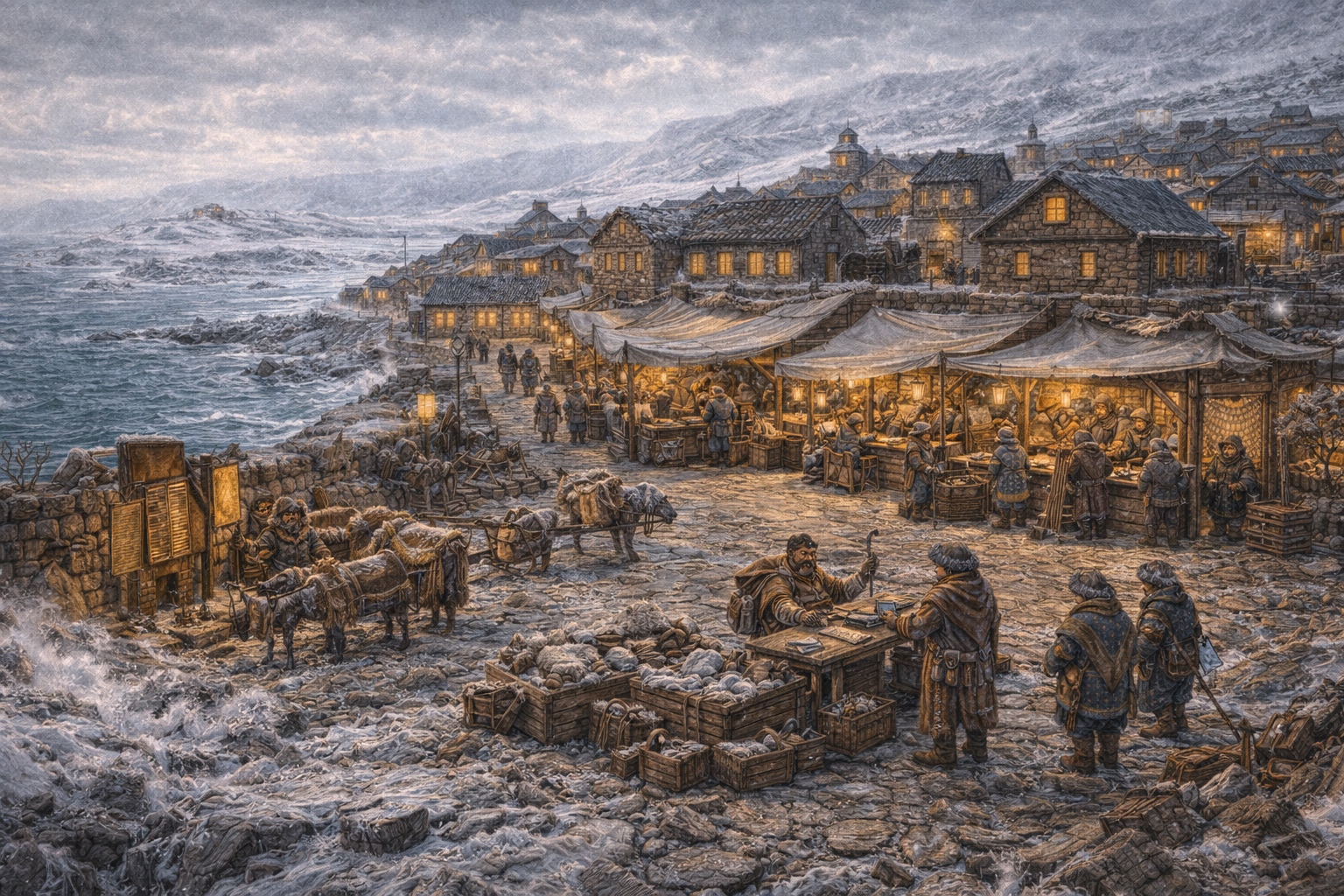
The market square is the first thing most visitors encounter: covered stalls, the smell of cured fur and smoked meat, the particular noise of an active trading floor where multiple languages are in use simultaneously. Sulaco does not grow most of what it sells. It handles, routes, and redistributes: the furs from the plateau trappers, the geothermal minerals from the Vroa traders, the preserved foods from the southern supply routes, the tools from the Dwarf smithing communities. A skilled buyer can find almost anything here if they have time and coin.
The people are commercially pragmatic in the way of communities that have organized themselves around trade rather than production. They are not cold (warmth is available, in the commercial sense), but it must be earned through transaction. Charity exists but is structured: the Coldhar administration runs a winter relief fund that provides minimum sustenance to anyone within the settlement boundary who asks, without conditions. This is both genuinely humane and practically sensible; a dead beggar generates no future commerce.
Geography & Setting
Sulaco occupies a sheltered basin in the subarctic tundra, positioned southwest of the Vroa Hot Springs geothermal complex. The basin provides wind protection that the open tundra does not; combined with the geothermal subsurface activity, it is one of the few places in the Southern Cold Marches where a settlement of Sulaco's size can function through winter without extraordinary hardship.
The terrain surrounding the basin is tundra plateau: treeless, wind-scoured, and traversable by sled in winter and by pack animal in the warmer seasons. The major routes into Sulaco converge from the north (toward Vroa and the glacier country), from the east (toward Morrito and Lake Chojil, and onward to Sendere), and from the south (toward the warmer regions where agricultural goods originate). The western route leads into open tundra with no major settlements within range.
Sulaco maintains a network of way stations along its primary trade routes: small stone shelters spaced a day's travel apart, stocked with minimum provisions and firewood. The Coldhar administration considers these infrastructure, not charity; without them, the supply chains that feed Sulaco's market cannot operate reliably in winter.
The People
Demographics
Sulaco's population is the most diverse in the Southern Cold Marches, a consequence of its trading hub function. Humans are the plurality, but Dwarves run the metalworking and way-station construction operations that support the trade routes. Gnomes dominate the administrative and accounting functions. Smalings are over-represented in the small-scale merchant community and the inn and tavern trade. Occasional elves appear (usually scholars studying the geothermal activity or travelers passing through), but permanent elven residents are rare; the cold does not suit them and the commercial atmosphere is not particularly interesting to them.
Visitors from across Antaea pass through Sulaco. The Southern Cold Marches political bloc meetings are held here. Some visitors stay.
Economy
Sulaco's economy is pure intermediary; it produces very little but facilitates the movement of almost everything in the Southern Cold Marches region. The market handles furs (arctic and subarctic species, cleaned and graded), geothermal goods (heated stone tile, mineral water with alleged therapeutic properties, sulfur for alchemical use), preserved foods (dried meat, fish, grain), and tools and metalwork (produced by the Dwarf community and traded in both directions). The administrative function generates revenue through taxation of transactions conducted within the settlement boundary, a modest percentage applied uniformly, which the merchant community considers reasonable and occasionally complains about as a matter of social obligation.
Primary Exports
- Processed furs: Arctic fox, snow hare, wolverine, and occasional larger pelts; Sulaco grades and certifies before redistribution
- Geothermal mineral goods: Heated stone tile (structural insulation), therapeutic mineral waters from the Vroa Spring trade, sulfur compounds for alchemical use
- Metalwork and tools: The Dwarf community's production, plus goods transshipped from elsewhere in the Marches
Primary Imports
- Agricultural goods: Grain, preserved vegetables, dried fruit from southern and eastern suppliers
- Timber: All structural wood is imported; the tundra is treeless
- Luxury goods: For the merchant and administrative class; wine, textiles, finished craft goods
Key Industries
- Fur trade intermediary: The largest volume activity; Sulaco grades and redistributes pelts from across the Marches
- Geothermal goods trade: The unique regional product; no other settlement has access to the Vroa Hot Springs output
- Administrative hub services: The Cold Marches political meetings and dispute resolution happen here; this generates steady institutional revenue
Food & Drink
The food in Sulaco is better than the surrounding terrain suggests, because commerce has been good enough to import quality ingredients. The taverns serve acceptable meals: roasted meat from the herds the settlement maintains on the tundra edge, fish from Sendere and Lake Chojil, bread from imported grain. The market has a food vendor district that is popular with travelers. The local specialty is a geothermal mineral broth, hot spring water reduced with herbs and meat, that has a devoted following among both residents and regular visitors. Whether the mineral content has any therapeutic effect is debated; it is undeniably warming.
Culture & Social Life
Sulaco's culture is commercial at its core: relationships are built on transaction, trust is established through reliable dealing, and status is measured in the quality of one's word in a contract. This is not cynicism; it is the framework that makes the market function. The social life of the town is consequently tied to the commercial calendar: the major blocs meetings bring the entire Southern Cold Marches administrative community into Sulaco, and the weeks surrounding them are the closest thing to a social season that the town produces.
The Coldhar administration's winter relief fund is the most consistently cited evidence of Sulaco's genuine communal values; the merchant community funds it through a voluntary surcharge on large transactions, and contributions are considered a social obligation sufficient that withholding them is noted unfavorably.
Festivals & Traditions
The Market Opening
Held at the first thaw each year. The formal opening of the full trading season, marked with a procession through the market district, the public announcement of the year's transaction tax rate (always a moment of commercial drama, though the rate has not changed in fifteen years), and a communal meal funded by the Coldhar administration. The meal is practical rather than festive; it feeds everyone and gets them ready to work.
Cael's Accounting
Held at midwinter. A day of deliberate stock-taking: households inventory their provisions, merchants inventory their goods, and the administration publishes the settlement's winter resource status publicly. The transparency is considered sacred; manipulating the accounting is treated as a serious offense against Cael's domain of honest reckoning. The day ends with a communal fire and the public reading of the resource report.
Music & Arts
Music in Sulaco is functional and tavern-oriented: working songs, trading songs, and the occasional bardic performance by travelers who have earned a night's lodging by entertaining the market. There is no significant permanent artistic tradition; the Gnome administrative community produces extremely precise decorative metalwork as a leisure practice, but this is more craft than art in the community's own estimation.
Religion
Primary Faith
Cael, goddess of weather, is the primary faith of Sulaco. In a tundra trading hub, weather is not an abstraction; it determines whether the supply routes operate, whether the way stations are accessible, and whether the market opens at full capacity or reduced. Cael's temple is a working facility: weather observation is conducted from its roof daily, and the priests are the community's most reliable source of route condition reports. The faith is practical rather than mystical; Cael is worshipped because she governs something important, and the worship is calibrated accordingly.
Secondary / Minority Faiths
Talbar, deity of commerce and deals, is the second-most-observed deity; the market's transaction records are kept in the Talbar temple annex, and the priests of Talbar serve as the closest thing Sulaco has to a notary public.
Echo is also widely respected as a civic faith: stability, fair accounting, and the expectation that the market remains a place where agreements hold.
Martus has a small but enthusiastic following in the trading community; his chapel sees more activity during the major market periods.
Secret or Forbidden Worship
Shinigami, deity associated with death and dark resurrection, is secretly observed by a small group connected to the fur trade's less reputable elements: specifically, those who handle pelts of disputed provenance. The worship is private and the group is small; the Coldhar administration is aware of its existence in general terms and has chosen to monitor rather than act, pending better intelligence on membership.
History
Founding
Sulaco was established by a Coldhar ancestor as a deliberate project rather than an organic settlement, a planned trading post at the basin's natural convergence of routes, with the geothermal subsurface heat identified as the site's key advantage. The founding generation invested heavily in the way-station infrastructure before the market itself was established, correctly identifying that reliable routes were a prerequisite for reliable commerce. The current settlement has grown from that original planned post into the Southern Cold Marches' largest settlement by some margin.
Key Events
The Coldhar Consolidation
Three generations after founding, the original Coldhar patriarch negotiated a series of agreements with the other major Southern Cold Marches settlements that established Sulaco as the formal administrative hub of the bloc: the location for political meetings, dispute resolution, and the collective management of the bloc's few external relationships. This gave the Coldhar family institutional authority beyond their commercial position, which they have maintained carefully.
The Vroa Trade Agreement
The formal agreement with the operators of the Vroa Hot Springs geothermal complex, establishing access rights and pricing for the heated stone and mineral water trade, is the most economically significant document in Sulaco's history. The original agreement was renegotiated twice; the current version has been stable for forty years. Overmaster Brennan Coldhar knows that the Vroa operators are aware of how dependent Sulaco is on the agreement and is quietly preparing for a renegotiation that will not go as well as the last one.
The Lost Caravan Season
Thirty years ago, an exceptionally severe winter closed all of the major routes into Sulaco simultaneously for eight weeks. The way stations held; the community's stored provisions, carefully managed under the Cael accounting protocols, were sufficient. The event established the Coldhar administration's reputation for competent crisis management and is still referenced when the winter relief fund's mandatory reserves are debated.
Current State
Sulaco is stable and prosperous within the constraints of its geography. The Vroa renegotiation concern is the dominant private worry. The Coldhar family succession is managed (Brennan has two children in administrative training), but the elder, Marta, is considerably more capable than the younger, and the community is watching to see how the succession is handled. The Southern Cold Marches political bloc has been relatively quiet, which Brennan interprets as the calm before something.
Leadership & Governance
House Coldhar: Overview
House Coldhar governs Sulaco through a combination of hereditary administrative authority and commercial legitimacy; the family founded the settlement, built its infrastructure, and has maintained it competently for four generations. The governance style is managerial: clear expectations, consistent enforcement, transparent accounting, and genuine investment in the infrastructure that makes the market work. The winter relief fund is the community expression of the philosophy.
Overmaster Brennan Coldhar
Human, Male: The Coldhar Hall administrative offices; the market floor most mornings
Brennan Coldhar is in his early fifties, heavyset, and operates with the unhurried confidence of someone who has run a complicated system long enough to know where everything is and what happens if it breaks. He is not charismatic in the way of political leaders, but he is deeply competent, and in Sulaco competence reads as a form of authority.
He is currently worried about the Vroa renegotiation, the Morrito-Sendere political tension, and the question of whether the Southern Cold Marches bloc is actually cohesive enough to be useful in an external crisis. He does not discuss these concerns publicly. He has begun building a reserve fund whose purpose is not documented.
Guard & Militia
The Sulaco Patrol is a salaried force of thirty people, the only paid standing security in the Southern Cold Marches. Their responsibilities include market security, route patrol, and the enforcement of the transaction rules. They are pragmatic professionals rather than soldiers. Their commander, a half-orc named Gorra Stoneback, has been in position for twelve years and is considered one of Brennan Coldhar's most important assets.
Law & Order
Sulaco law is commercial law with a security overlay. Transaction fraud is the most seriously treated offense; violence in the market is second. The adjudication process involves a three-person panel drawn from the senior merchant community, with the Coldhar administration holding final authority. Sentences are primarily financial, fines and trade bans, with expulsion reserved for serious or repeated violations. The Talbar temple annex maintains the legal records.
Notable Figures
Pellin Greystone: Senior Merchant and Market Voice
Gnome, Male: The Trading House; the market floor; wherever the interesting deals are
The most successful independent merchant in Sulaco, and the unofficial voice of the trading community in matters the Coldhar administration needs to understand. Pellin is sharp, good-humored, and has survived three decades in the Sulaco market through the simple method of knowing what everything is worth before he agrees to anything. He is genuinely fond of Brennan Coldhar and would not hesitate to oppose him publicly if the market's interests required it.
Marta Ashforge: Chief Smith and Coldhar Heir Apparent
Dwarf, Female: The smithing quarter; the Coldhar Hall when her father needs her
The head of the Dwarf smithing community and, more significantly, Brennan Coldhar's more capable child, currently running the metalwork operations while her less-capable brother handles administrative training. The community knows which one is more suited to eventually lead Sulaco. Marta knows it too. She has not discussed it with her father, because she suspects he knows and is working through the implications himself.
Ylva Thornwood: Temple Healer and Weather Reader
Elf, Female: The Cael temple; occasionally on the tundra routes
The senior priest of Cael's temple and the community's primary healer. Ylva is one of the rare permanent elven residents of Sulaco, having stayed after a planned brief research visit twenty years ago. She has a gift for reading the tundra weather that exceeds the technical instruments on the temple roof; the combination of these makes her route condition reports the most trusted in the settlement. She is also the only person in Sulaco who knows the full membership of the Shinigami-adjacent fur trade group, because two of them came to her for healing under circumstances that made the association obvious, and she has not decided what to do with the information.
Key Locations
Seat of Power
- Coldhar Hall: The administrative center and Coldhar family residence; a substantial stone building at the market square's northern edge with the transaction records vault in the basement.
Houses of Worship
- The Temple of Cael: Functional and prominent; the weather observation tower on its roof is the second-tallest structure in Sulaco. Daily route condition reports are posted on its outer wall.
- The Talbar Annex: Adjacent to the market, officially a temple but functionally the settlement's legal records office and notary function.
Inns & Taverns
- The Warm Foundation: Named for the geothermal heating; the primary establishment for well-resourced visitors. Excellent food, comfortable rooms, and a commercial information network that rivals the Coldhar administration's.
- The Pelt and Pipe: Favored by trappers and traders of modest means; loud, warm, and informative about route conditions.
Shops & Services
- The Main Market: The covered trading floor in the market square; the largest in the Southern Cold Marches, operating six days a week through the full year.
- The Greystone Trading House: Pellin Greystone's operation; handles the most complex and high-value transactions in the market.
- The Smithing Quarter: The Dwarf metalwork community; Marta Ashforge's operation is the largest but not the only one.
Other Points of Interest
- The Way Station Network: Not a single location but the infrastructure that makes Sulaco function; eleven stations on four routes, each maintained by Coldhar administration staff on rotating three-week assignments.
- The Geothermal Hearth: A public heated common room near the market square, funded by the winter relief operation; open at all hours, minimum provisions available, no questions asked.
Guilds & Organizations
- The Sulaco Merchants' Collective: The formal commercial organization; Pellin Greystone is its current chair. Negotiates collectively with the Coldhar administration on transaction rates and market regulations.
- The Smiths' Fellowship: The Dwarf-led metalwork guild; controls quality certification for metalwork sold in the Sulaco market.
- The Route Keepers' Association: The organization of way-station operators and tundra guides; works closely with the Cael temple on route condition reporting.
The Criminal Element
The organized criminal element in Sulaco is connected to the fur trade: specifically to the movement of pelts taken outside the licensed trapping territories, which is not precisely illegal under Southern Cold Marches law but is economically disruptive to the licensed traders. The group operates through front accounts in the market and has maintained low-profile stability for about fifteen years. The Shinigami worship connection is their least-known characteristic and potentially their most dangerous if discovered. Gorra Stoneback's patrol is aware of the group's commercial activities but has not found actionable evidence for enforcement.
Secrets, Rumors & Hooks
- The reserve fund Overmaster Brennan Coldhar is quietly building is not for the Vroa renegotiation. He received a private communication six months ago from a Morrito source, someone inside House Varkari, that the Varkari Codex expansion is being planned and will include Sulaco within its claimed administrative territory. Brennan has told no one. He does not yet know whether the information is accurate or a manipulation designed to produce a specific response from him.
- Ylva Thornwood's weather-reading gift is not purely skill. It is a minor divine attunement that she received during a storm on the tundra twenty years ago and has never reported to any temple authority, because she is not certain which deity granted it and is unwilling to speculate. The attunement occasionally provides information beyond weather; she knows things about the tundra that should require direct observation. She treats these episodes as anomalies and does not act on them.
- Pellin Greystone has been quietly accumulating documentation about a specific pattern in the fur trade: pelts from territories that should not be producing that volume, moving through accounts he cannot trace to their ultimate origin. He believes the pelts are coming from Southern Cold Marches settlements that are either under duress or no longer functioning as independent communities. He has brought this to Brennan Coldhar once, informally. Brennan listened carefully and changed the subject. Pellin is now less certain than he was about the Coldhar administration's full picture.
- The geothermal subsurface activity beneath Sulaco has been increasing for three years. The Cael temple's foundation monitoring instruments (installed as standard practice, rarely reviewed) show a slow but consistent change in the underground thermal profile. Ylva Thornwood has reviewed the records and has a preliminary assessment she has not finalized: the Vroa Hot Springs complex is expanding its underground reach. This is not immediately dangerous. It may be in ten to fifteen years.
- Marta Ashforge found a sealed chamber beneath the smithing quarter while excavating for a new forge foundation. The chamber contains equipment that appears to be a functioning alchemical laboratory, abandoned, but not very long ago. The equipment is high-quality and the residue in the vessels suggests work with compounds that are not standard metallurgical use. She sealed the chamber herself and has not told anyone.