Vistazul
Vistazul: Keel of the Heavens
"We do not build ships here. We build the sea's ability to carry purpose."
Chief Shipwright Haldra Ironkeel, at the launch of the Concordat Fleet
At a Glance
| Continent | Antaea |
| Region / Province | Sea of the Heavens (island) |
| Settlement Type | City |
| Population | ~7,200 |
| Dominant Races | Humans, Dwarves, Elves, Half-Elves |
| Ruler / Leader | Admiral-Governor Therin Saltmast |
| Ruling Body | The Admiralty Council (naval-civic governance) |
| Primary Deity | Zopha |
| Economy | Shipbuilding, naval training, maritime patrol, fishing, timber |
| Alliance | The Heavens Sphere |
| Known For | The finest warships in the Sea of the Heavens; the Naval Academy; the Blue Lantern patrol fleet |
First Impressions
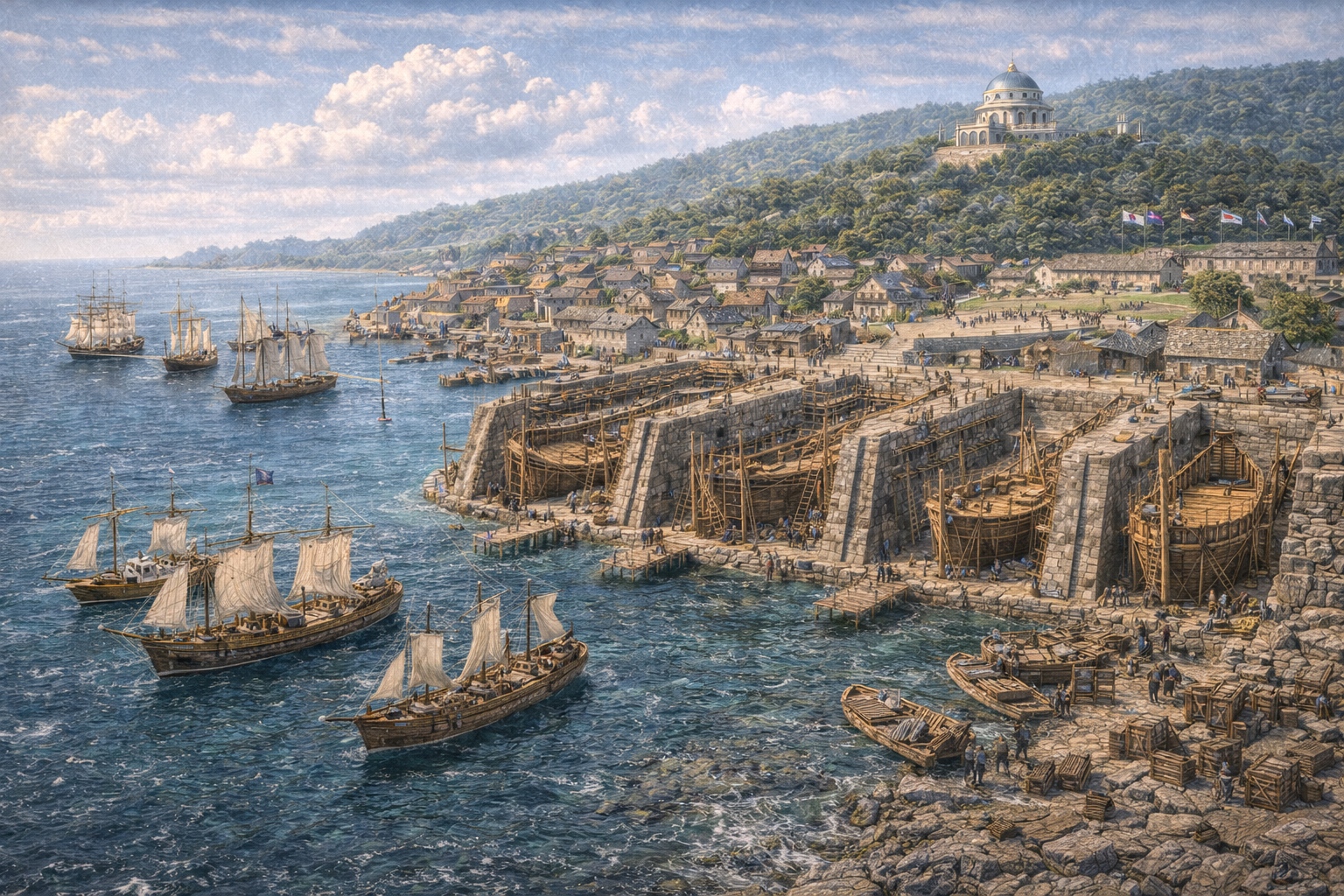
Vistazul's approach from the sea is dominated by the scaffolding. Three permanent dry docks stand on the island's southern shore, each large enough to hold a vessel of considerable size, and at least one is always occupied. The hammering and the smell of pine tar reach the water before the harbor does. The island's silhouette above the docks is dense with forest, the same forest that feeds the timber operations that feed the shipyards.
The harbor is military in organization without being hostile. Arriving vessels are met by a harbor pilot whose questions are efficient: origin, cargo, purpose, duration of stay. Trade vessels, fishing boats, and supply ships are directed to the commercial pier district without ceremony. Vessels whose purpose is unclear are directed to a holding anchorage while their documentation is reviewed. No ship enters Vistazul's harbor unclassified.
The city behind the harbor is organized around function: the shipyard district, the academy grounds, the naval barracks, the commercial district that serves all of them, and the residential areas arranged by occupational community. It is a working city with the aesthetic of something built to a plan: efficient, maintainable, and not particularly beautiful except for the view from the high point of the island's ridge, which looks out across the entire Sea of the Heavens and justifies the name entirely.
Geography & Setting
Vistazul occupies one of the Sea of the Heavens' larger islands, positioned at a point that gives the naval patrol fleet practical reach across the majority of the sea's commercial routes. The island's terrain includes a forested ridge running east-west that provides both the timber for shipbuilding and the elevation for the signal stations that communicate with the Heavens Sphere's other settlements. The southern coast's natural bay provided the foundation for the dry docks; the northern shore is open fishing territory.
The forest is managed, not wild, with sustainable harvesting protocols developed by the Zopha temple's forestry scholars over generations. The calculation is straightforward: Vistazul's shipbuilding capacity depends on timber supply, and timber supply depends on the forest not being depleted. The management protocols are strict and enforced by the Admiralty Council with the same seriousness as naval regulations.
The climate is maritime, with reliable seasonal winds that the Academy's navigators use for training purposes. The island's position in the Sea of the Heavens exposes it to the significant storms that cross the sea in autumn; the harbor's protected bay and the dry docks' storm barriers are designed for this.
The People
Demographics
Vistazul's population is shaped by the naval and shipbuilding functions. Humans are the largest group, filling officer, sailor, and general population roles. Dwarves dominate the shipwright trades; their precision and endurance suit the work, and the Ironkeel family has run the chief shipwright position for three generations. Elves are over-represented in the Academy's navigation and cartography instruction, where their long memories and pattern recognition serve the discipline. Half-Elves bridge the naval and academic communities effectively. The non-military commercial population serves the garrison, the Academy, and the shipyard workers.
The permanent civilian population is supplemented by a rotating naval presence; the patrol fleet's crews cycle through Vistazul for resupply, training, and refit, adding several hundred people to the effective population at any given time.
Economy
Shipbuilding is the primary industry in every sense; the dry docks operate continuously, producing the warships and patrol vessels that the Heavens Sphere requires and the merchant vessels that other customers commission. The Naval Academy is the second significant economic driver: the training fees, the accommodation of cadets and instructors, and the ancillary commerce around both are substantial. Fishing operates as food security. The timber industry supplies both the shipyards and an export trade in worked lumber.
Primary Exports
- Warships and patrol vessels: The Blue Lantern class is the standard Heavens Sphere patrol vessel; Vistazul builds all of them
- Merchant vessels: Civilian commissions supplement the military build program; Vistazul hulls are considered the most reliable in the Sea of the Heavens
- Naval training graduates: Officers and navigators trained at the Academy command ships throughout the Heavens Sphere; their credentials carry the Vistazul mark
- Worked timber: Surplus from the managed forest, sold to settlements without sufficient timber access
Primary Imports
- Iron and metalwork: The shipyards consume enormous quantities; sourced from Dwarf trading networks outside the Heavens Sphere
- Rope, sail, and rigging materials: Hemp and sailcloth from agricultural settlements
- Food and grain: The island's food production cannot feed the full population; significant import dependency
Key Industries
- Shipbuilding: The defining industry; the dry docks are the physical and economic heart of the settlement
- Naval training: The Academy trains the officers who command Heavens Sphere vessels; its reputation is the island's institutional prestige
- Timber and forestry: Both supply chain for shipbuilding and independent export commodity
Food & Drink
Vistazul's food culture is naval: substantial, practical, and designed to sustain physical labor. The taverns near the shipyard district serve large portions of fish stew, smoked meat, and bread. The Academy's dining hall has a reputation for being the best food on the island, an observation that the shipyard workers find simultaneously accurate and irritating. There is a small district of better restaurants serving the officer class and wealthy visitors. The local drink is a dark ale brewed from imported grain; it is good enough that barrels of it are occasionally exported.
Culture & Social Life
Vistazul's culture is structured around hierarchy: the naval hierarchy of rank and the professional hierarchy of shipbuilding craft. Both are transparent, internally consistent, and taken seriously. Social relations follow these hierarchies more naturally than most settlements would admit to; who outranks whom matters at the dinner table as well as the deck. What mitigates this is the genuine meritocracy within the hierarchies; rank is earned through demonstrated competence, and the Academy's promotion standards are strictly observed.
The relationship between the military and civilian populations is generally collegial; the civilians exist to serve the naval function and understand this without resentment, because the naval function is the source of the island's prosperity and security. The shipyard workers in particular have strong institutional pride in the vessels they produce.
Festivals & Traditions
The Launch
Whenever a major vessel is completed. The launch of a new ship from the dry docks is Vistazul's most significant recurring celebration: work stops, the community gathers, and the vessel is formally named, blessed by the Zopha clergy with a navigation prayer, and put into the water. The naming ceremony involves the ship's future commander breaking a sealed clay vessel of the island's ale across the bow. The ale comes from a specific vintage maintained in the Academy's cellar for this purpose.
The Blue Lantern Night
Held annually at midsummer. Commemorating the establishment of the patrol fleet, the island's harbor is lit entirely by blue lanterns on this night, with the fleet vessels anchored in formal formation in the bay. It is a display of institutional pride with the practical secondary effect of reminding every passing ship that the Sea of the Heavens has active naval patrol.
Music & Arts
Music in Vistazul is sailor's music: rhythmic, practical, and performed as much for coordinating work as for entertainment. The Academy maintains a formal choir for ceremonial occasions, which is considerably better than anyone outside Vistazul expects. The primary art form is cartography; the Academy produces the most accurate and beautifully executed sea charts in the Heavens Sphere, which are both functional documents and considered art objects by collectors throughout the region.
Religion
Primary Faith
Zopha, deity of knowledge in its applied and navigational forms, is the primary faith of Vistazul. The temple is the most striking architectural building on the island, a circular structure with a domed roof that serves as an observatory and a library. The clergy are scholars and navigators; the high priest holds a permanent position on the Academy's faculty. Zopha worship here is oriented toward the accumulation and application of knowledge for practical purpose: better charts, better timber selection, better hull design. The temple library contains the most complete collection of sea charts and navigational records in the Heavens Sphere.
Secondary / Minority Faiths
Ryujin, deity of the sea, is the second-most-worshipped deity; sailors address Ryujin directly and practically, without much institutional mediation. Bridhel, goddess of music and poetry, is honored by the choir community and the cartographers who consider their work an art form. Cael, goddess of weather, is observed by navigators who take weather-reading seriously.
Secret or Forbidden Worship
Mamaxa, known as The Mistress, has a small following in the patrol fleet's harder-edged ranks: sailors whose relationship to pain, discipline, and endurance has drifted into something the official faith structures don't accommodate. The Admiral-Governor knows this exists and has made a strategic decision: a small, private, stable cult that does not affect operational performance is less problematic than a suppression campaign that drives it underground and makes it resentful.
History
Founding
Vistazul was established as a deliberate naval installation by the Heavens Sphere's founding political agreement, the same Concordat of Islands that established Santo Rey's neutrality and created the Sphere's governance framework. The installation predated the full settlement; it began as a repair facility and expanded into a full shipyard over the first generation. The civilian population grew to serve the naval installation.
Key Events
The Construction of the Academy
A century after founding, the Admiralty Council formalized the training function that had been operating informally, establishing the Naval Academy as an institution with structured curriculum, certification standards, and the authority to credential officers throughout the Heavens Sphere. This transformed Vistazul from a shipyard with a training function into a naval capital with a shipyard.
The Battle of the Broken Shoal
Eighty years ago, a coalition of pirate fleets operating from outside the Heavens Sphere attempted to blockade the Sea of the Heavens' primary trade routes. Vistazul's patrol fleet, the Blue Lanterns, broke the blockade in a three-day engagement at a shoal formation north of the main island chain. The battle is still studied in the Academy's tactics curriculum. The fleet commander who won it is the namesake of the Blue Lantern class of patrol vessel.
The Forest Compact
Forty years ago, the Admiralty Council's timber management protocols were formalized into law following a period of over-harvesting that had reduced the production forest's sustainable yield. The compact between the Admiralty Council and the Zopha temple established the current forestry management system and the enforcement authority. The forest has recovered to pre-crisis capacity, which the Zopha clergy considers one of their temple's most significant achievements.
Current State
Vistazul is at operational peak: the shipyard is running at full capacity, the Academy class is the largest in a decade, and the patrol fleet is well-maintained. The political complications within the Heavens Sphere (the realignment questions, the Moramora situation) have produced increased commissioning requests that the shipyard is only barely keeping up with. Admiral-Governor Therin Saltmast is concerned that demand is exceeding sustainable build rate and that the political urgency is creating pressure to compromise on hull quality. He has not yet compromised. He is aware the pressure is increasing.
Leadership & Governance
The Admiralty Council: Overview
Vistazul is governed by the Admiralty Council, a body of five senior naval officers and two civilian representatives who hold both military and civic authority. The Admiral-Governor is the first member and holds final authority. The governance style is structured and procedural, with genuine respect for the civilian community's needs balanced against the operational requirements of the naval installation.
Admiral-Governor Therin Saltmast
Elf, Male: The Admiralty Hall; the Academy grounds; the dry dock inspection walks
Therin Saltmast is three centuries old, which in the context of Vistazul's command structure means he has personally known four generations of officers and shipwrights and carries institutional memory that no written record can fully replicate. He is not sentimental about this advantage; he uses it the way a navigator uses a chart, as a tool for better decisions.
He is currently managing the build-rate pressure with the particular patience of someone who has watched institutional shortcuts create disasters before. He is also privately aware that one of the Admiralty Council's junior members has been meeting with a diplomatic contact from outside the Heavens Sphere: he knows who, he knows roughly what, and he is deciding when to act.
Chief Shipwright Haldra Ironkeel
Dwarf, Female: The dry docks; the timber selection yard; wherever the current build problem is
The head of the Ironkeel family's shipwright operation and the most important non-military figure in Vistazul. Haldra has opinions about hull integrity that she considers non-negotiable and has communicated this to the Admiral-Governor in terms sufficiently clear that he has stopped suggesting otherwise. She is respected by the Admiralty Council in the specific way that people who can end your most important capability are respected.
Guard & Militia
Vistazul's security is naval; the Marine Corps attached to the harbor installation handles both external defense and internal security. Civilian security is managed by a separate harbor watch, but serious matters are handled by the Marines. The harbor classification system is the primary security mechanism; knowing who is in the harbor at all times is Vistazul's first line of defense.
Law & Order
Naval law governs the military population; Antaean common law governs civilians. The two systems interact occasionally with friction, managed by the Admiralty Council's civilian members. The one absolute jurisdiction is the harbor; all vessels in Vistazul's harbor are subject to Admiralty authority regardless of their civilian status. This is understood by everyone who docks here and is non-negotiable.
Notable Figures
Navigator-Scholar Mira Starcourse: Academy Cartography Faculty
Smaling, Female: The Academy; the Zopha temple library; occasionally at sea
Mira Starcourse is the Academy's senior cartography instructor and the person responsible for the most significant advancement in Sea of the Heavens chart accuracy in the last fifty years, a correction to the eastern shoal charts that had been sending ships slightly off course for two generations. She is small, precise, and speaks in the measured way of someone who has learned that other people's questions are usually less specific than they think. She is currently working on a chart project that she has described to colleagues as "correcting a significant error in the canonical understanding of the western approaches" and has not explained further.
Commander Vael Deepwater: Blue Lantern Fleet Commander
Human, Male: The patrol fleet; the harbor when in port
The operational commander of the patrol fleet, responsible for the day-to-day execution of the Sea of the Heavens patrol mission. Vael is direct, physically imposing, and has the specific leadership style of someone who has commanded ships in bad weather and learned that clarity is more important than complexity. He has recently been seeing patrol data that suggests increased unusual vessel activity in the eastern approaches that he cannot fully account for with known traffic patterns.
Key Locations
Seat of Power
- The Admiralty Hall: The governance center and Admiral-Governor's official residence; a fortress-solid stone building overlooking both the harbor and the dry docks.
Houses of Worship
- The Temple-Observatory of Zopha: The dome is visible from most of the island; inside, the library of sea charts and the observatory equipment share space with the formal worship functions. Open to Academy students and credentialed scholars.
- The Sailors' Chapel (Ryujin): A simple structure near the harbor, open at all hours; walls covered with offerings from sailors before long voyages and thanks from survivors of difficult ones.
Inns & Taverns
- The Blue Lantern: The flagship establishment, near the harbor; named for the fleet. Where visiting officers stay and where the Academy's better social events happen.
- The Shipwright's Rest: In the dry dock district; where Haldra Ironkeel and her people eat after shift. Excellent ale, good food, zero tolerance for shipbuilding criticism from people who don't build ships.
Shops & Services
- The Ironkeel Yard: The primary shipbuilding operation; the main dry dock and the associated workshop buildings.
- The Academy Chart Shop: The commercial arm of the Academy's cartography faculty; sells the finest sea charts available in the Heavens Sphere.
- The Timber Yard: The managed forest's processing and distribution operation; supplies both the shipyard and the export timber trade.
Other Points of Interest
- The Three Dry Docks: The defining physical feature of Vistazul; each named for a significant historical vessel. Currently: the Stormward (vessel under construction), the Concordat (refit), the Blue Lantern I (maintenance).
- The Academy Grounds: The Naval Academy campus on the island's higher ground, overlooking both the harbor and the sea; includes training facilities, a parade ground, the library, and the cartography workshops.
Guilds & Organizations
- The Admiralty Council: The governing body; military-civic combined governance.
- The Shipwrights' Guild: Haldra Ironkeel's organization; controls certification for all hulls built in Vistazul and maintains quality standards.
- The Academy Officers' Brotherhood: Alumni organization of Academy graduates; the largest professional network in the Heavens Sphere's naval community.
- The Forestry Compact Oversight Board: Joint administration between the Admiralty Council and the Zopha temple; monitors timber harvesting and forest health annually.
The Criminal Element
The organized criminal element in Vistazul is maritime intelligence trade: the buying and selling of information about the patrol fleet's routes, schedules, and vessel capacities. The customers are primarily commercial actors who want to time their movements to avoid inspection rather than avoid the patrol entirely; the most sophisticated customers are foreign naval interests. The Admiralty Council's counter-intelligence function is good; it maintains awareness of most of the information trade and feeds known actors deliberately false patrol schedule data. This works until it doesn't.
Secrets, Rumors & Hooks
- Navigator-Scholar Mira Starcourse's chart correction project is more significant than she has disclosed. She has identified an island, or what may be an island, in the western approaches that does not appear on any existing chart and whose existence, if confirmed, would substantially alter the understood geography of the western Sea of the Heavens. She is not certain whether it is land, a persistent weather phenomenon, or an artifact of the measurement errors she has been correcting. She needs to go there to find out and has not yet decided how to do this without triggering institutional interest she isn't ready to manage.
- Admiral-Governor Therin Saltmast's awareness of the junior Council member's meetings with an outside diplomatic contact is more nuanced than surveillance typically produces: Therin knows because he knows the contact personally. The contact is from a faction he had dealings with three centuries ago, when he was a different kind of officer in a different kind of conflict. He is waiting to understand what the contact wants from the junior Council member before deciding whether this is a threat, an opportunity, or something older and more complicated.
- The Mamaxa cult within the patrol fleet is currently stable, but one of its members is Commander Vael Deepwater. This is not known to Admiral-Governor Saltmast. It does not affect Vael's operational performance. It does mean that Vael's decision-making about certain categories of action (enforcement, prisoner treatment, the use of controlled pain in interrogation) is colored by a framework that Saltmast would not endorse if he knew about it.
- One of the vessels in the harbor, a merchant ship that has been in the holding anchorage for twelve days on a documentation review, is not what its papers say. The harbor watch knows the papers are questionable. What they have not yet determined is whether the vessel is engaged in smuggling, intelligence collection, or something the existing categories don't cover. Haldra Ironkeel noticed that the hull construction on the vessel is not consistent with any known shipyard's methods and mentioned this to Mira Starcourse, who has been thinking about it ever since.
- The Zopha temple library contains a chart, sealed in the restricted archive for sixty years, that shows a patrol route that doesn't match any known geography of the Sea of the Heavens. The chart is dated from before the Battle of the Broken Shoal. The routing, if followed, would take a fleet precisely where the battle occurred, except the route approaches from a direction that should have been impassable based on the shoal charts of the time. Someone knew the correct route when the official charts were wrong.