Zulie
Zulie: Where the River Meets the World
"Every coin in Antaea passes through Zulie at least once. We take a small percentage each time. That is all."
Grand Consul Elias Marcantore, at the Confederation Assembly
At a Glance
| Continent | Antaea |
| Region / Province | Coastal, Amnyth's Sea (east); Castano River terminus |
| Settlement Type | Major City |
| Population | ~19,000 |
| Dominant Races | Humans, Half-Elves, Smalings, Dwarves, Gnomes, Elves |
| Ruler / Leader | Grand Consul Elias Marcantore |
| Ruling Body | The Grand Consulate (elected merchant-civic government) |
| Primary Deity | Talbar |
| Economy | River trade terminus, maritime trade, manufacturing, banking, Confederation administration |
| Alliance | Zulie River Confederation (lead city) |
| Known For | The largest city in eastern Antaea; the Exchange; the Castano River terminus; the Confederation's commercial and political capital |
First Impressions
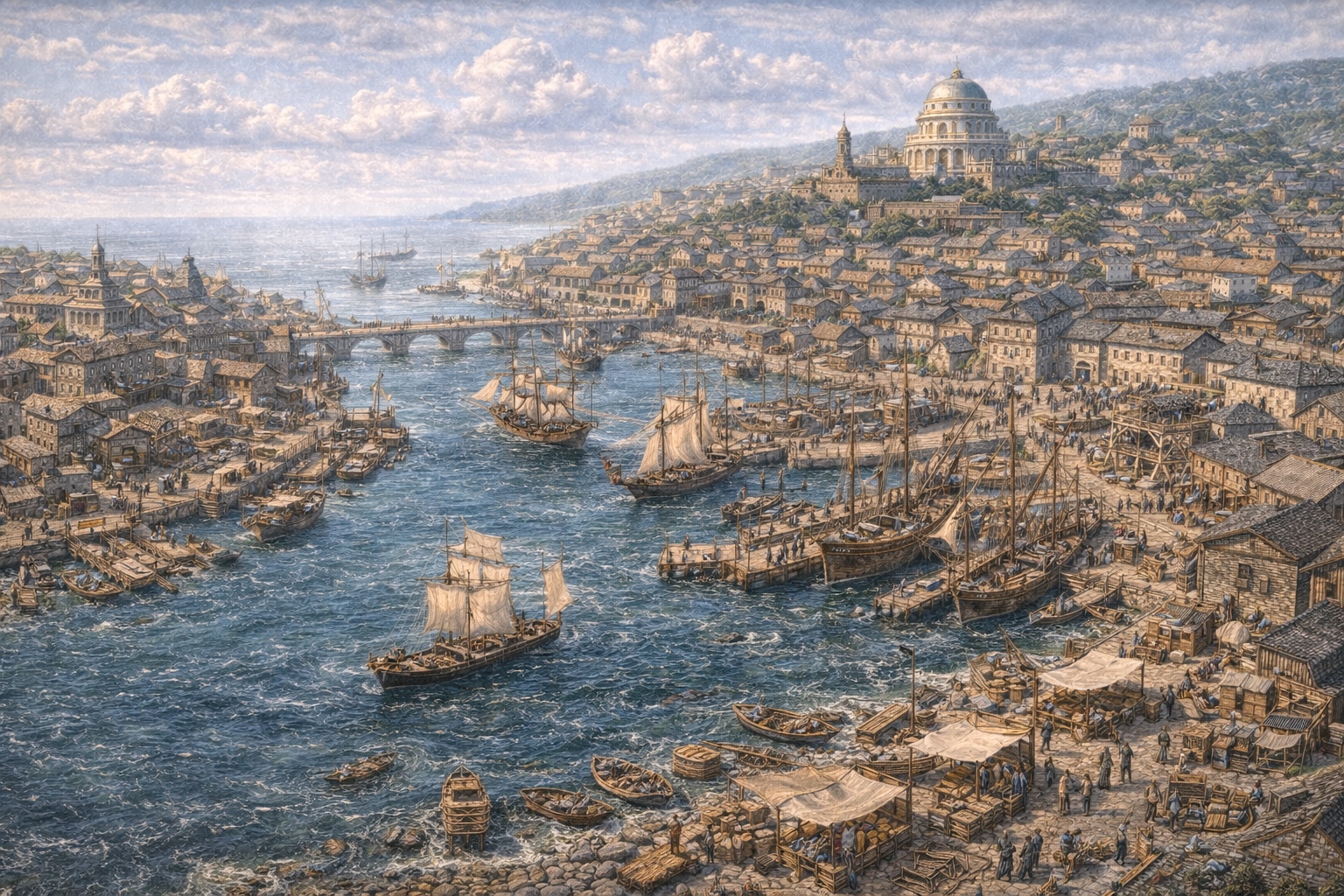
Zulie is audible before it is visible. The river traffic on the Castano's final approach (barges, fishing boats, ferries, the occasional flat-bottomed grain carrier) creates a constant noise of commerce that carries downstream for miles. By the time the city's skyline appears, the river is already crowded.
The harbor is not one harbor but three: the River Terminal, where Castano River traffic arrives and departs; the Deep Harbor, where the ocean-going vessels of the Amnyth's Sea trade dock; and the Fisher's Shore, which handles the local fishing fleet and the smaller coastal traders. Each has its own character and its own market district attached. The result is a city that feels like three ports that grew together and became something larger than any of them intended.
The streets behind the harbor districts are dense and purposeful. Zulie does not have a great deal of scenery: there are no cliffs to stand on, no dramatic views, no single defining architectural feature. What it has is depth: layers of commerce, culture, and history compacted into a city that has been the dominant economic force in eastern Antaea for two centuries. The Grand Consulate building is the closest thing to monumental architecture: a broad-fronted stone structure facing the central plaza, designed to convey authority without intimidation, which is exactly what the Confederation's founding compromise required.
The people are various, fast-moving, and commercial in their basic social grammar. Zulie receives more visitors per year than any other city in Antaea east of the Heavens Sphere, and it processes them efficiently. A stranger with coin and a purpose is welcome; one with coin and no clear purpose is watched; one without coin is directed to the Harbor Relief station and not mistreated.
Geography & Setting
Zulie sits at the precise point where the Castano River meets the eastern coast of Antaea, opening into Amnyth's Sea. This position is the source of everything; the city exists because this is where river commerce transitions to maritime commerce, and that transition requires infrastructure, services, and administration. The natural geography created the opportunity; the merchant families who founded the city created the institutions.
The terrain is flat coastal lowland, warm temperate in climate: the warmest and most agriculturally productive region of the Confederation. The river provides fresh water; the sea provides fish, trade access, and the maritime connection that makes Zulie's commerce possible. The city has expanded along both banks of the Castano's final reach, connected by three bridges and the river ferry system that operates continuously.
The city's hinterland, the farms and smaller settlements of the Castano valley, provides the agricultural base that feeds Zulie's population and generates the surplus goods that flow downstream to the city's markets. The relationship between Zulie and the valley settlements is mutually dependent; the valley produces, Zulie markets, and the revenue flows in both directions.
The People
Demographics
Zulie is the most diverse settlement in Antaea in absolute terms, a consequence of two centuries as a commercial hub that draws people from every direction. Humans are the plurality but not the majority in any strict sense. Half-Elves are unusually represented; Zulie's mercantile culture produces a great deal of cross-cultural contact, and the city's population reflects this over generations. Smalings are deeply embedded in the small-merchant, courier, and intelligence-gathering communities. Dwarves run the banking and accounting institutions. Gnomes are over-represented in engineering, manufacturing, and the administrative bureaucracy. Elves tend toward the legal, archival, and scholarly functions.
The city's visitor population is enormous and rotating: traders from the Castano valley, maritime merchants from across Amnyth's Sea and beyond, diplomatic missions from Confederation members and external parties, and the constant flow of people who come to Zulie to do business and leave when it's done.
Economy
Zulie's economy is built on the intermediary function: the transition point between river commerce and maritime commerce requires loading, unloading, storage, sorting, financing, insuring, contracting, and administering all goods that pass through. Each of these functions generates revenue. The city also manufactures (processed goods, textiles, preserved foods, metalwork) and exports both its own production and the goods of the Confederation's interior. The banking sector is the most sophisticated in Antaea east of the major cities; Zulie's financial institutions provide letters of credit accepted throughout the continent.
Primary Exports
- Castano valley agricultural goods: Grain, hardwood, tropical fruits from the Moriche region, processed foods; Zulie is the terminus for everything produced in the river valley
- Manufactured goods: Textiles, preserved foods, finished metalwork; Zulie's manufacturing capacity is the largest in the Confederation
- Financial services: Letters of credit, insurance contracts, trade financing; the Zulie banking sector's paper moves commerce throughout Antaea
- Confederation administrative authority: The legal and governance infrastructure of the Zulie River Confederation is based here; membership services, dispute resolution, and political representation are all centrally administered
Primary Imports
- Maritime goods: Spices, luxury items, specialized materials from across Amnyth's Sea and beyond; Zulie is the entry point for maritime imports into the eastern Antaean interior
- Raw materials: Iron, stone, specialized agricultural inputs; the manufacturing economy requires constant material input
- Skilled workers: The city's growth requires constant influx of craft and technical skills it cannot fully produce internally
Key Industries
- Trade intermediary and logistics: The foundation; everything else is built on the river-to-sea transition function
- Banking and financial services: The most sophisticated in eastern Antaea; Dwarf-led institutions with continent-wide reach
- Manufacturing: Textiles, processed foods, metalwork; significant industrial capacity
- Confederation administration: The political hub of the Confederation; administrative services generate substantial institutional revenue
Food & Drink
Zulie's food culture is the most varied in Antaea east of the Heavens Sphere, a consequence of two centuries of immigration. The river district's food stalls serve cuisine from every Confederation settlement and several from outside. The deep harbor district has maritime food cultures from across Amnyth's Sea. The wealthy residential quarter has restaurants that import ingredients from across the continent. The Harbor Relief station provides basic sustenance to those without means.
The city's signature drink is a light wine produced from grapes grown in the Castano valley's warmer reaches, a product that has become associated with Zulie specifically and is now one of its recognizable exports. The banking houses serve it at contract signings.
Culture & Social Life
Zulie's culture is mercantile and cosmopolitan; diversity is not just tolerated but practically useful, because a city that processes commerce from every direction needs people who understand every direction. The social framework is built on contract, credit, and reputation rather than hereditary status; what matters in Zulie is whether your word is reliable and your accounts are current.
The Confederation Assembly, held in Zulie four times per year, is the city's most significant recurring social event, concentrating the political and commercial leadership of the eastern Antaean alliance network into the city for several days and generating the negotiation, alliance-building, and deal-making that keeps the Confederation functional.
Festivals & Traditions
The River Opening
Held in spring, when the river traffic resumes full volume after the quieter winter months. The formal opening of the full trading season, marked with a public ceremony at the River Terminal where the Grand Consul signs the year's first cargo manifest. The ceremony is followed by a market festival that runs for three days. It is the closest thing Zulie has to a civic identity celebration.
The Founding Day of the Confederation
Annual observance on the anniversary of the Confederation's founding agreement. A formal political ceremony in the Grand Consulate, followed by public celebration in the plaza. The reading of the founding charter is shorter than at Santo Rey's Concordat Day but covers similar territory. The commercial community uses the occasion for contract signings of symbolic significance.
Music & Arts
Zulie's cultural life is varied enough to support professional music, theater, and visual arts at levels other settlements cannot. The central plaza hosts public performance regularly. The city's arts institutions are merchant-funded rather than religious or governmental; the banking houses and major trading firms sponsor concerts and exhibitions as a form of social credibility. The result is a cultural scene that is high-quality, commercially minded, and somewhat lacking in the kind of art that prioritizes truth over saleability.
Religion
Primary Faith
Talbar, deity of knowledge and commerce, is the primary faith of Zulie in a thoroughly institutional sense: the major temple is physically adjacent to the Central Exchange, the priests function as the city's most trusted notary corps, and the doctrine of honest dealing under Talbar's witness is the foundation of Zulie's commercial reputation. The high priest of Talbar holds a seat on the Grand Consulate's advisory council. The faith is practical, respected, and genuinely believed by most of the merchant community.
Secondary / Minority Faiths
Amador, deity of love and passion, is the most popular personal faith among the general population; Zulie's cosmopolitan culture produces a lot of cross-cultural relationships that find Amador's domain relevant. Bridhel, goddess of music and poetry, is supported by the arts institutions. Echo is observed by the agricultural and logistics merchant community that depends on the Castano valley's production: stability, fair distribution, and "the river keeps running" as a civic virtue. Ryujin, deity of the sea, is maintained by the maritime trading community in the deep harbor district.
Secret or Forbidden Worship
A small, quiet network devoted to Zopha operates under the city's commercial surface: not as a public school or library, but as an information-exchange of ledgers, shipping intelligence, and political rumor. It is less a cult of ecstasy than a cult of useful truth: people with access to records who have decided that knowledge is safest when shared only with those who can keep it. The Grand Consul does not know about it. His Chief Magistrate does.
History
Founding
Zulie was established by a consortium of merchant families who recognized that the Castano River terminus was the natural location for a permanent trading infrastructure. The founding families negotiated a governance agreement (the earliest form of what became the Grand Consulate) and began the systematic development of the harbor infrastructure within the first decade. The Confederation grew around Zulie rather than Zulie joining the Confederation; the city's economic gravity attracted the river valley settlements into a formal relationship over three generations.
Key Events
The Castano Compact
The foundational agreement of the Zulie River Confederation, negotiated over two years between the Castano valley settlements and the Zulie merchant families, established the commercial and political relationship that defines the Confederation. It is a careful balance between Zulie's dominance and the valley settlements' autonomy; every Grand Consul since has had to manage this balance.
The Banking Reform
A century ago, following a crisis in which three major trading firms failed simultaneously and their collapse threatened dozens of smaller operations, the Grand Consulate established the Zulie Banking Compact, the regulatory framework that governs the financial sector. The Compact introduced reserve requirements, mandatory insurance pools, and the letter of credit standardization that made Zulie's financial paper reliable across the continent. The Dwarf banking families consider this the city's most significant institutional achievement.
The Orinokia Dispute
Forty years ago, a boundary and river access dispute between Zulie and Orinokia, a significant settlement upstream on the Castano, nearly fractured the Confederation. The negotiation that resolved it established several precedents about the Confederation's internal dispute resolution mechanisms and created the Assembly consultation requirement that now governs major policy decisions. Grand Consul Elias Marcantore's grandmother was the Grand Consul who resolved it; he grew up with the negotiation transcripts as family reading.
Current State
Zulie is at peak prosperity but managing several pressures simultaneously. The Moriche Rainforest settlements, Maxan and others, are requesting increased Confederation involvement in their security situation, which would require military expenditure the Confederation has not historically maintained. The Sonoro harbor toll system is generating diplomatic friction with northern trading partners. And Grand Consul Marcantore is in his third consecutive term, which is two more than the Compact's framers intended as a norm; the question of succession and who will follow him is producing maneuvering in the commercial elite that he is managing carefully.
Leadership & Governance
The Grand Consulate: Overview
The Grand Consulate is an elected body of eleven members: seven representing the city's commercial districts, two representing the Confederation's other settlements, and two at-large civic members. The Grand Consul is elected from within the Consulate by the Consulate members and serves three-year renewable terms. The current Compact limits consecutive terms to two; this limit was not enforced when Marcantore's second term ended because the Assembly did not reach consensus on a successor.
Grand Consul Elias Marcantore
Human, Male: The Grand Consulate chambers; the Exchange floor on market days; everywhere else by proxy
Elias Marcantore is sixty-two years old, in his third consecutive term, and widely acknowledged as the most effective Grand Consul the Confederation has had in living memory. He is also a political fact that the governance structure did not anticipate, someone competent enough that removing him would be visibly costly, but whose continued tenure is eroding the procedural norms that make the Consulate legitimate.
He is aware of this tension and is managing it in the way he manages everything: through precise understanding of who wants what, how much they want it, and what he has that they need. He intends to retire at the end of his current term. He has said this before.
His current primary concern is not political; it is the Moriche security situation, which he believes is more serious than his military advisors are telling him, and the Oshala cult, which his Chief Magistrate has briefed him does not exist and which he suspects does exist and is more senior in membership than anyone is comfortable acknowledging.
Chief Magistrate Orvina Castlebrook: Chief Legal Officer
Half-Elf, Female: The Consulate judicial wing; the city court
The city's senior legal officer and the effective head of its administrative machinery. Orvina has served under Marcantore for sixteen years and is the single most capable administrator in the Confederation by most assessments. She runs the city's day-to-day governance while Marcantore manages the political landscape. She knows about the Oshala cult. She has made a careful calculation about when and whether to tell Marcantore. The calculation is ongoing.
Guard & Militia
The Zulie Guard is the largest professional security force in eastern Antaea, a force of two hundred and fifty officers covering the harbor districts, the market, the Consulate, and the residential areas. Commanded by a rotating Captain-General with a five-year term. The harbor districts have specialized port watch units; the financial district has a separate patrol funded by the banking compact. Crime in Zulie is managed rather than eliminated; the city is too large and too diverse for anything more ambitious.
Law & Order
Zulie follows the Confederation Commercial Code, the most comprehensive commercial law framework in Antaea, supplemented by Antaean common law and the city's own municipal regulations. The court system has three tiers: the commercial court (Talbar-administered, for trade disputes), the civil court (Orvina's jurisdiction), and the Consulate appeals process for major matters. The system is complex, slow in significant cases, and genuinely fair by the standards of the region.
Notable Figures
Harbor Master Pia Lightwind: River Terminal Director
Smaling, Female: The River Terminal; the Deep Harbor; wherever the scheduling problems are
Pia Lightwind runs the most complex logistics operation in eastern Antaea, the coordination of river traffic and maritime traffic through Zulie's three harbor districts. She is small, precise, and capable of maintaining awareness of dozens of simultaneous variables in a way that her staff finds quietly impressive and visitors find disorienting. She has been Harbor Master for twelve years; before that, she was a river pilot on the Castano for twenty. She knows everything that moves through Zulie and when, which makes her both essential to the Grand Consul and a person of significant interest to the Oshala network.
Master Merchant Harkon Delvaine: Senior Banker and Exchange President
Dwarf, Male: The Exchange; the Delvaine Banking House; occasionally the Consulate advisory chambers
The head of the Delvaine banking family and the president of the Central Exchange, the governing body of Zulie's financial market. Harkon is two hundred years old and has survived four Grand Consuls, three financial crises, and one attempt on his life that he has never publicly acknowledged. He is the most powerful person in Zulie who does not hold a Consulate position, and he and Marcantore have a relationship of mutual respect and careful wariness that both of them would describe as friendship with correct qualifications.
He is the senior member of the Oshala cult.
Scholar-Archivist Serryn Moonveil: Confederation Records
Elf, Female: The Grand Archive; the Talbar temple library
The Confederation's senior archivist and the person responsible for maintaining the legal record of every Confederation agreement, treaty, and Assembly decision. Serryn is three centuries old and has seen the Confederation from its second generation; she was not present at the founding but has interviewed the last people who were. She is the institutional memory of the Confederation in the way that goes beyond written records; she remembers the context, the arguments, the informal agreements that shaped the written ones. She does not involve herself in current politics. She answers questions about precedent with the precision and sometimes the weight of someone who was there when it happened.
Key Locations
Seat of Power
- The Grand Consulate: The governing center and ceremonial heart of the Confederation; a broad-fronted stone building facing the central plaza. The Assembly chamber can seat all Confederation representatives. The Grand Consul's offices occupy the upper floor with windows looking east toward Amnyth's Sea.
Houses of Worship
- The Temple of Talbar: The largest temple in Zulie; functionally also the city's primary notary office, contract registration service, and commercial court. Adjacent to the Exchange.
- The Chapel of Amador: The most visited religious site in the city by visitor count; intimate, welcoming, and open at all hours.
- The Ryujin Dock Shrine: A practical harbor-district temple serving the maritime trading community; small but actively maintained.
Inns & Taverns
- The Castano House: The premier establishment; where Confederation delegations and wealthy merchants stay. Rates that confirm you have arrived.
- The River Pilot: The working tavern of the harbor districts; where actual information about actual conditions can be obtained.
- The Confluence: The central plaza tavern; where everyone passes through eventually.
Shops & Services
- The Central Exchange: The commercial heart of Zulie; the trading floor where commodity prices are set and major contracts are executed. Open six days per week.
- The Delvaine Banking House: The senior financial institution; issues letters of credit honored throughout Antaea.
- The Grand Archive: Serryn Moonveil's operation; the complete legal record of the Confederation, open to credentialed researchers.
Other Points of Interest
- The River Terminal: The Castano River terminus infrastructure; the system of docks, warehouses, and sorting facilities that manages the river-to-sea cargo transition.
- The Deep Harbor: The ocean-going vessel facility; where the large maritime traders dock and where the Amnyth's Sea commerce enters and exits.
- The Harbor Relief Station: The city's social welfare anchor; basic sustenance and shelter, no conditions, Consulate-funded.
- The Central Plaza: The civic heart; the Consulate fronts it, the Talbar temple borders it, the public market occupies part of it, and performances happen in its central space on most evenings.
Guilds & Organizations
- The Grand Consulate: The governing body; civic and commercial combined.
- The Central Exchange: The financial market's governing institution; Harkon Delvaine's organization.
- The Confederation Merchant Assembly: The trade organization representing Confederation-wide commercial interests; meets quarterly in Zulie.
- The River Pilots' Guild: The professional organization of Castano River navigation specialists; essential infrastructure for the river trade.
- The Harbor Workers' Collective: The organization of dock and logistics workers; the largest labor organization in eastern Antaea.
The Criminal Element
Zulie's criminal element is substantial, organized, and managed with pragmatic realism by the city administration. The harbor districts have smuggling operations that the Guard has a working relationship with; information flows in both directions in exchange for limits on what is moved and how. The financial district has a fraud and manipulation element that the banking compact has partially contained; a residual operates in the spaces the compact doesn't reach. The most significant organized criminal presence operates the intelligence trade: not the Oshala cult's information network (which is ideological rather than commercial) but a parallel commercial intelligence operation that sells information about trade movements, cargo contents, and Consulate deliberations to interested parties throughout the Confederation and beyond.
Secrets, Rumors & Hooks
- The Oshala cult's senior membership includes Harkon Delvaine, three Consulate members, the head of the River Pilots' Guild, and the person who manages the Confederation Archive's restricted section. Chief Magistrate Orvina Castlebrook knows this. She has been calculating for two years whether exposing it would strengthen or destabilize the Confederation, given that half of its most effective institutions are run by members. She has not reached a conclusion.
- Grand Consul Marcantore has been conducting secret negotiations with a diplomatic contact from outside the Confederation, specifically from a power with interests in the Moriche Rainforest that he has not named to the Assembly. The negotiations concern a military assistance arrangement in exchange for trade access rights that the Confederation's founding compact does not permit him to grant without Assembly consent. He believes the arrangement is necessary and that Assembly consent is obtainable but would take longer than the situation allows. He is wrong about one of those two things.
- The Castano River has been changing. The River Pilots' Guild has documented a gradual shift in the river's channel over the past twenty years, a slow movement of the primary current toward the northern bank. If the trend continues at the current rate, the River Terminal's southern docks will be significantly less accessible within thirty years. Pia Lightwind knows this. Harkon Delvaine knows this. The Consulate does not know this, because neither of them has decided how to present information that would require a thirty-year infrastructure investment without triggering the political argument about who pays for it.
- The banking reform a century ago resolved a crisis triggered by three simultaneous firm failures. What is not in the public record is that the failures were not simultaneous by accident; they were triggered by a coordinated action whose purpose was to force the regulatory reform that the Delvaine family had been unable to achieve through normal political channels. The Delvaine family archive contains documentation of this. Harkon Delvaine has read it. He has decided that the reform was worth the method and that he would make the same decision. He considers this an Oshala question and has addressed it accordingly.
- Serryn Moonveil has found, in the archive's oldest physical records, a document that predates the Confederation founding by approximately fifty years. The document appears to be a land survey (specifically, a survey of the area where Zulie now stands) that identifies the land as belonging to a community whose name does not appear anywhere else in the Confederation's records. The survey suggests this community occupied the land for at least a century before the founding merchant families arrived. Serryn has been trying to determine what happened to this community. She has found no subsequent records. This is itself the most significant piece of evidence.