Anchor Dragon
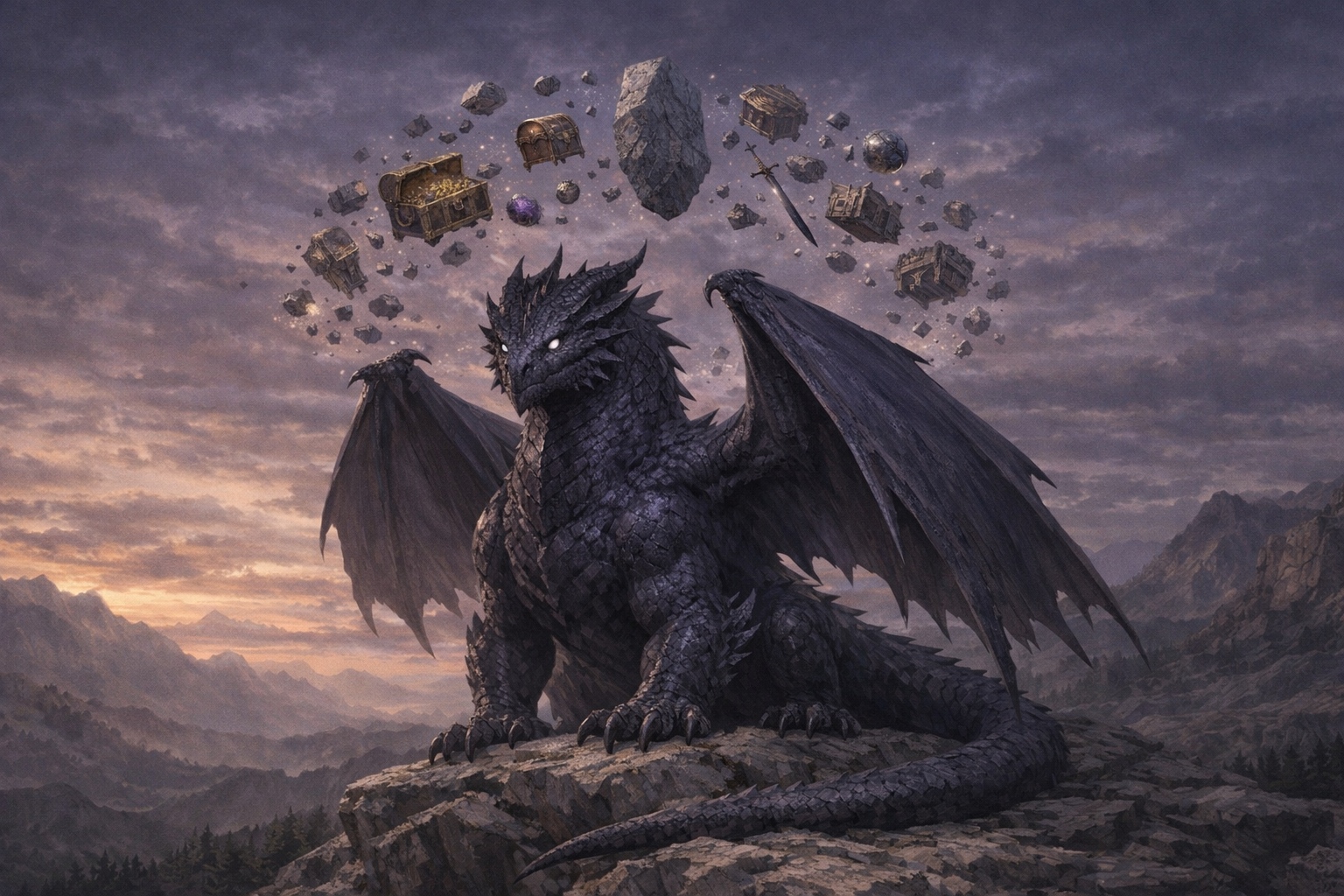
Anchor Dragon
"The ground was pulling at us; that is the only way I can describe it. Not sucking us down, not the normal weight of things. The air was thick with it. My companion lifted her arm and it took visible effort. One of the horses simply lay down and could not be made to rise again. The center of it, whatever it was, was somewhere ahead of us. We did not go ahead."
Partial journal entry, recovered from an abandoned camp near the Vel Plateau, [Irna](Irna/Welcome to Irna)
IDENTIFICATION
- Common Name: Anchor Dragon
- Plural Form: Anchor Dragons
- Alternate Names: Weightkeeper (rare scholarly usage); Gravewyrm (inaccurate folk term from communities that encountered its territory without understanding the mechanism; the deadness of the landscape was attributed to death magic); Soleth Vorah in an old [Antaea](Antaea/Welcome to Antaea) dialect, meaning roughly "the one the world bends toward"
- Classification: Dragon
- Sub-Classification: Elemental Apex, Gravity Plane-Affiliated
- First Recorded Observation: The most significant early description is in the Philosophical Catalogue of Forces by the [Irna](Irna/Welcome to Irna) natural philosopher Deth Coranthis, who documented a zone of anomalous gravitational behavior in the northeastern highlands without identifying the cause. The connection to a living creature was made over a century later by a scholar who visited the same region and found the lair.
OVERVIEW
At a Glance
The Anchor Dragon does not breathe fire or water or compressed air. It does not need to. It controls gravity in the space around it (increasing it, removing it, or reversing its direction), and this control is precise enough to serve as weapon, defense, and method of displaying the material it hoards simultaneously. The Anchor Dragon's presence is felt before it is seen, in the way the body grows heavy or the footing unexpectedly fails, in the way objects fall sideways or hang suspended without support. It is the most conceptually alien of the seven types in its capabilities, and encounters with it are described as experiences that disturb the relationship with the physical world rather than simply as dangerous meetings with a large predator.
Role in the Ecosystem
The Anchor Dragon's gravity manipulation reshapes its territory's ecology through a mechanism no other organism uses. The zone of elevated gravity maintained around its lair suppresses the mobility of any creature not adapted to the field, creating a continuous predation pressure on species that cannot compensate for the weight increase. Over time, this selects for organisms in the territory with unusually robust musculature and bone density, or with behavioral strategies that keep them out of the high-gravity zone. The area directly beneath a long-term Anchor Dragon lair is ecologically specialized; it contains fauna found nowhere else that have been shaped by generations of unusual gravitational pressure. The zero-gravity and inverted-gravity zones the dragon occasionally creates are ecologically disruptive and transient, but their aftereffects (objects deposited in impossible locations, soil disturbance patterns, the occasional animal found suspended far from its natural range) persist in the landscape.
General Reputation
Deeply unsettling. Communities that have experienced the territory of an Anchor Dragon describe a fundamental disorientation that is difficult to articulate, the violation of the most basic sensory assumption about how the world behaves. Most mortal beings relate to gravity the way they relate to breathing: it is not thought about, it is simply the condition of existence. The Anchor Dragon removes this certainty from its territory, and the psychological effect is disproportionate to the danger. Experienced travelers who have crossed Anchor Dragon territory and survived describe the experience as harder to recover from than encounters with other dragons that were more conventionally dangerous.
PHYSICAL DESCRIPTION
General Appearance
The Anchor Dragon is unusual among the seven types for its variability in size. It adjusts its own mass and density through the same gravity-plane affinity that allows its external manipulation; it can become denser and more compact, or expand to a larger, less dense form. The range runs from comparable to a Gale Dragon at the small end to approaching Ore Dragon proportions at the large end; most individuals maintain a preferred "default" form that falls in the middle of the range, comparable to a large adult Ember Dragon. This size variability means that physical description is necessarily approximate.
In its typical form, the Anchor Dragon is proportionally balanced: not the extreme forms of the Gale Dragon's wing-to-body ratio or the Tide Dragon's sinuous elongation, but a form closer to the canonical dragon body plan than any other type. It is heavily built in proportion to its length, with the sense of compacted density that its biology produces. The wings are proportional and functional across the range of sizes; at smaller, denser forms the flight is fast and maneuverable; at larger, lighter forms the flight is slower but more extended.
The coloration of the Anchor Dragon is notable for its depth rather than its pattern: a deep, near-purple dark hue on the dorsal surface, shading through to a slightly lighter but equally saturated ventral tone. The scales have an unusual visual property: they do not scatter light the way most surfaces do, but appear to absorb it, giving the body a quality that makes it difficult to resolve at range, not through camouflage but through a perceptual flatness that the eye struggles to bring into focus. The eyes are the exception: pale, with a slightly silver quality, and immediately visible against the dark body.
Size and Dimensions
- Typical length/height: Highly variable; typical maintained form 20 to 28 meters in body length; can contract to approximately 14 meters at maximum density or expand to approximately 40 meters at minimum density
- Typical weight/mass: Variable by the same mechanism. The dragon's actual mass appears to be something like a fixed quantity that can be redistributed through density change; "light" expanded form and "heavy" compressed form represent the same total material differently organized
- Notable scale reference: In compressed form, the Anchor Dragon's body is noticeably heavier than its apparent size suggests; things near it feel the gravitational effect before it is visible, and the ground under its feet shows depression inconsistent with its visible bulk
Distinguishing Features
The gravitational field it generates is the single most distinctive feature, more useful for identification than any physical characteristic. The expanded or contracted size shift, visible over the course of an encounter as the dragon adjusts its form, is unique among the dragon types. The scale's light-absorbing quality, the visual flatness that makes it difficult to resolve at range, is a secondary physical identifier.
Sensory Apparatus
The Anchor Dragon perceives gravitational fields as a primary sense. It reads the gravitational topology of its environment (the mass distribution of objects, the density gradients in the substrate, the movement patterns of anything with significant mass) with the same precision that other creatures read light or current. This gives it a comprehensive awareness of its environment that is not dependent on conventional sight or sound. It knows where everything heavy is, how heavy it is, and what direction it is moving. Its conventional senses are functional but secondary to gravity-perception. It appears to have limited ability to perceive the Gravity Plane directly, in ways that naturalists have described as a form of "distance sense", an awareness of mass-event relationships not available to any other observer.
BIOLOGY
Diet and Feeding
The Anchor Dragon is carnivorous and hunts using gravity manipulation as its primary tool. Prey is immobilized by selective application of high gravity to its position (the target animal is pinned to the ground by a force multiplier it cannot move against) while the Anchor Dragon approaches at its leisure. Alternatively, prey can be lifted by zero-gravity application, removed from the ground cover that might have protected it, and released from height. The dragon's physical capabilities are fully functional for the kill once the prey is immobilized or repositioned. Feeding signs are unusual: kill sites sometimes show evidence of the prey having been suspended at height before death, with the fall impact visible in the remains.
Reproduction and Life Cycle
The Anchor Dragon's once-in-a-lifetime reproductive cycle follows the general pattern. The female's behavioral change during ovulation is an intensification of the gravitational field around the lair to what might be described as extreme exclusion: the field becomes strong enough that approach to the lair is physically impossible for any creature not adapted to the gravity effect, creating a biological quarantine that functions more absolutely than any other nesting protection behavior in the natural world. Hatchlings emerge in the high-gravity field and are, from birth, capable of managing their own small-scale gravity effects; they must be, because the lair's field would otherwise be lethal to them.
Lifespan and Development
- Juvenile period: Several decades. The juvenile Anchor Dragon's gravity manipulation is limited in radius and force, and develops gradually. Young individuals are most dangerous in the specific area around them but have not yet developed the extended-radius effects of adults.
- Typical adult lifespan: Biologically unlimited. An ancient Anchor Dragon would be extraordinary: its gravitational field extended to enormous radius, its size variability potentially ranging further in both directions than younger individuals.
- Elderhood: The orbital hoard of an ancient individual, objects maintained in gravitational suspension, would be significantly more elaborate and extensive than a younger individual's collection, representing centuries of accumulated material in perpetual orbit around the lair site.
Relationship to Magic
Gravity Plane affiliation is the most complete of any dragon type in the sense that the Anchor Dragon's primary capabilities are all expressions of this plane rather than supplementation of biological functions. The gravity manipulation is not assisted by gravity-plane energy; it is gravity-plane energy directed through the dragon's awareness. Arcane magic in the vicinity of an Anchor Dragon is affected by the gravity field: magical effects that involve projectiles or physical displacement are subject to the same gravitational variation as any other physical phenomenon. Direct magical attack is not specifically disadvantaged relative to physical attack, but the spatial disorientation produced by the field, the inability to predict which way is "down" at any given moment, makes controlled magical work extremely difficult for practitioners within the radius.
Environmental Adaptations
The Anchor Dragon's environmental adaptation is recursive: it adapts its environment to itself through the gravity field rather than adapting its body to a fixed environment. The five-fold gravity field maintained around the lair is not merely a territorial marker; it is the environment the animal is most comfortable in, the field it regulates and inhabits. Its biology functions across a range of external gravity conditions that would be fatal to most organisms, from near-zero to significantly elevated above normal. This makes it functionally capable of operating in more environments than any other dragon type; there is no terrain condition that gravity variation alone makes uninhabitable for it.
BEHAVIOR
Intelligence and Cognition
Full dragon intelligence, with a distinctive quality that observers describe as the most methodical of the seven types. The Anchor Dragon appears to think in terms of forces and relationships rather than positions and movements; it is always aware of what everything near it weighs, how it is moving, and what happens if the force acting on it changes. This produces a cognitive profile that is highly predictive and strategic, capable of planning the spatial manipulation of a complex engagement several steps ahead.
Social Structure
Solitary throughout adulthood. The Anchor Dragon's territorial expression, the gravity field, is particularly absolute as a boundary marker because it is physically experienced rather than merely signaled. Another Anchor Dragon attempting to enter established territory does not need to read tracks or scent marks; it feels the field change at the boundary.
Territory and Range
Territory is physically defined by the gravity field, which extends outward from the lair to a radius that represents the boundary of maintained field effect. Within this radius, the ground is effectively the dragon's, and everything in it is subject to gravity variation at the dragon's discretion. The field does not end sharply; there is a gradient zone at the boundary where the effect diminishes to the undetectable. The size of this territory scales with the age and power of the individual.
Daily and Seasonal Patterns
The Anchor Dragon's activity does not show strong light-cycle or seasonal patterns in the way that temperature-sensitive or prey-availability-dependent behavior does. Its hunting is opportunistic (it is always aware of prey moving in its territory) and does not require the active search behavior that other predators use. Prey comes to it, in the sense that the territory is large enough to contain sufficient prey animals, and the dragon simply monitors and acts when it chooses.
Hunting, Feeding, or Foraging Behavior
The Anchor Dragon hunts by waiting in the knowledge that its territory contains everything it needs. When it selects a target, the gravity manipulation is the hunt: high-gravity application pins the target before any physical approach is made. The dragon then approaches at whatever pace it prefers. Against more sophisticated prey (organized groups, armed parties) it uses gravity variation tactically, applying different field strengths in different zones of the engagement simultaneously to isolate, confuse, and neutralize threats independently. A party that finds itself in an Anchor Dragon engagement is experiencing a situation where the rules of physical combat no longer apply uniformly.
Communication
Dragon tongue, with no specific adaptation for its gravity manipulation capabilities; it communicates with others of its kind through the same vocalization and subsonic resonance as all types. The gravitational field itself communicates territorial presence to other Anchor Dragons through the simple fact of detection.
HABITAT AND RANGE
Primary Habitat
The Anchor Dragon does not have strong environmental requirements beyond the stability needed to maintain its lair over time. It has been found in mountain regions, high plateaus, deep forests, and coastal terrain, distinguished less by the environment itself than by the gravity field that surrounds its lair. The lair location tends toward positions with natural exposure (hilltops, cliff faces, elevated terrain), which gives the orbital hoard the visibility the dragon appears to prefer, and provides the approach distance that allows the gravitational field to function as a graduated deterrent.
Geographic Distribution
The Anchor Dragon appears to have the most even distribution across Dort's landmasses of any dragon type, which may reflect its lack of specific habitat requirements. Confirmed territories are found in [Irna](Irna/Welcome to Irna)'s highlands, the interior plateaus of [Antaea](Antaea/Welcome to Antaea), and the elevated regions of [Shoing](Shoing/Welcome to Shoing). The deep deserts of [Jazirah](Jazirah/Welcome to Jazirah) have reported anomalous gravity zones that may indicate territory there as well.
Lair and Den Characteristics
The Anchor Dragon's lair is surrounded at all times by a maintained gravitational field approximately five times normal strength, extending outward from the lair to a significant radius. This field is permanent (it does not fluctuate except during encounters where the dragon is deliberately varying field strength for tactical purposes), and it is the first and most reliable sign of lair location. Entering the field without extraordinary preparation produces progressive immobilization as the effective body weight increases to the point where movement is impossible; most animals caught in the high-gravity zone cannot escape under their own power.
Above the lair, in the zero-gravity and adjusted-field space that the dragon maintains separately from the high-gravity perimeter, the hoard floats: a constellation of objects in permanent gravitational suspension, orbiting the lair site in patterns determined by the Anchor Dragon's aesthetic and organizational preferences. These objects range from small personal items to large structural pieces, all maintained in careful suspension at varying distances and orbital speeds. The effect, seen from outside the gravity perimeter, is of a slowly rotating collection of objects hovering in the air above an unremarkable landscape: strange enough to identify at range, and specific enough in character to distinguish from any other unusual aerial phenomenon.
THREAT AND DEFENSE
Threat Response
The Anchor Dragon's engagement threshold is crossed by presence in the high-gravity territory or approach to the lair. Unlike some other types, its response to detection of an intrusion is not immediate physical action; it first applies the graduated gravity increase that is simultaneously an alarm, a deterrent, and a non-lethal demonstration of capability. If the intruder does not withdraw, the response escalates to active gravity manipulation directed at the specific target. The sequence from "you feel heavier" to "you cannot move" to "the ground is no longer below you" can occur over seconds or minutes depending on the dragon's assessment of the situation.
Offensive Capabilities
The gravity field manipulation is the primary weapon system and has no conventional parallel. High-gravity application prevents movement, then prevents breathing (as the weight of the chest wall becomes too great for the respiratory muscles to overcome), then produces structural failure of the skeletal system at sufficient extremes. Zero-gravity application removes the anchor to the ground and allows the dragon to reposition a target at will, including to height, and to release it. Gravity direction reversal drops a target "up"; this is the most immediately disorienting capability and produces outcomes that other methods cannot replicate. Throughout all of this, the dragon's physical body remains available as a weapon of normal dragon scale: the claws, tail, and jaws of any dragon this size are independently capable of destroying most things. The Anchor Dragon's preference, however, is to not use these until gravity manipulation has removed the target's ability to respond.
Defensive Adaptations
The gravity field is defense as well as offense; the five-fold field around the lair means that conventional assault requires either extraordinary physical conditioning to operate in, or magical means of countering the field. The dragon's own density-adjustment capability means that it can make itself dramatically harder to move by physical impact by increasing its own gravitational commitment. Its ability to apply zero-gravity to itself as a flight enhancement means it can escape from ground engagement far more quickly than its apparent body plan suggests.
Known Vulnerabilities
The gravity manipulation requires continuous attention; the Anchor Dragon is managing a spatial field while simultaneously operating as a physical entity, and disruption of its concentration disrupts the field. Engagements that require the dragon to respond to simultaneous threats from multiple directions, each requiring different field responses, appear to impose cognitive load that degrades the precision of the manipulation. Accounts of successful engagements with Anchor Dragons consistently emphasize overwhelming complexity rather than raw force: more threats than it can process simultaneously, in more spatial locations than the field management can address at once. Physical capabilities that exceed the ability of enhanced gravity to counter (magical force, siege-weapon scale impact) can also cause the dragon to shift from managed engagement to reflexive response, which is less tactically sophisticated.
Disengagement and Flight
The Anchor Dragon can simply stop holding the field at the high-gravity setting and fly away, leaving its territory faster than pursuit is possible. It may reduce the orbit of its hoard before departing (drawing the suspended objects closer to the lair or taking specific items with it), which takes time and provides a limited window of opportunity for those who understand what the behavior indicates.
TRACES AND SIGNS
Physical Evidence
The most direct physical evidence of an Anchor Dragon territory is the gravitational anomaly itself, measurable and distinct from any geological cause. The orbital hoard, if the lair is occupied, is visible from distance: objects floating in an organized pattern in the air above an otherwise unremarkable location, maintaining their positions or slowly orbiting through patterns that no wind or current could account for. The ground beneath the high-gravity field shows long-term compaction significantly beyond what the environmental conditions would produce. Objects that have been in the zero-gravity field or subjected to gravity reversal are often found in impossible positions: things resting on the undersides of ledges, wedged into ceiling cracks of caves, deposited in places accessible only from above.
Environmental Disturbance
The high-gravity perimeter produces distinctive ecological effects over time. Vegetation in the zone shows characteristic forms: plants that have adapted to increased gravitational load develop shorter, stouter structures than their unaffected relatives; root systems are more extensive. Animals native to the territory exhibit the bone density and musculature characteristics of high-gravity adaptation after generations of selection. The soil compaction beneath the lair creates a drainage characteristic that produces visible differences in vegetation density from aerial observation. Animals that died in the field and could not be removed by scavengers (the weight too great, the scavengers too deterred by the field) leave skeletal remains in the high-gravity zone that accumulate over decades.
Behavioral Indicators
Animals in or near an Anchor Dragon's territory move with deliberate economy (avoiding the higher-gravity zones through learned or instinctual behavior) and show the characteristic high-gravity adaptation behaviors of animals that have existed in the territory for generations. Travelers' animals entering the territory from outside show the distress response of an animal encountering an unexplained weight increase: stumbling, reluctance to proceed, eventually refusal to continue forward. Birds avoid the airspace above the lair's orbital hoard, not because of a direct threat response but because the zero-gravity and inverted-gravity zones above the lair create air currents unpredictable enough that even casual flight in the area is hazardous.
Auditory and Sensory Indicators
There is no sound associated with the gravity field itself. The most distinctive sensory indicator for the unprepared is the physical sensation of increased weight, a gradual onset of heaviness that is initially ambiguous (easy to attribute to fatigue, to altitude, to carrying load) and becomes unambiguous as the gradient increases. Gravity reversal produces a stomach-orientation sensation that experienced explorers describe as immediately recognizable once encountered: the visceral sense that "down" is in a new direction, accompanying a sudden change in vestibular reference. There is also a visual indicator at the hoard: the objects in suspension, caught in whatever light conditions exist, produce occasional glints and slow rotations that attract the eye at range before their nature is understood.
IN-WORLD KNOWLEDGE
Scholarly Understanding
The Anchor Dragon is among the most theoretically interesting of the seven types for natural philosophers, because its capabilities require engagement with questions about the fundamental nature of gravity: whether it is a fixed property of the physical world, what relationship the Gravity Plane has to the observable world's physics, and how a biological organism can interact with this relationship. These questions are not answered. The capability is documented; the mechanism is not. Scholarly work on the Anchor Dragon is in many ways a catalogue of observations that resist explanation under any current theoretical framework.
Folk Knowledge and Tradition
The floating-objects sign is the most widely known folk indicator; communities in Anchor Dragon territories have specific terms for the lair-hoard phenomenon and treat sighting it as an immediate signal to change direction and maintain that change for at least a day's travel. The heavy-air feeling associated with approaching the high-gravity perimeter is treated in folk tradition as a supernatural warning, "the land saying no" in one [Irna](Irna/Welcome to Irna) highland tradition. The practical guidance embedded in these traditions is sound: they direct people away from the territory, which is the correct response. The theoretical framework (the land has a will, the heavy air is a warning from ancestors, etc.) is culturally meaningful but not biologically accurate.
Known Uses
The biologically unique material of the Anchor Dragon is the gravity-plane tissue: specifically the organs involved in the field manipulation, which have no structural analog in any other organism. These have been used, with very limited success, in attempts to create gravity-affecting instruments. The bones, which have unusually high density even by dragon standards (reflecting the self-applied gravity compression during the density-increase state), are valued for structural applications requiring maximum strength in minimum material volume. The hoard itself, if it could be accessed, contains the most extraordinary collection of objects imaginable, a gravity-suspension museum of things someone, somewhere, has been searching for for decades or centuries.
Creature Ecology Template v1.0, Dort World