Ember Dragon
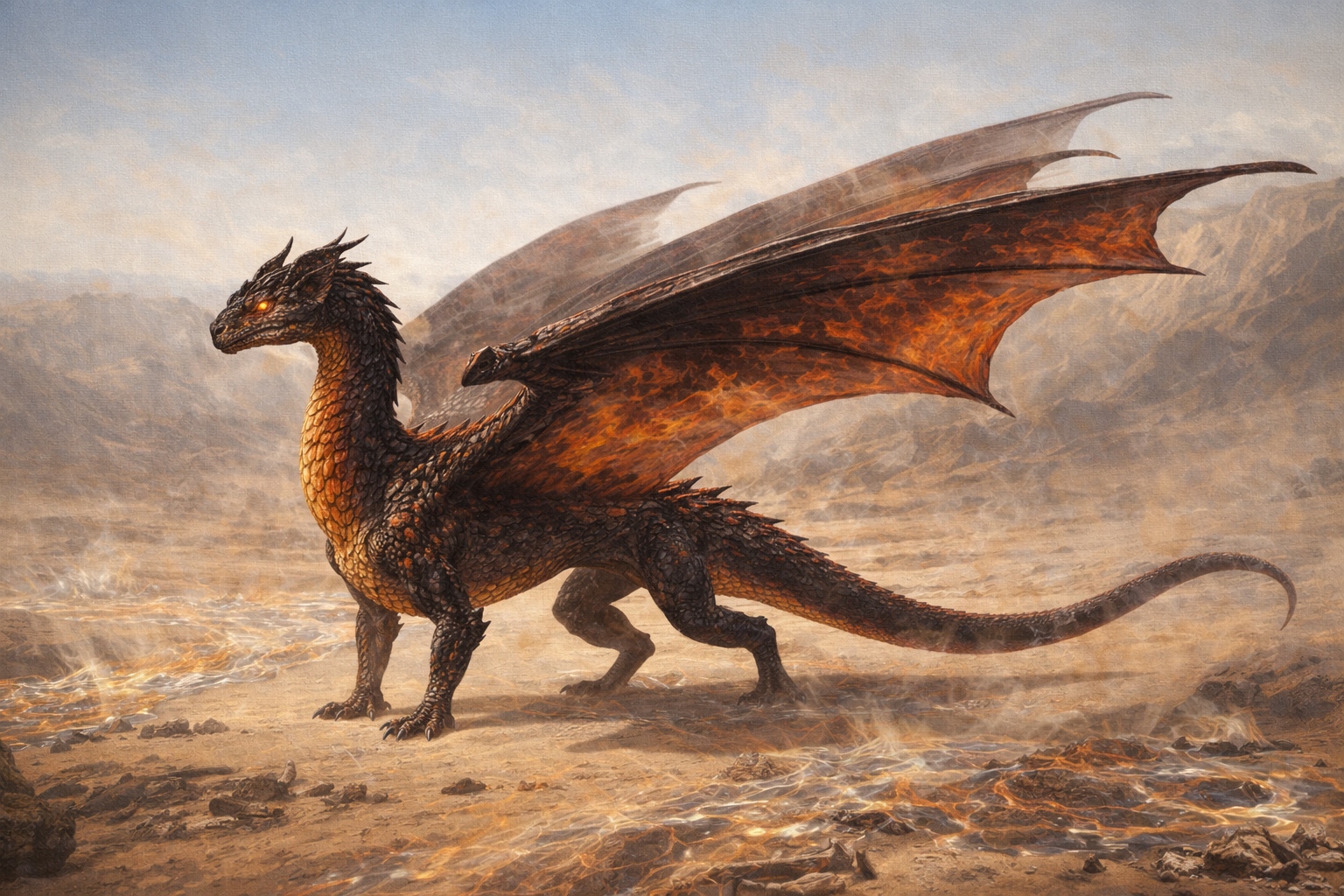
Ember Dragon
"The sands had turned to glass in a strip two hundred paces wide and half a league long. The glass was still warm when we reached it three days later. Whatever we had come to find in that desert, we turned back."
Surveyor's report, Third Cartographic Expedition into the Arad Interior, [Jazirah](Jazirah/Welcome to Jazirah)
IDENTIFICATION
- Common Name: Ember Dragon
- Plural Form: Ember Dragons
- Alternate Names: Firedrake (archaic, inaccurate; conflates with lesser creatures); Ashwyrm (derogatory, used by peoples whose lands have been overflown); Kaleth-Seran in the oldest [Jazirah](Jazirah/Welcome to Jazirah) dialect, meaning roughly "that which walks in the sun's anger"
- Classification: Dragon
- Sub-Classification: Elemental Apex, Fire Plane-Affiliated
- First Recorded Observation: Depicted in the oldest extant [Jazirah](Jazirah/Welcome to Jazirah) stonework, predating written record. Formally described in The Catalogue of Immensities by the Irnan scholar Heleth Voss, approximately 400 years ago, though the description is incomplete and contains numerous errors.
OVERVIEW
At a Glance
The Ember Dragon is the most commonly encountered of the great dragons: not because it is common, but because its territory encompasses the most traversed regions of the deep desert, and because its hunts occasionally carry it to the edges of civilization. It is a creature of devastating speed and more devastating fire, a predator at the apex of an ecosystem most living things struggle simply to survive. To see one is to understand immediately that you are witnessing something the world was not built around you.
Role in the Ecosystem
The Ember Dragon is the supreme predator of the deep desert and the surrounding arid badlands. Its hunting range is vast, and its presence suppresses the populations of every large creature within that range. Paradoxically, the desert benefits from its existence: the Ember Dragon's kills provide nutrition at points along the desert floor that would otherwise be barren, its excavations create shelter used by dozens of lesser species, and the glass formations left by its fire breath serve as landmarks, water condensers in cold nights, and habitat for organisms that grow nowhere else. The deep desert without Ember Dragons would be ecologically impoverished, though it is unlikely any desert-dweller would trade the present arrangement for the alternative if offered.
General Reputation
Fear, at a remove, and a strange respect born of distance. Peoples whose lands border the deep desert do not speak of Ember Dragons casually. They are treated as forces of nature rather than creatures, more like drought or wildfire than like predators. The [Jazirah](Jazirah/Welcome to Jazirah) interior tribes have extensive bodies of tradition around Ember Dragons: signs of passage to look for, behavioral patterns that indicate active hunting, the etiquette of vacating contested territory without appearing to flee. The scholarly consensus in most lands holds that Ember Dragons are among the more "legible" of the great dragons; their behavior is consistent, their territory is known, and they do not hunt beyond their range without reason. This legibility is cold comfort to anyone who has seen one fly.
PHYSICAL DESCRIPTION
General Appearance
The Ember Dragon is built for speed in the air and devastation in a single pass. The body is long and comparatively lean for a dragon of its scale, with a deep chest that houses its fire-generating organs and a tapered abdomen that narrows to a whip-like tail. The neck is long and flexible, allowing the head to orient independently of the body's flight path, a critical adaptation for a predator that attacks on the move. The limbs are held close during flight, minimizing drag, and the wing structure is broad at the root and swept back toward pointed tips, generating the lift-to-speed ratio that makes the Ember Dragon the second-fastest of the seven types.
The coloration of the Ember Dragon is strongly suggestive of its elemental affinity. The dorsal scales deepen from near-black at the spine, the color of cooling lava crust, through dark reds and burnt oranges to the ventral surface, which is the dull amber-orange of embers that have not yet gone cold. In direct sunlight, the scales catch light differently than organic material should, scattering it internally in ways that make the animal difficult to resolve against desert haze. The eyes glow faintly in darkness with a light the color of heated iron, requiring no external illumination to be visible.
Size and Dimensions
- Typical length/height: 18 to 28 meters from snout to tail tip; standing height at the shoulder of 5 to 8 meters; wingspan of 35 to 55 meters
- Typical weight/mass: Substantial but not at the extreme end of the dragon range; the Ember Dragon is built for speed over mass, and its skeleton and musculature reflect this
- Notable scale reference: An adult Ember Dragon can span an average village square wing-to-wing while hovering; its body, laid flat, would overhang both ends of a standard merchant barge
Distinguishing Features
The single most reliable identifier at a distance is the thermal shimmer. An Ember Dragon in flight generates enough ambient heat that the air around it visibly distorts, particularly at the leading edges of the wings and around the neck and chest where the fire organs concentrate. At night or at dusk, the eye-glow is a secondary identifier. Closer inspection reveals that the scale surfaces have a subtly irregular texture unlike any other scaled creature; they are not smooth or uniformly keeled, but have a finely cracked quality, like glaze on fired ceramics, which is a consequence of the heat the body generates internally. The breath, even between firings, smells of sulfur and heated stone.
Sensory Apparatus
The Ember Dragon perceives heat as a primary sense, overlaid on normal vision. It sees the thermal signature of living creatures as clearly as it sees their physical form, and at greater range: a large animal generates a heat profile visible to the dragon before the animal itself would be distinguishable. This thermal perception extends in all directions and is not limited by light conditions, making nighttime hunting no different in kind from daylight pursuit. Its conventional vision is exceptional by any standard, with the resolution and range expected of an apex aerial predator. Hearing is acute, though subordinate to the thermal sense. Smell plays a lesser role than in some other dragon types, but the Ember Dragon can detect the chemical signatures of prey species and water sources at significant range.
BIOLOGY
Diet and Feeding
The Ember Dragon is an obligate carnivore with a prey base that consists primarily of large desert fauna, the megafauna of the deep interior and the larger herd animals of the surrounding badlands. It does not subsist on small prey; a single kill may represent a week or more of feeding. The hunting method is typically aerial, with the dragon locating prey by thermal signature from altitude, descending in a fast pass, and using fire breath to incapacitate or kill before landing to feed. For very large prey, multiple fire passes may precede contact. The fire breath serves not only to kill but to cook, and the Ember Dragon has strong digestive tolerances for heavily charred material; it does not prefer raw meat and has been observed declining to feed on kills made by other predators until it has reworked them with fire.
Feeding signs are distinctive: the bones at a kill site will be scorched white, cleaned completely of soft tissue, and often show signs of fracture from extreme heat expansion. The Ember Dragon consumes the marrow and crushes the long bones, so intact skeletal remains are rarely found.
Reproduction and Life Cycle
As with all dragon types, reproduction is a once-in-a-lifetime event for the female. The ovulatory period for an Ember Dragon female is preceded by months of behavioral change: increased territorial aggression, expansion of range, and a marked increase in the frequency and intensity of fire-breath use, believed to be connected to the elevated internal temperatures the process requires. Males who enter her territory during this period may be attacked or may be permitted to approach; the female's choice appears to be individual-specific rather than governed by fixed behavioral rules. The clutch typically consists of three to seven eggs, deposited deep in the lair complex, in chambers maintained at temperatures exceeding those of the surrounding rock. The female does not leave the lair during incubation.
The eggs are roughly ovoid, hard-shelled, and dark-colored, easily mistaken for large rocks in the lair environment. Incubation lasts approximately one year. Hatchlings emerge already capable of producing flame, though at a fraction of adult intensity. The mother remains in close proximity for several years; after this period, the juveniles are driven off and must establish their own territories.
Lifespan and Development
- Juvenile period: Several decades of rapid growth, during which the young dragon establishes a territory and develops its fire organs to full capacity
- Typical adult lifespan: Biologically unlimited. Ember Dragons do not age to senescence. Most choose to pass to the spiritual realm after two to five centuries; those who remain continue to grow. An Ember Dragon that has persisted for a thousand years would be dramatically larger and more powerful than a young adult; the relationship between age and scale appears to have no theoretical ceiling.
- Elderhood: Elder Ember Dragons are distinguishable by size alone. Their glass formations become larger and more elaborate; their territorial range expands to proportions incompatible with regular prey availability, suggesting they feed with diminishing frequency and may sustain themselves partly through the fire-plane affinity that constitutes part of their biology.
Relationship to Magic
The Ember Dragon is not inert to magic, but neither does it interact with the arcane in the complicated fashion of some other types. Its fire is not magical fire in origin (it is produced by biological organs with a chemistry that naturalists are still debating), but the intensity at which it burns exceeds what pure chemistry should produce, suggesting a connection to the Fire Plane that supplements the biological process. Magical fire directed at an Ember Dragon is notably less effective than against most creatures; this is consistent with the theory that the body is partially constituted by fire-plane energy and does not process fire as a threat the way biological tissue normally would. Arcane workings in the immediate presence of an Ember Dragon are not disrupted, but the extreme ambient heat does interfere with certain materials and concentration-dependent practices.
Environmental Adaptations
The Ember Dragon is one of the best-adapted large organisms to the deep desert on record. Its water requirements are minimal; it appears to extract sufficient moisture from prey tissue and to supplement this through fire-plane affinity in ways not yet understood. Its thermoregulatory needs are inverse to most creatures: it prefers ambient temperatures above 45 degrees Celsius, and its activity level and apparent comfort increase with heat. The scales' ceramic-quality surface reflects solar radiation selectively, absorbing specific wavelengths while protecting the underlying tissue. It does not overheat in conditions that would kill any other large creature. In cooler climates, the Ember Dragon becomes less active and appears uncomfortable; exposure to genuine cold produces behavioral distress.
BEHAVIOR
Intelligence and Cognition
The Ember Dragon is intelligent in the fullest sense: capable of extended strategic reasoning, long-term memory, individual recognition across decades, and what can only be described as a personal history. It remembers every kill, every intrusion into its territory, every encounter. It is not impulsive despite the violence it is capable of; experienced observers consistently note that the Ember Dragon appears to make deliberate decisions before acting, including decisions to permit trespass rather than spend energy on something not worth its attention. It is aware that most creatures it encounters are beneath its power to a degree that makes conflict unnecessary. This awareness does not make it merciful; it makes it selective.
Social Structure
Solitary throughout adulthood. Ember Dragons maintain exclusive territories against others of their own type; two adults sharing a range is not observed. Encounters between same-type dragons appear to be rare, brief, and resolved without violence in most cases, through a combination of vocalization and territorial marking. Different dragon types may overlap territorially without conflict; an Ember Dragon and an Anchor Dragon may hold overlapping ranges because they neither compete nor interfere with each other. The Council of Elders, the only formalized collective body among dragons of all types, operates outside normal territorial rules; its workings are not well understood by any mortal scholar.
Territory and Range
An individual Ember Dragon's territory encompasses an enormous area of deep desert and adjacent badlands: typically several thousand square kilometers at minimum, expanding with age and power. Boundaries are not physically marked in ways mortals can reliably detect; other Ember Dragons appear to understand them from a combination of vocalization, thermal marking, and the visible extent of recent kill and glass activity. The Ember Dragon does not patrol its boundaries actively; it simply knows them, and knows when something has entered them.
Daily and Seasonal Patterns
Largely crepuscular in the hottest months, hunting at dawn and dusk when prey animals are also most active, resting in the lair during peak midday heat not because the heat harms it but because its prey has gone underground. In cooler seasons or at higher elevations, activity extends into daylight hours. There is no evidence of true hibernation or dormancy. Reproductive periods aside, behavior is otherwise consistent throughout the year.
Hunting, Feeding, or Foraging Behavior
The Ember Dragon hunts primarily from altitude. Its thermal vision allows it to locate prey across vast stretches of featureless desert from a height at which it is itself nearly invisible, and it uses air currents to cover range with minimal energy expenditure. The attack is typically a single fast descent (not a stoop like a bird, but a controlled dive that converts altitude into speed) culminating in a fire pass across the prey at close range. The precision of the fire breath at speed is extraordinary; observers have described individual targets being struck in a pass where surrounding animals were untouched. After a successful fire pass, the dragon lands to feed or, if the prey is mobile and injured, circles at low altitude until movement ceases.
Communication
The Ember Dragon, like all dragons, communicates with others of its kind through the dragon tongue: a language of low-frequency vocalizations, subsonic resonance, and components that mortals cannot perceive. It understands mortal languages but does not speak them; this is not a limitation but a consistent choice. Dragons have been known to communicate with mortals through behavior (deliberate positioning, controlled fire use, territory departure) and occasionally through writing when literacy is established on both sides, but spoken exchange in mortal tongues does not occur.
HABITAT AND RANGE
Primary Habitat
The Ember Dragon requires the deep desert and is not found outside it except during long-distance movement between territories or occasional incursions into adjacent arid terrain. The minimum conditions appear to be sustained temperatures above 40 degrees Celsius, absence of standing water for significant distances, and substrates (sand, rock, hardpan) that conduct and retain heat. The hottest, driest regions are preferred: interior desert basins, volcanic rock plains, areas with active geothermal surface features. Its lair is underground in all confirmed cases, accessed through tunnels of its own excavation, positioned in the substrate layer where daytime temperatures remain above what would kill most organisms.
Geographic Distribution
The Ember Dragon is found in the deep desert interiors of [Jazirah](Jazirah/Welcome to Jazirah), where the most extensive arid regions of Dort are found, and in the volcanic badlands of the [Funta](Funta/Welcome to Funta) interior. Populations are sparse but confirmed. It is absent from [Irna](Irna/Welcome to Irna) and the wetter regions of [Shoing](Shoing/Welcome to Shoing), and has no confirmed presence in [Antaea](Antaea/Welcome to Antaea) or [The Second Lands](The Second Lands/Welcome to The Second Lands), though the interior regions of those continents are incompletely surveyed. Within [Jazirah](Jazirah/Welcome to Jazirah), the tribes of the deep interior have mapped approximate territorial extents for the Ember Dragons they coexist with, and this tribal knowledge represents the most accurate geographic record available.
Lair and Den Characteristics
The Ember Dragon's lair is underground, accessed by one or more tunnels of its own making. The tunnel approach is navigable by the dragon: wide enough for the body, with chambers that expand below. The tunnel system is typically not labyrinthine; the Ember Dragon is not attempting to confuse intruders but to reach the temperature-stable depths it requires. The deep chambers are maintained at extraordinary temperatures, the walls showing the glassy smoothing that comes from sustained fire application. Egg chambers, where present, are identifiable by their perfectly smooth walls and the absence of any debris; the Ember Dragon is fastidious in its reproductive space. The outer chambers of the lair typically contain the hoard and feeding debris. A functional lair is surrounded by a visible blast radius of glass and charcoal on the surface, the result of regular take-off and landing fire use. This surface evidence is the most reliable indicator that a lair is occupied rather than abandoned.
THREAT AND DEFENSE
Threat Response
The Ember Dragon's default is indifference. Most creatures that enter its territory are not worth attention. The threshold for engagement is crossed when something constitutes a genuine intrusion: active approach to the lair, interference with a hunt, or the presence of armed parties in numbers sufficient to suggest intent. Once the threshold is crossed, the Ember Dragon does not warn; it acts. There are no threat displays, no escalating warning behaviors of the kind observed in lesser predators. The first sign of aggression is usually the first fire pass.
Offensive Capabilities
The primary weapon is the fire breath, a sustained, directed stream of fire at temperatures that melt stone and vitrify sand. The breath is not a cone or cloud but a focused jet, capable of precision targeting even at speed. It can be sustained for several seconds or released in shorter bursts; longer applications produce the glass formations that mark the dragon's territory. The physical body is itself a weapon of staggering force: the tail alone, as a striking weapon, can shatter stone walls. The claws can shear through materials no mortal weapon would damage. The Ember Dragon in close combat uses fire breath, claws, and tail: rarely the jaws, which are reserved for feeding. An important note: conventional bladed or blunt weapons do not meaningfully damage a dragon of this scale. The scale surface alone is comparable in resistance to worked metal plate; the musculature and skeletal density beneath it are beyond anything a hand weapon was designed to address. Magic and siege-scale weaponry are the only categories that reliably produce damage.
Defensive Adaptations
The Ember Dragon's primary defense is its offenses; it is the apex predator in its environment and has no natural predators. Its scale surface provides extraordinary physical protection. Its fire resistance is biological: fire does not harm it, and it moves through its own breath weapon without effect. Its speed in the air makes it difficult to engage before it chooses contact. It is also difficult to find if it does not wish to be found: within its desert environment, its camouflage against heat haze and sand color is surprisingly effective despite its size.
Known Vulnerabilities
Sustained exposure to cold is the Ember Dragon's most significant vulnerability. Its biology is tuned to heat, and the cooling of its internal temperature disrupts the fire-generating organs and, at sufficient extremes, its broader metabolic function. Experienced hunters note that attacks made in cold weather or at high altitude, particularly if the dragon can be kept aloft long enough for cold to accumulate, are notably more effective than those conducted in its preferred environment. Water applied in sufficient quantity to the fire organs region has been associated with catastrophic failure of the breath weapon in at least one documented account, though replicating this in practice requires getting something close enough to deliver it. The dragon's focused fire is also exploitable in cover-based engagements; it is designed for open-ground, aerial attacks and is measurably less effective in confined stone spaces where the heat reflects back.
Disengagement and Flight
The Ember Dragon withdraws when it chooses to, not when forced to. It has no flight reflex in the way lesser predators do. If it decides an engagement is not worth continuing, a calculation it makes based on factors observers cannot always identify, it simply leaves, climbing to altitude and departing. It may return. It has been known to return days or weeks later to finish something it left unresolved.
TRACES AND SIGNS
Physical Evidence
The most unmistakable trace of the Ember Dragon is the glass field: strips or patches of desert sand that have been vitrified by fire breath, producing rough glass formations in elongated shapes that correspond to flight paths. A single pass can produce glass formations running hundreds of meters. Older glass fields, those produced months or years ago, accumulate windblown material and lose their surface sheen, but remain identifiable by the formation shape. Bones at kill sites are scorched white and structurally altered, with long bones crushed and marrow cavities empty. The dragon's own tracks on the ground surface are rare (it prefers to land on rock), but when found, show a wide four-point stance with the wing-knuckle impressions of a landing rather than a standing posture.
Environmental Disturbance
Extended occupation of a territory by an Ember Dragon produces recognizable large-scale environmental change. The surface around the lair entrance is continuously worked to glass and char, forming a distinctive bleached zone visible from a significant distance. Persistent heat anomalies, areas where ground temperature remains elevated above ambient for reasons that cannot be explained by geology, are associated with heavily used lair complexes. Long-term hunting pressure reduces large fauna populations across the territory, creating a zone of conspicuous megafauna absence. In territories occupied by ancient individuals, the glass field accumulation can cover significant surface area, becoming a geological feature in its own right.
Behavioral Indicators
Other desert predators vacate areas actively hunted by an Ember Dragon, not by fleeing but by gradually shifting their own range boundaries outward. Herd animals in the territory show distinctive behavioral patterns: high situational alertness, preference for narrow canyon shelter over open plain, and the specific freeze-or-scatter response associated with aerial threat rather than the different response shown to ground predators. Birds and flying insects avoid the air column directly above the lair. Scavengers, which cannot afford to avoid the territory because the kill debris is too nutritionally significant, show the highest-stress behavioral profiles of any animals observed in proximity to Ember Dragon territory.
Auditory and Sensory Indicators
The approach of an Ember Dragon is sometimes preceded by a sound naturalists have described as a deep resonant harmonic below the threshold of full hearing: perceived as pressure rather than sound, originating from the fire organs warming to readiness. The fire breath itself, at full intensity, is loud enough to be disorienting at moderate range and physically painful at close range. The smell of an active territory, near the lair, is distinctive: sulfur, heated stone, and the organic char of processed kills. The thermal disturbance of a low-altitude Ember Dragon displaces warm air downward, producing a hot downdraft perceptible before the animal is visible.
IN-WORLD KNOWLEDGE
Scholarly Understanding
Ember Dragon scholarship is better developed than for most dragon types, simply because its territory intersects with more documented expeditions and more has survived to be written down. The basic biology (fire breath, elemental affinity, desert habitat, single lifetime reproduction) is established in most major natural histories. The fire organ is described in several partial dissection accounts, though none of these were conducted on a voluntarily deceased specimen and their accuracy is contested. The thermal vision is inferred from behavioral observation; no direct examination has confirmed its mechanism. The relationship between age and continued growth, and the voluntary nature of dragon death, is accepted by most serious scholars on the basis of the testimony of long-lived witnesses who have observed specific individuals over generations. The Council of Elders is acknowledged but its function is almost entirely unknown.
Folk Knowledge and Tradition
The interior tribes of [Jazirah](Jazirah/Welcome to Jazirah) possess the most practically accurate knowledge of Ember Dragon behavior of any population on record, accumulated over thousands of years of coexistence. Their behavioral maps (which territories are occupied, which individuals are old and therefore enormous, what patterns of movement precede an active hunt) are more reliable than scholarly records. Their protective traditions include: abandoning any route where glass fields are fresh (within a season), reading the behavior of desert raptors as a proxy for dragon presence at altitude, and the practice of night travel during periods when an Ember Dragon is believed to be hunting, on the theory that thermal signatures are harder to distinguish at night when the desert floor radiates heat from the day. This last practice is of contested accuracy but is deeply embedded in tradition. The glass formations are regarded as landmarks and named features of the landscape; long-term glass fields predate any living memory of their formation and are treated as natural geography.
Known Uses
Every part of the Ember Dragon has documented use, and the commercial value of a single individual's remains is sufficient to fund a significant military expedition, which is one of the reasons such expeditions occasionally occur.
The scales, once removed from the body and allowed to cool to stability, retain significant heat resistance and are used in specialized metallurgical and alchemical work. The fire-organ tissue, properly preserved, is the most potent fire-magic component known, and commands extraordinary prices in alchemical markets. Dragon blood in general is biologically active in ways that make it valuable across numerous applications; Ember Dragon blood specifically has properties associated with fire resistance and is used in the preparation of certain protective compounds. The bones, exceptionally dense, are used structurally in high-status construction and as the basis for specialized tools that must withstand extreme temperatures. The eyes, which retain their thermal-vision properties for some period after death, are used in scrying instruments. The meat is consumed in parts of [Jazirah](Jazirah/Welcome to Jazirah) where dragon-hunting traditions exist, and is reported to be gamey and intensely flavored. The skull, displayed whole, serves as the most significant status symbol available to any mortal power, and as a beacon to every other dragon on the continent, an aspect of the tradition that most scholars consider catastrophically foolish.
Historical Encounters and Notable Events
The dragon called Serath-of-the-Long-Glass, known in scholarly literature and [Jazirah](Jazirah/Welcome to Jazirah) tradition alike, is the oldest confirmed individual Ember Dragon, estimated at between eight hundred and twelve hundred years old based on comparative size records spanning multiple generations of tribal observers. Its territory in the deep [Jazirah](Jazirah/Welcome to Jazirah) interior is vast enough to encompass what would otherwise be three or four separate territories, and it is believed to feed infrequently, perhaps once every several months. The glass formations associated with its range are so extensive and so old that geographers have mistakenly classified some of them as volcanic in origin. It has not approached any settlement in living memory and appears to be in the declining-activity phase that precedes the voluntary passing that most dragons eventually choose. Whether it will choose that passage or continue is unknown.
Creature Ecology Template v1.0, Dort World