Ore Dragon
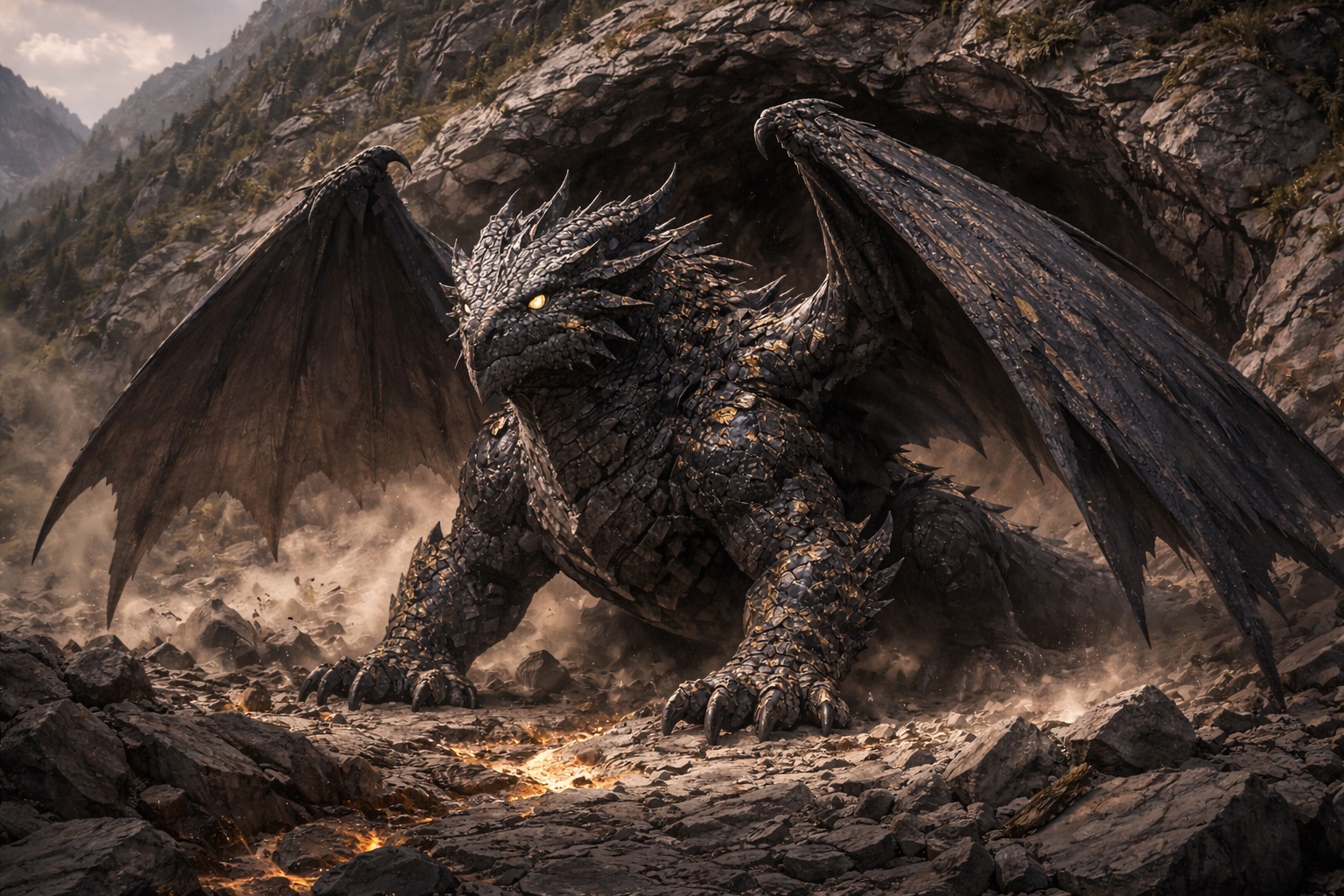
Ore Dragon
"The soldiers formed on the field. The ground was flat, surveyed the day before, and we had chosen it deliberately. Three hours into the engagement, the field was no longer flat. It was no longer a field."
Account attributed to a surviving officer of the Kethrani Campaign, [Funta](Funta/Welcome to Funta) Interior Wars
IDENTIFICATION
- Common Name: Ore Dragon
- Plural Form: Ore Dragons
- Alternate Names: Earthwyrm (generic and inaccurate in implication; it does not simply dwell in the earth); Mountainbreaker (regional term, [Shoing](Shoing/Welcome to Shoing) interior); Karath Solenn in the mining dialect of the [Funta](Funta/Welcome to Funta) deep tunnels, meaning approximately "what the ore remembers being before it was ore"
- Classification: Dragon
- Sub-Classification: Elemental Apex, Mineral Plane-Affiliated
- First Recorded Observation: The most ancient references come from [Shoing](Shoing/Welcome to Shoing) mining records, which document encounters during deep excavation work in terms clearly describing something far outside the range of known underground fauna. Formal scholarly description is limited; the Ore Dragon's underground habitat and the catastrophic nature of most encounters leave few surviving observers.
OVERVIEW
At a Glance
The Ore Dragon is the largest, heaviest, and physically strongest of the seven types. It does not move fast. It does not need to. It burrows through solid rock as other creatures walk through open air, and it fights from below; an enemy who cannot locate it underground is fighting an opponent who has already chosen the terms of every engagement. When the Ore Dragon decides to act, the ground itself becomes the weapon. It is the only dragon type that almost never fights in the open; it fights through the landscape, using the earth around and beneath its opponents the way a weapon master uses a blade.
Role in the Ecosystem
The Ore Dragon's excavation patterns reshape the geology of its territory over time. The tunnels it creates (enormous, structurally complex, reaching deep into the mineral earth) become habitat for hundreds of species that could not otherwise survive underground. The geological disruption of its regular movements creates new cave systems, shifts underground water tables, and occasionally redirects surface water features. Mineral-rich rock formations that its body passes through are altered chemically; there are geological anomalies throughout [Funta](Funta/Welcome to Funta) and [Shoing](Shoing/Welcome to Shoing) that mineralists have categorized as "dragon-touched", formations whose chemical profile is consistent with having been in prolonged contact with Ore Dragon tissue. From the surface, the Ore Dragon's presence is expressed as mild baseline geological activity: small earth movements, subtle subsidence, the occasional fresh crack in old rock that appears without any surface cause.
General Reputation
Underground-working communities (miners, tunnelers, deep-construction workers) have the most specific and pragmatic relationship with the Ore Dragon. The traditions are consistent across cultures: there are signs to read in the rock that indicate proximity, and there are places in the deep earth that are simply not entered. Surface communities in the territories have a more abstract relationship with an animal that never appears above ground in normal circumstances, but the occasional seismic event attributed to Ore Dragon movement provides a concrete reminder of its existence. The overarching cultural attitude is one of respect expressed as extreme caution: you do not go into the Ore Dragon's earth, and you hope it does not decide to come into yours.
PHYSICAL DESCRIPTION
General Appearance
The Ore Dragon is massive in a way that makes size comparisons to other creatures feel inadequate. The body is broad, deep-chested, and densely built: not the lean predator profile of the Gale Dragon or the streamlined form of the Tide Dragon, but something built to move through solid material and to endure anything that could be thrown at it. The neck is thick and reinforced, the head broad with powerful jaw musculature suited to the biting and forcing behavior involved in rock transit. The forelimbs are enormous: broad, heavily clawed, built for excavation rather than for striking, though the force available in those limbs makes the distinction somewhat academic in conflict. The hindlimbs are comparably massive. The tail is thick and heavily armored, used as both counterbalance during excavation and as a weapon of catastrophic force in close combat.
The wings are the Ore Dragon's most unexpected feature given its overall body plan: they are present and functional, but small in proportion to the body, suited for low-altitude, slow flight rather than the extended aerial operation of other types. The Ore Dragon can fly, but it does so infrequently, briefly, and without the effectiveness it brings to any ground or underground operation. The scale surface is the heaviest of any dragon type: dark, rough-textured, and embedded with mineral deposits that accumulate over the animal's life, making the hide of an older individual contain significant concentrations of the ores and metals present in its territory's geology.
Coloration is dark throughout: deep iron-grey to near-black on the dorsal surface, with the ventral surface only slightly lighter. The mineral-embedded scales of older individuals show streaks and patches of metallic color corresponding to whatever ores are predominant in their territory; a dragon that has lived in copper-rich geology for centuries may have visible verdigris tones distributed through its scale pattern.
Size and Dimensions
- Typical length/height: 30 to 45 meters in body length; standing height at the shoulder of 10 to 14 meters
- Typical weight/mass: The heaviest of all dragon types by a significant margin. The scale and bone density, the mineral accumulation, and the sheer mass of muscle designed to move through rock produce a weight that strains any available comparison
- Notable scale reference: An adult Ore Dragon's footprint, if it could be cleanly taken on soft ground, would exceed the floor plan of a modest house. Its shoulder height while standing is comparable to the walls of a fortified town.
Distinguishing Features
Scale at ground level and the excavation-built forelimb profile are the immediate identifiers on the rare occasion the Ore Dragon is seen on the surface. The mineral accumulation in older scales is visible as metallic streaking; no other creature accumulates mineral deposits within its integument. The Ore Dragon does not need to be seen to be identified; the seismic signature of its underground movement (a rhythmic, deep vibration with a cadence unlike any geological process) is the most common form of identification.
Sensory Apparatus
The Ore Dragon perceives mineral and geological structures as a primary sense; it reads the composition, density, layer structure, and stress state of the rock around it as clearly as other creatures read their visual environment. This geological sense extends outward through solid material and provides a three-dimensional map of the underground environment that no other form of sensing could replicate. It knows where every cavity, water table, structural weakness, and hard formation is in its territory, updated continuously. Its underground navigation is perfect. Its conventional vision is functional but secondary to the geological sense; its eyes are adapted for low-light and no-light conditions. Vibration detection is acute and provides surface-level information about what is happening above ground: the Ore Dragon knows when something large is standing on the earth above it, what direction it is moving, and approximately how many individuals there are.
BIOLOGY
Diet and Feeding
The Ore Dragon is an obligate carnivore that hunts primarily by ambush from below. It does not follow surface prey; it intercepts them by identifying their presence through vibration detection, positioning itself underground ahead of their movement, and erupting through the surface at the chosen moment. For large prey, the attack itself is typically the kill: the physical impact of the eruption, tons of mass moving upward through rock and earth, is not survivable by most targets. The Ore Dragon consumes large prey entirely and returns underground; it does not leave significant surface kill sites because feeding occurs underground in most cases. What is left on the surface is the collapse of the eruption point and any larger skeletal material the dragon chose not to consume.
Reproduction and Life Cycle
The female Ore Dragon's once-in-a-lifetime reproductive period is the most logistically extraordinary of any dragon type. The behavioral changes are subtle by the standards of other types: deeper retreat into the lair complex, avoidance of surface contact, a contraction of hunting behavior to the immediate territory. The eggs are laid in the deepest chamber of the lair, in direct contact with the specific mineral formations the female has prepared for this purpose, apparently deliberately selecting substrate composition for the eggs' incubation environment. Hatchlings emerge already capable of limited burrowing and grow rapidly through the juvenile period.
Lifespan and Development
- Juvenile period: Decades of growth, during which the young Ore Dragon develops underground range and geological-sense precision. Juveniles are not capable of the seismic attacks of adults and are, relative to adults, more vulnerable in open ground.
- Typical adult lifespan: Biologically unlimited. An Ore Dragon that has declined to pass for over a thousand years would be a geological feature in its own right: its body too large for easy underground movement, its territory essentially unmapped by mortals. The oldest known individual, or at least the one associated with the most ancient geological anomaly pattern, cannot be assigned a definite age.
- Elderhood: Ancient Ore Dragons are believed to move more slowly and hunt less frequently, relying on the scale of their physical presence: too large to easily avoid underground, taking prey that passes over them simply because the territory is so thoroughly theirs.
Physiology and Notable Biology
The mineral accumulation in Ore Dragon scales is a unique biological phenomenon. The scales are not simply passively collecting mineral deposits; they are actively incorporating them, the tissue metabolically processing the ores the body contacts during excavation and integrating them into the scale matrix. An Ore Dragon's hide is, chemically, a geological record of its territory and its history: the mineral profile at different points on the body reflects what geological strata the animal was in contact with at different periods of its life. The biological mechanism for this incorporation is entirely unknown. The resulting scale structure is harder than any organic material otherwise recorded and is partially metallic in composition.
The seismic capability, the ability to produce controlled earth-shaking, appears to originate in a combination of the physical force the body can generate and the Ore Dragon's understanding of geological stress patterns. It does not simply vibrate; it strikes weak points in the geological structure in sequences that amplify through the substrate, producing effects disproportionate to the direct force applied.
Relationship to Magic
Mineral Plane affiliation manifests in the Ore Dragon's geological sense, in the mineral-incorporation biology, and in the seismic capability's force multiplier. The earth around an Ore Dragon in its territory appears to respond to its presence in ways that pure physical contact does not explain; its movement through rock is faster and less destructive to its own body than the physics of dense material transit should permit. Magic used against an Ore Dragon has complicated interactions depending on type: earth-based magical effects are essentially non-functional against it, which is consistent across all elemental types. Lightning is more effective than its physical armor would suggest, as is fire, not because the hide is vulnerable but because the internal biological systems are not as insulated against these as against physical force.
Environmental Adaptations
The Ore Dragon is adapted to the deep earth. It processes the low-oxygen environment of sealed underground spaces through a respiratory system that operates efficiently at oxygen concentrations far below what most organisms require. Its body temperature management is calibrated for the cool, stable temperatures of depth rather than surface conditions. It manages the pressure of deep rock through a musculoskeletal density and reinforcement that no surface-adapted organism requires. The mineral incorporation helps here as well; the partially metallic scale structure distributes pressure loads differently than organic material alone.
BEHAVIOR
Intelligence and Cognition
Full dragon intelligence, expressed through what amounts to a territorial strategist's perspective. The Ore Dragon knows its territory three-dimensionally (underground, surface, and the vertical column connecting them) to a precision that no other intelligence can match in the same environment. It plans engagements the way an architect plans a building: selecting where the ground fails, what the underground approach allows, where the structural weaknesses in any surface formation are. It is patient in ways that other dragon types are not required to be, because its approach is never visible until it is complete.
Social Structure
Solitary and exclusively territorial against same-type individuals. The Ore Dragon's territory management means that boundary encounters between same-type individuals involve the geological-sense communication long before physical proximity; each can perceive the other's presence through rock, and the negotiation of territory occurs through subsonic vibration at ranges that would be impressive even by the standards of deep-ocean communication.
Territory and Range
A single Ore Dragon's territory encompasses an enormous volume of underground material as well as the surface above it. The territory is managed with geological precision: the dragon knows where every tunnel it has made is, where every natural cavity exists, where every structural weakness under the surface could be exploited. Territorial boundary is not a line on the surface but a three-dimensional boundary through the substrate, and intrusion at any level is detected immediately.
Daily and Seasonal Patterns
The Ore Dragon's activity is not well correlated to surface day-night cycles, since its primary environment is not exposed to light. It appears to be active in irregular patterns related to geological factors (pressure changes, underground water movement, and what might be the equivalent of territorial maintenance) rather than biological rhythms tied to light or temperature. Seismic activity associated with Ore Dragon movement can occur at any time and does not show the seasonality patterns that other types' behavior does.
Hunting, Feeding, or Foraging Behavior
The Ore Dragon does not expose itself to engage prey. It waits until the prey is above it, positions through underground movement to the optimal strike location, and attacks upward through the earth. The eruption attack, the dragon driving through the surface from below, is its primary hunting technique. For targets on the surface that are stationary or predictably moving, this approach is executed with methodical patience: the dragon may wait for hours or days underground before acting. It will not come to the surface to pursue something that has moved off. It will simply wait for it to come back, or for another opportunity.
For defended positions, structures, or fortifications, the Ore Dragon's approach is different: it attacks the ground under the target, using seismic force to destabilize the foundation before any surface attack is made. By the time anything appears at the surface, the structural integrity of the target area has already been compromised.
Communication
Dragon tongue, transmitted through substrate vibration in the underground environment as well as through conventional vocalization on the surface. The underground communication channel of the Ore Dragon is unique among the dragon types; the geological-sense communication through rock means that it can transmit to other Ore Dragons at extreme range through the substrate, and that it is always, in some sense, broadcasting its presence to any other Ore Dragon within geological range.
HABITAT AND RANGE
Primary Habitat
Deep underground: specifically, geologically stable mineral-rich substrate that provides both the material density the dragon's movement requires and the ore composition its biology processes. It is not found in geologically unstable regions (active volcanism, frequent major seismic events above the baseline it generates) or in sedimentary bedrock that lacks sufficient hardness. The ideal habitat is deep, stable, mineral-rich formation: the interior mountain ranges, the deep geological shield of continental interiors, ancient and stable rock. It requires surface territory above its underground range for hunting.
Geographic Distribution
The deep interior mountains of [Shoing](Shoing/Welcome to Shoing) and [Funta](Funta/Welcome to Funta) are the best-documented territories. The geological shield regions of [Irna](Irna/Welcome to Irna)'s interior highlands are probable territory. The [Jazirah](Jazirah/Welcome to Jazirah) desert regions, despite the hard substrate, may have populations; the deep desert geology is ancient and stable. [The Second Lands](The Second Lands/Welcome to The Second Lands) and [Antaea](Antaea/Welcome to Antaea) are incompletely surveyed in their deep geology. Mining traditions across all continents contain encounters that cannot be explained by any other underground organism, suggesting wider distribution than confirmed records indicate.
Lair and Den Characteristics
The Ore Dragon's lair has no tunnels leading to it. This is the defining characteristic that distinguishes its lair from the many tunnels and chambers the dragon creates elsewhere in its territory: the lair chamber is a sealed space in the deep rock, accessible only by the dragon moving through solid material. The chamber is large (sized for the dragon's full body and the accommodation of its hoard), and the walls show the smoothing and mineral alteration that comes from centuries of proximity to the animal. The hoard consists of building cornerstones and keystones retrieved from mortal constructions: the foundation stones of settlements, the capstones of arches and doorways, specific structural elements selected for reasons that appear deliberate. Recovering these stones from the lair is not currently possible by any known means.
THREAT AND DEFENSE
Threat Response
The Ore Dragon does not have a conventional threat-response sequence. It does not warn. It does not display. When it decides something on the ground above it has moved from an observed presence to an unacceptable one, it acts. The transition is invisible to the target. The only external signal that a decision has been made is the seismic preamble: the slight increase in ground vibration that precedes an eruption attack, detectable with sensitive instruments or by those trained to feel it with their feet, occurring seconds before the attack.
Offensive Capabilities
The eruption attack is the primary weapon: the dragon drives upward through the surface, and the force of mass moving through rock at speed, combined with the impact and the geological disruption that attends it, is catastrophic to anything above the strike point. The seismic attack sequence, used against fortifications, large groups, or terrain the dragon wishes to restructure, involves the controlled generation of ground movement that can collapse structures, open sinkholes, and shatter stone formations across an area much larger than the dragon's body. In direct physical combat, which is rare because the dragon prefers not to be on the surface, the scale of its body means that physical contact is devastating even without deliberate attack; it is simply too large, too dense, and too strong.
Conventional weapons do not damage the Ore Dragon. The scale alone defeats any blade or bludgeon; beneath it, the body is structurally reinforced against mechanical forces in ways that exceed any armored vehicle mortal construction has produced. Magic and siege-scale weapons are the only categories that produce meaningful effect, and even these require specific targeting to reach the vulnerable internal systems.
Defensive Adaptations
The scale is physical armor of a quality that has no equivalent. The mineral incorporation in older individuals adds additional resistance; the partially metallic scale structure is resistant to forces that would damage purely organic material. The primary defensive strategy is avoidance: the Ore Dragon is almost never on the surface in a defensive position because it controls when and where it surfaces, and it does not surface when that would expose it to disadvantage. If it chooses to return underground, nothing on the surface can prevent it.
Known Vulnerabilities
On the surface, in the open, the Ore Dragon is at its worst; its speed is limited, its flight is slow and limited in duration, and it cannot use the seismic and eruption capabilities that make it overwhelming underground. The tactical principle that has occasionally worked against Ore Dragon attack is to force sustained surface engagement rather than allowing underground return. This is easier to describe than to accomplish. Lightning-based attack appears to penetrate the scale insulation more effectively than other physical or fire attacks; this has been reproduced in enough documented accounts to be considered reliable information.
Disengagement and Flight
The Ore Dragon's preferred disengagement is simply to go underground. If on the surface and under attack, it moves toward soft ground or breaks rock with its forelimbs and descends. The disengagement into earth takes seconds once begun and ends all pursuit. Whether it returns is a function of whether it considers the conflict unresolved.
TRACES AND SIGNS
Physical Evidence
The most obvious surface trace is excavation evidence: ground that has been driven through from below shows a characteristic eruption pattern (material pushed upward and outward, not collapsed inward) distinguishable from sinkholes, animal excavation, or any other cause. The scale of the eruption point identifies the size of the animal. Older eruption sites, where the ground has partially settled, retain the outward-pushed pattern for years. Underground, the Ore Dragon's passage through rock leaves tunnels of its own body profile: smooth-walled, oval in cross-section, with the characteristic mineral alteration in the walls that indicates Ore Dragon biological contact.
The missing cornerstones and keystones that the dragon takes for its hoard leave behind physical evidence at their source: structures that inexplicably lose foundational stones from below, with no tunneling evidence at surface level, with no explanation consistent with any conventional cause.
Environmental Disturbance
Long-term Ore Dragon occupation of a territory produces measurable geological change. The subsidence pattern (slight, repeated, insufficient to cause surface alarm on any single event but cumulative over centuries) eventually becomes measurable in survey data. Underground water table shifts attributable to major tunnel creation affect surface water patterns in ways that seem unrelated to the cause. The mineral-altered rock of heavily used tunnel complexes, if ever exposed by geological movement or mortal excavation, is chemically anomalous in ways that geologists classify as unique. The baseline seismic activity of a region hosting an Ore Dragon is slightly elevated above what the regional geology alone would produce.
Behavioral Indicators
Surface animals respond to Ore Dragon underground presence through vibration detection most organisms possess at the reflex level. Large animals suddenly stopping and looking at the ground, with no visible stimulus, is the most common secondary indicator. Livestock that will not enter a specific field, or that move away from a grazing area in an organized fashion without apparent cause, is a classic and well-documented pre-eruption behavioral signal. Burrowing animals, which have the most sensitive vibration detection among surface fauna, abandoning established warrens with urgency is one of the most reliable early indicators known. In underground mining environments, work animals displaying distress without odor or sound cause are treated as an emergency signal by any experienced mining crew.
Auditory and Sensory Indicators
The subsonic vibration of Ore Dragon underground movement is perceptible to those trained to feel it through the soles of their feet, a rhythmic, deep tremor with a cadence unlike geological vibration. At close range underground, this becomes audible as a low grinding, the sound of enormous mass moving through dense material. On the surface, a few seconds before an eruption attack, the ground resonates at a frequency that some individuals describe as "feeling the air get heavy" or "the silence getting loud", a subjective sense that the substrate is about to change state. Experienced miners in Ore Dragon territories are trained to associate any unexplained ground movement with immediate evacuation, without waiting to understand the cause.
IN-WORLD KNOWLEDGE
Scholarly Understanding
The Ore Dragon is the least directly studied of the seven types. The impossibility of following it underground, combined with the nature of surface encounters as sudden, violent, and rarely survived with useful observation, means that most formal scholarship is inferential. The geological traces (mineral-altered tunnels, the anomalous rock formations associated with territorial occupation) have been studied by mineralists who did not originally connect them to the Ore Dragon. The synthesis of geological anomaly data with the historical record of encounters has been the dominant approach in recent scholarship. The mineral incorporation biology is documented from examination of scale material recovered from deceased juveniles; the seismic capability is inferred from incident records.
Folk Knowledge and Tradition
Deep-mining communities across [Shoing](Shoing/Welcome to Shoing) and [Funta](Funta/Welcome to Funta) have the most accurate practical knowledge. The behavioral indicator reading (animal behavior, ground vibration, the auditory cues of deep movement) is taught to miners as survival knowledge from the beginning of their training. The tradition of not excavating in the direction of certain deep formations, maintaining a category of underground space as simply "not ours to enter," is consistent across cultures and appears to encode accurate information about territorial boundaries that the cultures themselves no longer consciously know the origin of.
Surface communities in affected regions have traditions that are less precise but consistent in their core guidance: build on deep-anchored foundations rather than surface-laid ones (the cornerstones the Ore Dragon takes appear to be specifically keystone and foundation elements, not random stone), avoid camping on soft ground above known geological anomalies, and treat animal distress as more reliable than your own senses for predicting what is about to happen underground.
Known Uses
Ore Dragon remains are among the most economically significant material in Dort, precisely because the mineral-integrated scale has properties unlike any organic or mineral material processed conventionally. The scale of a mature individual, with its metallic incorporation, is sought for specialized metallurgical applications, high-stress structural uses, and as a material component in alchemical work requiring unusual hardness or conductive properties. The bones (dense, partially mineralized) are used in similar ways. The biological organs associated with geological sensing, if they can be recovered, are of intense interest to scholarship and have been used in deep-underground navigation instruments. The deep tissues of the body, which contain the mineral-processing biology, are complex enough that their alchemical properties are not yet fully characterized.
Historical Encounters and Notable Events
The destruction of the [Funta](Funta/Welcome to Funta) border fortress at Kerath Holl, a structure whose complete disappearance was attributed to enemy action for forty years until geological investigation revealed the actual cause, is now recognized as an Ore Dragon territorial event. The fortress had been built directly over an established Ore Dragon tunnel complex; the construction appears to have triggered the response. The missing cornerstones from the structure, documented in the original construction records and never found in the debris, are now understood to have been retrieved for the hoard. The event reshaped deep-foundation construction practices in [Funta](Funta/Welcome to Funta) for generations.
Creature Ecology Template v1.0, Dort World