Prism Dragon
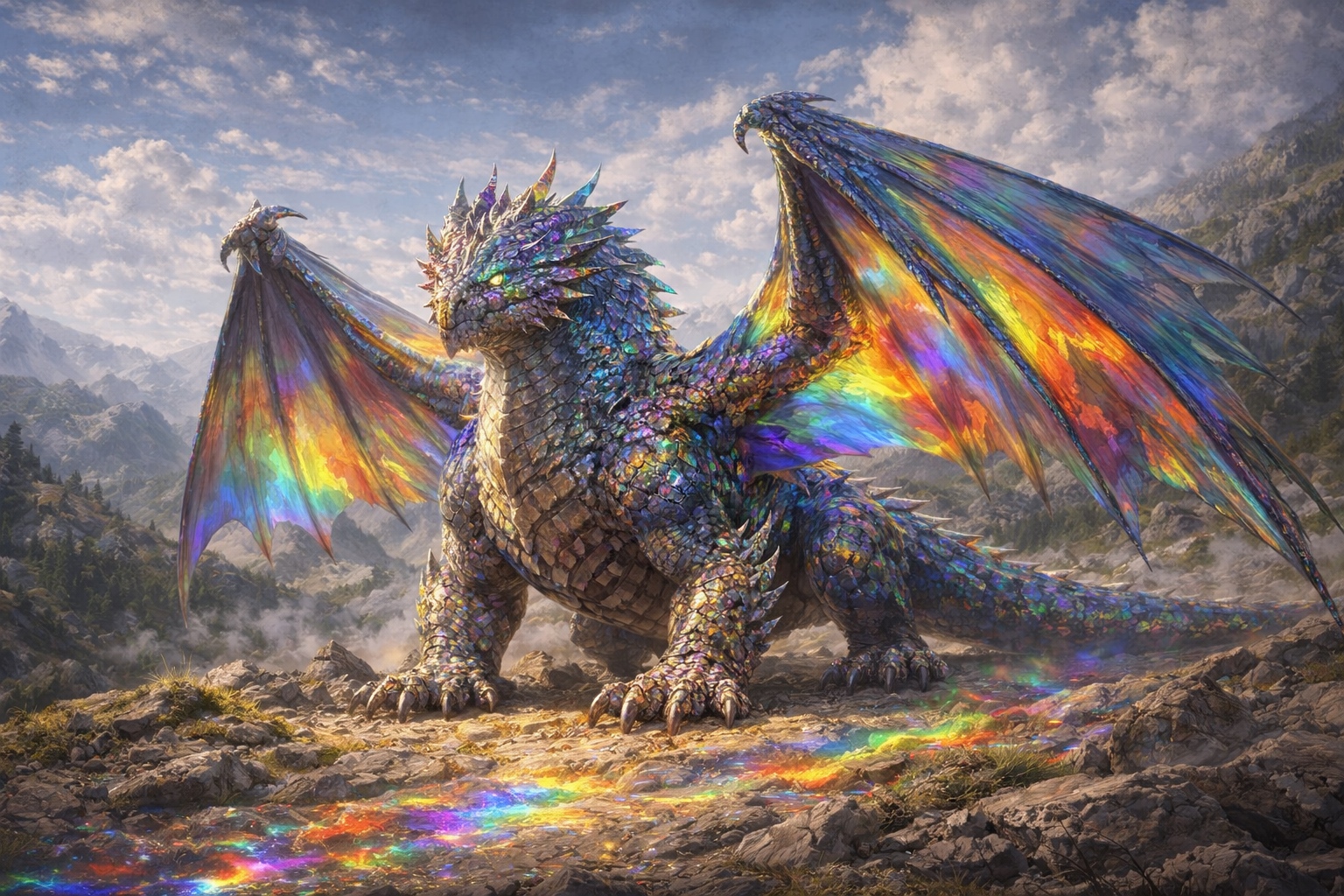
Prism Dragon
"The apprentice was the first to realize something was wrong. Her training had given her the sensitivity to notice what the rest of us couldn't: the way her workings were pulling in the wrong directions, feeding somewhere they shouldn't, producing effects that didn't match the intention. By then we had already been in its territory for three hours. It had been watching us the entire time. We were the most dangerous thing in the region, and it had already turned that against us."
Testimony before the Collegium of Natural Inquiry, attributed to a senior practitioner, name withheld
IDENTIFICATION
- Common Name: Prism Dragon
- Plural Form: Prism Dragons
- Alternate Names: Arcanewyrm; Spellbreaker (folk term from communities burned by magical practitioners during a Prism Dragon engagement; accurate but reductive); Leth Voranna in an academic [Irna](Irna/Welcome to Irna) tradition, meaning "the dragon that empties the vessel"; Mirrorwyrm (used in [Shoing](Shoing/Welcome to Shoing) arcane academic circles, referencing the redirection rather than absorption quality of its interaction with magic)
- Classification: Dragon
- Sub-Classification: Elemental Apex, Arcane Plane-Affiliated
- First Recorded Observation: Formal documentation is complicated by the fact that practitioners who survive an encounter tend to have lost most of their tools and often their confidence. The most detailed early account is in the archived records of the Collegium of Natural Inquiry, [Irna](Irna/Welcome to Irna), approximately 300 years ago, a commissioned investigation into why a well-equipped research expedition had returned with no magical equipment functional and three of eight members dead from causes their companions could not explain.
OVERVIEW
At a Glance
The Prism Dragon is the apex predator of arcane space: not the physical terrain, but the layer of magical activity that overlays the world. It senses magical workings the way other predators sense movement. It absorbs the energy of spells cast near it, uses that energy, and redirects it. Against a prey base of ordinary animals, this capability is dormant and irrelevant; against the rare, exceptionally dangerous prey of armed mortal parties with magical capability, the Prism Dragon is uniquely adapted. Its presence turns the greatest advantage such a party can have into a direct contribution to the enemy. Every spell cast becomes a partial asset of the dragon. The more powerful the magical assault, the more the Prism Dragon has to work with.
Role in the Ecosystem
The Prism Dragon's role in the mundane ecosystem is that of a large aerial apex predator with the full suite of capabilities any dragon brings: territorial pressure on large fauna, landscape modification through movement and hunting, long-term geological and environmental effects from lair maintenance. Its arcane-specific ecology is more unusual: the Prism Dragon's presence in a territory creates a zone in which ambient magical field is measurably depleted, because the dragon processes ambient arcane energy as a supplement to its biological requirements. Areas of long-term Prism Dragon habitation show reduced magical activity in the local field, a subtle difference that practitioners notice and that has ecological effects for organisms whose biology incorporates arcane energy in some way.
General Reputation
Among magical practitioners specifically, the Prism Dragon occupies a unique position of threat in the bestiary of the known world. It is the one creature against which magical power is not only ineffective but counterproductive, and the practitioners who know of it treat it with a specific anxiety that other dragons (which can be resisted magically, even if not easily) do not produce. Among non-practitioners, the Prism Dragon's reputation is confusing: accounts of encounters where the trained magic-users in a party were the ones most at risk, where the physical fighters had better outcomes than the practitioners, are counterintuitive and frequently disbelieved. The folk reputation is less specific than the scholarly one: a dragon that is beautiful and terrible and that drains something out of the world around it.
PHYSICAL DESCRIPTION
General Appearance
The Prism Dragon is physically large (the largest of the dragon types after the Ore Dragon), but it is the quality of its appearance rather than its scale that most survivors attempt to describe first. The scales have a property that no other surface in the natural world shares: they refract and separate light in the manner of a prism, breaking white light into its constituent colors in a continuous display across the body surface that shifts with movement and lighting angle. In direct sunlight, the Prism Dragon is preceded by moving color-wash across the terrain around it, the fractured light scattering across the ground before the animal itself is in view. The effect is extraordinarily beautiful by any account and is entirely consistent with being the last thing you see.
The body plan is proportional and large: broad chest, substantial neck, well-developed wings designed for sustained fast flight rather than the extreme velocity of the Gale Dragon or the hovering capability of the Anchor Dragon. The forelimbs are long and well-developed, the hindlimbs equivalently proportioned, producing a well-balanced physical form that is mobile on the ground and fast in the air. The wingspan is correspondingly large for the body, and the Prism Dragon is one of the fastest fliers among the seven types despite its size.
The eyes are the most discussed feature at close range: they cycle through the spectrum continuously, shifting color in a pattern that matches nothing in the animal's internal state as far as observers have been able to determine, and that does not relate to the light being cast by the scale surface. Looking directly at a Prism Dragon's eyes at moderate range is described by survivors as an experience that persists in memory with unusual vividness.
Size and Dimensions
- Typical length/height: 28 to 38 meters in body length; among the longest body lengths of any dragon type
- Typical weight/mass: Heavy for its length, but less dense than the Ore Dragon, a large, well-built body rather than a maximally dense one
- Notable scale reference: The light-scatter from a Prism Dragon in full sun can illuminate terrain around it visibly enough to read by, at a range where the dragon itself is still only a silhouette
Distinguishing Features
The prismatic scale refraction is unmistakable and unique. No other organism produces this effect naturally. At range, the color-scatter on terrain before the dragon becomes visible is the first sign; closer, the continuous light-show across the body surface is identifiable at any distance the body itself is visible. The breath weapon, when used, produces a visible effect unlike any other: a beam of light-spectrum separation that, where it contacts its target, produces the arcane-unweaving effect, visually appearing as a stripping and dimming of any enchantment it touches.
Sensory Apparatus
The Prism Dragon's primary unusual sense is its perception of the arcane field; it sees magical workings, enchantments, active spells, magical items, and the arcane potential of practitioners the way other creatures see light. This perception is precise enough to identify what a spell being cast will produce before the casting is complete, which is functionally predictive awareness of magical intent. It can distinguish the type, power, and direction of any magical working within its range. Its conventional vision is exceptional, as expected in an aerial apex predator of its size. It may also have sensitivity to light at frequencies outside the mortal-visible spectrum, given the nature of its scale biology.
BIOLOGY
Diet and Feeding
The Prism Dragon is carnivorous and hunts with the full range of a large, fast aerial predator's physical capabilities. The arcane capability is not involved in ordinary hunting against non-magical prey; it is a supplementary biological process, ambient arcane energy processing, and a specialized capability reserved for specific prey or threat contexts. Kills and feeding signs are consistent with large aerial predator patterns: substantial prey taken whole or in pieces, bones remaining, no significant processing beyond consumption.
Reproduction and Life Cycle
The standard dragon pattern applies. The Prism Dragon female's ovulatory period produces behavioral changes consistent with other types: territorial intensification, reduced range, elevated aggression toward anything in proximity. The eggs are deposited in the lair and incubated there. Hatchlings emerge with the scale refraction property already present, though at reduced intensity compared to adults, and with a primitive form of magical sensitivity that develops to full adult capability over the juvenile period.
Lifespan and Development
- Juvenile period: Several decades of development during which the scale refraction intensifies and the arcane absorption and redirection capabilities mature. Juvenile Prism Dragons are dangerous physical predators but do not yet have the full arcane capability; a juvenile encountered near a magical practitioner does not pose the specific threat that an adult does.
- Typical adult lifespan: Biologically unlimited. An ancient Prism Dragon would have a scale refraction effect of extraordinary intensity, and an arcane absorption range potentially spanning the entire local magical field of the region it inhabits. The oldest individuals may be the explanation for persistent magical dead zones in regions with no other obvious cause.
- Elderhood: Ancient Prism Dragons appear to have developed a relationship with the Arcane Plane that approaches something practitioners describe as structural integration: the dragon not just absorbing and redirecting energy, but being partially constituted by it in a way that makes it difficult to distinguish where the organism ends and the arcane field begins.
Relationship to Magic
The Prism Dragon's Arcane Plane affiliation is the most directly expressed of any type. The scale refraction is a biological consequence of the arcane-plane integration; the scale structure that produces the light separation is the same structure that interacts with magical energy. Arcane attacks directed at the Prism Dragon are absorbed into this structure rather than affecting the body. The absorbed energy is then available for the dragon's use: to accelerate, to enhance its own strength, to fuel the breath weapon, or to redirect back toward the attacking practitioner. The more powerful the incoming magical attack, the more the dragon has to work with. This is not a resistance property; it is an active recycling of incoming threat. The Prism Dragon does not become immune to magic; magic becomes a resource for it.
The breath weapon, the arcane unweaving beam, is a directed application of Arcane Plane energy as a destructive force targeted specifically at the structural integrity of magical workings. It strips enchantments from items, collapses sustained spells, disrupts maintained magical effects, and in contact with practitioners creates a brief but debilitating severance from their access to the arcane field. It does not kill through this mechanism alone; it disarms.
Environmental Adaptations
The Prism Dragon's environmental requirements are not specifically restrictive. It adapts to temperate, cold, high-altitude, and moderately arid environments. The one environmental requirement appears to be the presence of a meaningful ambient magical field; territories in areas of very low arcane activity are not preferred. The Prism Dragon appears to supplement its biological energy intake with ambient arcane energy, and the absence of that supplement may not be lethal but is evidently uncomfortable.
BEHAVIOR
Intelligence and Cognition
Full dragon intelligence, with a strategic quality specifically calibrated to the magical dimension. The Prism Dragon thinks about engagements in terms of magical resource flow: who has how much arcane capability, what they will likely do with it, what the Prism Dragon can absorb and redirect, and what the outcome of the magical-energy redistribution will be. Against non-magical opponents this intelligence produces a straightforwardly dangerous large predator. Against magically capable opponents it produces something that naturalists have described as tactical genius, though the mechanisms are different from what that phrase usually implies.
Social Structure
Solitary throughout adulthood, consistent with all types. Territorial exclusivity against same-type individuals. The Prism Dragon's territory is defined as much by the local magical field as by physical geography; it claims the arcane space as well as the land.
Territory and Range
Physical territory covers the range expected of a large aerial apex predator: tens of thousands of square kilometers, with regular patrol of borders. The lair location is chosen for magical field density in addition to the physical characteristics that other types select for (defensibility, food access, stable geology). The ambient magic depletion effect extends outward from the lair but is most intense in the immediate lair area.
Daily and Seasonal Patterns
The Prism Dragon is diurnally active in most documented cases, which may relate to its light-scattering biology; it produces the most dramatic visual effect in full sun, which some naturalists have proposed is not incidental but functional, though the mechanism is unclear. It may also relate to prey activity patterns; the animals it hunts are largely diurnal.
Hunting, Feeding, or Foraging Behavior
The Prism Dragon hunts large fauna as a straightforward large aerial predator and does not routinely use its arcane capabilities in this context. Against human or humanoid targets, particularly parties with magical capability, the hunting behavior is entirely different and reflects its specific adaptations. It identifies the magical practitioners in the group first, uses the terrain and its own misdirection capabilities to position such that magical attacks are the first response, absorbs those attacks, and uses the accumulated energy to enhance its next physical action. Experienced accounts describe the sensation of casting a major working against the Prism Dragon and then watching it accelerate.
Communication
Dragon tongue, as with all types. The Prism Dragon's presence in the local magical field is perceptible to other Prism Dragons at range; the arcane depletion signature is identifiable as a territorial marker through sensitivity that no non-dragon possesses.
HABITAT AND RANGE
Primary Habitat
The Prism Dragon is found in areas with meaningful ambient magical field density: regions where arcane activity is higher than baseline, whether through natural geological magic, proximity to significant arcane sites, or the concentration of practitioners in nearby settlements. Beyond this requirement, it is adaptable to varied terrain, showing confirmed presence in mountainous regions, old-growth forest, and elevated plains. The lair position tends toward places of natural magical significance: ley line intersections, magically charged geological formations, sites with a history of arcane activity.
Geographic Distribution
The Prism Dragon's distribution follows the distribution of ambient magical field density across Dort's landmasses. The most magically active regions (the arcane-geography of [Irna](Irna/Welcome to Irna)'s interior, parts of [Shoing](Shoing/Welcome to Shoing) where geological magic is high, and the old arcane sites of [Antaea](Antaea/Welcome to Antaea)) are the confirmed or probable territories. [Jazirah](Jazirah/Welcome to Jazirah) has lower ambient magical field in most regions and correspondingly fewer documented presences. [Funta](Funta/Welcome to Funta) and [The Second Lands](The Second Lands/Welcome to The Second Lands) are less characterized.
Lair and Den Characteristics
The Prism Dragon's lair is invisible. This is not camouflage in the conventional sense but a sustained magical effect that renders the physical approach to the lair visually inaccessible; every approach route redirects the observer's perception, creating a spatial misdirection that makes finding the lair effectively impossible without specific countermeasures. The effect is maintained continuously and is distinct from physical concealment: there is no obstruction, no covering of the entrance, no tunnel to miss. The lair is simply not locatable by conventional navigation.
The physical lair chamber contains the hoard: drained magical items (enchanted objects that have had their stored power fully absorbed by the dragon over time, the physical item intact but the arcane charge gone) and documents. The document collection is the more unusual component: the Prism Dragon accumulates written records of a specific kind: information that someone wanted kept secret, intelligence that someone paid to protect, the contents of sealed letters and coded records. How it acquires these is not fully understood. The hoard has never been inventoried by any mortal party.
THREAT AND DEFENSE
Threat Response
The Prism Dragon's default behavior toward a party without magical capability is that of any large predator making a territorial calculation. It may attack, it may observe and permit passage, depending on factors specific to the encounter. Its default behavior toward a party containing magical practitioners is fundamentally different: it observes at range, using the arcane-sense to inventory what kind and scale of magical capability is present, and initiates engagement at a time and from a position that maximizes the probability of receiving a magical attack early in the encounter. It is, in effect, more interested in the magically capable party than in the non-magical one.
Offensive Capabilities
The physical offensive capabilities of a large, fast dragon apply in full. The arcane absorption and redirection is the specific additional dimension: spells that would have damaged or constrained the Prism Dragon instead become available as energy the dragon uses. The breath weapon, the arcane unweaving beam, is targeted primarily at magical equipment and maintained magical effects. A practitioner who has invested years in enchanted equipment enters a Prism Dragon encounter with significant material advantage; they exit without it. Physical weapons of conventional design are not useful against this creature any more than against other dragon types; only siege-scale or magical weapons produce meaningful damage. The specific problem is that magical weapons used against it feed it.
Defensive Adaptations
The misdirection field around the lair prevents approach. The arcane absorption prevents magic from damaging it. The scale surface provides physical protection consistent with any dragon type. Its speed in the air makes it difficult to engage on the attacker's terms. The Prism Dragon is most vulnerable to physical attack conducted without magical supplementation; there is a narrow category of high-force physical assault that does not involve magic, conducted by opponents who understand they cannot use their arcane capabilities, that represents the practical approach documented in the few successful engagements.
Known Vulnerabilities
The Prism Dragon's absorption mechanism is not unlimited. There appears to be a rate of input beyond which the absorbed energy cannot be processed, producing visible overload effects: the scale refraction becomes chaotic, the light-scatter turns erratic and bright, and the dragon's behavior shifts from tactical to reflexive. This has been deliberately exploited in at least two documented cases by coordinating a very large number of simultaneous magical discharges rather than a sequence of powerful ones, the goal being to exceed the absorption rate rather than outperform it. This approach requires extraordinary resources and coordination. It also requires that the practitioners involved understand they will lose the energy invested in the assault.
Disengagement and Flight
The Prism Dragon withdraws into its territory through the misdirection field; once it crosses the threshold of the lair-area misdirection zone, it is effectively gone. No documented pursuit has resulted in finding the lair. It may return; the Prism Dragon has been known to resume interrupted engagements hours or days later, apparently having assessed the situation from the arcane-field data available to it during the interval.
TRACES AND SIGNS
Physical Evidence
The most reliable physical trace is the magical dead zone. Items that have been in proximity to the Prism Dragon over time, or that have been directly passed through by the breath weapon, show characteristic discharge: the magical charge is gone, the item is physically intact, and the internal arcane structure shows a specific pattern of emptying that practitioners describe as unlike normal magical depletion. Kill sites are consistent with large aerial predator patterns, with no magical residue at the site despite the normal ambient magic in the environment. The absence of ambient magic is itself diagnostic.
Environmental Disturbance
The arcane depletion field extends outward from the lair, creating a region of below-ambient magical activity. Practitioners entering this zone describe it as a progressive dulling of their arcane sensitivity: subtle at the boundary, unmistakable at the center. The zone persists even when the dragon is absent, though it recovers over time without the dragon's presence maintaining it. Long-term habitation creates a persistent magical dead zone that may be the most lasting ecological effect the Prism Dragon produces; areas of ancient occupation, long since abandoned, may still show measurable arcane field depletion.
Behavioral Indicators
Wildlife in Prism Dragon territory does not show specific behavioral indicators that distinguish it from other dragon-territory behavior, because the primary capability of the Prism Dragon is not directly sensed by non-magical animals. Practitioners entering the territory, however, may notice that their arcane sensitivity is providing less information than usual, a subtle sense that the field is quieter than the environment should produce. Magical items show diminished function before physical contact with the dragon; enchanted equipment entering the territory may underperform gradually. The misdirection field around the lair produces a specific navigational indicator: groups that attempt to approach the lair area on a consistent heading find that they have been walking parallel to or away from it without experiencing any apparent turn.
Auditory and Sensory Indicators
The Prism Dragon produces the same subsonic resonance as other types in its vocalization range. The specific sensory indicator unique to the Prism Dragon is the arcane-sense depletion that practitioners experience as a perceptual dimming: the magical field registering as quieter, less present, with ambient workings less accessible. The breath weapon produces a visual effect that some describe as a beam of darkness: not the absence of light but the active separation of arcane content from the target, which visible-spectrum light partially records as a stripping effect.
IN-WORLD KNOWLEDGE
Scholarly Understanding
The Prism Dragon is the subject of intense scholarly interest precisely because it challenges the fundamental assumption that magical power is an advantage in any encounter with a dangerous creature. The Collegium of Natural Inquiry has devoted significant resources to understanding the absorption mechanism, the redirection capability, and the implications for arcane practice more broadly. The scale structure has been examined in detail from recovered material and is unlike any other material; the biological mechanism for arcane absorption remains theoretical rather than empirically established. The breath weapon, the arcane unweaving, has been documented from survivor testimony and from the physical evidence of discharged magical items; its mechanism is entirely unknown.
Folk Knowledge and Tradition
Non-practitioner communities in Prism Dragon territories have a folk tradition that is somewhat less precise than in other dragon territories because the most specific threat is not apparent to them. "Beautiful and deadly, do not look too long" is one consistent folk warning, referencing the visual effect of the scales. Practitioners who survive encounters and communicate the experience tend to produce local academic traditions around the specific threat profile; the most accurate folk knowledge of the Prism Dragon exists in communities adjacent to arcane institutions that have had direct experience. The misdirection field around the lair is encoded in various forms of "the place you cannot find" tradition: landmarks that are always somewhere else when you look for them, paths that don't arrive where they should.
Known Uses
The scale material is among the most sought-after substances in Dort for arcane applications. Its properties for containing, directing, and processing magical energy (applied to instrument-making, protective construction, and as a component in workings requiring unusual arcane stability) are documented and reliable. A single scale can be worth more than most practitioners earn in a career. The organs associated with the arcane processing are of equal interest and equivalent value. The hoard (drained magical items whose physical construction is typically of high quality, and the document collection) would be of extraordinary value to the right parties; the documents especially, which presumably contain information that someone wanted protected enough to pay for it.
Historical Encounters and Notable Events
The defeat of the Third Collegium Expedition to the northern [Irna](Irna/Welcome to Irna) highlands is the defining event in Prism Dragon scholarship. The expedition was dispatched with the most accomplished magical practitioners available, extensively equipped with the finest enchanted instruments and weapons of the period. The encounter that ended it was reconstructed from the two surviving members, neither of them practitioners, over the course of several years of testimony. The reconstruction demonstrated for the first time that the Prism Dragon's arcane absorption was systematic rather than incidental, and that the expedition's magical strength had been the cause of its vulnerability rather than its protection. The tactical principles derived from this reconstruction (conduct against a Prism Dragon using minimal magical action, rely on physical capability, if magic must be used do not do so sequentially) have informed every subsequent formal engagement.
Creature Ecology Template v1.0, Dort World