Tide Dragon
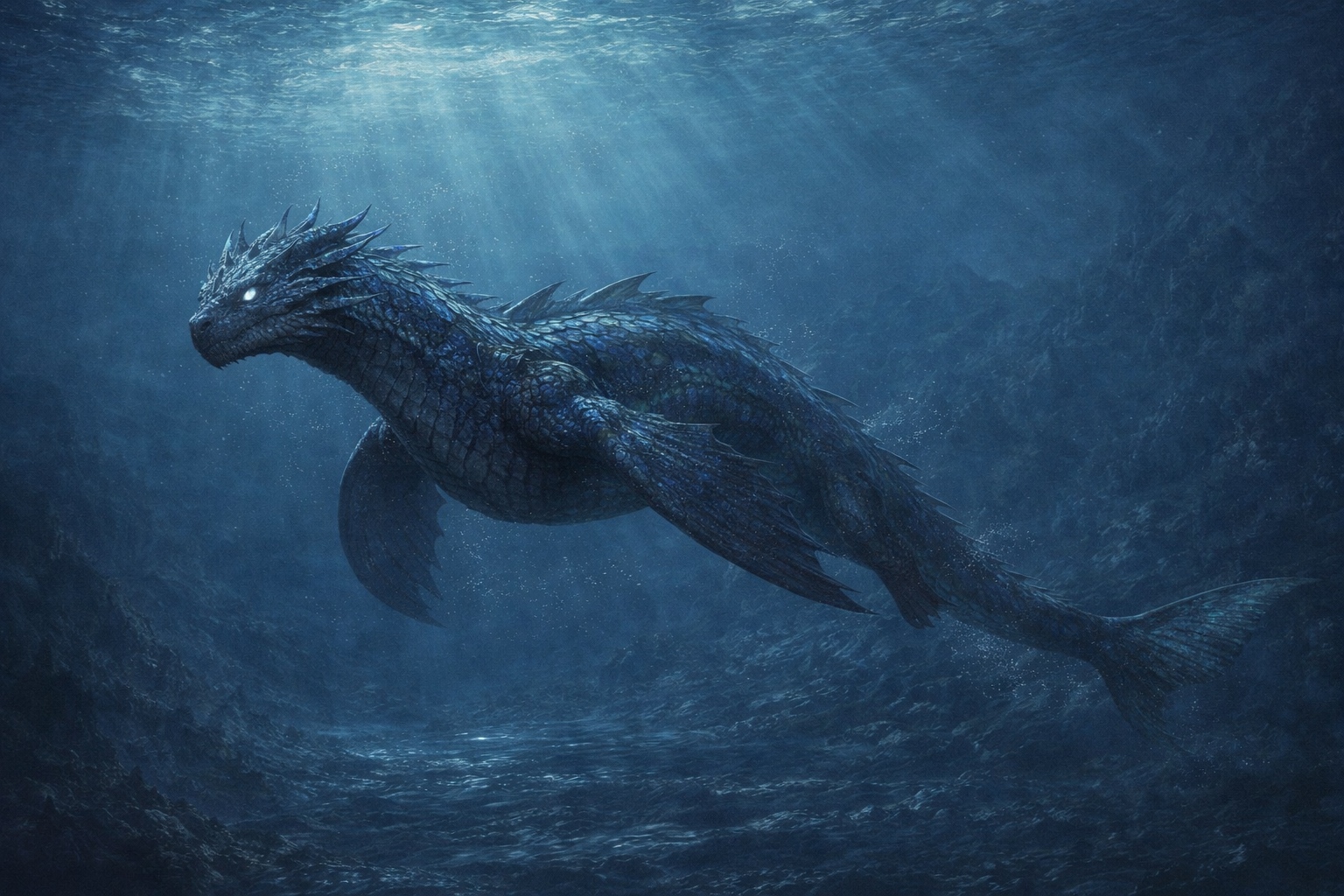
Tide Dragon
"We were three days out and making good time when Orvath noticed the current had changed. Not shifted: changed entirely, running the wrong direction. By nightfall we could see nothing in the water, but the crew would not go below. Nobody slept. It passed us before dawn, whatever it was, close enough that the wake came over the rail. We never saw it."
Account of Captain Fenara Doss, retrieved from the harbor authority log at Seln Point, [Irna](Irna/Welcome to Irna)
IDENTIFICATION
- Common Name: Tide Dragon
- Plural Form: Tide Dragons
- Alternate Names: Deepwyrm; Abyssal (an older name, now deprecated in scholarly usage due to confusion with void-related phenomena); Arath Molanna in the old coastal [Shoing](Shoing/Welcome to Shoing) dialect, meaning "the thing that the tide knows"; Sea Sovereign (poetic usage, occasionally found in [Antaea](Antaea/Welcome to Antaea) maritime literature)
- Classification: Dragon
- Sub-Classification: Elemental Apex, Water Plane-Affiliated
- First Recorded Observation: The oldest confirmed documentation is a series of carvings on the sea-facing walls of a [Shoing](Shoing/Welcome to Shoing) coastal city, depicting a creature of unmistakable size beneath a fleet, dating to the early settlement period. Formal naturalist description is sparse; the difficulty of studying an oceanic apex predator limits scholarly access.
OVERVIEW
At a Glance
The Tide Dragon lives primarily beneath the ocean's surface, in the deep water that most creatures never reach and survive. It is the largest creature in any ocean it inhabits, and it moves through water with a speed that ships cannot match even with favorable wind. On land or in the air it is slow and ungainly, but it does not need to be anything else; its domain is the sea, and in the sea it is absolute. Most encounters with Tide Dragons are not recognized as such: a changed current, a ship gone missing in good weather, a day when no fish run where fish always run. The Tide Dragon rarely shows itself, and when it does it is usually in the context of an event that leaves few survivors to report.
Role in the Ecosystem
The Tide Dragon regulates population dynamics in the deep ocean in ways that remain poorly understood simply because observation is so difficult. It is unquestionably the apex predator in its range, but its feeding frequency is low enough, given its scale, that it does not depopulate the ocean; it maintains pressure on the largest marine fauna and, by doing so, structures the cascade of population dynamics below. More concretely, the Tide Dragon's movement through the deep ocean displaces enormous volumes of water. These displacement events drive upwellings that bring nutrient-rich deep water to the surface, creating the conditions for the plankton blooms that form the base of coastal fisheries. Fishing communities whose livelihoods depend on certain upwelling patterns are, in a real sense, dependent on the movement patterns of Tide Dragons they have never seen.
General Reputation
Coastal peoples throughout Dort have traditions about the sea's sovereign creature, though few have seen one and survived to provide detail. The dominant emotional register is dread: not the specific dread of a predator that might eat you, but the larger dread of something so far beyond the scale of normal experience that comprehension fails. Maritime superstitions around Tide Dragons vary by region: in some [Irna](Irna/Welcome to Irna) coastal communities, seeing the bow-wake of a large unseen underwater object is considered a potential sign of a Tide Dragon, and the traditional response is to immediately change heading and reduce speed; in parts of [Antaea](Antaea/Welcome to Antaea), the folk belief holds that Tide Dragons occasionally permit certain passages through their territory as a form of toleration rather than failure to notice, and offerings of cargo thrown overboard are a traditional negotiation. Whether these practices have statistical validity is unknown.
PHYSICAL DESCRIPTION
General Appearance
The Tide Dragon is long, sinuous, and hydrodynamically optimized in ways that distinguish it immediately from the more typical four-limbed body plan of most dragons. The body is massive and elongated, tapering at the tail into a broad fluked terminus that provides the primary propulsive force in water. The forelimbs are large and flipper-like, used for steering and maneuverability rather than propulsion; the hindlimbs are considerably reduced, present but not prominent, and are folded against the body during swimming. The wings are reduced compared to other dragon types, sufficient for flight but not designed for speed or duration; they are most usefully understood as emergency mobility tools rather than primary limbs. The neck is substantial and reinforced, built to withstand the hydraulic pressures of deep-water movement.
The coloration follows the depth-gradient logic of the ocean. The dorsal surface, the side facing up in the water, is deep blue-black, difficult to distinguish from the water column above when seen from below. The ventral surface is paler, the silvery-blue of water lit from above, making the animal difficult to see from the surface. The scales have a faint iridescent quality under direct light, shifting through blues and greens, but this is visible only at close range; at distance the animal reads as a dense darkness moving through the water. The eyes are pale and extremely large, adapted for low-light conditions.
Size and Dimensions
- Typical length/height: 25 to 35 meters in body length; the overall form is so elongated that this length does not translate to the same height or bulk as other large dragons
- Typical weight/mass: Among the heaviest of the dragon types despite the sinuous build, due to the density required for deep-water pressure tolerance
- Notable scale reference: An adult Tide Dragon's body, laid out straight, would comfortably span the width of a large harbor entrance. Its wake in motion is perceptible as a wave on the surface from considerable depth.
Distinguishing Features
The most distinctive feature at close range is the breadth of the tail flukes, which are unlike anything else in the ocean and produce a characteristic sculling motion visible as a slow, powerful lateral displacement. The forelimbs, with their broad flipper structure, are also unmistakable. At distance or when only partially visible, the sheer scale of the animal is the distinguishing feature; there is nothing else in the ocean that moves like this. The breath weapon of the Tide Dragon, when used in or near water, produces a superheated steam and high-pressure water effect rather than pure fire; when used in air, it manifests as a high-pressure water column of considerable force. The breath does not generate flame.
Sensory Apparatus
The Tide Dragon perceives currents as a primary overlay on its environment; it senses the movement patterns of water the way other creatures sense light, able to read from current behavior the presence, size, speed, and direction of any object large enough to displace water at range. In the open ocean this allows detection of vessels and large marine fauna at distances that conventional vision or hearing could not reach. Its low-light vision is exceptional, adapted to the near-total darkness of depth. It also appears to sense pressure differentials directly, which provides a form of environmental mapping that does not depend on light or current. It is uncertain whether the Tide Dragon possesses any form of echolocation; it produces low-frequency sounds in the water that may serve a similar function.
BIOLOGY
Diet and Feeding
The Tide Dragon feeds on large marine fauna; the largest whales and deep-sea organisms are within its prey range. It does not feed frequently relative to its mass; the deep ocean caloric economy operates at different rates than surface environments. Observed feeding behavior involves extended pursuit at depth, where the Tide Dragon's speed advantage over any marine animal is decisive. The breath weapon is used to stun or kill large prey in the water; the effect in water differs from the air, generating a shockwave and superheated zone that is lethal to marine biology within the radius. Feeding signs, when they can be examined, show the same thorough consumption pattern seen in other dragon types; very little is left at a kill site.
Reproduction and Life Cycle
The female Tide Dragon's reproductive period, like that of other types, is a once-in-a-lifetime event. The behavioral changes preceding it include a period of markedly increased aggression that extends to other species' vessels and settlements in ways her normal behavior does not; coastal communities across [Shoing](Shoing/Welcome to Shoing) and [Irna](Irna/Welcome to Irna) have traditions around periods of heightened maritime danger associated with a Tide Dragon's ovulatory cycle, though most communities do not identify the cause correctly. The eggs are deposited in the lair, deep underwater, and the female remains with them through incubation. Hatchlings are aquatic from birth and are functional swimmers before their eyes open.
Lifespan and Development
- Juvenile period: Several decades, during which the juvenile ranges in coastal and shallower water before developing the deep-water pressure tolerance of the adult
- Typical adult lifespan: Biologically unlimited. Most Tide Dragons choose to pass to the spiritual realm after several centuries; those who remain continue to grow. Ancient individuals are responsible for the deepest and most persistent current anomalies in the ocean's records.
- Elderhood: An ancient Tide Dragon would be dramatically larger than any documented individual and might approach a scale where its movement constitutes a geological event: producing tsunamis in shallow coastal regions, permanently altering current patterns across ocean basins. There is no confirmed record of a Tide Dragon at this scale in recent centuries, though certain unexplained oceanic events in older maritime records have been attributed to them.
Relationship to Magic
The Tide Dragon is affiliated with the Water Plane in the same structural sense that the Ember Dragon is affiliated with the Fire Plane. Its breath weapon's behavior in water, the shockwave and superheated zone, exceeds what the biology alone should produce, and naturalists have long attributed this to plane-energy supplementation. It is notably resistant to water-based magic, which passes through it without effect. Its movement through the ocean appears to reinforce certain natural current patterns and disrupt others in ways that suggest active interaction with water-plane dynamics beyond what physical displacement alone would explain.
Environmental Adaptations
The Tide Dragon is pressure-adapted to the deepest ocean trenches; its biology handles pressures that would crush any other large animal. It can remain submerged indefinitely and breathes water through gill-like structures along the neck in addition to air through conventional lung architecture. In cold water, it shows no behavioral distress; its internal temperature management allows it to function in near-freezing deep-ocean environments. It is not, however, equally comfortable in all water; the shallower, warmer water of some coastal regions appears to cause mild discomfort, possibly because the reduced pressure is physiologically unusual for an animal tuned to depth.
BEHAVIOR
Intelligence and Cognition
Full dragon intelligence: strategic, historical, individual. The Tide Dragon is not simply a large predator that has no awareness of the effect it has on the world. It is aware that ships travel through its territory, that fishing communities exist above it, and that certain of its behaviors produce observable results in the surface world. What weight it assigns to these observations is unknown, but it clearly assigns some: there are documented patterns of Tide Dragon behavior consistent with deliberate choice about when and where to surface, rather than simple opportunism.
Social Structure
Solitary throughout adulthood. Same-type territorial exclusivity applies in the ocean as it does for other dragon types; an ocean of sufficient size may contain multiple Tide Dragons with overlapping or adjacent ranges, but active territory sharing does not occur. Different dragon types do not share oceanic and terrestrial territories in the way other combinations might; the ocean is the Tide Dragon's exclusive domain by both preference and functional design.
Territory and Range
The territory of a Tide Dragon is defined by ocean basin rather than by any measurable landmark, and covers hundreds of thousands of square kilometers of open water plus the adjacent coastal and shallow-water margins. Current-perception gives the Tide Dragon an effective awareness of its territory far exceeding what any other animal achieves through conventional senses. Intruders, by which is meant other Tide Dragons, are known at extreme range and apparently negotiated through low-frequency vocalization before physical contact occurs.
Daily and Seasonal Patterns
The Tide Dragon's activity is not well enough documented to characterize daily patterns with confidence. It appears to spend most time at depth, surfacing infrequently. Its hunting does not seem to be bound by light cycles; in the deep ocean, light is irrelevant. Seasonal behavioral changes associated with the reproductive cycle are the only well-documented pattern shift; outside of this, it is believed to be active continuously throughout the year.
Hunting, Feeding, or Foraging Behavior
The Tide Dragon hunts at depth, using current-sense to locate prey at range and closing through the water column at speeds marine fauna cannot match. Its relentlessness is noted in every account that manages to describe a pursuit: once a Tide Dragon has identified a target and begun to close, the outcome is not typically affected by the target's evasion. The deep ocean provides no shelter, no cover, and no terrain to use. The attack is a physical strike combined with the breath weapon; in open water, the breath weapon creates the kill zone and the physical body finishes what remains. It does not appear to give up a pursuit once committed.
Communication
The Tide Dragon communicates with others of its kind through the dragon tongue, adapted in part to the acoustic properties of deep water, where low-frequency sound travels over extraordinary distances. It does not communicate with mortals in speech. It is aware of ship communication, including signal lights and horn patterns, in the sense that it notices them, but does not respond to them in predictable ways.
HABITAT AND RANGE
Primary Habitat
The open ocean, specifically deep water: ocean trenches and abyssal plains are the core habitat. The Tide Dragon requires access to the deep ocean and is not found in inland bodies of water regardless of size; the pressure and depth requirements of its biology are not met by lakes or inland seas. Coastal and shallow water is traversed but not inhabited; the dragon moves through these zones rather than staying in them.
Geographic Distribution
All open ocean around Dort's major landmasses contains confirmed or probable Tide Dragon territory. The ocean surrounding [Irna](Irna/Welcome to Irna) and [Antaea](Antaea/Welcome to Antaea) to the west, the waters between [Shoing](Shoing/Welcome to Shoing) and [Funta](Funta/Welcome to Funta), and the deep ocean of the southern latitudes are all associated with Tide Dragon reports in maritime tradition. Population density is, by the standards of large territories, low; the ocean is vast and each individual controls enormous range.
Lair and Den Characteristics
The lair is on the ocean floor, at depth, in a location chosen for geological stability and deep-water pressure. It is excavated or selected from existing natural formations: deep cave systems, stable trench walls, hydrothermal vent complexes. A functional lair is not accessible to any mortal swimmer or submersible vessel; the pressure alone prevents approach. The hoard is maintained there: everything lost to the sea that the Tide Dragon chooses to keep, sunken cargo, the wreckage of ships, objects of apparent significance to whoever lost them. The criteria for what the Tide Dragon retains from the detritus of the surface world are not understood but appear to be consistent choices rather than random accumulation.
THREAT AND DEFENSE
Threat Response
The Tide Dragon does not perceive most ships as threats. It perceives them as small objects traversing its territory, and for most of its history with the surface world it has simply ignored them. Engagement occurs when something constitutes a specific triggering condition: entry into an area it considers the inner territory around the lair, presence during the ovulatory period, or (in rarer documented cases) what appears to be deliberate response to perceived insult. The specific triggering conditions for the last category are not well characterized. Once engaged, there is no flight or negotiation.
Offensive Capabilities
In water, the Tide Dragon is effectively unstoppable by any force currently available to mortals. The combination of speed, scale, and the breath weapon's underwater shockwave effect means that any vessel it chooses to destroy will be destroyed. The physical impact of the body alone, even a non-combat collision, produces structural damage that no ship construction survives. On land, which the Tide Dragon visits rarely and uncomfortably, its size and physical force remain devastating, but its mobility is severely compromised; it cannot fly quickly or fight effectively in terrain it is not built for.
Defensive Adaptations
Depth is the Tide Dragon's primary defensive adaptation; it is unreachable at its natural operating depth by any mortal capability. Its scale provides physical protection consistent with other dragon types. Water-based attacks, including magical water effects, do not harm it. The dragon's current-sense provides advance warning of anything approaching through water, making surprise from below essentially impossible.
Known Vulnerabilities
The Tide Dragon's vulnerability is exposure. On the surface or in the air, its speed and maneuverability are drastically reduced, and it is susceptible to attack in ways it is not at depth. Fire-based attacks are more effective against it than most other damage types; this is consistent across all dragon types with water affiliation. Extended engagement in shallow water, where pressure support is reduced, may impose physiological costs, though this is inferential rather than documented. Its relentlessness in pursuit is a behavioral predictability that has been used tactically in at least one historical engagement; the Tide Dragon was drawn into a prepared position rather than fought in the open water on its own terms.
Disengagement and Flight
There is no confirmed instance of a Tide Dragon fleeing a conflict. Whether this reflects the fact that, in its natural environment, it has never encountered a threat serious enough to prompt flight, or whether it reflects something about dragon psychology specific to this type, is unknown.
TRACES AND SIGNS
Physical Evidence
Direct physical traces of the Tide Dragon on the seafloor are known only from deep-diving accounts, which are rare and fragmentary. On the sea surface, the characteristic trace is displacement: bow waves from a large underwater object moving at speed, visible as unusual wave patterns that do not correspond to wind or current. Objects from the ocean floor appearing on the surface without explanation, stirred up by deep movement, are another associated trace. On shore, the most reliable physical indicator of recent Tide Dragon presence in coastal waters is the condition of the catch: absence of fish across an entire run, or the presence of deep-sea organisms in coastal shallows, displaced by water-column disturbance.
Environmental Disturbance
Current anomalies are the most persistent environmental trace. A Tide Dragon moving through its territory displaces water in patterns that alter surface currents in ways measurable to experienced navigators. Extended occupation of a territory by a single large individual can produce semi-permanent current modifications that persist because the dragon's habitual routes reinforce the same pattern repeatedly. In coastal zones, these modifications translate to changes in local fishery productivity, shoreline deposition patterns, and storm surge behavior during severe weather. Communities whose fishing traditions span multiple generations sometimes have oral records of major current changes that, retrospectively, may correspond to Tide Dragon territorial shifts.
Behavioral Indicators
Marine fauna behavioral change is the most practically useful pre-encounter indicator. Schools of fish moving rapidly away from deep water toward the surface or shore, the sudden departure of whale pods from established feeding grounds, seabirds abandoning a usually productive patch of ocean: these are the secondary indicators that experienced maritime observers use. The near-total cessation of any marine activity in a localized area sometimes precedes a surfacing; the underwater current-displacement of a rising Tide Dragon apparently triggers a flight response across species lines.
Auditory and Sensory Indicators
The Tide Dragon produces low-frequency vocalizations in the water that can be felt rather than heard on the surface, a subsonic pressure against the hull of a vessel that has no obvious external cause. In the water column, these sounds carry over extraordinary distances, and deep-diving practitioners have reported them as a pervasive, directionless sense of sound at the lower edge of perception. Experienced ship captains associate hull-trembling with no wind or wave cause with deep-water dragon proximity, though this is not universal knowledge.
IN-WORLD KNOWLEDGE
Scholarly Understanding
Tide Dragon scholarship is the most limited of any dragon type, simply because access to specimens, living or dead, is effectively impossible through conventional means. The basic outline of the biology (deep ocean habitat, Water Plane affiliation, aquatic apex predator) is established. Physical description in scholarly literature is derived almost entirely from partial surface sightings and, in rare cases, from encounters that produced survivors. The specific mechanics of the breath weapon, the precise nature of the current-sense, the deep-water lair: all of these are inferred rather than directly observed. Most naturalists who have attempted serious Tide Dragon study have done so through the collation of maritime testimony rather than direct investigation.
Folk Knowledge and Tradition
Maritime traditions across all coastal cultures in Dort contain Tide Dragon material, though it is rarely identified as such. The folk category of "sea monster" contains within it a subset of accounts (those involving an object of implausible scale, extreme speed, and apparent purposefulness) that naturalists now attribute to Tide Dragon encounters. The practical maritime knowledge is sound: avoid areas of current anomaly, treat unexplained hull vibration as a signal to change course, do not attempt to retrieve objects that have gone overboard in suspected Tide Dragon territory. The religious and folk-magical material is less reliable, but some traditions' behavioral guidance (offerings thrown overboard, course-change protocols, specific timing avoidance) may encode genuine observed correlations between behavior and outcomes even where the theoretical framework is wrong.
Known Uses
Theoretically, the same economic logic applies to the Tide Dragon as to other dragon types; every part has use, and the accumulated material in the lair is itself of immense value. In practice, recovering anything from a Tide Dragon's deep-ocean lair is not currently within mortal capability. Surface encounter remains, where they exist at all, are partial and degraded by water. A few accounts of dead Tide Dragons beached on coasts (always young individuals, never adults, and always of unknown cause of death) describe the material condition and note its value; these beachings attract every alchemist and material merchant within travel distance. The brain-matter in particular, with its current-sense architecture, is described as biologically unlike anything else and has been used in experimental navigation instruments with limited success.
Historical Encounters and Notable Events
The sinking of the fleet sent by the Irnan city-state of Verath, approximately two hundred years ago, is attributed in most serious maritime histories to a Tide Dragon rather than to the storm that official accounts cite. The fleet was attempting to establish a deep-water trade route through waters that tribal tradition in the coastal [Shoing](Shoing/Welcome to Shoing) indicated were held territory; seventeen ships departed and two returned, with the survivors' accounts describing an attack that no storm matches. The event ended the Verathi deep-ocean expansion program and has served as a reference point in maritime risk assessment since. The specific Tide Dragon involved, if it was indeed a Tide Dragon, would likely still be alive.
Creature Ecology Template v1.0, Dort World