Umbral Dragon
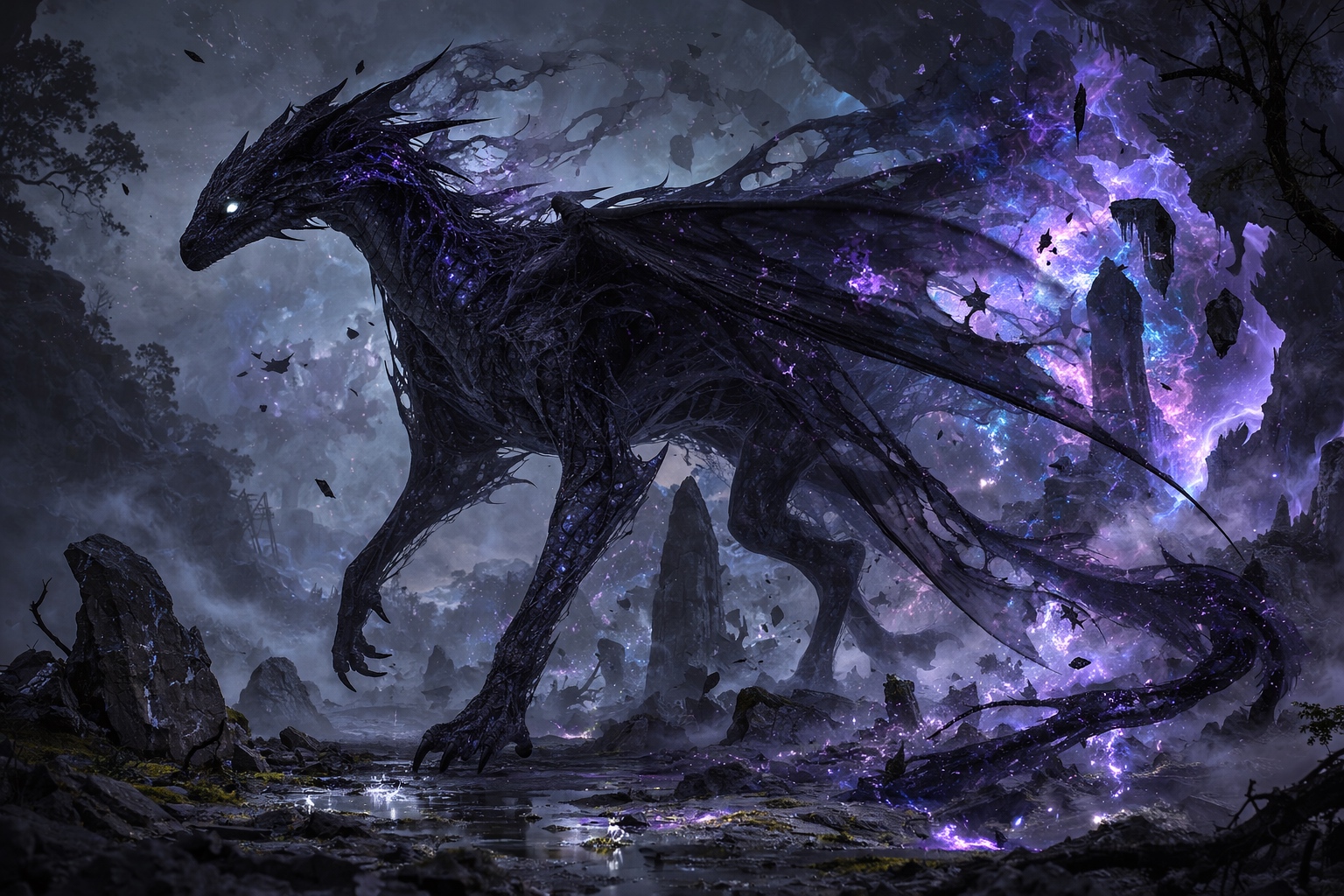
Umbral Dragon
"The second set of tracks simply began. Not emerged from brush, not stepped from a doorway, not descended from the roof. They began in the middle of the courtyard floor, mid-stride, as though something had been walking where nothing had been, and then had not. The first set of tracks, the ones that predated the incident, ended the same way, three paces further on. We do not know what happened to Hareth. No body was found."
Investigative record, Penal Registry of the city of Althun, [Irna](Irna/Welcome to Irna)
IDENTIFICATION
- Common Name: Umbral Dragon
- Plural Form: Umbral Dragons
- Alternate Names: Shadowwyrm (common folk usage); Dimwyrm (academic usage, referencing the plane of origin); Vel Soran in the mystical tradition of the western [Irna](Irna/Welcome to Irna) interior, meaning "the one that is somewhere else while it is here"; the Void-Drake (an archaic and inaccurate term that conflates Dim affiliation with void-plane concepts, now deprecated in serious scholarship)
- Classification: Dragon
- Sub-Classification: Elemental Apex, Dim Plane-Affiliated
- First Recorded Observation: The difficulty of observing an organism that inhabits two planes simultaneously makes this impossible to establish with confidence. The most widely cited formal documentation is a series of accounts compiled by the Irnan scholar Veleth Anass, who spent seven years collecting and cross-referencing disappearance events across the [Irna](Irna/Welcome to Irna) interior before reaching the conclusion that they shared a common cause.
OVERVIEW
At a Glance
The Umbral Dragon lives in both the Dim and the Prime simultaneously; this is not a description of its ability to move between planes, but of its baseline existence. It is never fully in one place. From the Prime, it appears as a large, dark, partially translucent figure that seems to exist slightly off-register with the physical world around it. From the Dim, it is an anchor of mass and solidity in a plane that is otherwise characterized by emptiness and non-substance. When it lands, it brings a zone of the Dim with it; the ground under its feet becomes both-planes-at-once, the half-existence of the Dim temporarily mapping onto Prime geography. Things that were solid may not be. Distance stops making sense. And the dragon has been watching from the Dim long before it decided to arrive.
Role in the Ecosystem
The Umbral Dragon's effect on its territory is the most subtle of any dragon type in the physical plane, and the most significant in the Dim. It is the apex predator of both environments and the only creature that manages this simultaneously. In the Prime, its predation is light relative to its scale; it does not hunt frequently, does not need to, and its territorial presence suppresses other large predators more through the specific quality of threat than through regular kill pressure. In the Dim, it organizes and structures an environment that otherwise has no apex; the creatures of the Dim, which are defined by the plane's properties of absence and dissolution, avoid the Umbral Dragon's territory in the Dim for the same reasons that surface creatures avoid a large predator's range. The Umbral Dragon therefore manages two ecosystems simultaneously, existing in the overlap between them.
General Reputation
Dread, at a fundamental level. The Umbral Dragon's specific quality of threat (the fact that it can observe from a plane that cannot be perceived without special capability, that it can act without warning, that things taken into the Dim are simply gone) touches a specific category of existential fear distinct from the fear of being killed. The folk traditions around it across all cultures in its range share a common feature: the impossibility of preparation. You can watch for an Ember Dragon on the horizon. You cannot watch for something that is watching you from a place you cannot see.
PHYSICAL DESCRIPTION
General Appearance
The Umbral Dragon in the Prime is consistently described as "almost there": present, visible, clearly real and physical, but with an edge-quality to its presence that no other large creature has. The outline of the body is distinct but the transitions (scale to air, wing to sky) have a softness, a slight blurring, as though the boundary between the animal and its surroundings is not entirely resolved in this plane. This is not an optical illusion; it is a consequence of the creature existing in two planes at once, with neither plane having full claim to its physicality.
The body plan is proportional and mid-range in size among the seven types: second-smallest after the Gale Dragon, with a build that is lean rather than compact, built for the low-walking movement pattern it uses on the ground rather than for the sustained aerial operation of the Gale or Prism Dragons. The limbs are long relative to the body, producing a stalking movement quality at ground level. The wings are present and functional but the Umbral Dragon uses flight sparingly; the energetic cost of full Prime-plane transit, including flying, is high for an organism half-constituted by a plane that does not support mass in the same way. The tail is long and flexible, held with a controlled stillness in movement rather than the expressive use of a tail in most other types.
The coloration is the darkest of any dragon type: deep black, matte, absorbing light rather than reflecting it. Detailed examination of the scales shows an internal structure that appears to continue inward further than scales should, as though the scale surface has depth that extends into the Dim rather than terminating at a physical boundary. The eyes are the only point of light in the body: pale grey, almost silver, with a stillness that does not change with the animal's emotional state or activity level in the way that the eyes of other creatures do.
Size and Dimensions
- Typical length/height: 15 to 22 meters in body length; the second-smallest type, smaller than most other dragons but with proportionally long limbs that make its standing height deceptive
- Typical weight/mass: Less than its physical dimensions suggest, consistent with partial constitution by a plane where mass works differently
- Notable scale reference: The Umbral Dragon moves with less sound per unit of body size than any other dragon type; the partial Dim constitution reduces the physical impact of its movement. It can approach significantly closer to sensitive animals before triggering the reflex responses that normally come well ahead of a creature this size.
Distinguishing Features
The edge-softness of the physical form is the single most reliable identifier. No other organism of any size has this quality; it is immediately recognizable once seen. The matte-black coloration combined with the lack of sound appropriate to its scale are secondary identifiers. The zone of Dim-overlay that deploys when the dragon lands, a spreading area of altered reality around the point of contact, is the tertiary and most alarming identifier, but by the time it is observed, identification is academic.
Sensory Apparatus
The Umbral Dragon perceives both planes simultaneously. This is its primary sensory capability and the most functionally significant of any dragon type's unusual sense. It sees the Prime and the Dim at once, overlaid, the physical landscape and the Dim landscape occupying the same perceptual space in its awareness. This means it knows the Dim geography of every location in its territory as well as the Prime geography: where Dim creatures are, where Dim spatial distortions occur, how the planes map to each other in specific locations. It also means it can observe anything in the Prime from within the Dim, watching from a place that is present but imperceptible.
BIOLOGY
Diet and Feeding
The Umbral Dragon's feeding requirements appear lower than a creature of its size would need if fully constituted by Prime-plane biology. It hunts and kills large prey, but infrequently. The specific mechanism may involve the Dim-plane component of its constitution providing energetic sustenance through channels that do not require conventional feeding, though this is speculative. Kills it does make are consumed thoroughly; feeding signs are similar to other dragon types, though the kill site typically shows evidence of the Dim-overlay zone having been deployed; objects in the immediate kill area may be displaced to positions that were accessible from the Dim but not from the Prime, and the kill itself may show damage patterns inconsistent with any physical weapon.
Reproduction and Life Cycle
The Umbral Dragon's reproductive behavior is the least documented of any dragon type. The once-in-a-lifetime female reproduction is assumed consistent with all types, but no confirmed reproductive event has been directly observed. The lair location being in both planes simultaneously means that no mortal has been in proximity to an Umbral Dragon nest. Hatchlings are presumably capable of at least partial Dim-plane existence from birth, since the lair is not accessible from the Prime.
Lifespan and Development
- Juvenile period: Several decades, during which the dual-plane biology develops to full adult integration. Juvenile Umbral Dragons have less stable plane-integration; they are more fully in the Prime than adults, which makes them more physically vulnerable but also more visible.
- Typical adult lifespan: Biologically unlimited. The oldest individuals are the most deeply Dim-integrated; their presence in the Prime becomes more partial, their physical boundary more ambiguous. The oldest Umbral Dragon in any tradition is described as "barely here at all," which may be a description of an individual approaching the voluntary passage that most dragons eventually choose, though whether the Umbral Dragon's version of this passage involves the same spiritual realm as other types is unknown.
- Elderhood: Ancient Umbral Dragons appear to achieve a state where the Dim-overlay they deploy is permanent and encompassing rather than temporary and localized, their entire territory existing in both planes at once.
Physiology and Notable Biology
The Umbral Dragon's dual-plane constitution is unique among known organisms. It is not an organism that visits the Dim; it is an organism that exists in both planes, with biological systems partially distributed across the two. This has several consequences. The body is partially non-physical in the Prime-plane sense; not all of it is addressable by physical attack, and not all of it generates the physical signature that the visible portion suggests. It does not fully cast a shadow in the Prime because the light interacts with both planes simultaneously, and the shadow it would cast in the Prime is partially offset by the Dim component of its constitution.
The transit capability, moving fully between planes, is energetically costly and is used sparingly. The partial transit of the Dim-overlay deployment is less costly and can be sustained, but still requires energy. The Umbral Dragon is therefore not constantly jumping between planes; it maintains its partial existence in both and makes full transits selectively.
Relationship to Magic
The Umbral Dragon's relationship to the Dim Plane is constitutive rather than affiliatory. It does not draw on the Dim for supplementary power; it is partly made of it. Magic directed at it has complicated effects because the physical component is not the whole target; striking the Prime-plane body does not necessarily address the Dim-plane component, and vice versa. Magical effects that specifically target Prime-plane existence are less effective against an organism that is not fully in the Prime. Magic that accesses the Dim (Dim-sight, Dim-walking, direct Dim-plane interaction) is more effective against it than any purely Prime-plane approach, which is one reason the Umbral Dragon is less likely to encounter practitioners with Dim-plane capability and more likely to engage them aggressively when it does.
Environmental Adaptations
The Umbral Dragon does not require specific environmental conditions in the Prime. It has been found in forest, mountain, coastal terrain, and deep interior. What it requires is a Dim geography that is workable; the Dim maps differently onto different Prime regions, and some Dim-geographies are more stable and habitable than others. The specific locations it chooses for lairs are positions where the Prime-Dim correspondence creates a stable overlap zone: a location in the Prime that has a corresponding stable location in the Dim rather than a location where the Dim is chaotic or unstable.
BEHAVIOR
Intelligence and Cognition
Full dragon intelligence, expressed through a perceptual and strategic framework that incorporates both planes simultaneously. The Umbral Dragon is patient in ways that other types are not required to be because it can observe from the Dim indefinitely without detection, and it does. It knows the behavioral patterns of everything in its territory (daily routines, routes, responses to specific stimuli) from extended observation conducted where it cannot be seen. When it acts, it acts with information no other predator has gathered in the same way.
Social Structure
Solitary, consistent with all types. The Dim-plane territory is as exclusively held as the Prime-plane territory, and the Umbral Dragon is aware of other Dim-capable entities at ranges that nothing in the Prime can match. Encounters between Umbral Dragons, like other types, appear to be rare and resolved without violence.
Territory and Range
The Umbral Dragon's territory exists in two planes and is managed in both. Prime-plane territory covers the typical large range of a dragon apex predator. Dim-plane territory is not directly mappable to Prime geography, because the planes do not correspond one-to-one in every dimension. The Umbral Dragon's lair occupies a specific overlap point, and from there its Dim-plane range extends through Dim-geography that may not correspond to the adjacent Prime terrain.
Daily and Seasonal Patterns
The Umbral Dragon's activity does not follow light-cycle patterns; in the Dim, there is no light cycle, and an organism partially constituted by the Dim does not have the same relationship to solar time that purely Prime organisms do. It may be slightly more present in the Prime during dawn and dusk (transitional light conditions where its partial-existence visual quality is less conspicuous), but this is observational inference rather than established biological rhythm.
Hunting, Feeding, or Foraging Behavior
The Umbral Dragon watches from the Dim before it acts. By the time it deploys the Dim-overlay or makes a full Prime appearance, it knows what it is dealing with: how many targets, what capabilities, what positions, what their routine response to threat is. The hunt sequence begins not when the prey is aware of the dragon but when the dragon decides it has sufficient information. The deployment of the Dim-overlay zone is the opening move, creating a zone where the rules of the Prime are unreliable and where the dragon has full advantage. The grab, reaching through the Dim-overlay to take something into the Dim, is used selectively, for specific prey that must be removed from the Prime or that cannot be engaged there effectively. In some documented cases, prey has simply disappeared from a group mid-engagement, taken into the Dim without the surrounding party being able to intervene.
Communication
Dragon tongue, adapted in part to Dim-plane acoustic properties. The Umbral Dragon's vocalization in the Prime is quieter than expected for an animal of its size, and the sound has an unusual quality that those who describe it associate with distance, as though the source is further away than the visible position of the animal. This is consistent with the sound originating partially in a space that is not the Prime.
HABITAT AND RANGE
Primary Habitat
Any Prime terrain with a corresponding stable Dim geography. The Umbral Dragon selects territories where the Dim-Prime correspondence is reliable: where the overlay zones it creates behave consistently, where the Dim geography within its range is stable enough to navigate and inhabit. This selection process is not visible to Prime-plane observers; from the outside, the Umbral Dragon appears to choose territory for the same reasons other predators do, and the Dim-geography consideration is invisible.
Geographic Distribution
The Umbral Dragon is found throughout Dort's landmasses in territories whose density is roughly comparable to other dragon types. Confirmed presence in [Irna](Irna/Welcome to Irna)'s deep forests and highlands, the interior of [Antaea](Antaea/Welcome to Antaea), and the older forests of [Shoing](Shoing/Welcome to Shoing). The deep desert of [Jazirah](Jazirah/Welcome to Jazirah) has some reports but the correlation between Dim geography and arid desert terrain is unclear. [The Second Lands](The Second Lands/Welcome to The Second Lands) and [Funta](Funta/Welcome to Funta) are likely habitat by geography but less documented.
Lair and Den Characteristics
The Umbral Dragon's lair exists in both planes. The Prime-plane component (to the extent it can be accessed, which is contested) appears as a location that the eye can see and the body cannot reach; there is something there, but the approach to it is disrupted by the constant Dim-overlay maintained in the lair area. The Dim-plane component is the actual inhabited space: a zone of stable Dim geography that corresponds to the Prime-plane lair location, fully accessible to the dragon and entirely inaccessible to anyone without Dim-walking capability.
The hoard is maintained in the Dim-plane component. It consists of what the Umbral Dragon is the last creature to have, the final surviving specimens of categories of thing that no longer exist elsewhere. The last living member of an extinct line, kept in the Dim where it persists. The last physical copy of a destroyed text. The last object of a specific kind, taken from a civilization that no longer exists. The last practitioner of a lost tradition, taken before the tradition ended. Whether these are kept alive in the Dim, or preserved in some other fashion, or simply remembered in a form that only the Umbral Dragon can access, is among the most contested questions in all of Dort's natural philosophy.
THREAT AND DEFENSE
Threat Response
The Umbral Dragon's threat response begins with observation from the Dim, conducted before any visible action. It assesses before it acts, always. The decision to engage (which is not always made, even when something has entered its territory) is made from a position of full situational awareness. When it does act, the opening is the Dim-overlay deployment or a direct strike from apparent non-presence, depending on which produces the better initial position.
Offensive Capabilities
The primary offensive capability unique to this type is the grab, reaching through the Dim-overlay to remove a target from the Prime entirely. This is selective: it is not used on large groups and appears to require the Dim-overlay zone to be deployed first, establishing the threshold the target is pulled across. Against targets in the Dim-overlay zone, the physical rules of the Prime apply imperfectly, and the Umbral Dragon's physical capabilities (claw, tail, jaws) are enhanced by the partial reality the zone creates. Physical contact in the full Prime, without the overlay, is devastating by the scale expected of any large dragon. The dragon cannot be followed into the Dim by Prime-only beings, which makes disengaging into the Dim after a strike a near-perfect tactical withdrawal.
Defensive Adaptations
The primary defense is the Dim itself; the dragon can leave the Prime at will, and there is no pursuit possible. The partial constitution means that not all of the body is addressable by Prime-plane physical attack at any given moment; the effective target is smaller than the visible body. The observation-before-action behavioral pattern means it is never surprised and never caught in an unfavorable position if it chooses its engagement correctly.
Known Vulnerabilities
Physical attacks that specifically address both planes, objects or forces that exist in Prime and Dim simultaneously, are more effective than purely Prime-plane approaches. This is rare. The Umbral Dragon is also more vulnerable during the high-energy state of full transit between planes; the moment of complete arrival in or departure from the Prime involves a brief period where its dual-plane existence is destabilized. Experienced accounts describe this as a window measured in seconds rather than moments, but a window nonetheless. The Dim-overlay zone, while it advantages the dragon enormously, does create a localized area where Dim-capable opposition can engage it on more equal terms than would otherwise be possible.
Disengagement and Flight
The Umbral Dragon does not flee. It departs. The distinction is that a dragon that flees is responding to a threat that has overcome it; an Umbral Dragon that departs is exercising a tactical choice that has nothing to do with whether the threat is winning. It can be in the Dim before any physical pursuit is organized. Whether it returns is a separate question, and the answer is typically yes; it will have observed any further development from the Dim and will have decided what to do about it.
TRACES AND SIGNS
Physical Evidence
The most distinctive physical trace is the cold spot: a zone of lowered temperature associated with recent Dim-overlay deployment, persisting for hours to days after the zone is dissolved. The temperature drop is not extreme but is measurable and consistent; it is not caused by air movement or shade, and it does not correspond to any geological feature. Objects that have been at the boundary of a Dim-overlay zone show specific material changes: fabrics become brittle at the edges, organic material shows cell-level damage consistent with partial exposure to the Dim's dissolution properties, metals show a faint clouding of their surface that does not correspond to oxidation. Personal effects of individuals who have been taken into the Dim are sometimes left at the point of their disappearance, items in pockets that the Dim did not carry through with the person.
Environmental Disturbance
Long-term Umbral Dragon territory shows a persistent background effect of Dim-proximity. The light quality in heavily used areas is sometimes described as subtly wrong: slightly dimmer than the available light should produce, with shadows that are a degree too present. This effect is most noticeable at dusk and dawn. Animals native to the territory develop behavioral patterns oriented around avoiding specific locations at specific times, encoded in prey-species social behavior without any visible cause. The locations they avoid correspond to areas of frequent Dim-overlay deployment.
Behavioral Indicators
Wildlife in Umbral Dragon territory behaves as prey animals under observation by a predator they can sense but cannot locate. The specific behavioral profile (high alertness, avoidance of specific areas without visible cause, the kind of vigilance shown toward a predator that approaches silently) is distinct from the behavioral profile in other dragon territories because the dragon is not always visible even to the secondary perception that animals use for predator detection. Animals tracking invisible presences are the most reliable secondary indicator: prey animals freezing, orienting toward nothing, and then moving away from the nothing, repeatedly and consistently, is evidence of Dim-presence in the Prime.
Auditory and Sensory Indicators
The Umbral Dragon on the move in the Dim makes no sound audible in the Prime. Its full Prime-plane presence makes less sound than its body size suggests. Practitioners with any Dim-sensitivity describe the Umbral Dragon's presence as a perceptual weight: an impression of substantial something in a space where vision registers nothing, a specific quality of wrongness in the ambient perception of the planes. The cold-spot phenomenon is a physical rather than purely sensory indicator. The sound of the Dim-overlay deploying, if there is one, has been described as the sound of silence happening, which is less illuminating than its authors intend, but suggests an absence of sound where sound should be rather than the presence of an unusual noise.
IN-WORLD KNOWLEDGE
Scholarly Understanding
The Umbral Dragon is among the most philosophically complex subjects in Dort natural history, because its study requires engagement with the nature of the Dim and the fundamental question of what it means for something to exist in two planes simultaneously. The practical biology (the dual constitution, the transit capability, the Dim-overlay) is established from surviving accounts and from the physical evidence of cold-spot and material-alteration traces. The hoard is known to exist and its content-category is described in the most reliable accounts; what exactly it contains and how it is maintained is unknown. The voluntary-passage question (what happens when an Umbral Dragon chooses to pass, whether it passes to the same spiritual realm as other types or into the Dim permanently) is entirely open.
Folk Knowledge and Tradition
The strongest folk traditions are "things that disappeared without violence" traditions: the understanding that people, animals, and objects can simply be gone, in the presence of no visible cause, in the territory of a specific kind of dragon. The cold-spot identification, widely encoded in folk tradition as "the Dim's kiss" or various regional equivalents, provides practical advance warning that is more useful than most folk-knowledge for predator encounters because it identifies the aftermath of recent activity. The general guidance is the simplest and most universally consistent: in territory associated with disappearances without cause, do not separate from your group, do not investigate what you feel but cannot see, and do not stop moving.
Known Uses
The Umbral Dragon's physical material has properties consistent with Dim-plane integration that are extraordinary in practice: scale material that has Dim-constitution can be used in workings or instruments requiring access to the Dim, as a physical anchor for Dim-walking preparations, or as a shielding material against Dim-exposure. The organs associated with the dual-plane biology have no practical parallel elsewhere and represent the frontier of Dim-plane research for practitioners with the capability to use them. The hoard, if it could be accessed, would be of incalculable historical and scholarly significance. Every item in it would be, by definition, the last of something. The value of that would depend entirely on what the categories are.
Historical Encounters and Notable Events
The disappearance of the Voreth Expedition into the northern [Irna](Irna/Welcome to Irna) interior is the most-referenced event in Umbral Dragon scholarship, primarily because the expedition included two practitioners with documented Dim-sensitivity whose observations, retrieved from their written notes (which were found at the camp, though they were not) provide the most detailed firsthand account of Dim-overlay deployment and the grab behavior. The reconstruction from their notes established that the expedition was under observation from the Dim for at least three days before any action was taken, and that the dragon knew the full composition and capability of the group before it acted. Whether the Umbral Dragon took the two practitioners because they were Dim-sensitive, or whether this was coincidental, is a question that has occupied scholarship for decades.
VARIANTS
The Dim-Anchored
Extremely ancient individuals that have progressed beyond the baseline dual-constitution biology into a state where Dim-integration is so complete that their Prime-plane presence is barely maintained. The physical body is present but the boundary quality is extreme; they appear to be more absence than presence, more Dim than Prime, while still inhabiting both. The Dim-overlay they deploy is not a localized zone but a continuous personal field: wherever they stand, both planes are present at once. These individuals are extremely rare; most Umbral Dragons appear to have chosen to pass before reaching this state. The question of whether they are still the same creature as the dragon that was documented two thousand years ago, whether the Dim-integration eventually dissolves individual identity or only transforms it, is not answerable with available information.
- Distinguishing traits: Near-total visual ambiguity in the Prime; constant personal Dim-field; Dim-overlay extends far beyond body proximity
- Range / location: No confirmed permanent location; these individuals appear to have abandoned territory in the conventional sense
- Notable differences: The grab behavior is essentially passive: anything in their immediate presence is subject to Dim-exposure without deliberate action; approach without Dim-shielding is not advisable
Creature Ecology Template v1.0, Dort World