The Order of the Abyssal Octopus
The Order of the Abyssal Octopus
The ocean does not have a floor in the way that sailors imagine it. It has a depth at which light does not reach, and a depth below that at which pressure would destroy anything built to survive the surface, and a depth below that which has not been mapped and which the Order of the Abyssal Octopus describes with the specific reverence of people who have been shown the edge of something they cannot see the bottom of. Zoth-Ommog is down there. It has always been down there. The Order did not put it there. They are simply the ones paying attention.
Zoth-Ommog
It is not a demon in the theological sense. The Order's scholars are clear on this point and find it important: Zoth-Ommog predates the frameworks that produce categories like "demon." It is an entity of the deep ocean — not of the ocean as sailors experience it, but of the part that existed before any surface creature came along to name it. The octopus form is not a true form. It is the closest approximation that minds shaped for the surface can hold. The arms extending outward into every deep current. The central intelligence that does not distinguish between knowing and consuming. The patience of something that has been waiting longer than waiting has a word.
The cult does not believe that awakening Zoth-Ommog will produce a benevolent outcome. They believe it will produce a transformative one, and that the distinction matters. The ocean was here before cities and will be here after them. The Order considers themselves realistic about this.
Morwen the Deep-Seer
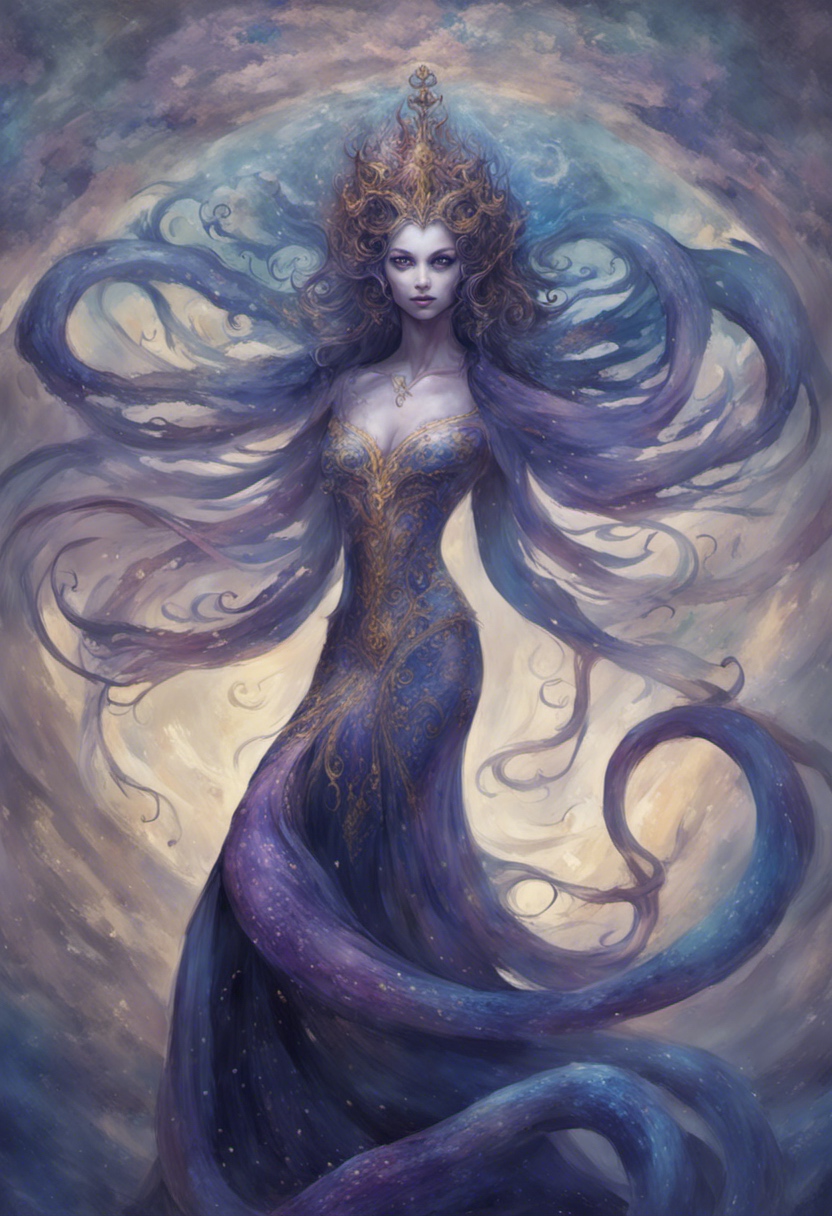
Sea Elf — Leader
She maintains a life above the water that most people see: a wealthy merchant in exotic sea goods, respected in the port cities she frequents, known for her knowledge of ocean currents and her uncanny predictions of weather and shipping conditions. The knowledge is real. The predictions come from somewhere she does not explain, and the people who buy her goods and her advice do not press on the explanation, because the advice is correct.
She came to the Order not through desperation or power-hunger but through understanding — a moment in deep water, years ago, when she felt something look back. She has been corresponding with that something ever since, in the way that you correspond with a vast and patient intelligence: by listening more than speaking, and by being careful about what you ask.
She dresses in deep blues and purples, the octopus symbol worked into her jewelry in silver. She is tall, slender, and moves with the particular stillness of someone who is always slightly more aware of her surroundings than the situation appears to require.
Notable Members
Thalos
Sea-folk male — Security and Ritual
Morwen's right hand in practice and in presence. He leads the cult's rituals and handles the security of their meeting sites, which are always near water and always difficult to approach without being observed. He is not subtle and does not try to be. His value is that he is completely reliable in environments that would unsettle less-adapted people, and that his loyalty to Morwen and to the work is genuine rather than transactional. He has been in the deep water. He knows what is there. He finds this clarifying rather than terrifying, which is something Morwen recognized in him before she recruited him.
Nerida
Human female — Recruitment
She is young for the position and effective beyond what her age would suggest. She attends social gatherings in port cities with the specific patience of someone who is listening for a particular frequency — the sailor who went somewhere he shouldn't have and came back changed, the fisherman whose catches have shifted in ways he can't explain, the scholar who has been asking questions about the deep ocean that the academic establishment doesn't want to answer. These are the people she finds. She does not promise them power. She offers them an explanation, which is a more effective lure for the kind of person the Order wants.
Dagon
Half-Orc male — Enforcer
Old for his position, with the patience of someone who stopped being in a hurry decades ago. He handles threats to the Order with a thoroughness that does not require theatrical violence — most of the time, the threat resolves without one, and when it doesn't, it resolves cleanly. He is deeply spiritual in a way that surprises people who look at him and expect belligerence. The ocean is the oldest thing, he says, when he says anything about it. Everything that lives came out of it. He considers the Order's work a return to something, rather than a departure.
Operations
The Order does not recruit widely. It recruits specifically — the people Nerida identifies, the sailors and scholars and sea-adjacent individuals who have already felt something that needs a name. This keeps numbers small and commitment high. Members who join tend to stay.
Their activities are less operationally dramatic than other cults of their scale. They conduct their rituals. They study the ocean. They chart depths that no cartographer has mapped. They gather objects from the deep and tend them with the care of archivists. Occasionally they interfere with shipping in ways that look like weather. Occasionally they don't interfere and the weather happens anyway, and they watch it happen with expressions that observers find difficult to read.
The Awakening — the moment at which Zoth-Ommog rises in a form the surface world can perceive — is their stated goal and also not a matter of urgency. Zoth-Ommog has been waiting since before the first settlement was built on a coastline. The Order believes it will wait as long as is necessary. They are building toward something that does not need to be rushed, which makes them substantially more patient than most organizations with apocalyptic ambitions, and substantially harder to detect.
Ritual: The Awakening of the Depths
At midnight on the new moon, members gather near the ocean's edge — on a dock, a sea cliff, a beach where the water goes deep quickly. Eight candles ring a circular cloth marked with the octopus symbol, one flame for each arm. The bowl of seawater sits at center. The leader writes the names of those present on parchment with a squid-beak quill dipped in seawater, recites the petition, and burns the parchment over the candles.
The smoke goes out over the water. Members believe the petition descends with it to where Zoth-Ommog rests. Whether or not the petition is received, the ritual produces something in the participants that they consistently describe as a sense of being held by something vast and not hostile. This is the thing that keeps them coming back.
Port authorities in several Shoing and Funta coastal cities maintain files on the Order of the Abyssal Octopus. The files note the octopus symbol, the water-adjacent meeting sites, and the unusual demographic of members — educated, skilled, not the desperate underclass that most cults draw from. The files do not note that the sea conditions around meeting sites are consistently, if subtly, unusual on the nights the Order assembles. No one has looked at the weather records alongside the meeting dates. No one has thought to.