Junaloia
Junaloia: Jewel of the Rhodian Islands
"You may trade here. You may work here. You may grow old here. You will never belong here."
Common saying among long-term outsider residents of Junaloia
At a Glance
| Region | Rhodian Ocean: Dort Islands archipelago |
| Settlement Type | Island Town (unofficial archipelago capital) |
| Population | ~3,500 (Junaloia); several thousand more across the archipelago |
| Dominant Races | Human, Elf; Dwarf, Smaling, Drakin, Serren present |
| Ruler / Leader | Kaimana, Council Head |
| Ruling Body | Council of elected representatives |
| Primary Deity | Ryujin |
| Economy | Fishing, Whaling, Agriculture, Mining |
| Known For | Manalani fruit, self-sufficiency laws, the dragon legend of Johanna, strict insularity |
First Impressions
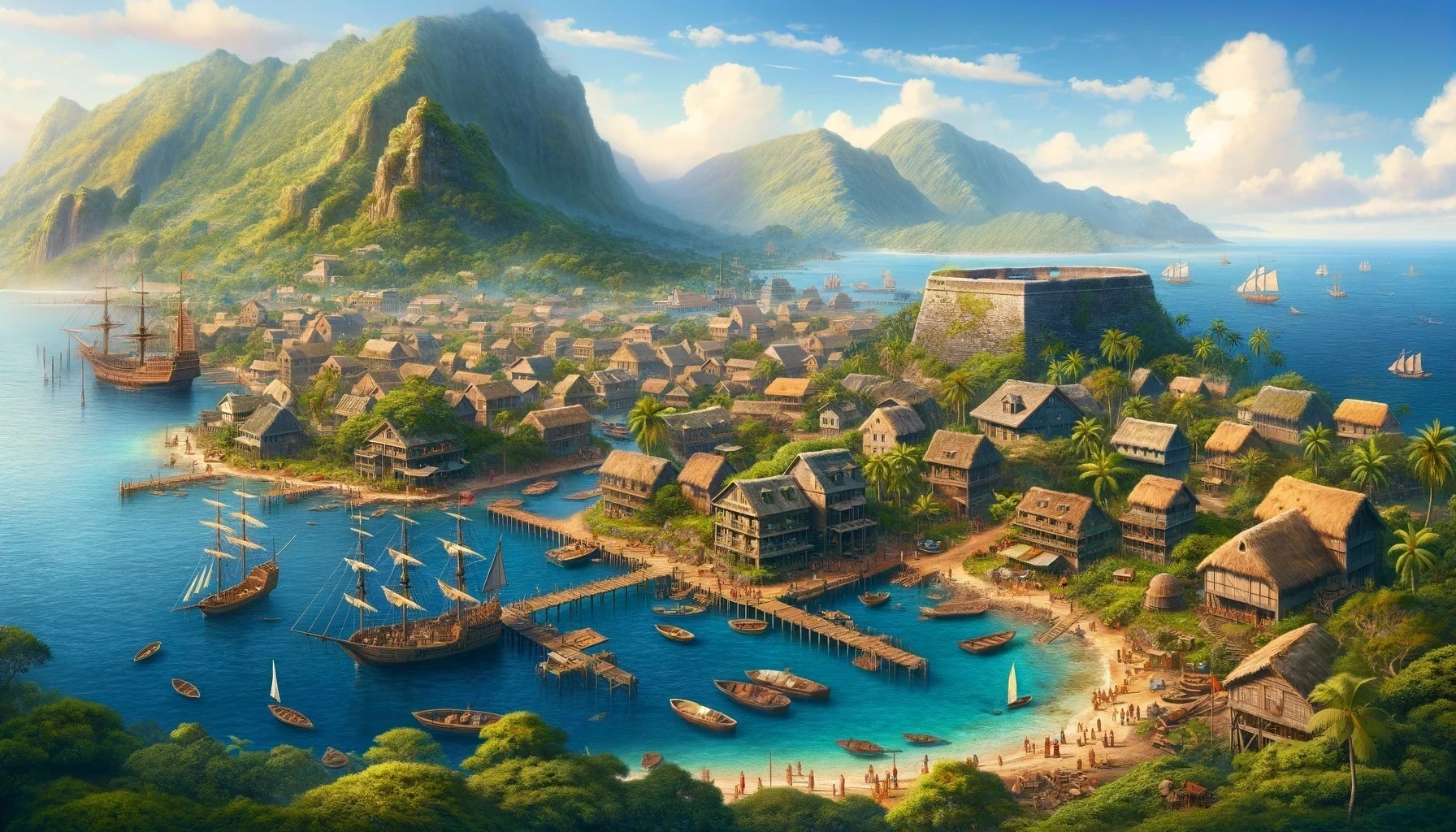
The island rises from the Rhodian Ocean as a mountain: steep slopes descending toward the water, a peak often lost in cloud. The natural harbor at the base is well-protected, and the stone fort on the hill at its entrance has watched arrivals since before anyone living can remember. Three patrol vessels are always on the water. They are polite, unless they have a reason not to be.
The town itself is a labyrinth of narrow lanes between thatched and wattle-walled buildings, built to make maximum use of the available slope. Stone structures are reserved for communal shelters used when hurricanes hit, the fort, and the buildings of the Council. Everything else is organic and slightly irregular, climbing the hillside in tiers. The market near the harbor is the social center: loud, fragrant with fish, salt air, and the faint sweetness of Manalani fruit in season.
The islanders are direct with visitors and warm with each other, with a clear interior boundary between the two. You are welcome here. You will feel that you are welcome here. You will also feel, without anyone saying it, that you are a guest and that your guest status has unwritten terms.
Geography & Setting
Junaloia is a volcanic island in the Rhodian Ocean, part of the Dort Islands archipelago of which it is the largest and most populated. The island is essentially a mountain with the ocean at its base: the harbor is its low point, the peak is its high point, and the inhabitable land is the slope between. The mountain's upper reaches are rich in metal, stone, and minerals; controlled extraction has supplied the town's material needs for generations without depleting the deposits. The lower slopes are farmed. The harbor is fished and whaled. The ocean surrounds everything, and Ryujin is worshipped accordingly.
The climate is oceanic: warm, humid, with hurricane seasons that the stone shelters were built to survive. The mountain channels and moderates the worst weather. Drought has happened once in recorded history, and the experience left marks on the laws.
The People
Demographics
The archipelago's population identifies first with their home island and second with the Dort Islands as a collective. Junaloia, as the largest and the seat of the inter-island Council, attracts more visitors and long-term outsider residents than the other islands. The majority are human and elven. Dwarves are present and respected for their expertise in the mountain's extraction operations. Smalings are common among the agricultural community. Drakin and Serren are less common but not remarkable.
Outsiders are welcome to trade, work, and establish businesses. They cannot own land. They cannot hold governance positions. They cannot take island-born partners without social consequences for the partner; the norm against outmarriage is informal but effectively enforced by community pressure.
Economy
Junaloia's economy runs on a prohibition: common goods cannot be imported. The island produces what it needs. This was a deliberate policy choice (enacted during the Years of Scarcity), and it has held since. The effect is a fully developed local market for everything from fish to metalwork, with no outside competition. A merchant class has grown around the rare exotic goods that are exempt from the prohibition, trading luxury items to the wealthy elite who have no legal constraint on importing what isn't common.
The Manalani fruit is Junaloia's one recognized export that commands prices well above the cost of production. Demand far exceeds the limited annual harvest.
Primary Exports
- Manalani Fruit: Harvested once yearly during the Ryujin festival; small, round, purple-skinned, gold-fleshed, jasmine-citrus fragrance. Medicinal and culinary applications. Extremely high price in outside markets due to scarcity.
- Refined Metals & Minerals: Extracted from the mountain; exported as processed material rather than raw ore
Primary Imports
- Luxury and Exotic Goods: Exempt from the common goods prohibition; imported by wealthy merchants for the elite market
Key Industries
- Fishing & Whaling: Primary food source and trade commodity within the archipelago
- Mountain Extraction: Metal, stone, and mineral extraction under state supervision; primary source of material wealth
- Agriculture: Terraced farming on the lower slopes, supplying the local market; Pomaika'i's innovations have expanded yields significantly
- Thatchwork & Construction: A highly respected craft; the quality of Junaloia's building work is considered the archipelago standard
Food & Drink
Seafood is the staple: fish, whale, shellfish from the harbor. Root vegetables and grains grown on the terraced slopes supplement the diet. Herbs native to the island season everything. The Manalani fruit appears in the local diet only during harvest season and at the Ryujin festival; outside that window, the entire yield goes to export. Junaloia's cooks favor bold flavors and one-pot preparations, food designed for people who work outdoors and eat communally.
Sea shanties are sung while cooking. This is not a metaphor.
Culture & Social Life
The culture of Junaloia is organized around the concept of the island as a living entity that its people are responsible for maintaining. Self-sufficiency is not just economic policy: it is a moral position. To rely on the outside world for something the island can produce is considered a small failure of character. To need the outside world to provide what it cannot is acknowledged only with reluctance.
This produces a society that is industrious, proud, and deeply suspicious of any individual or arrangement that might create dependency. Outsiders who understand this find the islanders easy to work with. Outsiders who don't understand it find them obstinate.
The preference for intra-island marriage is real and enforced socially rather than legally. Islanders who choose otherwise are not formally punished: they are simply made to understand that they have made a choice that creates distance between themselves and the community. Most do not make that choice twice.
Horses are a luxury of the wealthy. Donkeys and oxen are the working animals for everyone else.
Festivals & Traditions
The Ryujin Harvest Festival
Annual, timed to the Manalani fruit ripening. The entire island participates in the harvest, young and old picking fruit while traditional songs are sung across the mountain slopes. The festival includes communal feasts, market days for the archipelago's inter-island representatives, competitive fishing, and ceremonies at Ryujin's temple. It is the largest social event of the year and the only time the Manalani fruit is consumed locally in significant quantity.
Music & Arts
Sea shanties are the dominant popular music form, sung during work and at festivals. The rhythm of shanties is practical: it coordinates labor. Festival music is more elaborate: drums, stringed instruments, and vocal harmonies telling the stories of Johanna, the gods, and the sea. Dance is communal and performed in circles during religious ceremonies, with forms that have not changed in recorded memory.
Thatchwork is considered a fine craft here, not merely construction. The most skilled thatchers are known by name across the archipelago. Kalani Ironfoot's work on the Council Hall is pointed out to visitors the way other settlements point out civic monuments.
Religion
Primary Faith
Ryujin, god of nature and the ocean, is the dominant deity of Junaloia and the archipelago generally. His temple sits on the harbor hill, near the fort. Worship is practical rather than mystical: Ryujin is the ocean and the ocean feeds the island; devotion is an acknowledgment of dependence and gratitude. The festival is its most elaborate expression. The clergy perform blessings over fishing vessels before they leave the harbor and receive offerings of the first catch. In lean seasons, the temple operates as a food distribution point.
Secondary / Minority Faiths
Thulgard (hearth and defense), Amaterasu (sun and agriculture), Echo (unity and knowledge), Martus (luck; heavily worshipped among fishermen), Kraut (nature and cultivation), and Jula (peace) all have shrines or small temples. The churches serve dual purposes as centers of basic education for children.
Secret or Forbidden Worship
No formally forbidden worship is recorded. The archipelago's insularity means outside faiths rarely arrive with committed practitioners; those that do are quietly observed until they demonstrate whether they're compatible with the community's stability.
History
Founding
The founding of Junaloia is attributed in the oldest oral accounts to a celestial sign from Ryujin: a constellation visible from the ocean that resembled the Manalani fruit, which the first settlers followed to the island. Whether this is literal or retrospective myth, it has been the official account long enough that the distinction no longer matters to the people who live here. A humble fishing village was established at the harbor, the mountain was found to be rich in what the settlement needed, and it grew.
Key Events
The Era of Johanna
The most significant political event in the archipelago's history was the unification of the islands under Johanna. Kaimana claims direct descent from her. What is documented: Johanna ruled Junaloia at a period when hostile races were active across the archipelago, and she negotiated and enforced a mutual defense pact among the islands that resulted in the collective elimination of those threats. The islands have operated as a cooperative loose alliance since.
The legend attached to this history goes further: that Johanna was not merely a political leader but the oldest living golden dragon, who took human form, ruled Junaloia, and arranged a mating with a red dragon named Ruby to establish new dragon bloodlines and prevent the opening of Hades and the resulting demon inundation. Whether this is history or myth, the legend is told and retold with equal reverence for both versions.
The Years of Scarcity
A series of natural disasters (hurricanes, drought, and a brief volcanic eruption) tested the island's self-sufficiency. Resources that had been abundant became scarce. The community's response shaped Junaloia's subsequent laws: the prohibition against importing common goods was enacted during this period, the stone communal shelters were built, and the culture of self-reliance was formalized from a preference into a legal principle.
The Golden Age
Following Johanna's unification and the resolution of the scarcity period, Junaloia expanded rapidly. The fishing village became a town, then the town grew into a settlement significant enough to anchor inter-island governance. The stone fort was constructed. The Ryujin festival grew from a local harvest tradition into an archipelago-wide event drawing representatives from every island. Trade routes to select outside markets were established for the Manalani fruit.
Current State
Junaloia is stable, prosperous by its own standards, and tightly bound to its traditions. The criminal underworld that has grown in the absence of hostile races is the current leadership's most visible ongoing problem. The laws against outside participation in governance hold but require periodic reinforcement as outside merchants grow wealthy enough to attempt workarounds. The Manalani fruit export market continues to attract interest from parties who would prefer to establish growing operations elsewhere, something Junaloia actively prevents.
Leadership & Governance
The Council of Junaloia: Overview
Governance is vested in a Council drawn from the dominant and common races: primarily humans, dwarves, and elves. The Council makes decisions collectively, convenes town meetings for significant matters, and holds the inter-island representative assemblies during the Ryujin festival. Kaimana serves as Council head, a position that carries executive authority in emergencies and procedural authority at all other times.
The Council's relationship with the population is built on genuine respect going in both directions, maintained by the tradition of consulting the community before major decisions. This makes governance slower than other models and more durable.
Kaimana: Council Head
Human, Female: Council Hall, harbor district
Kaimana is a woman in her late fifties who carries her authority the way the island carries its mountain, as a fact of geography rather than a performance. She claims descent from Johanna, and whether this is bloodline or mythology, she has Johanna's documented reputation for diplomacy and governance. She is measured, deliberate, and genuinely interested in the welfare of her community rather than its governance for its own sake.
What she wants is stability. What she's willing to do for stability is the question that has defined her tenure.
Guard & Militia
Three patrol vessels maintain constant watch over Junaloia's waters. The captains of these vessels coordinate directly with the Council on external threats. On land, a small guard force serves as an extended police body: fewer in number than a city its relative size would maintain, compensated by community cooperation and the absence of the hostile races that previously required larger forces. The criminal underworld is the primary active concern.
Law & Order
Law in Junaloia is applied by the Council through a system of community elders who handle minor matters and formal tribunal for serious offenses. Punishments trend toward labor, community service, and fines rather than physical harm: the island needs its people functional. Exile is the harshest common penalty and is rarely used. Outsiders who violate laws are expelled from the island and logged by the harbor fort; repeat offenders are turned away on arrival.
Notable Figures
Kalani Ironfoot: Master Thatchworker
Dwarf, Male: Workshop near the Council Hall
Stocky and slow-moving with the precision of someone who measures twice always. His thatchwork is architectural: not just functional but beautiful, and the best of it has structural integrity that outlasts comparable stone buildings in hurricane conditions. He is the person the Council calls when a building matters. His opinion on matters outside thatchwork is not asked for but is given freely and is frequently right.
He knows the mountain's material properties better than most of the extraction supervisors: he has been building with what comes out of it for forty years.
Leilani Swiftwind: Captain, First Patrol Vessel
Elf, Female: Harbor and open water
Leilani has captained the lead patrol vessel for three decades. She is efficient, courteous to incoming vessels until a reason presents itself to be otherwise, and has personally turned away or apprehended every significant attempted smuggling operation in her tenure. She is not warm with outsiders and makes no effort to appear so. She is fair.
She has navigational knowledge of the Rhodian Ocean's currents and hazards that no chart fully represents, accumulated over thirty years of patrol routes. Several captains from outside have offered her employment. She has declined without discussing it further.
Pomaika'i: Head Agriculturist
Smaling, Male: Terraced farms, upper slopes
Pomaika'i looks like a Smaling who has spent decades working in sun and soil, which is what he is. His innovations in terraced farming (new crop rotations, soil management techniques, water channeling down the volcanic slopes) have increased the island's agricultural yield significantly over twenty years. He is cheerful, interested in talking about farming to anyone who will listen, and less cheerful about the Council's allocation of agricultural resources, which he considers chronically underfunded given how much the island's self-sufficiency depends on his work.
He knows what grows on the island better than anyone, including several plants that have unreported properties he uses in his own remedies.
Moana: Luxury Merchant
Human, Female: Warehouse and shop, harbor district
Moana is wealthy: not island-wealthy, but wealthy in the way that makes island-wealthy people uncomfortable. Her trade in exotic goods exempt from the import prohibition has made her the supplier to every elite family in the archipelago. She is charming in the specific way of people who learned charm as a professional tool and eventually stopped noticing they were using it. She wants more access to outside markets, more goods, and a relaxation of the prohibition that she has lobbied for, quietly, for twenty years. She knows the political limits of what she can push for and stays just inside them.
She is the most connected person on the island for anything involving outside-world information.
Key Locations
Seat of Power
- Council Hall: Stone building above the harbor, on the hill below the fort. Open to the public for scheduled sessions. The Manalani export records are kept here under lock. Kalani Ironfoot's thatchwork on the entry hall is considered his finest work.
Houses of Worship
- Temple of Ryujin: Harbor hill, near the fort entrance. Open at all times. The harbor blessing ceremony happens here at dawn on fishing days. The Manalani harvest festival opens and closes with ceremonies at this temple.
- Shrine of Martus: Small, near the docks. Sailors leave coin here before departure. The fishermen's equivalent of insurance.
Inns & Taverns
- The Tidewater Inn: Harbor district, for traders and arriving visitors. Clean, adequate, loud in the evenings. The proprietor speaks Irna Common, Shoing Common, and enough Funta Common to manage.
Shops & Services
- Moana's Trading House: The largest private establishment in the harbor district. Exotic goods, luxury items, and a back room for serious negotiations. Moana is frequently present.
- The Thatchwork Guild Hall: Where construction projects are contracted and Kalani Ironfoot's team operates from. Also a gathering space for the craft community.
The Market
- Harbor Market: Daily, open-air, centered on the lower harbor district. Fish, produce, crafts, metalwork. The island's economic heart. During the Ryujin festival it expands to fill the harbor district entirely.
Other Points of Interest
- The Fort: Stone, harbor hill, staffed continuously. Serves as watchtower, harbor control, and symbol of the island's capacity for self-defense. Inside is a museum level documenting the island's history from founding to the present. The Johanna tapestry, a massive woven narrative of her rule, is the centerpiece.
- Manalani Orchards: Upper slopes, restricted access during harvest. The orchards are the most carefully managed land on the island. Entry without Council permission during harvest season is a significant offense.
The Criminal Element
Junaloia's underworld grew to fill the security vacuum left when Johanna's pact eliminated the hostile races. Smugglers, thieves, and kidnappers operate primarily in the harbor district and the outer settlements. They traffic in goods that circumvent the import prohibition (common goods brought in through unofficial channels) and in the export of things the Council hasn't approved for export. The kidnapping operation specifically targets outsiders, who are easier marks and whose disappearances are less likely to trigger a full Council investigation.
The guard is active against these elements but underpowered relative to the operation's scale. Leilani Swiftwind's patrol catches the maritime end; the land-side operation has deeper community ties and is harder to root out.
Secrets, Rumors & Hooks
- Kaimana's claim of Johanna's lineage is not genealogically documented. There is a theory among older scholars that "Johanna" was not a person but a title, and that whatever the current bearer of that lineage actually is, it is not fully human. Kaimana does not respond to questions on this topic.
- The Manalani fruit's medicinal properties include effects that are not publicly listed. The Council has documentation on these effects that is not shared with buyers. At least one buyer, a physician from Irna, noticed what the documentation omits and sent a letter of inquiry that was never answered.
- The criminal underworld's kidnapping operation is not random. Targets are outsiders with specific skills or knowledge the people behind the operation want. Who is behind it is not the guard captain or the Council: it is someone with access to information about arriving visitors before they dock.
- The sealed dragon egg found in a mountain mine seven years ago is in the Council Hall's vault. No one outside the Council knows about it. Pomaika'i knows because he was with the extraction team. He has not been asked about it and has not volunteered the information.
- Moana's trade network extends to Frankton Island. The goods that arrive twice yearly on The Skyshadow include materials that pass through Moana's hands before reaching Lord Frankon's castle. The nature of the arrangement, and what Moana receives in return, is her most carefully kept secret.