Aviari
Aviari
CORE IDENTITY
- Race Name: Aviari
- Plural Name: Aviari
- Adjective Form: Aviari
- Alternate Names: Skyfolk (common neutral); the Flock-People; the Winged (archaic, now considered mildly reductive)
- Self-Name (Endonym): Sorani, "those of the sky" in their own tongue; used philosophically and in formal contexts, less often in daily speech than the race name itself
- Outsider Names (Exonyms): Featherkin (common, neutral to warm); the High Ones (Jazirah usage, respectful); Windwalkers (Smaling term, affectionate); the Watchful (Urgrak usage, accurate and meant as high regard)
OVERVIEW
Short Description
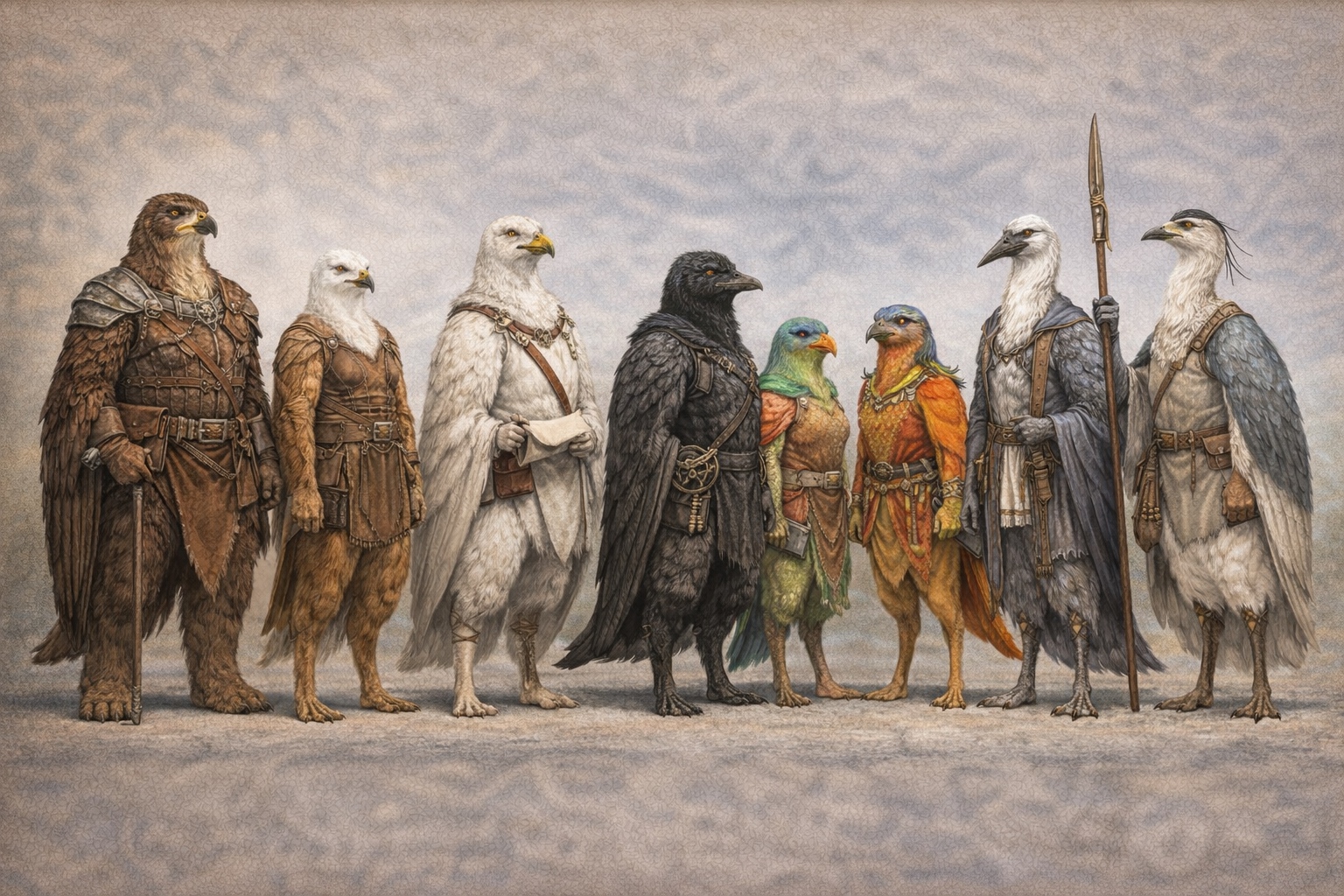
The Aviari are a beastfolk people of unmistakably avian character: bipedal, feathered, with functional wings that serve as their primary upper limbs and a precision of form that makes them appear composed even in motion. They are organized into flocks rather than nations, and flock-identity carries the weight that clan or pride does for other peoples. Their origins trace to mage-work that encoded avian nature into sapient form; Aviari regard this origin with the same settled acceptance that marks the other shaped peoples; it is the beginning, not the question. What the Aviari live is altitude: the view from above, the precision of the eye that sees terrain entire, the understanding that the most complete picture of anything is always obtained from a distance.
General Reputation
The Aviari are regarded throughout most of Dort as precise, observant, and somewhat elevated in their manner: not arrogant exactly, but possessed of a perspective that comes from literally seeing things from above that others see only from within. Outsiders often find them unexpectedly warm once past the first impression of composure; the Aviari are not cold, they are simply exact. In Shoing and northern Irna, where large Aviari flock-territories have existed for centuries, they are respected as reliable navigators, honest traders of aerial intelligence, and formidable allies in mountain terrain. In lowland urban contexts, they are frequently the subject of genuine curiosity; a person with functional wings walking a market street draws attention even in cities that see many peoples.
Role in the World
The Aviari occupy a civilizational niche that no other people fully duplicates: they are the world's eyes. Navigators, surveyors, scouts of significant territory, carriers of messages across terrain that defeats ground travel, and the most reliable aerial observers of military movement, weather, and geographic change. Their flock-territories correspond closely to mountain ranges, coastlines, and high plains: places where altitude provides genuine advantage and where their flight capability translates into access that no ground-based people can match. They are not empire-builders, but their knowledge of how places connect, how trade routes link, and where terrain makes certain movements impossible gives them leverage in diplomatic and commercial contexts that their population numbers alone would not suggest.
PHYSICAL TRAITS
General Appearance
An Aviari reads as avian immediately: feathered from crown to foot, with a lean bipedal frame and wings that fold against the body at rest in a manner that gives them an unusual silhouette: broad-shouldered when the wings are partially extended, narrower when fully folded. Their heads carry the forward-set eyes, short hooked or curved bill, and upright posture that identifies the lineage even before the feathers register. The overall impression is of something precisely constructed: no wasted surface, every element placed with intention.
Size Ranges
- Typical height: 5'2" – 6'4" (varies by lineage; see Variants)
- Typical weight/build: Consistently lighter than visual impression suggests; hollow-boned skeletal structure means most Aviari weigh significantly less than non-winged peoples of equivalent frame. Build is lean and cable-muscled through the chest and shoulders.
Distinguishing Features
All Aviari share a set of features consistent regardless of lineage: feathers covering the full body (varying in texture, density, and pattern by lineage and individual), forward-set eyes with exceptional visual acuity, a bill rather than a muzzle (ranging from short and hooked to long and narrow depending on lineage), hollow bones that reduce weight at the cost of some structural resilience, and wings that function as their primary upper limbs. The wing-hand structure, a clawed grasping joint at the leading edge of the wing, allows manipulation, though with less fine-motor precision than a fully hand-capable limb. Aviari who need to write, work fine craft, or handle small objects have developed techniques around this limitation that outsiders often find elegant. Their voices carry further than body size would predict; all Aviari have a natural resonance that projects cleanly in open air.
Sexual Dimorphism
Sexual dimorphism varies significantly by lineage. Sky-kin show the most pronounced dimorphism; male-presenting individuals often carry richer plumage coloration and a more dramatic crest, which deepens with age. Shore-kin dimorphism is minimal. Song-kin dimorphism is expressed primarily in vocal range rather than appearance. Across all lineages, the difference is noted but does not create meaningfully different functional roles.
Aging Patterns
Aviari hatchlings are mobile and vocal within days, but genuine flight capability develops slowly; most Aviari achieve full controlled flight between ages seven and twelve, with early attempts producing the characteristic short-hop bounding movement of young fliers. Adult standing in the flock is recognized when a young Aviari demonstrates navigational competence (the ability to find their way home over unfamiliar terrain), which typically occurs between ages sixteen and twenty. Visible aging in Aviari appears as feather color change: the plumage gradually acquires lighter or greyer tones, particularly at the crown and around the eyes, and in some lineages the crest feathers develop distinctive white streaking. Elders whose plumage has turned predominantly pale are called the White-Crowned and are treated with marked deference.
Regional Variation
Aviari appearance is defined by lineage rather than geography. A Sky-kin hatched in the warm lowlands of Funta carries the same broad wingspan and sharp vision as one raised in the cold highlands of Shoing. Within lineages, minor plumage variation exists (extended generations in dense forest environments produce slightly more muted coloration in some lineages), but the lineage characteristics remain dominant. Aviari are exempt from continental appearance demographic norms; their appearance is defined by bloodline and lineage, not birthplace.
BIOLOGY
Diet
Aviari are omnivores with strong lineage-based dietary preferences. Sky-kin and Shore-kin lean heavily toward fish and animal protein; Song-kin and Dusk-kin are more broadly omnivorous with significant grain and fruit consumption. All Aviari require a higher caloric intake than ground-based peoples of comparable size; flight is metabolically demanding even when limited. Aviari in sedentary roles (confined to ground activity for extended periods) eat notably less than those in regular flight, and both groups find each other's consumption habits somewhat remarkable.
Sleep Patterns
Aviari are diurnal, oriented toward the light. Most lineages sleep in elevated positions when possible; roosting preference is deep-seated and is expressed even by Aviari who have lived their entire lives in non-roosting architecture. Shore-kin are the partial exception, sometimes resting on floating platforms or watercraft. Communal roosting is biologically comfortable and culturally common within flocks, though the arrangement is less physically intimate than Canix sleeping patterns; Aviari tend toward proximity rather than contact.
Reproduction Basics
Aviari lay clutches of one to three eggs, with single-egg clutches most common in larger lineages and two-to-three more common in Song-kin and smaller lines. Both parents incubate and care for eggs and hatchlings; the broader flock participates in early hatchling socialization, teaching navigation, vocalization, and flock-identification calls before formal flight training begins. Aviari hatchlings are not left unattended; the flock maintains continuous awareness of all non-flying members.
Lifespan Ranges
- Typical lifespan: 70–100 years
- Maturity: 16–20 years
- Elderhood: 60–75 years
Environmental Adaptations
Aviari physiology adapts well to altitude and open sky; thinner air is handled with greater ease than most peoples manage, a consequence of the respiratory efficiency required for flight. All lineages tolerate wind and temperature variation better than their apparent frame suggests. The hollow-bone structure reduces resilience in falls and impacts that would not significantly harm denser-boned peoples; Aviari are aware of this asymmetry and develop careful habits around ground-level physical risk that occasionally read as caution to non-Aviari observers. In practice it is simply accurate self-assessment.
PSYCHOLOGY & CULTURE
Typical Temperament
Aviari present as composed, observational, and precise. They are oriented toward the complete picture before the assessment; they would prefer to circle once more before landing than to commit to a position based on insufficient information. This quality translates into social interaction as a thoughtfulness that can read as deliberate, reserved, or simply careful depending on the observer. Within the flock, this composure is balanced by a surprisingly ready warmth; Aviari among trusted companions are expressive, given to vocal richness in conversation, and possessed of a dry wit that frequently catches ground-dwelling peoples off guard. The view from altitude is not detachment. It is simply the insistence on seeing clearly before speaking.
Cultural Values
- The complete view: The foundational Aviari epistemic value, that judgment before sufficient information is fundamentally a failure of craft, not a sign of decisiveness. An Aviari who commits to a position before they have mapped the terrain is considered to have made a preventable error. This extends from navigation to argument to diplomacy.
- Economy of the wing: Every unnecessary action costs lift. The Aviari aesthetic of precision (doing exactly what is needed, no more) is expressed in craft, in speech, in social navigation. Excess is considered a form of sloppiness.
- Flock-sight: The understanding that a single perspective is always partial. Aviari make significant decisions by aggregating viewpoints across the flock; what appears true from one altitude often looks different from another. This is considered wisdom, not indecision.
- The honest account: Aviari who navigate (and all Aviari navigate) do not embellish terrain reports. The cliff is the height it is. The wind is the speed it is. Exaggerating danger to appear brave or minimizing it to appear bold are both considered forms of incompetence. The honest account is not modesty; it is professionalism.
Taboos
- False navigation: Providing incorrect route or terrain information, whether through carelessness or deliberate deception. In a culture built on the accuracy of aerial observation, this is considered one of the deepest possible betrayals; it endangers lives and undermines the one contribution Aviari make that no other people can duplicate.
- Abandoning a flock-mate in unfamiliar sky: Leaving another Aviari alone in terrain they do not know, without guidance to safety. The obligation to escort the lost home is considered unconditional.
- Clipping: The term for grounding another Aviari: damaging wings, confining them, or otherwise removing their ability to fly. This is a profound violation; it is the removal of identity as much as capability.
Social Structures
The flock is the primary unit of Aviari society, typically ranging between fifteen and sixty members. Flocks hold recognized airspace and landing territories; flock-territory is defined by the sky above as much as the land below, and disputes between flocks are most often about airspace corridors: the specific paths between thermals and reliable updrafts that make flight efficient. Multiple flocks sharing a mountain range or coastline form loose alliances called sky-runs, coordinating airspace rights, shared navigation knowledge, and emergency signaling. There is no Aviari nation; the sky-run is the largest coherent Aviari political unit.
Family Structure
Aviari pair bonds are long-term and publicly recognized within the flock. Both bonded partners share incubation and hatchling-rearing in roughly equal measure; the biological investment in each egg is high enough that both parents are considered essential to successful rearing. The flock takes on a broader socialization role for hatchlings, but birth parents maintain a distinct relationship with their young throughout life. Adoption of non-flock-kin hatchlings is recognized but relatively uncommon; Aviari flocks have less population pressure driving adoption than peoples with larger litter sizes.
Leadership Patterns
Flocks are led by a Flight-Head, chosen by demonstrated navigational expertise and acknowledged by flock consensus. The Flight-Head's primary competency is navigation: the ability to find routes, read weather, locate water and food over unfamiliar terrain, and bring the flock home from anywhere. Political skill matters in negotiations with other flocks or ground peoples, but a Flight-Head who cannot navigate is considered to have the wrong job. Leadership transitions when the Flight-Head acknowledges a successor whose navigation has surpassed their own; this voluntary passing of the role is considered the appropriate form and earns the departing leader lasting honor.
GEOGRAPHIC DISTRIBUTION
Primary Homelands
- Shoing: The mountain ranges and high plateau regions of Shoing hold the largest and oldest established Aviari flock-territories. Sky-kin dominate the high ranges; Shore-kin occupy the river valleys and coastal escarpments. Shoing Aviari have been in formal diplomatic relationship with neighboring peoples for over a thousand years and hold recognized airspace rights in several large territorial frameworks.
- Irna: Mountain ranges and highland coastal cliffs throughout Irna support significant Aviari populations. Irna Aviari flocks have integrated most extensively with non-Aviari ground cultures, particularly in the north and along the western coast.
- Open seas and coastlines (all continents): Tide-kin are found wherever there is sustained coast or open ocean; their flock-territories are the most geographically extended of any Aviari lineage, spanning coastlines across all continents.
Secondary Populations (Diaspora)
- Funta: Smaller Aviari populations in the highland interior and along the southern coast, primarily Sky-kin and Song-kin. Funta Aviari are a significant minority presence in several highland trade routes where their navigation knowledge is commercially valuable.
- Antaea: Shore-kin along the long Antaean river systems and coast, and Song-kin in the warm inland forests. Antaea Aviari populations are smaller but well-established and have been present for several centuries.
- Jazirah: Small, mainly Dust-tolerant Sky-kin populations in the high escarpments. Jazirah Aviari are known primarily through their role in carrying messages across the deep desert in ways that ground travel cannot match.
Migration Patterns
Aviari migration is seasonal for many lineages; the long-distance movement of flocks between summer highland territory and winter lowland shelter follows patterns older than recorded history. These seasonal movements are not considered migration in the displacement sense; they are part of the flock's territorial cycle. True range expansion, establishing new permanent flock-territories, typically follows the discovery of unclaimed or under-utilized airspace by young Aviari scouting beyond their birth-flock's range, who then return with navigational knowledge that allows a fission-flock to settle it.
Adaptations by Region
Aviari in cold highland Shoing rely on dense underfeathering for warmth and have developed architectural conventions for communal cold-weather roosting that use enclosed spaces for thermal retention. Tide-kin in open ocean territories have developed navigation techniques using star-position, wave-pattern reading, and magnetic sensitivity that are considered among the most sophisticated wayfinding traditions in Dort, and they guard these methodologies within the flock. Song-kin in warm Antaea forest interiors have adapted their foraging into a broad omnivory that includes fruit, grain, insect, and small animal protein: the most varied diet of any Aviari lineage.
Cultural Differences Between Lands
Shoing Aviari flocks have the most formally developed airspace negotiation traditions, a consequence of long-standing proximity to large non-Aviari political structures with overlapping territorial claims. Irna Aviari, through centuries of ground-culture contact, have developed the most fluent relationships with non-Aviari peoples and the most sophisticated commercial traditions around selling aerial intelligence and navigation services. Funta Aviari maintain the most distinctly separate flock culture, with less integration into surrounding ground-culture institutions than any other regional population. Tide-kin flock culture across all coastlines shares a distinctive character that crosses continental lines; a Tide-kin from the Shoing coast and one from the Irna coast will find each other's customs more familiar than either finds the inland flocks of their own continent.
HISTORY
Origins
The Aviari name their origin the First Ascent: not the mage's shaping, which they acknowledge factually, but the moment when the first shaped Aviari found a thermal, spread their wings, and rose into air. This is the origin that matters: not creation, but the first time a shaped being understood what it had been given. The mage's work is noted in oral tradition without significant elaboration; the Aviari do not find their shaped nature troubling or particularly interesting as a philosophical question. What interests them is what came after.
Major Turning Points
The Sky-War of the High Ranges (estimated sixteen centuries before the current era) was the largest recorded inter-flock conflict in Aviari history, arising from competition over thermal corridors in the Shoing highlands as population grew beyond what existing airspace agreements could accommodate. The conflict lasted approximately forty years and ended with the Compact of Open Sky, an inter-flock agreement establishing that thermal corridors are shared navigation routes rather than territorial exclusives. This compact, re-affirmed and expanded over the centuries, remains the foundation of inter-flock airspace law.
The Great Coastal Expansion (approximately nine centuries before the current era) describes the period when Tide-kin flocks first established permanent territories beyond the Shoing coast, extending across open ocean to reach the shores of other continents. This was a genuine achievement of navigation (crossing open water without landmark), and Tide-kin claim of that crossing as a flock identity is among the most prestigious in Aviari culture.
The Ground Accords (approximately five centuries before the current era) were a series of formal agreements between Irna Aviari flocks and the ground-state powers of that continent, establishing recognized airspace rights, commercial protocols for navigation service fees, and the framework within which Aviari flock-territories could exist within non-Aviari political geographies. These accords are the most legally sophisticated documents Aviari culture has produced and serve as the template for flock-ground negotiations elsewhere.
Current Historical Posture
The Aviari are stable and, by their own assessment, watching. Their population is not large, but their strategic position, aerial observers over every major geography, gives them influence well beyond population numbers. The current moment they are watching most closely is the expansion of urban density in Irna and Shoing into territory that Aviari flocks have historically used as fly-through corridor. The flock-leaders engaged in those negotiations are patient, which is appropriate. They have time. They can see further than the negotiators across the table.
LANGUAGE
Language Name(s)
The Aviari language is called Soranthi, "the sky-tongue," with the same root as their self-name. It is a single language with lineage-influenced variation: the phonological base is consistent across all lineages, but Sky-kin speech tends toward shorter, sharper utterances; Shore-kin toward longer, more measured phrasing; Song-kin toward the widest melodic range within spoken language. These are tendencies rather than dialects; mutual intelligibility across all lineages is complete.
Script
Aviari writing is called Flightmarks, a precise, angular notation system developed from the marks made by talons on clay and stone, which gives it a characteristic sharp-edged aesthetic. It is written on stone, fired clay tablets, and treated bark. Flightmarks are designed for durability in outdoor conditions; the script is weather-resistant on appropriate materials, a practical consequence of flock life in mountain and coastal environments. Urban Aviari have adopted regional scripts for commercial documentation, but Flightmarks remain the language of flock records, navigational charts, and formal correspondence.
Trade Language Status
Soranthi is not a dominant trade language, but Aviari individuals are widely known as excellent language learners, and most adult Aviari who interact regularly with ground peoples speak one or two additional languages fluently. The premium on clear communication in navigation contexts makes Aviari inclined toward language mastery; a navigator who cannot speak the language of the territory they are guiding through is considered to have a professional gap. Common carries Aviari loanwords primarily in vocabulary related to navigation, weather reading, altitude, and distance estimation.
Dialect Range
The lineage-influenced variations in Soranthi are the primary internal variation; these are tendencies rather than dialects, and any Aviari can understand any other Aviari without meaningful difficulty. Regional variation in vocabulary, particularly for terrain features visible from altitude, creates some local opacity but does not impede comprehension.
Naming Agent Cross-Reference
See _Cannon/Race naming ai agents/beastfolk/Beastfolk - Avian.md for full naming rules and generation guidance.
NAMING CONVENTIONS
Aviari names follow a given name + flock name structure, drawn from the Japanese phonological system documented in the naming agent file. Names are mora-timed, precise, and typically two to three syllables; elder and notable Aviari may carry four-syllable names. Flock names follow the same phonological tradition and describe territory or founding character.
Different lineage types draw from different root clusters within the same phonological system: Sky-kin favor sharp hawk-roots (Taka-, Haya-, Sora-); Shore-kin favor patient crane-roots (Tsuru-, Mizu-, Har-); Dusk-kin favor darker raven-roots (Kara-) with heavier vowels; Song-kin favor light small-bird roots (Suzu-, Har-) with lighter endings.
Sex and Name Form
Aviari sex-marking is systematic and carried entirely in the ending: the root carries meaning, the ending carries sex, and any root can produce either. The mage's enforced tidiness shows here as clearly as anywhere: the system has almost no exceptions. Feminine endings are -ko, -ne, -no and -mi; masculine are -shi, -to and -ru; and -ki, -ri, -te and -n are genuinely ambiguous and very common. In a name generated without a specified sex, those four should predominate.
Because the ending governs absolutely, Takako and Takashi share the hawk-root and differ only in sex. Siblings are commonly given the same root with different endings, and flight-partners sometimes adopt matched roots deliberately; Mizuko and Mizuto reads as family to any Aviari. Flock names never inflect.
Name Examples
- Given names (general): Takashi, Soraki, Kazeno, Tsurumi, Hayane, Karako, Suzurin, Harumo, Mizuri, Torishin
- Given names (elder / formal): Same names; elders are distinguished by title prefix, not name change
- Flock names: Takamori, Sorakaze, Tsuruhara, Karaumi, Mizumine, Hayakori, Suzunone
- Honorific / title examples: Sora- (before the name) for a recognized Flight-Head; -no (appended) for an acknowledged White-Crowned elder; -shi (appended) for a qualified navigator
- Full name examples: Takashi Takamori, Soraki Sorakaze, Hayane-no Tsuruhara, Karako Karaumi, Mizuri-shi Mizumine
SOCIETY
Common Professions
Aviari are overrepresented in every profession that benefits from aerial perspective or precise long-range observation: navigation and wayfinding, cartography, meteorological observation, military reconnaissance, and the courier trade for messages that need to cross difficult terrain quickly. Their navigation knowledge is their most commercially valuable export; flocks in Irna and Shoing have established formal fee structures for guide services that other peoples depend on for mountain and coastal crossings. Urban Aviari find roles in architecture consultation (the view from above makes structural planning intuitions different), in precision craft work where their economy-of-motion aesthetic produces distinctive results, and in the performing arts; Aviari vocal range and natural projection make them sought-after performers in cultures that value voice.
Craft Traditions
Aviari craft is defined by precision and lightness; they work in materials that reward delicacy: fine-line engraving on stone and shell, detailed cartographic work, feather-based textile arts developed around the molted plumage of community members. Navigational charts produced by Aviari flocks are considered the most accurate available in most of Dort and command a significant price premium; the cartographic tradition is treated as a form of sacred craft within the flock, with a distinct mentorship lineage that passes technique from one generation to the next. The specific projection methods and reference systems vary by flock and are considered flock property.
Trade Roles
Aviari export navigation services, precision cartographic products, meteorological knowledge (particularly of seasonal wind patterns and storm behavior), and raw feather materials. They import worked metal (their wing-hand structure limits fine metalwork), grain staples (high metabolic demand), and luxury goods for flock celebration occasions. Aviari commercial negotiation is direct and detail-oriented; they tend to specify terms precisely and hold to them, and they respond poorly to partners who are vague about obligations; vagueness in a navigation context is dangerous, and the instinct carries over.
Military Tendencies
Aviari flocks are not conquest forces, but their military value as scouts, signal corps, and aerial disruption of ground formations is recognized and employed across most of Dort's military traditions. The Aviari approach to force is reconnaissance-first: understanding the terrain and the opposing disposition before committing to engagement. Flocks do not maintain standing warriors; all adult Aviari are capable of aerial combat in the defense of flock territory, and the combination of speed, altitude advantage, and their ability to disengage and re-engage at will makes them difficult opponents on their own terms. Aviari mercenary scouts are employed by most major military powers and are worth more than their numbers suggest.
Religious Tendencies
Aviari spiritual life centers on the sky itself as the encompassing context for all existence: not as a deity to be petitioned, but as the medium within which everything has its place. The thermal that lifts without effort, the storm that grounds the flock, the clear morning that allows the longest sight: these are treated as the expressions of a world that can be read but not controlled, and the appropriate response is attention and skill. Most flocks maintain a tradition of dawn observation: members gather at first light to watch the sky and take weather reading, which is simultaneously practical preparation and a form of meditation. There is no priesthood; the Flight-Head's navigation role carries the closest thing to spiritual authority.
INTERACTIONS
Relations with Other Races
- Gnomes (Zannovi): An unexpected but durable relationship. Gnome tinkerers have produced optical instruments (long-tubes for far-seeing) that Aviari navigation has adopted enthusiastically, and the commercial relationship has deepened from there. Gnome cook guilds and Aviari have less contact but are generally warm when they meet.
- Felari: Mutual respect between two peoples who approach the world through observation rather than force. Aviari and Felari are natural partners in scouting and intelligence work; a Felari tracking from ground level and an Aviari reading terrain from altitude is a combination that is notably effective and is used deliberately in several Irna and Shoing military contexts.
- Canix: Aviari find Canix vocal expressiveness both remarkable and useful; the long-distance howl-call systems and Aviari signal-call systems have been adapted into joint communication protocols in several regions. The relationship is warm at the working level; Aviari are occasionally overwhelmed by the social energy of large packs.
- Elves (Aelvari): A relationship of aesthetic appreciation and mild philosophical tension. Both peoples value precision and elegance; both have long histories and careful attention to tradition. The tension is between the Aelvari preference for ground-level depth and the Aviari preference for aerial breadth; each finds the other's perspective partial in interesting ways.
Stereotypes (Given and Received)
- Stereotypes about them: That they are cold or detached (false, a consistent misread of composed precision); that they cannot be trusted in ground-level commitments because they will simply fly away (false; Aviari who make agreements hold them, and the taboo against false navigation extends broadly to false accounting); that they look down on ground peoples (literally unavoidable given the physiology; culturally untrue as a general attitude).
- Stereotypes they hold: That ground peoples make decisions with insufficient information and then are surprised by outcomes; that Canix confuse emotional intensity with clarity; that Smalings understand something about the value of the specific place that Aviari, moving constantly, occasionally lose; that Dwarves have solved problems no one else has thought to identify.
Cooperation Patterns
Aviari cooperate most readily with peoples who are specific about terms, value accurate information, and do not interpret aerial perspective as judgment. Navigation contracts, cartographic partnerships, military reconnaissance agreements, and altitude-based territorial negotiations are the primary cooperation modes. Aviari are reliable long-term partners in ongoing relationships; flocks that have worked with a ground people for multiple generations develop genuine inter-cultural depth.
Conflict Patterns
Conflict arises most consistently when airspace rights are not acknowledged: when ground-based powers treat the sky above their territory as their own without reference to flock agreements that predate them. The second major conflict pattern is information disputes: Aviari who provide accurate navigation data that leads to outcomes the client dislikes are sometimes accused of deliberate misdirection, which is the accusation that most reliably provokes Aviari from composed to genuinely angry.
VARIANTS
Physical / Regional Variants
Aviari lineages are defined by biological heritage rather than geography. Mixed-lineage flocks exist and are common along coastlines and at geographic transitions; lineage characteristics remain identifiable in individuals regardless of flock composition.
Sky-kin
The hawk and eagle lineage, the soaring hunters of open altitude. Sky-kin are the largest-framed Aviari, with the proportionally broadest wingspans and the most powerful sustained-soaring capability. Their coloring runs from rich amber-brown through deep slate, typically with lighter underside plumage and a dark eye-stripe or hood. Their forward-set eyes have the sharpest long-distance vision of any Aviari lineage; Sky-kin can resolve detail at distances that other lineages register as blur. They are primarily associated with the high mountain ranges of Shoing and Irna and are the lineage most associated with flock leadership; the Flight-Head tradition is most developed in Sky-kin flock culture, though it is present across all lineages.
- Typical height: 5'8" – 6'4", broad build
- Defining biological traits: Broadest wingspan relative to body; sharpest far-distance vision; powerful thermal-soaring musculature; amber-to-slate coloring with light underside; most pronounced dimorphism in plumage richness
- Range: High mountain ranges of Shoing and Irna; significant presence in highland Funta and Jazirah escarpments
Tide-kin
The seabird and oceanic lineage. Tide-kin have the widest absolute wingspan of any Aviari, proportioned for endurance soaring over open water rather than maneuvering through complex terrain. Their plumage is waterproof to a degree that allows repeated water-surface contact without saturation, a biological trait unique among Aviari lineages. Coloring runs from bright white through grey to charcoal, often with vivid bill and foot coloring that varies by individual. Tide-kin are the endurance fliers of the Aviari: capable of covering oceanic distances by soaring on wave-generated updrafts in a way that requires minimal active wingbeating. Their navigation instincts are the most developed of any lineage, incorporating sensory information (magnetic field orientation, wave pattern reading, and star-position awareness) that other lineages use less fluently.
- Typical height: 5'6" – 6'2", lean long-winged build
- Defining biological traits: Widest absolute wingspan; waterproof plumage; oceanic endurance soaring; most sophisticated navigation sensory suite; white-to-grey-to-charcoal coloring
- Range: All coastlines; open ocean crossing flock-territories; primarily coastal Shoing, Irna, and Funta
Dusk-kin
The raven and corvid lineage, the most cognitively flexible Aviari. Dusk-kin are medium-built with predominantly dark plumage, ranging from deep blue-black to oil-slick iridescent in direct light; their feathers carry the metallic sheen that marks the corvid ancestry. Their memory for specific objects and locations is more developed than other Aviari lineages; Dusk-kin have a confirmed tendency to cache significant objects: not as hoarding, but as a spatial memory practice that extends into their navigation habits. They are more comfortable operating alone or in smaller sub-groups than other Aviari lineages, making them the most useful lineage for solo scouting and independent information work. Their vocalizations have the widest imitative range; Dusk-kin can reproduce many non-Aviari sounds with sufficient fidelity to be useful in communication contexts.
- Typical height: 5'4" – 6'0", medium build
- Defining biological traits: Predominantly dark iridescent plumage; most developed object and location memory; most comfortable in solo operation; widest imitative vocal range; most cognitively flexible lineage
- Range: Irna and central Funta primarily; found wherever complex populated terrain offers information-gathering opportunity
Song-kin
The small songbird and parrot lineage, the smallest Aviari and the most socially dense. Song-kin flocks run larger than other lineage flocks and maintain tighter internal spacing; their social behavior more closely resembles what outsiders expect of birds than any other Aviari lineage. Their vocal range is the broadest of any Aviari lineage; Song-kin can produce sounds spanning from frequencies that other Aviari cannot generate to tonal complexity that approaches singing in its conventional sense. They are more vividly colored than other lineages, with plumage that runs through greens, blues, reds, and oranges in combinations that vary significantly by individual. Their flight style is more agile and maneuvering-focused than the thermal-soaring Sky-kin or endurance-soaring Tide-kin; Song-kin navigate dense canopy and cluttered urban airspace with ease.
- Typical height: 5'2" – 5'8", light build
- Defining biological traits: Smallest Aviari; widest vocal range; most vivid and varied plumage coloration; most agile maneuvering flight; largest social flock density; warmest climate adaptation
- Range: Antaea and warm southern Funta primarily; anywhere with dense canopy or warm urban environments
Shore-kin
The crane, heron, and wading bird lineage: the most patient and longest-limbed Aviari. Shore-kin are tall and spare, with long legs adapted for standing in shallow water and a longer, straighter bill suited to the stand-hunt technique: the practice of becoming completely still for extended periods until prey comes to them rather than pursuing it. Their patience is biological before it is cultural; Shore-kin physiology maintains a lower resting metabolic rate than other lineages, allowing them to sustain still-periods that other Aviari would find difficult. Their plumage tends toward pale grey, white, and blue-grey with variable accent markings. Shore-kin are the most water-comfortable Aviari lineage; they wade regularly and some individuals swim short distances, though water-crossing is not a navigation method.
- Typical height: 5'8" – 6'4", lean long-limbed build
- Defining biological traits: Longest legs of any Aviari; stand-hunt physiology (lower resting metabolism, superior stillness duration); water-comfortable wading; longer straight bill; pale grey-to-white plumage; most patient temperament
- Range: River systems and coastal wetlands across all continents; concentrated in Antaea waterways, Funta river margins, and Irna coastal flats
Cultural Branches
The Charter Flocks
Flocks that have entered formal long-term service agreements with non-Aviari ground governments, providing navigation, reconnaissance, and aerial courier service under recognized contract. Found primarily in Irna and Shoing, where ground-state political complexity has made sustained Aviari contracts valuable to all parties. Charter Flocks maintain their internal flock identity fully; the external contract is an obligation, not an absorption. Other flocks view them with a spectrum of opinion ranging from admiration for their negotiating skill to concern about what sustained ground-culture immersion costs.
The Deep-Sky Flocks
Flocks that have fully committed to oceanic territory, maintaining no fixed ground presence; their flock-territory is defined entirely by ocean airspace and they conduct all permanent activity on ships, floating platforms, or island stops. Found primarily among Tide-kin. Deep-Sky flock culture has drifted further from ground-culture contact than any other Aviari tradition and has developed navigation knowledge that charter flocks and mountain flocks acknowledge openly as beyond their own competence.
DEVELOPMENT NOTES (Author use only, not canon)
Story Hooks
- A Charter Flock in Irna has received navigation intelligence from a second flock that contradicts something in the charter flock's own records, and both flocks are certain of their own accuracy. One of them was wrong. The question is when.
- A Sky-kin Flight-Head is navigating a succession; she has identified the next Flight-Head, a young Dusk-kin who joined the flock from outside. The flock is not certain. The candidate is more certain than anyone, which is itself a question.
- A Tide-kin flock is maintaining a course to a destination that other flocks' navigation records indicate does not exist where the Tide-kin say it is. The Tide-kin are not wrong. The other flocks' records are not wrong either. The discrepancy is recent.
- A Song-kin flock in an Antaea city has been the primary aerial signal system for that city for two hundred years. A new trade consortium has proposed a ground-based mechanical signal system that would make the flock's role redundant. The flock's response has been unexpected.
Unresolved Lore / Open Questions
- What was the location of the First Ascent? Is it still a notable place in Aviari oral history?
- How do Aviari flock-territories in Jazirah interact with Canix pack-corridor systems? Both peoples are claiming communication-route infrastructure over the same geography.
- Are there Aviari lineages beyond the five documented? Owl-type, for instance, would be predominantly nocturnal, an unusual variant.
- What is the full scope of Tide-kin navigation knowledge? It is reportedly more developed than any other people's: what specifically can they navigate that others cannot?
Development Notes
- Cross-link with Shoing and Irna settlement entries when written
- The Compact of Open Sky deserves a dedicated canon document
- The Ground Accords in Irna may be relevant to city-level entries
- Dusk-kin urban populations in Irna cities could be significant background presence
- Consider whether any named Aviari flocks should appear in major city or mountain range entries