Centaur
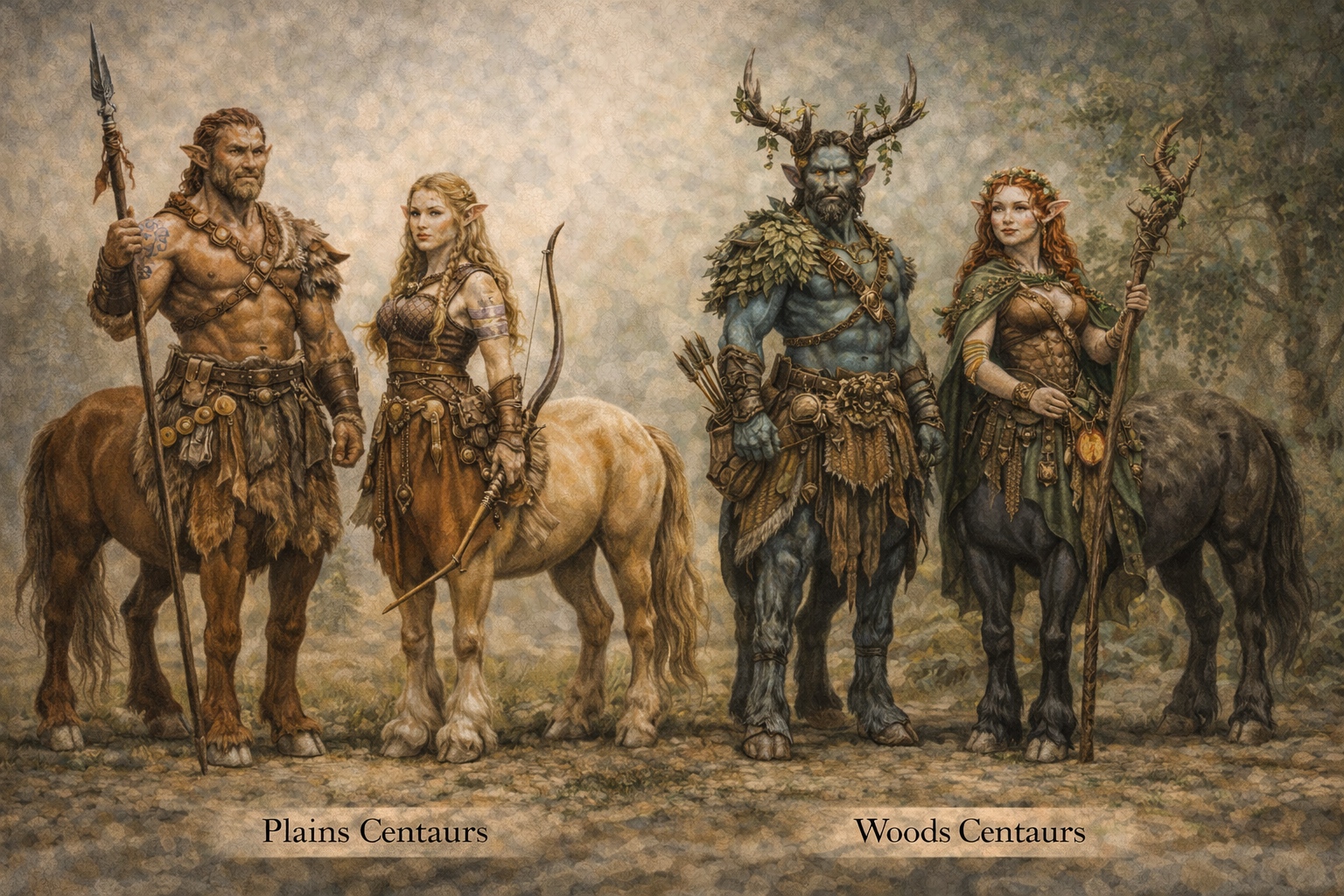
Centaur
Core Identity
Pronunciation: SEN-tar
Singular/Plural: Centaur / Centaurs
Demonym: Centaur
Classification: Primordial, pre-mage folk; not beastfolk in the designed sense
Also called: Sky-readers (when referring to the learned tradition), Run-folk (when referring to the wild tradition), the Old People (in some Irna traditions)
The Centaurs are not shaped. They are not the product of any mage's fascination or any experiment's intention. Where every beastfolk people carries a creator's signature somewhere in their naming tradition or their biology (the slight enforced regularity, the mage's aesthetic preference crystallized in a body plan), Centaurs carry none of this. They are older than the current age of Dort's peoples. Their names accumulated over centuries rather than being assigned in the first generation. Their language predates the languages of most peoples alive today.
They are equine from the waist down and humanoid from the waist up, and this is not a compromise between two natures. It is one nature, complete, that other peoples have been trying to categorize incorrectly since they first encountered it.
Overview
Centaurs are among the oldest living peoples on Dort; their oral and written traditions stretch back before the first mage-created beastfolk, before the expansion of the great continental civilizations, into the period that most peoples call myth or legend and the Centaurs call the first sky. How long they have existed is a question Centaur scholars discuss without urgency. A long time. Longer than most.
They are found primarily in open grasslands, high plains, and the foothills of mountain ranges: terrain where a four-legged body can move at full capacity and where the sky is not interrupted. They are not an urban people. Most Centaur communities do not maintain permanent structures. They are not nomadic in the sense of having no home territory (they have very clear home territories, which they return to seasonally and defend explicitly), but they are not sedentary, and the idea of building walls that prevent movement is fundamentally alien to Centaur spatial understanding.
The defining axis of Centaur civilization is not geography or lineage but tradition: the split between the learned Chiron tradition and the wild tradition is the central organizing tension of Centaur cultural life, present in every community in varying proportions, and the most interesting thing about any individual Centaur is where they stand on it.
Physical Traits
The Centaur body is a single integrated organism, not a fusion of two distinct beings. The division at the midsection that appears obvious to outside observers is no more fundamental to Centaur anatomy than the distinction between torso and legs is in a bipedal being; it is a visual demarcation, not a biological seam. The Centaur cardiovascular, respiratory, and digestive systems are continuous. The equine lower body is not a mount. It is them.
The lower body. The equine portion is fully horse-sized; a Centaur's lower body is not the scaled-down body of a small horse but the body of a large and powerful working horse, typically 14–17 hands at the withers. This lower body is the primary physical fact of Centaur existence: it determines how they navigate space, where they can go, how fast they move, what kind of terrain they call home. Centaur lower body coloring ranges from deep black through bay, chestnut, grey, dun, and cream: the same color range as equine animals, with significant individual variation. The coat is smooth in summer and develops a thicker winter growth in cold-climate individuals.
The upper body. The humanoid upper body begins at what would be the horse's shoulder-neck junction. It is fully humanoid in structure (head, neck, torso, arms, hands) with no equine remnant features except the continuation of the neck musculature from below, which gives Centaur necks and shoulders a distinctive depth of muscle that bipedal beings do not have. Upper body coloring is human-range in tone, with no consistent relationship to lower body coloring. A chestnut-coated Centaur may have deep brown or pale cream upper body skin. The upper body does not match the lower body.
Hair. Centaurs have full hair on the humanoid head, and a mane, a distinct and separate growth of longer hair running from the top of the humanoid neck down the withers to the back of the equine shoulder. The mane and head hair are separate and typically similar in color. The tail is fully equine and typically matches the lower body coat.
Size. At the withers, adult Centaurs stand 14–17 hands (roughly 5'8" to 5'11"). The humanoid torso adds roughly 3 to 4 feet of height above that, making the top of the head typically between 9 and 10 feet from the ground. Length from chest to hindquarters is roughly 7 to 8 feet for most adults.
Lifespan. Centaurs live 180–240 years. This extended lifespan, combined with their primordial origin, means that the oldest living Centaurs have personally witnessed events that other peoples know only as legend.
Biology
The dual-system body. The Centaur cardiovascular system is the largest of any non-giant being on Dort; the equine lower body requires enormous cardiac output to sustain at full gallop, and the humanoid upper body requires the same precision of blood flow as any thinking, fine-motor creature. The heart is accordingly large and powerful, located at the center of the body just below where the humanoid torso joins the equine. Centaurs who are injured in this central region face the most serious threat to survival.
Movement and endurance. Centaurs are built for sustained endurance movement rather than explosive short-distance speed. They do not sprint the way a deer or a greyhound does; they cover ground at a sustained trot or canter that most bipedal beings cannot match over any distance longer than a short run. A Centaur traveling at their comfortable road pace covers roughly three times the daily ground distance of a walking human. In pursuit or in flight, this is a significant advantage in open terrain.
Diet. Centaurs are broadly omnivorous with a significant herbivore component; the equine digestive system processes large volumes of grass and plant material, while the humanoid metabolism benefits from concentrated proteins. Centaurs consume substantially more daily calories than any same-height bipedal being, and they are always aware of this in planning, in travel, and in territorial calculation. Terrain that cannot sustain a Centaur community's dietary needs cannot be home territory, regardless of its other qualities.
Reproduction. Single births are overwhelmingly the norm; twins are extremely rare and carry significant ritual meaning in most Centaur traditions. Gestation is approximately 13 months. Foals are upright and mobile within hours of birth; the full bipedal/quadrupedal coordination develops quickly because stationary helplessness is a serious vulnerability for a people without walls. Intellectual and emotional development is slower; Centaurs are not considered adult until approximately 25 years of age, with the full philosophical maturity that marks elder status coming much later.
Sleep. Centaurs sleep in a standing doze for most of their rest cycle, with a shorter deep sleep period spent lying down. The transition to lying down and rising from it is the most physically vulnerable moment in a Centaur's day. Most Centaurs sleep in groups where at least some members remain in the lighter standing doze while others take their lying rest.
Psychology and Culture
The central drama of Centaur psychological and cultural life is the tension that the mage-philosophers who study them have described as the body and the star: the pull between the animal intelligence that runs, that knows weather, that reads predator and prey, that is never fully rational, and the humanoid intelligence that reasons, argues, studies, and looks upward.
This is not a conflict between good and bad impulses. The Centaur who lives fully in their equine instinct is not degraded by it; the Centaur who lives primarily in abstract scholarship has not transcended anything. The tension between the two is the specifically Centaur experience of consciousness, and the way an individual resolves it, or chooses not to resolve it, defines who they are more than almost any other factor.
The Chiron tradition. Named for the great teacher Chiron, the most celebrated figure in Centaur history: a healer, scholar, and philosopher who taught for centuries and whose students included many of the most significant figures of several peoples' histories. The Chiron tradition holds that the humanoid mind is the Centaur's highest gift and that it must be cultivated deliberately: studied, trained, refined. Chiron-tradition Centaurs are scholars, healers, astronomers, philosophers, and teachers. They read the stars as text. They maintain libraries: carved stone tablets, bark-text archives, and the accumulated knowledge of study-lineages reaching back generations. A Chiron-tradition community (called an academy) is typically smaller (8–30 members), organized around shared scholarly pursuit, and relatively stationary within its territory.
The shadow side of the Chiron tradition: it can become a rejection of the equine self, an implicit belief that the horse-body is something to be managed or transcended rather than an equal part of the whole. Centaurs who carry this belief to its conclusion are often described by wild-tradition Centaurs as half-present, beings who have talked themselves into living as less than they are.
The wild tradition. The wild tradition holds that the Chiron tradition's elevation of the humanoid mind is a kind of self-betrayal, an attempt to become more like short-lived peoples who live in boxes and cannot run. The wild tradition cultivates what the Chiron tradition tends to control: the equine instinct, the landscape-reading, the physical presence in weather and terrain, the knowledge that comes from running rather than from sitting still. Wild-tradition Centaurs name their children for the conditions of their birth: the storm, the mountain, the river in flood. They read the world through their hooves before they read it through their minds.
Wild-tradition communities (called runs) are larger (15–60 members), more mobile within their territory, and organized around an experienced elder rather than a scholarly discipline. Their knowledge is practical, spatial, and oral; they carry no tablets, but they can tell you the weather pattern of every season over a stretch of country for the last fifty years, and be right.
The shadow side of the wild tradition: it can become a rejection of the humanoid self, a contempt for scholarship, for sitting still, for learning from anyone other than the land. Chiron-tradition Centaurs describe this failure as running away from yourself.
The space between. Most individual Centaurs are neither fully one nor the other. A Chiron-tradition scholar who still gallops alone at dawn. A wild-tradition elder who keeps a small carved library of star-records she pretends not to care about. The most compelling Centaurs are the ones in whom the tension is not resolved: held deliberately, consciously, because the resolution itself would be a kind of loss.
Time and history. The Centaurs' exceptional longevity and primordial origin give them a relationship with time that differs from all other peoples'. A 200-year-old Centaur has personally witnessed events that form the mythological foundation of younger civilizations. The oldest living Centaurs have memories of things that no other living being remembers firsthand. This creates both a profound authority (when a Centaur elder says "I was there") and a genuine loneliness, being the only living witness to things that other peoples can only learn as story.
Geographic Distribution
Centaurs are found primarily on open terrain: grasslands, high plains, dry savannahs, and the rolling foothills of mountain ranges. They are present on every continent but are most numerous in the interior grassland zones of Irna and Funta. They are largely absent from dense forest (which constrains quadrupedal movement), from deep arctic regions (which their dietary needs cannot sustain), and from urban centers (which are architecturally incompatible with their body size and movement).
Centaur territories are defined loosely by seasonal range rather than fixed boundaries; they hold a known area, return to its most important locations on a seasonal cycle, and defend it against encroachment, but the boundaries shift with the year rather than being carved into stone. This approach to territory is frequently misunderstood by shorter-lived peoples' governments as indicating no territorial claim, which has been the source of centuries of conflict.
History
The First Sky. Centaur origin mythology (Ouranthis aion, "the sky's first age") describes a world before the younger peoples, when the great plains were larger and the sky touched the ground at the horizon. Whether the First Sky is historical memory, mythological tradition, or philosophical metaphor is a question Centaur scholars argue across generations. The consensus, such as it is: the First Sky contains both genuine pre-history and accumulated interpretation, and separating them is probably impossible and possibly beside the point.
The Age of Chiron. The period of Chiron's active teaching, estimated by Centaur scholars at roughly 20–22 centuries ago, is the most thoroughly documented era of Centaur history. Chiron's influence was not primarily internal; he taught widely, including students from peoples who were not Centaur, and his scholarship in astronomy, healing, and philosophy spread through several civilizations in ways those civilizations' own histories record. The scholarly tradition he founded is the basis for what is now called the Chiron tradition. He did not found it to be a tradition; he founded it to pass on what he knew. The systematization came after.
The Great Division (~18 centuries ago). The period following Chiron's death (he did eventually die, though Centaur accounts of when and how vary) saw a formal fracture in Centaur communities between those who followed his scholarly methods and those who rejected what they saw as his domestication of the Centaur nature. The Great Division did not produce armed conflict at scale; it produced a separation of communities, a formalization of the two traditions as distinct ways of life, and the establishment of the cultural tension that has defined Centaur society since. The Division is not considered a tragedy by most Centaurs today; both traditions survived and flourished, which is taken as evidence that neither was wrong.
The Compact of Open Sky (~14 centuries ago). A formal agreement between a coalition of Chiron-tradition academies and wild-tradition runs establishing shared territory protocols, recognized grazing rights, and mutual recognition of both naming traditions as legitimate Centaur practice. The Compact of Open Sky is the closest thing to a pan-Centaur political document; it has been revised several times and is still invoked in inter-tradition disputes.
The Territory Wars (~9 centuries ago). A sustained multi-generational conflict between expanding Irna agricultural empires and Centaur communities whose seasonal territory overlapped with lands being claimed for permanent farmland. The Territory Wars were not a single conflict but a series of related disputes, some resolved through negotiation, some through violence. The outcome was varied: some Centaur communities retained formal territorial recognition, some lost ground permanently, and some moved to territories that were less contested. The Territory Wars are the period in which most Centaur-Irna formal compact relationships were established, many of which remain in effect.
The Urban Question (~5 centuries ago). As Irna's cities grew to a scale that displaced grassland territory, the question of Centaur presence within urban environments became practical. Centaur-accessible city infrastructure requires substantially more physical space per individual than standard design. Some cities adapted, producing the Centaur-lane streets and Centaur-appropriate public spaces that characterize Irna's older large cities. Others did not. The Urban Question is ongoing; the relationship between a people who do not build walls and civilizations that are mostly walls has never been fully resolved.
Language
Spoken language: Ouranthis ("sky-tongue"). Ouranthis is the oldest continuously spoken language on Dort with an unbroken living tradition; it has changed significantly over the centuries but it has never died out into pure reconstruction. The language is Ancient Greek in its phonological character, upward-looking in its vocabulary and structure. Ouranthis sentences establish the sky before they establish the ground: setting, scope, and context precede action. This is not formal grammar so much as deeply embedded habit; Centaurs simply do not begin a statement with what happened before they have established the full space in which it happened.
The two traditions speak the same language with a notable register difference. Chiron-tradition Ouranthis uses longer compound words, more formal philosophical vocabulary, and the classical Greek construction patterns that convey measured deliberation. Wild-tradition Ouranthis is shorter, more landscape-specific, more immediate. Both are fully mutually intelligible; a speaker's tradition is identifiable within a few sentences.
Written script: Khirothis ("Chiron's marks"). The primary Centaur writing system, developed in the Chiron tradition and spread from it, is carved into stone and bark in a syllabic script of approximately 70 characters. The characters are sky-facing: angular, opening upward, designed to be legible in daylight from some distance. Traditional Khirothis stone tablets are meant to be placed upright and read while standing, not laid flat and read while seated. The script is excellent for astronomical notation and philosophical argument; it is less convenient for rapid correspondence.
Wild-tradition communities that maintain written records (not all do) typically use a simplified abbreviated form of Khirothis that prioritizes portability and speed over formal completeness. This abbreviated form is sometimes called Groundmarks within the wild tradition.
Naming tradition. Centaur names use Ancient Greek phonology in two distinct registers: the Chiron tradition's celestial and philosophical register, and the wild tradition's landscape and weather register. The tension between these two naming systems is a cultural axis: a name that crosses the boundary (a wild Centaur given a philosophical name, or a scholar whose name is a weather event) carries the history of that crossing without explaining it. Centaurs carry a given name and a lineage or territory marker.
Example names (Chiron tradition): Astralon, Eurynomon, Philimon, Kallisthos, Khronaios, Mnemosion, Pyrosthen
Example names (wild tradition): Hylaeos, Agrikhos, Orneos, Brontax, Drymokhos, Akreus, Pelokhon
With markers: Astralon Khironides, Hylaeos Pelionidhai
Naming Conventions
Naming Agent Cross-Reference
See _Cannon/Race naming ai agents/beastfolk/Beastfolk - Centaur.md for full naming rules and generation guidance. Note that Centaurs are filed with the beastfolk for convenience only; canon is explicit that they are not a shaped people and carry no creator's signature in their naming.
Personal Name Structure
Centaurs carry a given name and a lineage or territory marker. Names use Ancient Greek phonology in two distinct registers: the Chiron tradition's celestial and philosophical register, and the wild tradition's landscape and weather register. Unlike every beastfolk people, Centaur names "accumulated over centuries rather than being assigned in the first generation"; Ouranthis is the oldest continuously spoken language on Dort, and its naming tradition shows the irregularity of real linguistic drift rather than a mage's enforced tidiness.
The tension between the two registers is a cultural axis. A name that crosses the boundary (a wild Centaur given a philosophical name, or a scholar whose name is a weather event) carries the history of that crossing without explaining it.
Sex and Name Form
Sex is marked in the ending and is fully systematic, but the two traditions do not share their formal endings, so a name's ending tells you the bearer's sex while the shape of that ending tells you which tradition raised them.
In the Chiron tradition, masculine -on, -os, -imos, -andros, -aios and the lineage-formal -ides contrast with feminine -a, -ia, -eia and the long-vowel -e, -o. In the wild tradition, masculine -os, -us, -eus, -ys, -ax, -okhos contrast with feminine -a, -o, -e. The feminine is generative within each tradition (Astralon becomes Astralia, Hylaeos becomes Hylaea), but feminizing a wild name with a Chiron ending crosses registers rather than marking sex.
Long vowels mark formality and elder standing in both sexes. Lineage and territory markers never inflect: the -ides form marks descent and is identical for every descendant.
The register shares its phonology and its sex-marking with the Taurik, which means the distinguishing work falls entirely on roots and semantic field: Taurik names carry the labyrinth; Centaur names carry the horizon. Both peoples know this about themselves and are occasionally awkward about it.
Name Examples
- Given names (Chiron tradition): Astralon, Eurynomon, Philimon, Kallisthos, Khronaios, Mnemosion, Pyrosthen
- Given names (Chiron, feminine forms): Astralia, Kalliste, Mnemeia, Philima, Sophreia, Khroneia
- Given names (wild tradition): Hylaeos, Agrikhos, Orneos, Brontax, Drymokhos, Akreus, Pelokhon
- Given names (wild, feminine forms): Hylaea, Agrikha, Drymora, Ornea, Pelokha, Brontho
- Lineage markers: Eurynomides, Philokides, Astralides
- Full name examples: Astralon Astralides; Hylaea of the open range; Kalliste Philokides; Brontax of the storm country
Society
Academies and runs. The two primary social structures correspond to the two traditions. Chiron-tradition academies are organized around shared scholarly pursuit or a recognized master's teaching; they tend toward the smaller end (8–30 members) and maintain more fixed territorial base camps. Wild-tradition runs are organized around territory and elder leadership; they tend toward the larger end (15–60 members) and range more actively through their home territory.
Mixed communities, which are the norm rather than the exception, develop their own negotiated structures. Most Centaur communities of any size have both scholarly and wild-oriented members. The internal dynamics of how they organize is a significant part of each community's individual character.
Elders. Both traditions highly regard elders, though for somewhat different reasons. Chiron-tradition elder regard is based on accumulated scholarly knowledge: what has been studied and mastered over a long life. Wild-tradition elder regard is based on accumulated experiential knowledge: what has been survived, observed, and understood in the landscape. Both forms of respect are genuine and both are visible in inter-tradition contexts: a wild-tradition elder and a Chiron-tradition elder of similar age will typically recognize each other's authority without ceremony, understanding that the knowledge forms are different but the weight of years is comparable.
The sky compact. Within Centaur communities, formal agreements are made at night under open sky. The ritual requirement (that major decisions be made visible to the sky, with no roof between the decision-makers and the stars) is observed in both traditions, though the Chiron tradition interprets it philosophically (the sky as witness, celestial observation as truth-check) and the wild tradition interprets it practically (decisions made under sky are honest; decisions made under roofs can be private). The sky compact is not transferable to indoor settings; no agreement made inside a building has the same standing as one made under open sky.
Interactions with Other Peoples
Other primordial peoples. Centaurs have a particular recognition of Pachari, another people with memories that reach far back. The two peoples have collaborated on historical record-keeping across several continental regions, comparing Centaur oral traditions with Pachari memory-archive. The collaboration is not always harmonious (both peoples are confident in their own forms of knowledge), but it is genuine.
Taurik. An interesting tension: both peoples use Ancient Greek phonological tradition in their naming, which reflects the same cultural-historical stream that runs through both. Centaur and Taurik scholars are occasionally awkward about this; the shared linguistic root implies a shared origin-source that neither people fully claims. The naming agent for both peoples notes the distinction carefully: Taurik names carry the labyrinth; Centaur names carry the horizon. Both know this about themselves.
Shorter-lived peoples (general). The Centaur experience of shorter-lived peoples is shaped by scale and by time. A Centaur who has lived 180 years has watched the same city change governments seven times, the same forest be cleared, burned, and regrow twice, the same river move its course. They are patient about most things because they have seen most things resolve into irrelevance or come round again. This can present as wisdom or as a failure to take the present urgency seriously; both readings are sometimes correct.
Territory and agricultural peoples. The longest-running structural tension in Centaur history is with agricultural peoples whose land-use patterns conflict with Centaur seasonal territory. This is not a tribal conflict; it is a structural one, present wherever farming civilization and open-range Centaur territory overlap. Most regions with significant Centaur populations have formal compact frameworks addressing this; few of those frameworks are fully satisfactory to either party.
Variants
The Centaur people do not divide into biological subspecies. The significant variation within Centaur civilization is cultural and traditional, not heritable in the biological sense; the child of a Chiron-tradition scholar may grow up wild, and vice versa. The two traditions are the relevant variant framework.
Chiron tradition Centaurs are more likely to be found in mixed-population cities and scholarly contexts, more likely to maintain formal compact relationships with non-Centaur peoples, and more likely to hold formal roles as advisors, teachers, or healers. Their cultural sophistication in multi-people environments is generally high; they have been practicing it for centuries.
Wild tradition Centaurs are more likely to be found in open territorial contexts, less represented in urban environments, and more likely to maintain direct territorial knowledge as their primary expertise. In terrain they know, they are nearly impossible to track, ambush, or outmaneuver. Their cultural engagement with non-Centaur peoples is more on their terms; they can be deeply generous hosts and deeply implacable territorial defenders, depending on context.
Mixed-tradition individuals, which are the majority, hold both inheritances in ongoing tension. The most interesting Centaurs are those who are visibly in the middle of this tension, carrying a scholar's name into the open plains, or arriving at an academy with the bearing of someone who has never sat still.
Development Notes
On the primordial status. Centaurs predate the mage-created peoples. This should have specific weight when it comes up; they are not simply another race but a reminder that the world existed before the current age's reshaping. The oldest Centaur elders have memories that are literally ancient history. Writers should handle this with appropriate gravity: not every encounter with a Centaur elder needs to become a history lesson, but the possibility should be real.
On the tradition tension. The Chiron/wild tension is most interesting when it is not resolved in the text. Avoid having Centaur characters declare that one side is right. Both traditions have genuine merit and genuine shadow. The most authentic Centaur stories live in the space between.
On the body. The equine lower body is not a mount, not an animal companion, not a separate being. It is them. Writing that separates Centaur consciousness from their lower body, treating the humanoid torso as the "real" Centaur and the horse portion as a vehicle, misunderstands the species. The legs decide to run before the head articulates why. That is one consciousness with full range.
On architecture. Centaurs cannot enter most buildings designed for bipedal beings. This is practical worldbuilding: in any scene involving interior spaces, a Centaur either has access to a Centaur-appropriate structure or they are outside. The window-conversation, the meeting conducted at a door, the outdoor camp instead of the inn: these spatial realities are features of Centaur narrative presence, not inconveniences to be ignored.