Drakin
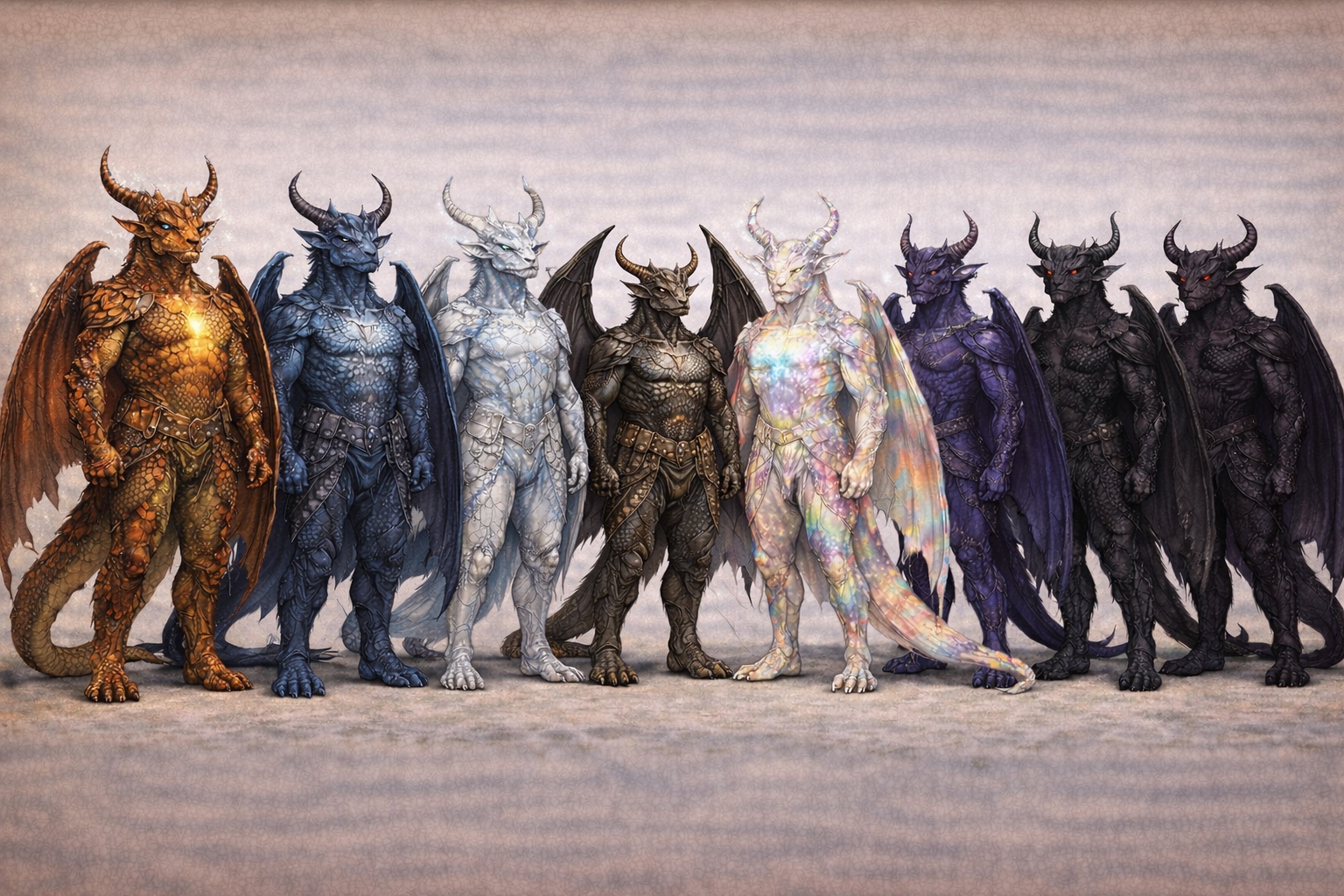
Drakin
CORE IDENTITY
- Race Name: Drakin
- Plural Name: Drakin
- Adjective Form: Drakin
- Alternate Names: Wyrmbloods (common, neutral to respectful); Mosaics (Shoing usage, references their scale pattern; considered a compliment by most Drakin); Scaledkin (trade-language shorthand, neutral); Half-Dragons (archaic; considered reductive and largely fallen out of use outside rural areas)
- Self-Name (Endonym): Drakin; the word in their own tradition is simply their name, carried without apology; it does not translate to a descriptor, which Drakin consider appropriate. They are not a category of something else. They are a people.
- Outsider Names (Exonyms): Emberkin, Tideskin, Galeborn, Orekin, Anchorkin, Prismkin, Shadowkin (all lineage-specific, used by those familiar enough to distinguish; generally received as accurate shorthand); Mockwyrms (derogatory, dragon-origin; implies failed imitation); Broodless (derogatory, dragon-origin; refers to Drakin's lack of a true dragon flight-group, which dragons consider a defining mark of legitimacy)
OVERVIEW
Short Description
Drakin are a people born from the deep history of Dort's dragon lineages: the rare offspring of unions between true dragons and the mortal peoples with whom some dragons, over long centuries, formed genuine bonds. They carry unmistakably draconic features: scales, wings, horns, a tail, elemental breath, and eyes that have never forgotten what their ancestors were. What marks them most distinctively is their mosaic scale pattern: rather than the singular, pure coloration of a true dragon, a Drakin's scales present in layered, interlocking fields of multiple colors, the chromatic inheritance of a heritage that bridges kinds. This is the visible mark of what they are: something distinct from the dragons who preceded them, something that did not exist before and could not have been planned.
General Reputation
Drakin are regarded throughout Dort with a mixture of fascination, wariness, and (where they have had generations to establish themselves) genuine respect. They are impossible to mistake for anything else. A Drakin walking into a city commands attention before they have said a word, and the nature of that attention depends heavily on the city. In Shoing, where dragons are a historical fact and dragon-lore is deeply embedded in scholarly tradition, Drakin enclaves are known quantities and treated accordingly: unusual, but neither threatening nor exotic beyond reason. In Irna, they are considered a mark of distinction; a city that has a resident Drakin family has something worth mentioning. In more isolated or rural communities across all lands, the response is rawer: some combination of awe, superstition, and a very old fear of what fire and scale and wings represent to people who have never seen a true dragon and may not understand where Drakin end and dragons begin.
True dragons are the exception to any generalized regard. Most dragons consider Drakin an embarrassment: evidence of a lapse, a too-deep involvement with mortal kind that produced something neither fully dragon nor fully anything else. The derogatory terms Mockwyrms and Broodless originate in dragon culture and have seeped into wider use through peoples who spend time near dragon territories. Drakin are not oblivious to this. They carry it, and most of them have made some kind of peace with carrying it, because the alternative is to spend a life seeking approval from beings who have decided the question in advance.
Role in the World
Drakin occupy a position in Dort's world that has no clean parallel: they are the living bridge between the most ancient and powerful creatures in existence and the mortal peoples who share the world with them. This is not a role they were assigned; it is what they are, by nature, whether they choose to engage with it or not. In practice, Drakin most often appear as rare but formidable individuals who have made their own way rather than inheriting an established place: explorers operating in territory that defeats other peoples, scholars of draconic history and elemental theory, mercenaries whose presence on a contract shifts the calculation for anyone considering opposing it, navigators of extreme terrain where their flight capability and elemental resistance provide advantages no other person can match. Where enough Drakin have gathered in one place across generations, small enclaves form, communities dense with draconic knowledge and a particular culture of earned standing that reflects their collective awareness that they have never been able to rely on the world to hand them anything.
PHYSICAL TRAITS
General Appearance
A Drakin reads as immediately and completely unlike anything else. The overall silhouette is powerful and winged: a broad-shouldered bipedal frame with large bat-structured wings folded at rest against the upper back, a muscular tail counterbalancing the upper body, and a distinctly draconic head featuring a pronounced muzzle, swept-back horn structures, and slit-pupiled eyes that carry depth even in full light. The scales cover the full body in interlocking plates that vary in size: larger and heavier across the chest, shoulders, and thighs; finer and more flexible along the joints, throat, and inner limbs. The defining visual characteristic is the mosaic coloration: no Drakin presents in a single pure color. Their scales carry their lineage's dominant hue in the majority of plates, but threads of other colors (sometimes subtle, sometimes vivid) run through the pattern in ways that are unique to each individual. No two Drakin have the same mosaic.
Size Ranges
- Typical height: 6'0" to 7'6", with variation by lineage; Ore Drakin tend toward the lower end of this range with heavier builds; Gale Drakin toward the taller and leaner
- Typical weight/build: 220–380 lbs; consistently denser than the frame suggests due to reinforced skeletal structure and the musculature required to support wings and tail; Drakin almost always outweigh any other being of comparable height
Distinguishing Features
The wings are the most immediately striking feature: fully functional structures capable of true flight, supported by reinforced shoulder and back musculature that gives all Drakin a characteristic broadness across the upper back. At rest, the wings fold into a shape that extends from the shoulders to just below the knees; fully extended, they span two to three times the Drakin's standing height depending on lineage. The tail is load-bearing and expressive; Drakin use it for balance in both movement and rest, and it communicates mood in much the way a Felari's tail does, though the signals are different enough that a non-Drakin observer reading the tail often misreads it. The elemental core (visible as a glow, a heat shimmer, a faint luminescence beneath the chest scales depending on lineage) intensifies when a Drakin is preparing a breath attack, under strong emotion, or in environments that resonate with their elemental nature. In the Ember lineage this manifests as a visible ember-light that pulses warmly at rest and brightens to an almost blinding intensity when the breath fires.
Sexual Dimorphism
Minimal by most measures. Both male and female Drakin develop the same full range of draconic features, the same wing and tail structures, and comparable musculature. Male-presenting Drakin commonly develop heavier horn ridges and more pronounced brow structure, while female-presenting individuals more frequently display greater complexity in their mosaic coloration: more distinct color fields and more intricate pattern transitions. Neither of these differences is universal, and Drakin culture attaches no hierarchical significance to them.
Aging Patterns
Drakin mature slowly. The early years involve rapid physical growth; Drakin children develop their full horn and tail structure by age ten, but the wings develop gradually, with first flight typically achieved between twelve and sixteen years of age. The years between first flight and full elemental maturity, when the breath weapon stabilizes in power and control, span roughly ages sixteen to twenty-three, and this period is considered adolescence in most Drakin communities. Adult standing is socially recognized when elemental control is demonstrated under pressure, typically in a formal acknowledgment within the Drakin's enclave or through a recognized deed in the outside world. Drakin in their physical prime maintain that prime for an unusually long period; the visible aging that begins around age eighty (scales deepening in color, horn structures becoming more elaborate, the elemental glow settling into a steadier intensity) marks elderhood among Drakin as a period of increased rather than diminished presence.
Regional Variation
Drakin physical appearance is defined almost entirely by lineage rather than region. An Ember Drakin raised in the mountain highlands of Irna carries the same fire-dominant mosaic and internal heat as one born near the volcanic islands of Shoing. Minor variation exists (Drakin who have lived multiple generations in cold highland environments may develop marginally denser scale coverage, and those in humid coastal regions show somewhat smoother scale edges), but the lineage characteristics remain dominant and consistent. The mosaic pattern of a given Drakin is individual, not regional; siblings may carry entirely different pattern distributions within the same lineage's color range.
BIOLOGY
Diet
Drakin are obligate high-caloric omnivores. Maintaining flight-capable musculature, elemental organ function, and the metabolic demands of scale regeneration requires substantial protein and mineral intake. Drakin in active lifestyles consume roughly twice the caloric volume of a large human, with a strong preference for dense animal protein and mineral-rich foods. The elemental organ, the biological structure responsible for producing and storing breath-weapon fuel, requires specific dietary inputs that vary by lineage: Ember Drakin consume sulfur-rich and iron-dense foods instinctively; Tide Drakin have a strong drive toward salt and seafood; Ore Drakin consume raw mineral matter in small quantities as a biological supplement. These tendencies read as unusual dietary preferences to outside observers but are straightforward physiological requirements.
Sleep Patterns
Drakin sleep deeply and in fewer cycles than most humanoid peoples, typically a single long sleep rather than fragmented rest. The elemental organ partially recharges during sleep, which means deep Drakin rest is a genuine biological necessity rather than merely a comfort. Many Drakin display a hoarding instinct toward sleeping spaces that scholars have connected to draconic ancestry: a marked preference for enclosed, elevated, or defensible rest positions rather than open ground. This tendency is more pronounced in some lineages than others. Among enclaves, communal sleeping areas are not common; most Drakin prefer individual rest spaces even within close-knit communities.
Reproduction Basics
Drakin breed true; two Drakin produce Drakin offspring. Lineage inheritance is not strictly predictable; Drakin parents of different lineages may produce children showing either parent's lineage characteristics or a genuine blend. Single births are standard; twins are rare and considered a significant event. Drakin invest heavily in each child, with both parents present and active in rearing throughout the long maturation period. Where enclave communities exist, the broader community plays a role in training young Drakin in elemental control: managing a breath weapon is not instinctual and requires extended instruction; unsupervised young Drakin are a genuine hazard to their surroundings.
Lifespan Ranges
- Typical lifespan: 120–180 years; some exceptional individuals with stronger draconic inheritance push beyond 200
- Maturity: Social adult standing around age 20–25
- Elderhood: Around age 100; elder Drakin are recognized by deepening scale color, more elaborate horn development, and a stabilized elemental core glow that no longer fluctuates with emotion
Environmental Adaptations
Each Drakin lineage carries a meaningful resistance to their elemental domain: Ember Drakin tolerate heat and fire that would kill most peoples; Tide Drakin can survive immersion in cold water for extended periods without harm; Gale Drakin are unaffected by extreme wind and altitude that incapacitate ground-adapted peoples; Ore Drakin resist impact and pressure damage that would break other bodies. These resistances are not absolute immunity but are pronounced enough to matter in practical terms. All Drakin tolerate altitude better than most humanoids, a consequence of the respiratory capacity required for flight. All Drakin are vulnerable to their opposing element in ways that pure dragon lineages are not; this is the biological cost of the mixed inheritance.
PSYCHOLOGY & CULTURE
These tendencies describe patterns common across Drakin communities. The wide dispersal of Drakin across all lands means individual variation is substantial; a Drakin raised in a Shoing enclave with deep communal tradition will differ meaningfully from one raised as the only Drakin in a human city.
Typical Temperament
Drakin tend toward intensity rather than ease. Not aggression; intensity: a quality of presence, of investment in things that matter, of carrying a position once it has been formed with a commitment that outlasts the conversation. They are not impulsive. The draconic inheritance that gives them long memory also gives them a consideration before action that can read as patience to those who don't know them and as calculation to those who fear them. Within trusted relationships, this intensity becomes warmth; Drakin form bonds slowly and maintain them with a ferocity that the people who have earned those bonds usually find remarkable. They do not forget what they owe. They do not forget what they are owed.
The persistent awareness of being neither fully accepted by true dragons nor completely ordinary among mortals is something most Drakin have resolved into something useful, a clarity about what they actually are rather than what others want them to be. This clarity is not always comfortable to those around them.
Cultural Values
- The earned name: Drakin culture across most traditions places enormous weight on accomplishment as the source of legitimate standing. You are not given your place; you demonstrate it. Titles earned through deed carry more weight than titles inherited through blood, and a Drakin whose reputation rests entirely on their draconic heritage and nothing else is considered to have squandered what they were given.
- The mosaic as self: Most Drakin communities have developed a philosophical relationship with their own scale pattern: the mosaic is not a dilution of draconic purity, it is the mark of being something that could only exist by combining what came before. Elder Drakin who have articulated this principle tend to describe the mosaic as a map of what a Drakin is: multiple things, held together, producing something coherent.
- The honest breath: Drakin who use their breath weapon are understood to have committed to a serious action. Using it carelessly, in shows of dominance over those who cannot match it, or as intimidation with no intent to follow through is considered a form of dishonesty; you have shown the real thing and wasted it on theater.
- Endurance before complaint: Drakin communities tend toward a cultural stoicism about hardship. This is not the absence of emotion; it is the belief that endurance is more informative about character than either suffering or relief, and that demonstrating both in public is somewhat undignified. Drakin complain to people they trust. Everyone else gets silence.
Taboos
- Submitting to a true dragon without contest: Not suicide resistance; a Drakin who is genuinely outmatched and knows it is not expected to die proving a point. But the expectation is that you do not simply roll over. You make them work for it. A Drakin who surrenders without meaningful resistance is considered to have confirmed what dragons say about them, which is the worst possible outcome.
- Betraying an enclave's location or composition to an enemy: Drakin enclaves are small and rarely in positions of political power. Their safety depends significantly on what others don't know about them. Revealing enclave specifics to those who would use the information against the community is treated as one of the deepest possible betrayals.
- Wasting the inheritance: A Drakin who has genuine elemental capability, flight, and the full complement of draconic traits and uses none of it, who lives as though the inheritance means nothing and makes nothing of themselves, is not condemned exactly, but they are viewed with something between pity and disappointment that Drakin find harder to bear than condemnation.
Social Structures
Drakin are too rare and too dispersed to have formed anything resembling a nation. The primary social unit where it exists is the enclave: a community of typically between four and thirty Drakin who share a settlement, often within or adjacent to a larger mixed-race city, organized around shared lineage and mutual support. Enclaves are not insular; most actively maintain relationships with the wider communities around them and depend on those relationships economically. Where no enclave exists, which is the situation for many Drakin, individual Drakin integrate into whatever structure best serves them, joining guilds, mercenary companies, scholarly orders, or simply operating independently.
Family Structure
Drakin family bonds are intense and long. The extended maturation period means children are in close relationship with both parents for over two decades, and these bonds typically persist in meaningful form throughout life. Drakin who lose family members (to violence, to distance, to estrangement) tend to carry the loss sharply, and the culture around grief among Drakin is not one of moving on quickly. Within enclaves, the community takes on genuine family obligations for orphaned young or Drakin whose parents are absent; the training of a young Drakin in breath weapon control is considered a community responsibility because the consequences of inadequate training are community-wide.
Leadership Patterns
Enclave leadership is informal and competence-based. The Drakin whose judgment is most consistently trusted by the community functions as the de facto leader without requiring formal appointment. Where formal appointment exists, it is typically for specific purposes (a negotiation, a defense, a difficult decision) rather than as permanent hierarchy. Drakin who attempt to claim authority through draconic lineage alone, or through physical dominance over smaller peers, are not respected. The distinction between strength of character and strength of scale is one most Drakin learn early and take seriously.
GEOGRAPHIC DISTRIBUTION
Primary Homelands
- Shoing: The oldest and largest Drakin populations in Dort are in Shoing, where dragons have existed since the ancient era and where the cultural and scholarly infrastructure to understand Drakin has existed longest. Shoing's tradition of tolerating fringe peoples and unusual magical histories means Drakin enclaves in several of Shoing's mountain ranges and island chains have been present for centuries and are known, mapped, and treated as legitimate community presences by neighboring peoples. The largest concentration of Ember and Tide Drakin in the world is in Shoing.
Secondary Populations (Diaspora)
- Irna: Drakin in Irna tend to appear as individuals or small family groups rather than established enclaves, though a handful of Drakin communities have existed in Irna's highland cities for generations. Irna's aristocratic culture has developed a complicated appreciation for Drakin; their draconic heritage reads as exotic distinction to the nobility, which creates opportunities but also a kind of objectification that most Drakin find exhausting.
- Funta: Small numbers of Drakin have been present in Funta's interior for as long as anyone has recorded. Ore and Ember lineages appear most frequently, drawn by the volcanic and highland terrain. Funta's tribal peoples respond to Drakin with the directness they bring to everything: if you're useful, you're welcome; if you're trouble, you're trouble.
- Jazirah: Drakin presence in Jazirah is sparse and complicated. Oshala's faith has not produced a unified doctrine on Drakin: some clerics regard them as evidence of divine power made manifest; others regard them as abominations outside the proper order. Individual Drakin in Jazirah navigate this uncertainty case by case. Those who have converted to Oshala's faith have found acceptance; those who have not exist in legal ambiguity.
- Antaea: Scattered Drakin individuals and very small family groups exist in Antaea, primarily in the northern highland territories. Antaea's general lack of centralized authority means Drakin face fewer institutional barriers than elsewhere, but also less institutional protection.
Migration Patterns
Drakin history of movement follows dragon territory more than any other pattern. When dragon populations in a region grow, stabilize, or shift, Drakin presence tends to correlate; the original unions that produce Drakin are tied to proximity with true dragons, even if subsequent generations are self-sustaining. The dispersal of Drakin from Shoing to other lands follows the general pattern of Shoing's outward cultural reach: traders, explorers, mages, and simply people seeking new contexts have carried Drakin bloodlines to every corner of Dort over centuries. Individual Drakin frequently travel extensively, drawn by the combination of capability and restlessness that the culture tends to produce.
Adaptations by Region
Drakin adapt their material culture significantly by land. Wing-and-tail accommodation is the practical constant everywhere; Drakin clothing is constructed with specific structural adaptations that most non-Drakin tailors require instruction to produce, and Drakin-friendly architecture includes different ceiling heights, reinforced roosting structures, and doorways scaled for winged occupants. In Shoing's mountain communities, Drakin enclaves have developed architectural traditions of their own, built into cliff faces and elevated terrain where their flight capability provides access that ground-dwelling peoples cannot easily follow. In Irna's cities, Drakin more often adapt to existing human architecture with compromises they find suboptimal but workable.
Cultural Differences Between Lands
Shoing Drakin have the deepest and most coherent cultural tradition; centuries of enclave history have produced a body of Drakin philosophy, craft, and internal governance that Drakin from other lands often recognize as the reference point for what Drakin culture could be. Irna Drakin, who typically lack the enclave context, tend toward stronger integration with human nobility and guild culture, and often present a more individually ambitious character than their Shoing counterparts. Funta Drakin have absorbed significant elements of tribal Funta culture, particularly the warrior traditions, and some of the Funta tribes have incorporated Drakin members into their structure with specific warrior-roles that leverage Drakin physical capabilities.
HISTORY
Origins
The first Drakin emerged in Shoing, where dragons have existed since before recorded history. Dragons capable of assuming humanoid form, a capability not universal among dragon kind but present in many of the older and more magically sophisticated lineages, occasionally formed deep bonds with mortal peoples over the long centuries when Shoing's dragon population and humanoid population shared the same land. The children of those unions were the first Drakin. The earliest accounts describe them as shocking to both communities (too draconic to simply be mortal, too mortal to be claimed by dragon culture) and largely left to find their own way. The first Drakin communities formed in isolation, small groups of similar people in the margins of territories that neither fully claimed them.
Major Turning Points
The growth of Shoing's human population through the centuries provided both opportunity and complication for Drakin. As Shoing developed into Dort's most populous land and its cities grew sophisticated enough to absorb unusual peoples, Drakin enclaves found the conditions for genuine stability; for the first time, being Drakin in a city was something other than being isolated. The first acknowledged Drakin enclave with formal community standing in a major Shoing city is documented in records dating to approximately 2700ME, representing a significant shift from the previous pattern of dispersal and concealment.
The spread of Irna's explorers to Shoing in 980ME introduced Drakin to peoples who had never encountered them, and the subsequent expansion of trade between lands began the slow process by which Drakin awareness spread to every civilized land. This period also produced the first recorded major conflict involving Drakin, an enclave in the Shoing highlands that resisted Irna's territorial claims using methods that made very clear what a committed community of Drakin could do in defensive terrain.
Current Historical Posture
Drakin are in a period of gradual visibility: more known than they were, better understood than they were, but still rare enough that most people encounter them infrequently and many settlements have never seen one. Shoing's enclaves have achieved a degree of stability and social recognition that their founders would not have expected. Drakin outside Shoing continue to navigate the variable reception of the wider world, each one in some sense an ambassador for their people whether they want to be or not. The question of the relationship between Drakin and true dragons (whether reconciliation, formal separation, or continued uneasy tension) has not been resolved and appears unlikely to be.
LANGUAGE
Language Name(s)
Drakin have no single native language. They speak the Common of whatever land they grew up in, and most learn Irna Common as a practical second language given how often they move between lands. What does exist is Drakari: not a complete language but a body of specialized terminology, naming traditions, and elemental vocabulary that Drakin use among themselves and that has been passed through enclave communities for centuries. Drakari functions more like a professional cant than a full language: dense, efficient, and opaque to outsiders, used between Drakin as a shorthand for concepts that take long sentences in any Common tongue to express adequately.
Script
Most Drakin use the script of the land they were raised in. Drakari terminology is written in a modified form of the ancient draconic script that scholars recognize as related to the inscriptions found in old dragon lairs, simplified and adapted for the smaller hands and faster writing pace of humanoid users.
Trade Language Status
Given how frequently Drakin operate across land boundaries, multilingualism is common. Most Drakin speak at least Irna Common and the Common of their home land; those who travel widely often accumulate three or four. The practical advantages of being understood by the broadest possible range of people are not lost on a people who have consistently depended on their individual reputations to open doors.
Dialect Range
Drakari terminology has regional variations reflecting the enclave traditions that developed it. Shoing Drakin and Irna Drakin using Drakari will recognize each other's terminology but will encounter words and phrases that require brief explanation. These variations are considered interesting rather than divisive, evidence that the tradition has been alive enough in multiple places to develop independently.
Naming Agent Cross-Reference
See Race Naming AI Agents / Drakin Naming Guide (future development).
NAMING CONVENTIONS
Naming Agent Cross-Reference
See _Cannon/Race naming ai agents/Fantasy Name Generator - Draconic.md, Register 3 and the Dort Application: The DRAKIN section, for full naming rules and generation guidance. Because Drakin personal names draw on the land or enclave that raised them, generation also requires the relevant register of _Cannon/Race naming ai agents/Fantasy Name Generator - Human.md (or the appropriate race file), except for the Shoing enclave tradition, which is a genuine Drakin invention and stands on its own.
Personal Name Structure
Drakin names follow a two-part structure: a personal name and an earned epithet. The personal name is given at birth or early childhood and draws on the phonological traditions of the Drakin's enclave or home land. The earned epithet is added when the Drakin achieves adult standing; it describes something true about them, determined in consultation with enclave elders or, for Drakin outside enclaves, through a private naming act the individual commits to and declares. The epithet is not always flattering; accuracy is valued over flattery. A Drakin called Vorthan the Methodical has been told something true about themselves and accepted it.
Earned epithets take one of four forms and no others: a definite adjective (the Methodical, the Unmarred, the Patient), a prepositional phrase (of the Long Memory, of the Open Hand), a hyphenated descriptive pair (Twice-Tested, Storm-calm), or a single plain formed word (Ashborn). The governing test is whether a committee of honest elders would actually say it about a specific person. If an epithet flatters, it is wrong; heroic self-description of the Flamecrest or Dragonsbane sort is not merely poor taste but a misunderstanding of what the epithet is for.
The Shoing enclave tradition holds the deepest form of Drakin personal naming, since the first Drakin emerged in Shoing; unlike every later regional variant it is not simply local human phonology, but the earliest Drakin communities' own construction, and it retained more of the draconic original than anything that followed.
Clan / House / Line Names
Lineage identifiers function as a third naming element in formal contexts; they reference the Drakin's elemental lineage and, where known, the generational depth of the enclave bloodline. These are used in formal documentation, treaty contexts, and when Drakin are introducing themselves to other Drakin for the first time. Day-to-day, most Drakin use only their personal name.
Regional Name Differences
Personal names vary by the naming traditions of the land the Drakin was raised in. A Drakin raised in a Shoing enclave will have a name shaped by Shoing phonology; one raised in Irna will draw from Irna's naming patterns. The earned epithet and lineage identifier are consistent across lands; they are the parts of Drakin naming that belong to Drakin rather than to their surrounding culture.
The practical consequence is that a Drakin from Irna and a Drakin from Jazirah share two-thirds of their name structure and share nothing at all in the first third.
Sex and Name Form
Personal names inherit sex-marking from the tradition that produced them: an Irna-raised Drakin marks it as Irna does, a Jazirah-raised Drakin as Jazirah does. The Shoing enclave tradition, being a Drakin invention rather than a borrowing, has its own: heavier consonant-final endings in -on, -os, -ain, -an lean masculine, vowel-final or liquid-final endings in -aka, -ira, -ae, -ela lean feminine, and the characteristic -ith and -aeth endings are used freely for both. That ambiguity is deliberate rather than accidental.
Earned epithets and lineage identifiers never inflect for sex. The Methodical is the Methodical for anyone, and constructing a feminine form of it is an error. A Tide-kin is a Tide-kin.
Formal vs. Informal Names
Among other Drakin, given name alone is standard. The full three-part name (given name, earned epithet, lineage identifier) is used in formal and diplomatic contexts, and in any situation where the Drakin is meeting others who do not know them. Drakin who have achieved wide enough reputation that the epithet precedes them sometimes use it as a shorthand introduction in place of the full structure.
Titles & Honorifics
- Flamebearer, Tidewalker, Galewing, Orebound, Anchormarked, Prismwoken, Shadowmarked: Lineage honorifics used within enclave communities; each marks the elemental identity of the individual
- The Unmocked: An honorific of recent coinage, used for Drakin who have achieved something significant enough that the dragon community's derogatory framing no longer attaches to them in any practical social context
- Enclave-elder: Functional title for the most senior and respected member of an enclave community; not formally appointed, but recognized and used in address
Name Examples
- Given names (Shoing enclave tradition): Kaerith, Zyraeth, Vaethos, Lirnaka, Thurvain, Selakon
- Given names (Irna-raised): Vorthan, Korvane, Aldraek, Mervath, Tharix, Elyndra
- Earned epithets: the Methodical, of the Long Memory, Twice-Tested, the Unmarred, Storm-calm, Ashborn, the Patient, of the Open Hand
- Lineage identifiers: of the Ember Line, Tide-kin, Gale-descended, of Ore Heritage, Anchor-touched, Prism-born, Umbral-born
- Full formal name examples: Kaerith the Unmarred, of the Ember Line; Vorthan of the Long Memory, Tide-kin; Zyraeth Storm-calm, of Ore Heritage
SOCIETY
Common Professions
Drakin find their way into professions that reward individual capability and benefit from their specific physical and elemental advantages. Mercenary work is common not because it is the only option but because it is one of the few fields where walking in unknown, being Drakin, and being assessed on demonstrated performance rather than prior reputation is the norm. Beyond mercenary work: long-range scouting and aerial survey for military and trade interests; scholarly work in draconic history, elemental theory, and the ancient period of Shoing's dragon age; enclave negotiators and diplomats, given that Drakin frequently move between lands and develop fluency in multiple cultures; and a smaller but consistent tradition of Drakin who pursue the arts; the intensity that Drakin bring to things they care about produces notable work in disciplines that reward conviction.
Craft Traditions
Drakin craft traditions center on two things: scale-work and forge-work. Drakin scales shed periodically throughout life and the shed scales are used in craft: as armor plating, in jewelry, incorporated into weapons. The tradition of crafting with one's own scales is considered intimate in a way that most non-Drakin don't fully understand; a piece that includes Drakin scales is not merely decorated, it carries something of the person. Forge-work is particularly associated with Ember Drakin, who can work metal at temperatures requiring specialized equipment for other smiths, and have developed techniques in high-heat metalworking that produce results difficult to replicate otherwise.
Trade Roles
Drakin are not major trade players at a civilizational scale; their populations are too small and their dispersal too wide to form the trade networks that peoples like Gnomes or Smalings have built. Individual Drakin in trade roles most often operate as high-value specialists: carrying cargo or messages over terrain that defeats ground travel, providing elemental capabilities that a trade expedition needs in a specific environment, or brokering between parties who trust no one else in the room. In Shoing, some of the older enclaves have established small-scale trade traditions around dragon-lore artifacts, scale-work craft goods, and elemental materials that can only be safely handled by lineage-appropriate Drakin.
Military Tendencies
Drakin approach combat as they approach most serious things: with consideration, commitment, and very little wasted motion once the decision to act has been made. Their individual combat capabilities are substantial: the combination of flight, scale armor, elemental breath, and a physical frame built around reinforced structure means that a prepared Drakin engaging in a fight they have chosen is a different proposition than almost any equivalent investment in non-Drakin fighters. Their military doctrine, such as it is, favors decisive engagement over prolonged maneuvering: if you have the advantage, use it; if you don't, don't fight yet. Drakin enclave defense relies heavily on terrain and the flight capability that makes their positions difficult to assault; no military commander who has studied the historical record would willingly attack a prepared Drakin enclave in mountain terrain.
Religious Tendencies
Drakin religious practice varies by land and community. Most Drakin in Shoing observe some form of the respect traditions around the ancient dragons: not worship, exactly, but acknowledgment of what the oldest creatures in the world represent. Enclave traditions in Shoing often incorporate rituals around elemental expression: Ember Drakin maintaining fire that has been burning since the enclave's founding, Tide Drakin performing dawn acknowledgments facing the nearest body of water. These are not organized religious structures but accumulated practices. Drakin in other lands typically practice the faith traditions of their community, sometimes maintaining their enclave's elemental acknowledgment practices alongside, sometimes setting them aside entirely.
INTERACTIONS
Relations with Other Races
- True dragons: The foundational tension of Drakin existence. Most true dragons regard Drakin as an embarrassment at best, evidence of a parent who compromised their nature for mortal attachment. The derogatory framing (Mockwyrms, Broodless) originates here. Some individual dragons hold different views, particularly very old ones who have formed genuine respect for Drakin who have made themselves into something remarkable; these are the exceptions that most Drakin hold in memory as evidence that it is possible. The general rule remains.
- Humans: The most common relationship, given human abundance everywhere. Varies completely by context. Humans who know Drakin by reputation tend toward respect; humans who have never encountered one tend toward the full range from fascination to fear. Irna's aristocracy has developed a particular fashion for Drakin associations that most Drakin find simultaneously useful and irritating.
- Serathi: A relationship with more complexity than outside observers usually expect. Both peoples are scaled, both are rare, and both navigate the world as unusual presences. There is a mutual recognition (a shorthand understanding of what it is to move through a world not built around you) that creates a mild baseline of goodwill between Drakin and Serathi where they meet. It is not solidarity exactly, but it is something.
- Aviari: Shared experience of being winged peoples in a world designed for those without wings creates practical alliance; Drakin and Aviari in mixed communities tend to solve each other's architectural and logistical problems with a pragmatic cooperation that other peoples observe as simply sensible.
- Gnomes: A durable commercial and intellectual relationship in most lands where both are present. Gnome artisans and Drakin forge-workers have a tradition of productive exchange; Gnome scholars are among the most consistent students of Drakin history and elemental theory, which Drakin generally find appropriate and occasionally flattering.
- Orcs: Mutual respect of a specific kind: both peoples are regarded with fear by outsiders, both carry reputations that precede them into rooms, and both have learned to use that reality rather than fight it. Drakin who have worked alongside Urgrak-clan Orcs often speak well of them.
Stereotypes (Given and Received)
- Stereotypes about Drakin: Dangerous (partially true; Drakin are capable of significant violence and most people can read this); volatile and prone to burning things (largely false; Drakin are in practice more controlled than the reputation suggests, because they are aware of how little margin they have for public accidents); arrogant (complicated; Drakin self-regard is real but it is usually earned self-regard, which is different); rich in ancient knowledge (true; Drakin with access to their lineage traditions carry draconic lore that no library replicates).
- Stereotypes Drakin hold: Dragons are static and cannot change (true as a generalization, though Drakin who have met the exceptions know better); mortals without draconic heritage underestimate threats (often true; it is a survival advantage to take fire seriously); Irna nobility collects things including people (accurate).
Cooperation Patterns
Drakin cooperate most naturally through direct personal relationship; a Drakin who trusts you will work with you, and a Drakin's trust is worth having because it is hard to earn and rarely given without cause. They work well with peoples who assess capability honestly and adjust accordingly, which produces natural alliances with mercenary companies, scholarly institutions, and trade networks that reward demonstrated performance over social category.
Conflict Patterns
The most consistent source of conflict for Drakin is the gap between their actual character and the character others have decided they have before the conversation begins. Fear-based hostility from rural communities who have no frame for Drakin other than dragon legend produces situations that most urban Drakin consider an occupational reality. The more serious conflicts arise from encounters with true dragons asserting territorial claims over Drakin-occupied land; these rarely end without violence, and the outcomes vary enough that no general rule applies.
VARIANTS
Physical / Regional Variants
Ember Drakin
- Defining traits: Scale mosaic dominated by deep amber, copper, and burnt orange, with threads of crimson and coal-black running through the pattern; internal elemental core manifests as a visible glow beneath the chest scales that pulses warm at rest and brightens to intensity when the breath fires; higher ambient body temperature than all other lineages; the most physically imposing build of any Drakin lineage, with the heaviest scale coverage
- Range / location: Most concentrated in Shoing's volcanic island chains and highland regions; present in Funta's inland hot regions and the volcanic margins of Irna's southern range
- Notes: The visible chest glow makes Ember Drakin difficult to conceal in darkness and impossible to pretend is something other than what it is; most Ember Drakin have made their peace with this early. The Ember lineage has the most established craft tradition of any Drakin variant: forge-work in temperatures that would kill other smiths and scale-work jewelry with a distinctive fire-aesthetic that commands significant prices in the right markets.
Tide Drakin
- Defining traits: Scale mosaic running from deep blue-black at the dorsal spine through dark teal and deep aquamarine to a paler silver-blue on the ventral surface, with occasional threads of pearl-white where the plates catch light at an angle; the counter-shading mirrors the ocean's own logic: dark from above, pale from below; smoother scale texture than other lineages; slightly narrower wingspan proportionally but with greater water tolerance; Tide Drakin can dive and swim without the wing-management difficulty other Drakin face near water; internal elemental core manifests as a cool blue-silver luminescence
- Range / location: Shoing's coastal island chains and river delta regions; Irna's western coast; scattered along all major ocean coastlines wherever Drakin have traveled
- Notes: Tide Drakin are the most comfortable Drakin lineage in mixed coastal communities; their elemental affinity aligns naturally with the Torten, Sea Elf, and human maritime peoples who share those spaces. Some of the oldest Drakin family lines in existence are Tide, having maintained presence in Shoing's island communities for longer than accurate records cover.
Gale Drakin
- Defining traits: Scale mosaic in blue-white and pale grey with a swept-back visual quality: the lightest tones concentrate along the back and dorsal surfaces, shifting to a slightly deeper sky-grey on the underside, with threads of deep sky-blue visible at the pattern edges; the lightest build of any lineage, with the largest wingspan proportionally; Gale Drakin are the best fliers among Drakin, capable of higher altitude and longer sustained flight than other lineages; internal elemental core manifests as a barely-visible shimmer rather than a glow, perceptible only in still air as a faint distortion at the leading edges of the wings
- Range / location: High-altitude mountain ranges throughout Dort; Shoing's northern highlands; the high spine of Antaea; Irna's northern mountain ranges
- Notes: Gale Drakin share mountain airspace with Aviari flocks more than any other Drakin lineage, and the relationship between the two peoples is the closest of any Drakin-other-race bilateral. Both are aerial peoples navigating a ground-oriented world; both value accurate information about what is between here and there. Gale Drakin often learn Aviari flock-navigation signals as a practical tool regardless of any deeper cultural affinity.
Ore Drakin
- Defining traits: Scale mosaic in deep iron-grey and near-black, with metallic threading distributed through the pattern: copper, silver, and iron tones that accumulate and intensify over a lifetime as the scales process mineral contact, making older Ore Drakin visibly more metallic than younger ones; the heaviest and densest build of any lineage; Ore Drakin are significantly heavier than equivalent-height Drakin of other lineages; wings are proportionally shorter, which limits aerial range but provides structural advantages in enclosed terrain; internal elemental core manifests as a deep vibration felt in proximity rather than a visible light effect
- Range / location: Mountain interiors, canyon systems, and underground-adjacent regions; significant presence in the deeper highland territories of Shoing and in the Irna mountain communities
- Notes: Ore Drakin whose wing structure limits sustained flight have adapted their combat and movement approach accordingly; they are the most ground-oriented of any lineage, and their scale density provides a natural armor that makes them formidable in close-terrain fighting. Ore Drakin enclaves tend to be the most architecturally permanent, built into rock rather than on it. Elder Ore Drakin, with lifetimes of mineral accumulation in their scales, are sometimes mistaken at a distance for animate stonework.
Anchor Drakin
- Defining traits: Scale mosaic in deep violet and near-black, with a quality of visual absorption: the scales pull light toward them rather than scatter it, giving the Drakin a slightly indistinct quality at range that observers often notice before they can articulate why; internal elemental core does not manifest as heat, light, or vibration but as a persistent subtle wrongness in the immediate space; objects in proximity seem very slightly heavier or lighter than expected, and individuals standing near an Anchor Drakin sometimes report an inexplicable sense of being anchored to the floor; the Anchor Drakin itself may seem marginally denser or lighter than their apparent size suggests depending on their mood and intent
- Range / location: No consistent geographic home; Anchor Drakin appear across all lands in small numbers, rarely in families, almost never in enclaves; the Anchor Dragon lineage is understood but the conditions that produce Drakin offspring are rare
- Notes: Anchor Drakin are regarded with unease even by other Drakin: not hostility, but the specific discomfort of standing near something whose relationship with weight feels negotiable. Most Anchor Drakin are aware of this effect and have developed patience for it. The ability to make the air around them feel heavier or lighter is not combat-trained so much as a condition of their existence; young Anchor Drakin learning control work primarily on making environments feel normal rather than on active use of the effect.
Prism Drakin
- Defining traits: Scale mosaic that actively separates light: rather than simply reflecting color, the scales refract ambient illumination into its constituent spectrum, producing a continuous shifting display of fractured color visible in any lighting condition; in direct sunlight a Prism Drakin casts moving color-wash on nearby surfaces and on their own skin between the plates; the prismatic display intensifies in the presence of active magic, the scales responding to arcane energy the way a cut gemstone responds to light; internal elemental core manifests as occasional spontaneous light-scatter in the immediate vicinity, visible as brief rainbow-edged refractions in the air
- Range / location: Most commonly found near major arcane centers, scholarly institutions, and sites of significant magical concentration; in Dort, this means proximity to the major guild-towers of Shoing and Irna and the arcane institutions of Antaea
- Notes: Prism Drakin have developed a close relationship with the scholarly and magical communities of the world by practical necessity; their elemental affinity is magic itself, and understanding their own nature requires access to arcane knowledge that most communities cannot provide. Their breath weapon disrupts active magical effects rather than producing a classical elemental manifestation, which is considered both remarkable and difficult to train around; young Prism Drakin learning control tend to work in environments carefully cleared of active spells. Unlike the Prism Dragon, whose interaction with arcane energy is predatory, the Prism Drakin's relationship is sympathetic; they feel magic rather than consuming it.
Umbral Drakin
- Defining traits: Scale mosaic in matte black and deep shadow-purple, absorbing light rather than reflecting it; the defining visual quality of Umbral Drakin is an edge-softness: the boundary between scale and air is slightly indistinct, as though the Drakin is not entirely resolved in the current plane, which is the most accurate description of what is actually occurring; the body is present and physical, but the mosaic carries traces of Dim-plane constitution in the inherited biology; internal elemental core does not produce light, heat, or vibration but manifests as a subtle chill in close proximity and occasional moments where the Drakin appears to flicker very slightly out of focus; the rarest lineage
- Range / location: No consistent geographic concentration; Umbral Drakin appear singly, in any land, descended from the rarest of the Umbral Dragon encounters that produce mortal offspring; the Umbral Dragon produces Drakin offspring so infrequently that most Drakin scholars consider the lineage more myth than established fact until they meet one
- Notes: The Umbral Drakin is not haunted, not dangerous in the way the reputation often implies, and not from somewhere other than here, but they are partially somewhere else simultaneously, in the faint biological sense that all Drakin carry their ancestor's elemental constitution. The instinctive behavioral traits associated with the Umbral lineage include a strong preference for enclosed spaces, an orientation toward shadow and low-light environments, and what other Drakin describe as an unusual hoarding instinct focused specifically on abandoned, lost, or final things: the last object from a dissolved household, the final copy of a destroyed text, the possessions of someone with no remaining heirs. Where other lineages hoard for beauty or material value, Umbral Drakin hoard to prevent things from ceasing to exist. They consider this unremarkable. Others find it either touching or unsettling depending on how they feel about the subject.
DEVELOPMENT NOTES (Author use only, not canon)
Story Hooks
- The parent question: A player Drakin who knows which specific dragon was their ancestor faces a character arc that no other race quite replicates: the possibility of confronting that ancestor, being acknowledged, being dismissed, being tested, or discovering that the dragon is long dead and the answers are in ruins somewhere.
- Anchor Drakin origins: The connection to pre-classification dragon lineages is an open thread that could lead into the ancient history of Dort, the Ancients, and the period before Ix shattered. An Anchor Drakin investigating their own lineage might be walking into something significantly larger than personal history.
- The Mockwyrm problem: A Drakin who has decided to confront the derogatory framing rather than carry it in silence (seeking formal acknowledgment from a true dragon community, or the reverse, organizing Drakin to publicly reject the framing) is navigating a conflict with the most powerful individual creatures in Dort on one side.
- A Prism Drakin near a major magical catastrophe is both maximally useful and maximally at risk; their elemental sensitivity means they feel the event before it breaks, which is invaluable intelligence, but also that the disruption hits them harder than anyone else in the room.
- An Umbral Drakin whose edge-softness is intensifying (becoming more pronounced over time, not less) is experiencing something that has no documented precedent. Are they becoming more Dim-constituted? Is it a sign of connection to a still-living Umbral Dragon ancestor? Something stranger?
Unresolved Lore / Open Questions
- How many Drakin enclaves exist in Shoing, and where specifically? The largest and oldest are mentioned but not located.
- What is the Anchor lineage's actual dragon ancestor? The connection to the ancient period is established but not specified.
- Does Jazirah's Oshala faith have an official position on Drakin? The current entry notes the ambiguity but does not resolve it; this seems like something that should eventually be settled in Jazirah's own documentation.
- Are there Drakin in The Second Lands? Given that The Second Lands has no typical settlement patterns, this seems possible but is not addressed.
Development Notes
- Drakin should be added to the Races & Lands table in Welcome to Dort.md; suggested ratings: Irna R, Shoing U, Funta R, Jazirah R, Antaea R
- The Drakari language/terminology system is sketched here but not fully developed; a dedicated naming agent file would be appropriate long-term
- The forge-work craft tradition of Ember Drakin could connect to existing Dort weaponry lore; cross-reference with Arcana/Weapons entries when developing further
- The Aviari-Gale Drakin relationship mentioned in Variants is a candidate for a dedicated cross-entry note in both race files
Template version 2.0, Dort World Races