Elves
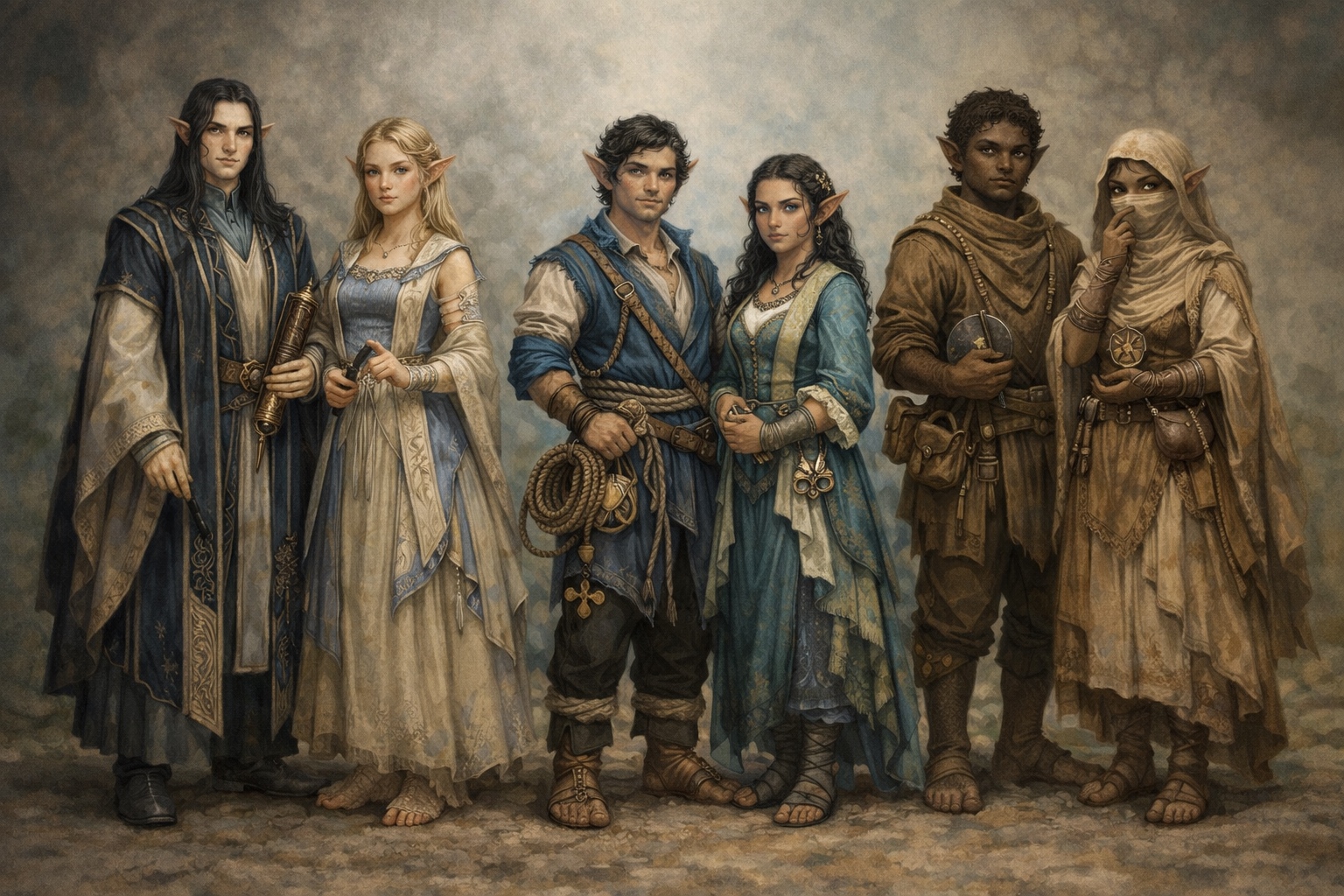
Elf
CORE IDENTITY
- Race Name: Elf
- Plural Name: Elves
- Adjective Form: Elven
- Alternate Names: Aelvari (formal self-designation, used in writing and ceremony); the Long-Lived (common across all continents, neutral); the Elder Kin (Irna, archaic and somewhat romantic in connotation)
- Self-Name (Endonym): Aelvari, meaning "those of the long remembering" or, in older usages, simply "the remembered ones"
- Outsider Names (Exonyms): Silkwalkers (Jazirah, used for Sand Elves specifically; neutral); Wavecallers (used for Sea Elves in Shoing and Funta coastal ports; neutral-to-admiring); Pale Court (Funta, used for High Elves specifically; sometimes implies detachment or arrogance)
OVERVIEW
Short Description
Elves are a long-lived, keenly perceptive people defined by their relationship to time and memory. They outlive most other races by several centuries, and this fact shapes everything about how they build, think, govern, and mourn. Four distinct lineages have diverged across Dort's continents and beneath them: the High Elves of Irna's ancient forests and courts, the Sea Elves of the world's coastlines and open water, the Sand Elves of Jazirah's interior deserts, and the Moren of the Underworld, whose sunless civilization developed in the deep places below the surface world. Each is distinct enough in appearance and culture to be treated as a separate people by outsiders. The first three branches maintain that they are branches of the same long root. The Moren's place in that framing is more complicated, and most surface Aelvari will not discuss it at length.
General Reputation
The world's relationship with elves is rarely neutral. They are admired for their learning, their artistic and architectural achievement, and their centuries of accumulated knowledge, and they are regarded with suspicion, not-quite-trust, and occasional resentment for the same reasons. An elf has typically watched more events than any human institution can remember; this gives them an authority that is deeply uncomfortable for those who value their own civilization's primacy. The common accusation is that elves are detached, that they observe where they should act, weigh where they should commit, and remember where others have moved on. This accusation is not entirely without foundation, though the Aelvari interpretation of the same behavior is that they understand consequences in a way that shorter-lived peoples cannot afford to.
Role in the World
The Aelvari occupy the world's memory. They are the civilization that was already old when others were beginning, and their civilizational niche is fundamentally archival; they preserve, transmit, and act as living witnesses to events that written records can only approximate. Alongside this, they are the foremost practitioners of the arcane arts in Dort, not because other peoples lack magical aptitude but because the investment of decades into mastery that magic requires is more naturally sustainable for a people who measure their lives in centuries. In practical terms, elves fill roles as scholars, diplomats, long-horizon planners, arcane practitioners, and (particularly among Sea and Sand variants) as navigators and guides through environments other peoples find hostile or illegible.
PHYSICAL TRAITS
General Appearance
Elves read, at first glance, as elongated: taller than average, with proportions that lean toward the vertical. Limbs are long relative to torso; faces are angular and fine-featured with notably large eyes set wide for the face. The overall silhouette is one of deliberateness and precision: there is nothing blunt about elven physical form. All three lineages share the basic proportional template, though they diverge significantly in coloration, build, and specific feature emphasis.
Size Ranges
- Typical height: 5'8" to 6'4" for High and Sea Elves; Sand Elves run slightly shorter, 5'6" to 6'0", with a leaner build
- Typical weight/build: 130–180 lbs; elves are consistently lean, with a density of muscle that does not present as bulk; they read as capable rather than powerful
Distinguishing Features
The features that most reliably identify an elf to any observer are the ears: distinctly pointed, of variable length by lineage and individual, and mobile in a limited range that functions as a secondary emotional register (pricked forward in interest, angled back in displeasure). Eyes are disproportionately large and typically possess an unusual depth of iris color: not luminous in darkness, but catching light in ways that human eyes do not. Elven hair grows to significant length without breaking and has a particular texture (fine and strong simultaneously) that makes it resistant to the tangling and damage that affects other peoples' long hair. Movement in all elves tends toward an economy of gesture; they do not fidget, do not make unnecessary motions, and this stillness in casual situations is one of the things outsiders most often read as "unsettling."
Aging Patterns
Elven childhood is long and protected. A young elf is not considered an adult by their own culture until approximately age 60, a fact that creates significant social awkwardness in mixed societies where a 40-year-old elf is legally an adult by other peoples' standards but culturally still in the equivalent of late adolescence. The transition to adulthood is marked by the Aelthon, the First Remembrance, a ceremony in which the young elf recites a memorized lineage going back as far as their teachers can carry it, demonstrating that they have internalized their place in the long chain of memory. Visible aging is extremely slow; an elf at 300 looks approximately equivalent to a well-preserved 40-year-old of another race. True elderhood (the Silvae, or silver-time) begins around age 500, marked by silver threading through the hair and a deepening translucency to the skin at the temples and wrists. Very old elves past 700 carry a quality of presence difficult to describe as anything other than geological; they have simply been present for so long that the world has shaped itself slightly around them.
Regional Variation
High Elves of Irna's forested heartlands and court-cities tend toward pale complexions ranging from ivory to light golden-brown, with hair in dark browns, blacks, and occasionally auburn. Sea Elves vary widely by the coasts they inhabit: Sea Elves settled along Funta's coastlines carry the deep browns and blacks characteristic of Funta's peoples, with slightly broader facial structure than their Irna kin; Sea Elves of Shoing's ports tend toward the warm yellows and tans of Shoing's demographic, with eyes more commonly showing amber and gold tones. Sand Elves of Jazirah's interior are typically deep brown to near-black in complexion, with a particular dryness to the skin surface that suits low-humidity environments, and hair that is often tightly coiled close to the skull before growing out. Regardless of coloration, all elves share the proportional signatures described above; lineage is identifiable by build and feature, not merely color.
BIOLOGY
Diet
Elves are omnivores with a strong cultural preference for foods that require care in preparation: complex-flavored ingredients, long-cooked or fermented elements, and the kind of cooking that rewards patience. This is partly cultural and partly biological: elven digestion handles diversity of ingredient better than it handles large volumes of simple food. An elf can eat anything most other humanoids can, but a diet of plain staples eaten in quantity is less satisfying to their digestive system and leaves them feeling underserved in a physiological sense, not merely an aesthetic one.
Reproduction Basics
Elven gestation runs approximately fourteen months. Births are almost invariably single; twins occur rarely enough to carry cultural significance. Elven birth rates are very low, and a given couple may have only two or three children across a lifetime of centuries. This means elven communities, despite their long lives, do not grow quickly, and population losses from war or disaster can take generations to recover. Both parents and the extended community invest intensely in each child; in High Elf society particularly, the birth of a child is a significant social event.
Lifespan Ranges
- Typical lifespan: 700–900 years; some individuals reach 1,000, though this is uncommon and tends to be accompanied by a withdrawal from active engagement with the world
- Maturity: Cultural adulthood at approximately 60; legal majority in most non-elven contexts at 18–20, which the Aelvari regard with polite distress
- Elderhood: The Silvae begins around age 500; those past 700 are considered among the living ancestors
Environmental Adaptations
Elven sensory acuity is notably above humanoid average across all senses, with particular emphasis on vision and hearing. They detect motion at greater range, see detail at greater distance, and hear frequencies outside normal humanoid range. In practical terms this means an elf in a forest moves through it differently than other peoples, receiving more information per moment. Sand Elves have developed a specific membrane adaptation to protect their eyes from airborne particulate, giving their eyes in bright conditions a slightly misted quality that resolves fully in normal light. Sea Elves have marginally better pressure tolerance and lung capacity for extended breath-diving.
PSYCHOLOGY & CULTURE
These are shared tendencies shaped by the particular experience of living centuries-long lives in a world of shorter-lived peoples. Individual Aelvari vary enormously. An elf who has spent 200 years among the communities of other races may present almost nothing of the cultural patterns described here.
Typical Temperament
Measured, observant, and slow to express strong reaction in public: not because elves lack strong reactions but because they have generally learned that their expressions carry disproportionate weight to shorter-lived peoples who read them against a different emotional baseline. Elves tend toward a wry quality rather than an openly warm one; humor, when it appears, is dry and often depends on long context. Within trusted relationships, elves are capable of intense emotional engagement, but the trust threshold is higher because the consequences of misplaced trust last, for an elf, a very long time.
Cultural Values
- The Long Memory: To remember is a moral act. Forgetting is not a neutral failure; it is a diminishment of what existed. Elves are expected to carry the memory of their lineage, their promises, and the notable events of their lifetime forward, intact.
- Patience as a form of respect: Acting quickly before understanding fully is considered a mild form of arrogance, an assertion that one's present judgment is worth more than the additional information that time would provide. This is not universal, and elves in crisis act as decisively as anyone; but in matters that allow deliberation, deliberation is the moral norm.
- The Oath-Word: An Aelvari oath spoken in their own language carries a weight beyond social convention. Breaking one is a profound personal failing with no formal legal enforcement, but the social consequences within elven communities are severe and long-lasting.
- Craft as memory-made-physical: Art, architecture, and fine work are considered forms of memory that outlast the individual. What an elf makes well becomes part of the long record.
Taboos
- Destroying records or art without cause: Burning a library, demolishing a notable structure, or erasing significant creative work is viewed as a form of violence against memory, one of the few things that can genuinely disturb an elf's practiced composure.
- Breaking an oath sworn in Aelthis: This is the deepest social rupture possible within Aelvari communities. It is not merely a personal failing but a statement that the individual has placed themselves outside the structure of elven obligation.
- Forgetting a name: Failing to remember the name of someone known to you, particularly someone deceased, is considered a minor but genuine failure of character. High Elf social culture invests significant ceremony in the formal stating of names at introductions because the act of learning a name is an implicit promise to carry it.
- Acting before grief is properly acknowledged: Among most Aelvari lineages, there is a cultural expectation that loss, particularly death, must be formally acknowledged before other business can proceed. Skipping this in favor of urgency is considered cold to the point of indecency.
Social Structures
High Elves organize around Houses: extended kinship networks with formal lineage records, arcane specializations, and court positions in the major Irna elven cities. Sea Elves organize around ship-kindreds and port-families: smaller, more mobile groupings defined by shared vessels and shared navigation knowledge rather than estate and bloodline. Sand Elves organize around nomadic bands that follow seasonal resource patterns through Jazirah, with a flat-ish leadership structure built around expertise rather than bloodline. All three forms share a deeper organizing principle: the extended family is the irreducible social unit, and the individual's obligations to it are not negotiable.
Family Structure
Elven partnerships tend to be long and chosen deliberately; the casual partnership that runs a few decades exists but carries a social reading of immaturity. Most enduring partnerships are formalized in the Aelthon-Mir ceremony (the "memory-joining"), which is understood as both a social contract and a declaration that the partners will carry each other's memories as their own. Children are raised by both parents and extensively by the extended family or House, with a deliberate cross-generational structure; grandparents and great-grandparents are often living and actively present in a child's life, which is not the case in most shorter-lived societies.
Leadership Patterns
High Elves: hereditary House leadership with formal councils of House heads for intercommunal governance. The legitimacy of a House leader depends on both bloodline and demonstrated competence in their House's specialty; a leader who is incompetent in the arcane arts of an arcane House loses standing rapidly regardless of birth. Sea Elves: leadership follows the most experienced navigator, validated by the practical results of their routes and decisions. Sand Elves: leadership goes to the elder whose counsel has most consistently proven correct over decades; this is roughly meritocratic but heavily weighted toward age as a proxy for accumulated judgment.
GEOGRAPHIC DISTRIBUTION
Primary Homelands
-
Irna: High Elves are concentrated in Irna's old-growth forest regions and in a handful of formal court-cities that have stood for thousands of years. These cities are built for permanence and beauty simultaneously: architecture that is as much memorial as functional, with layers of additions across centuries visible in any major building. The forests themselves are managed, not wild; elven forest-stewardship involves millennia of deliberate planting, shaping, and cultivation that produces what other peoples mistake for pristine wilderness.
-
Jazirah (Sand Elves): The deep interior of Jazirah (its upland plateaus, canyon systems, and the navigable margins of its great deserts) is Sand Elf territory in the sense that they know it better than anyone else and have traversed it continuously for longer than other peoples have been present. They do not hold it in the political sense; no Sand Elf "owns" the desert. But any desert route that can be used, they know.
-
All coastlines (Sea Elves): Sea Elves have no single homeland in the continental sense. Their homeland is the water, and their permanent-ish settlements are port-cities and island anchorages distributed across every continent's coast. The largest concentrations are in Irna's western coast, Funta's northern coast, and the island chains between Shoing and the open ocean.
-
The [Underworld](Cosmology/Mystical Realms/The Underworld): The Moren have built their civilization in the deep places: cave systems, underground rivers, and subterranean regions that exist beneath every continent. Their settlements are built around the features of the underground: bioluminescent fungi cultivated for light and food, underground waterways as transit routes, and cave formations shaped into architecture over millennia. The extent of Moren settlement below the surface world is not fully known to any surface people, including the Aelvari. Individual Moren do surface (for trade, for political reasons, or out of personal choice), but the civilization itself is below.
Secondary Populations (Diaspora)
- Shoing: A significant High Elf diaspora exists in Shoing's major cities, drawn by trade and arcane exchange. These communities have been present long enough to be fully integrated into Shoing city life rather than being transient; their descendants identify as Shoing Elves rather than Irna Elves.
- Antaea: Small but established elven communities in Antaea's major port cities, primarily Sea Elf in character.
Migration Patterns
High Elf migration is historically rare and tends to follow catastrophe; the major dispersals in the Aelvari record were driven by warfare and by what elven histories call the Long Silence (see History). Sea Elves are inherently mobile; their "migration" is simply their ongoing practice of following routes that move with seasonal conditions. Sand Elves move in established patterns that repeat annually, adjusting over decades as resource availability shifts, but do not migrate in the sense of abandoning their territory.
Adaptations by Region
Sea Elves on Funta's coast dress for heat and spray simultaneously: thin, salt-resistant fabrics in layered wraps that can be added or removed quickly, with a preference for natural dyes that do not run in saltwater. Shoing Sea Elves have incorporated regional craft aesthetics into their dress and ship-building in ways that distinguish them clearly from Funta or Irna Sea Elves. Sand Elves in Jazirah wear loose-fitting layers that manage desert temperature swings (cold nights, searing days) and cover exposed skin against sand and UV. All Sand Elf clothing is designed to be carried or packed efficiently when moving. High Elves in Irna dress for formality and permanence; their textiles are among the most elaborate on the continent.
Cultural Differences Between Lands
The gap between High and Sand Elf culture is, arguably, the largest cultural difference within a single race in Dort. High Elves are sedentary, archival, formal, and court-centered; Sand Elves are nomadic, practical, largely oral in tradition (parchment does not survive desert conditions well), and organized around collective survival rather than aesthetic accumulation. Sea Elves occupy a middle position: mobile and practical like Sand Elves, but with the commercial and cosmopolitan orientation of a trading culture that has deep roots in formal elven civilization. All three branches regard each other as legitimate Aelvari, but relations are sometimes strained: High Elves occasionally condescend toward Sand Elf oral tradition as insufficient preservation, and Sand Elves regard High Elf court culture as elaborate machinery for avoiding the actual experience of being alive.
HISTORY
Origins
Aelvari mythology places the first elves at the edge of the oldest forests at the moment the world became inhabitable: not created by gods but present at the beginning, like the trees themselves. This is a self-flattering origin story that most scholars from other races treat with appropriate skepticism. What is consistent with the material record is that elven civilization in Irna predates any other identifiable organized culture by at least a thousand years; the oldest elven structures in the continent's forest heartland are built with a confidence in permanence suggesting they expected to be there a very long time and have, in fact, been there very long.
Major Turning Points
The Age of Voices: In the earliest period of documented Aelvari history, running from approximately five thousand to three thousand years before the current era, High Elf civilization was at its most expansive and politically unified. Multiple Irna court-cities operated under a loose continental council. Magic was understood more widely and at greater depth than it is now. This period is remembered as the height; much that exists today is acknowledged by the Aelvari themselves as a partial recovery from what was lost when it ended.
The Unraveling: The collapse of the Age of Voices was not a single war but a cascading failure of the council-system over several centuries, driven by a combination of magical catastrophe (the nature of which is still disputed; the elven records are deliberately vague), external pressure from peoples who were expanding as elven civilization was contracting, and internal disagreements about how to respond. What is certain is that the Unraveling coincided with a permanent fracture within the Aelvari: a faction went underground during this period and did not return. Their descendants became the Moren. What role the Moren's departure played in the collapse (and what role the collapse played in their departure) is a question surface elves have not answered in three thousand years, and the silence has the specific quality of a decision rather than a gap. The aftermath is what elven histories call the Long Silence: a period of several centuries during which elven communities turned inward, ceased expansion, withdrew from many territories they had held, and focused on survival and internal memory-keeping over outward engagement. Many of the diaspora populations of Sea Elves and Sand Elves trace their origins to movements during the Long Silence.
The Sea Divergence: During and after the Long Silence, coastal elven communities that had been oriented toward trade and navigation found that their mobile way of life was more sustainable than the court-city model and gradually developed into the distinct Sea Elf culture. This was not a formal separation but a growing-apart across several centuries.
The Desert Withdrawal: Sand Elves are believed to have been a Jazirah-adjacent High Elf population that, during the Long Silence, retreated into the desert interior and simply stayed. The desert environment was hostile enough to deter pursuit and pressure, and the communities that developed there adapted over generations into something distinct.
Current Historical Posture
The Aelvari are a civilization in considered stability: not recovering from crisis, not expanding, but maintaining. The High Elf court-cities of Irna are older than any other living civilization and are still inhabited and functioning, which is itself remarkable. The knowledge that the Age of Voices was greater than what exists now is carried with a kind of dignified melancholy; elves today are aware they are the diminished form of what the Aelvari once were, and they differ in whether this calls for mourning, for rebuilding, or for simply accepting the long turn of things. The three lineages are somewhat more disconnected from each other than they were before the Long Silence, and there is no serious political movement toward reunification, though scholars maintain cross-lineage contact.
LANGUAGE
Language Name(s)
Aelthis: the elven tongue, a flowing, vowel-rich language with complex tense and aspect structures that encode temporal distance and certainty of memory as grammatical categories. There are four formal variants: Irna Aelthis (the court and scholarly form, considered prestige), Miral Aelthis (Sea Elf variant, compressed and practical, with a significant vocabulary around navigation, weather, and trade), Dunar Aelthis (Sand Elf variant, with a large vocabulary around desert navigation, oral recitation structure, and nomadic logistics that does not exist in the other forms), and Moren Aelthis (the underground variant, the most phonetically diverged from court standard; has developed a tonal quality adapted to sound carrying through stone, and a vocabulary around geological features, fungal ecosystems, underground navigation, and subterranean architecture with no equivalent in any surface dialect).
Script
Aelveth Script: a flowing cursive system with no straight lines, designed to be written quickly on smooth materials. The traditional surface is vellum or stretched silk. Aelveth Script can be written at extremely small scale without losing legibility, which has made it the default choice for treaty documents that need to be portable. Sand Elves, for whom paper and vellum are poor choices in desert conditions, have developed a parallel incised-rock notation system for permanent records that is read by touch as well as sight; this is not widely known outside Jazirah.
Trade Language Status
Aelthis is not a trade language; the Aelvari have never promoted it as such. Elves engaged in trade or diplomacy typically operate in the local common tongue of wherever they are working. Aelthis is a language the elves keep; it is rarely taught to outsiders, and when it is, it is treated as a significant intimacy rather than a practical transaction.
Dialect Range
The three variants of Aelthis are mutually intelligible between High and Sea Elves with moderate effort. Dunar Aelthis (Sand Elf) presents more difficulty; a High Elf and a Sand Elf speaking their respective dialects will achieve partial comprehension at best without dedicated study. Within each lineage, variation is relatively minor; elves' long memories and careful linguistic preservation mean that Aelthis changes more slowly than most languages.
Naming Agent Cross-Reference
See _Cannon/Race naming ai agents/Fantasy Race Name Generator.md (Elven section) for full phonological rules and generation guidelines.
NAMING CONVENTIONS
Personal Name Structure
Given name followed by House name (High Elves) or ship-kindred name (Sea Elves). Sand Elves use given name followed by band-name (a collective name for their nomadic group, changed when groups merge or split). All forms use two names in formal address.
Clan / House / Line Names
House names (High Elf) are compound Aelthis morphemes, two elvish roots joined with attention to phonotactics. They are never English translations. The meaning is present in Aelthis but is not used in direct address. Sea Elf kindred names often incorporate navigational references (a specific water body, a star-marker, a famous passage) rendered entirely in Aelthis phonology.
Regional Name Differences
High Elf names tend toward longer forms with more diphthongs and flowing vowel sequences. Sea Elf given names are shorter and crisper, a practical adaptation to shipboard contexts where names are spoken at speed in wind. Sand Elf names often include a doubled consonant element that is distinctive within Dunar Aelthis phonology and sounds unusual to High Elf ears.
Formal vs. Informal Names
Within trusted relationships, elves use a shortened or intimate form of the given name. The full given-name + House/kindred construction is reserved for formal introductions, official contexts, and solemn occasions. Earning the right to use an elf's intimate name-form is a genuine social marker and is not extended casually.
Titles & Honorifics
- Aelvar-Sol: "Leaf-elder", a High Elf with recognized authority in a House; used before the name in formal address
- Mir-Calor: "Memory-keeper", an elf designated to maintain the House or band's formal lineage records; a significant responsibility, not merely a clerical role
- Lir-Miral: "Song-navigator", Sea Elf title for an experienced route-master whose knowledge of currents and stars is considered mastery-level
- Dunar-Vel: "Desert-voice", Sand Elf title for the keeper of the oral tradition within a band; equivalent in prestige to the High Elf Mir-Calor
Sex and Name Form
Elvish marks sex in the suffix and only lightly, and neutral is the default; the neutral suffixes are both the larger set and the more elegant ones. The feminine markers -iel, -riel (daughter-of), -wen (maiden), -dra, -a and -is contrast with the masculine -ion, -orn (son-of, tree), -or, -dor and -ien, while -eth, -mir, -sol, -anor, -vael, -ithil, -aelin and -thorn carry no sex information at all. Most Elvish names should not be sex-marked.
The -iel ending is the tradition's most overused, and the discipline of rotating through -wen, -dra and -is matters more here than in any other register. The feminine is not lighter than the masculine; both draw on the same phonemic inventory, the same diphthongs, and the same ban on hard stops. The whole tongue is already soft; there is no softer variant of it.
House, epithet and place-origin names never inflect. A daughter of the house carries the house name unchanged. Penultimate stress is unaffected by sex.
Name Examples
- Given names (general): Aelindra, Caelithorn, Miriavel, Sylvoneth, Thalarien, Lirathwen, Naelisorn, Vaelmir, Soleth, Eiravel
- Given names (formal/elder): Thalioneth, Caelindras, Mirithilorn (longer forms used in ceremony and elder address)
- House / kindred names: Mirithil, Caelorn, Vaelanor, Thalithien, Lirsol, Naelmir, Silaelin, Galaelin
- Honorific / title examples: Aelvar-Sol Sylvoneth, Mir-Calor Thalarien, Lir-Miral Vaelmir
- Full name examples: Aelindra Mirithil, Thalion Caelorn, Lirathwen Vaelanor, Sylvoneth Naelmir, Vaelmir Silaelin
SOCIETY
Common Professions
The public face of elven society to other peoples is dominated by arcane practitioners, scholars, and diplomats. Internally, elven communities support the full range of professions any complex society requires (farmers, builders, weavers, physicians, soldiers), but these do not receive the social prestige in external representation that arcane and scholarly work does. Among Sea Elves, navigation and seamanship are the prestige vocations. Among Sand Elves, the oral tradition keepers, the route-finders, and the healers who know desert plant medicine carry the highest social standing.
Craft Traditions
High Elf craft is oriented toward beauty and permanence simultaneously; the two are not separable in the Aelvari aesthetic. Materials are chosen for how they age as much as how they look when new; a High Elf textile is intended to be recognizable as fine work after three hundred years of use. Aelthis script illumination is a recognized high art, as is the production of memory-objects, deliberately made items intended to trigger vivid recall of specific events. Sea Elf craft is practical and salt-resistant first, but their navigation instruments are works of precision that other peoples spend significant sums acquiring. Sand Elf craft is light, portable, and often repurposable: sand-tools that double as shelter poles, garments that become bedding.
Trade Roles
High Elves participate in trade primarily as buyers of rare materials for arcane and scholarly work and sellers of magic-related services and finished luxury goods. Sea Elves are among Dort's most prolific long-distance merchants, carrying goods between continents on routes only they fully know. Sand Elves trade within Jazirah's interior, moving goods between communities that are otherwise not in contact; they are valued intermediaries in desert politics. Elven bargaining culture is patient (they are in no hurry), which can be either reassuring (they will not rush you) or frustrating (they will not be rushed themselves).
Military Tendencies
High Elves maintain formal military houses: trained, disciplined, and equipped with the finest materials available. Their doctrine emphasizes precision and the use of terrain; they do not waste resources. Sea Elves are not a military culture in the structured sense but are highly effective at sea, and their navigation knowledge makes them dangerous asymmetrically; they can strike and vanish into routes other navies cannot follow. Sand Elves avoid pitched combat with larger forces through superior knowledge of terrain; they fight when cornered or in defense of their band, and in those contexts are formidable, but proactive warfare is not part of their cultural script.
Religious Tendencies
All Aelvari lineages maintain a reverence for memory as a spiritual practice (the act of remembering the dead, of preserving record, of passing forward what has been learned) that functions as a religious orientation even where it does not attach to a specific deity. High Elf religious practice tends toward formal ceremony tied to the cycle of the year and the commemoration of ancestral events. Sea Elves acknowledge the sea itself as something close to divine, not a named god but a presence that must be respected and offered to. Sand Elves practice a deeply animistic orientation, finding spiritual presence in specific desert formations, springs, and star-patterns that have been named and venerated for generations.
INTERACTIONS
Relations with Other Races
- Dwarves: Mutual respect between two peoples who outlive most others. The relationship is functional and sometimes collaborative on shared long-term projects, but not warm; dwarves find elven time-orientation slightly passive, and elves find dwarven time-orientation too focused on the artifact over the living.
- Gnomes: Elves find gnomes charming and occasionally frustrating. Gnomish ingenuity is admired; the ephemerality of gnomish work (a gnomish device that will be obsolete in fifty years does not interest an elf who will be alive in five hundred) is the point of friction.
- Smalings: Quiet goodwill in Irna, where the two peoples share the same forested and riverine territories without significant conflict. Smalings regard elves with a comfortable degree of wonder; elves regard Smalings with affection and occasionally with mild envy for their apparent contentment.
- Orcs: Variable by lineage and contact. High Elves regard orc expansion and tribal warfare with a detached concern; they have watched it before and have opinions about how it ends. Sea Elves deal pragmatically with orc coastal groups where necessary. Sand Elves and orcs have relatively limited contact in Jazirah.
- Humans: The most complex relationship. Elves see in human energy and creativity something both admirable and painful, the urgency of a life that must accomplish everything in a short time. The best human-elf relationships are characterized by genuine cross-generational respect; an elf who befriends a human family may maintain that friendship across four or five generations, watching the descendants of people they loved. This is emotionally complex in ways that both peoples are aware of.
Stereotypes (Given and Received)
- Stereotypes about them: That they are cold or unfeeling (false: they are measured, not cold; the confusion is real but based on a misread); that they are arrogant about their age and knowledge (partially true; some Aelvari elders do carry a weight of accumulated opinion that can read as condescension, though most elves are aware of this tendency and work against it); that they are all arcane practitioners (false; the majority of elves are not active spellworkers, though arcane aptitude is more common among them than in most other peoples); that High, Sea, and Sand Elves are effectively different races (false; they are culturally very different, but biologically one people).
- Stereotypes they hold: That shorter-lived peoples are reckless with things that matter because they won't live to see the consequences (partially true at the institutional level, unfair at the individual level); that dwarves confuse permanence of object with permanence of meaning; that humans build new things faster than they learn what they built last time.
Cooperation Patterns
Elves cooperate most naturally with peoples who share a long-horizon orientation or who have something specific they need that elves possess. High Elf scholarship draws scholars from all peoples, and those relationships are productive. Sea Elf navigation creates necessary commercial partnerships across multiple continents. Sand Elves cooperate within Jazirah's complex web of desert peoples as essential intermediaries.
Conflict Patterns
Land and memory are the core tensions. High Elves have lost significant forest territory over the centuries to the expansion of shorter-lived peoples who did not recognize long-established elven claim. The resentment from this is real and patient. Sea Elves have recurring tensions with peoples who want their navigation routes but do not want to pay for them or share wealth equitably. Sand Elves have ongoing tension with powers that want to claim Jazirah's interior without the navigational knowledge to hold it.
VARIANTS
Physical / Regional Variants
High Elves (Aelvar-Mir)
- Defining traits: The "baseline" Aelvari lineage from which most outsiders draw their mental image of an elf. Tallest of the three lineages; the most distinctly angular facial structure; typically pale-to-golden complexion in Irna, darker in diaspora populations. Adapted to temperate forest environments: no particular desert or ocean physiological modification.
- Range / location: Irna forest heartland and court-cities; significant diaspora in Shoing and Antaea ports
- Notes: The lineage with the most formal institutional structure and the deepest arcane tradition. High Elves carry the weight of remembering the Age of Voices most heavily, which shapes their culture toward a certain solemnity.
Sea Elves (Aelvar-Miral)
- Defining traits: Slightly more compact build than High Elves; broader hands with a natural grip strength adapted to rigging and rope work; marginally better lung capacity. Complexion varies by the coasts inhabited; they reflect the demographic norms of the region's coastlines rather than any universal coloration. Eyes tend toward aquatic color tones (green, grey, silver) more frequently than in other lineages, though this is a tendency, not a rule.
- Range / location: All major coastlines; concentrated in Irna's western ports, Funta's northern coast, Shoing's island chains
- Notes: The most cosmopolitan of the three lineages by virtue of constant contact with every other people. Sea Elves are often the first point of contact other peoples have with elven culture, and they tend to be more outward-facing and practically oriented than the High Elf cultural image suggests.
Sand Elves (Aelvar-Dunar)
- Defining traits: The most diverged surface lineage in terms of both appearance and culture. Consistently darker complexion than other surface Aelvari, deep brown to near-black, with a skin surface adapted to very low humidity. Slightly shorter average height than High or Sea Elves; leaner through the torso. Eyes have a distinctive protective membrane that gives them a slightly film-covered appearance in bright conditions. Hair typically grows close and tight at the root before extending.
- Range / location: Jazirah interior: upland plateaus, canyon systems, desert margins; no significant permanent communities outside Jazirah
- Notes: Sand Elves are least known outside their homeland, which is partly by design; they do not seek the world's attention, and the desert is an effective barrier. Their oral tradition preserves knowledge of desert geography, medicine, and history that no other peoples possess, making them indispensable to anyone who needs to move through Jazirah's interior.
Moren (Aelvar-Moren)
- Defining traits: The most visually distinct of all Aelvari lineages. Complexion ranges from deep charcoal-grey to blue-black, with a faint luminescent quality visible in low-light conditions: not a glow, but a quality of the skin that catches and holds faint light differently than surface skin does. Hair is white to silver, almost universally; color does not meaningfully vary. Eyes are adapted to low-light environments: very large iris, highly sensitive, typically silver, pale violet, or colorless grey. Average height is slightly shorter than High Elves; build is compact and quiet; Moren move with minimal sound as a baseline physiological tendency, not a cultivated habit. They are visibly uncomfortable in direct sunlight, not physically harmed but clearly preferring shade and indirect light.
- Range / location: The Underworld, beneath all continents. Most extensively settled beneath Irna and Funta. Individual Moren surface regularly for trade and other purposes; some, like certain matrons and merchants, maintain long-term surface residences. The civilization itself remains below.
- Notes: Moren society is matriarchal in structure; governance and religious authority concentrate in female lineages, though this is not universal across all underground communities. Their relationship with the surface branches of the Aelvari is cold at best and has not fully recovered from whatever happened during the Unraveling. Moren who live or travel aboveground are generally received with the same wariness that underground-origin peoples tend to attract; those who know what a Moren is may carry specific assumptions drawn from surface elven accounts of the Unraveling, which are one-sided by definition. See the Unraveling entry in HISTORY.
DEVELOPMENT NOTES (Author use only, not canon)
Story Hooks
- A High Elf elder approaches a party as a witness; she watched an event three hundred years ago that has become relevant again, but her testimony is legally complicated because the jurisdiction she witnessed it in no longer exists.
- A Sea Elf navigation chart covering a supposedly uncharted sea route is for sale; three different buyers claim it is theirs by right, and one of them is correct.
- A Sand Elf band appears at the edge of a settled territory carrying something they found in the deep desert: something that should not exist there, is very old, and that they will not give up but are willing to guide someone toward the site.
Unresolved Lore / Open Questions
- What exactly happened during the Unraveling? The deliberate vagueness in elven records suggests the Aelvari know more than they share. The Moren connection adds a dimension: the silence may not be ignorance but choice. What did the surface Aelvari do, or fail to do, that they prefer not to have recorded?
- Do the Moren have the surface version of events, the accurate version, both, or a third version that is also incomplete? Is there any Moren-side record of the Unraveling?
- Are the four lineages diverging further over time, or is there any slow pressure toward reconnection? The Moren's relationship with surface branches would need to be the first thing repaired for any reunion to be possible.
- What is the relationship between the oldest living elves (those approaching 800–1,000 years) and the Unraveling? Some elves alive today would have been children during the Long Silence. What do they actually remember?
- The Moren deity, not yet established. See Development Notes.
Development Notes
- Cross-link High Elf court-cities with Irna settlement files when written
- Sea Elf port communities should be noted in coastal settlement files for all continents
- The Long Silence's magical catastrophe is deliberately left open; this seems like it should connect to deeper world lore around arcana or planar events. The Moren and the Unraveling are the key to unlocking this.
- Sand Elf oral tradition could be a rich source of history that no written record contradicts or confirms, useful for mystery hooks
- Moren deity: Established as Nethara, an Ex Nihilo goddess of bioluminescence, cold light, mycelium networks, and the deep places. She predates the Moren by millennia; they found her already tending the underground when they descended during the Unraveling. See Nethara for full deity entry.
- Moren standalone page: Given the depth of existing Moren content in the world (Lady Kenani in Coleshill, settlement references across multiple continents), a dedicated Moren race page may be warranted in addition to this Variants entry. Flag for future session.
- All existing "moren" references in settlement files will be updated to "Moren" by the author directly.