Human
Human
CORE IDENTITY
- Race Name: Human
- Plural Name: Humans
- Adjective Form: Human
- Alternate Names: The People (used by humans across most lands as a general self-designation, implying centrality rather than arrogance); The Builders (Canix usage, respectful); Shortlives (Elven usage, neutral-to-affectionate, describes lifespan disparity without contempt)
- Self-Name (Endonym): Varies completely by land and people group; humans have no single endonym. Irna's core peoples call themselves "the Irnain" or simply by their kingdom. Funta's tribal peoples name themselves by tribe above all. Shoing's eastern peoples have elaborate lineage designations. The word "Human" is a category imposed from outside as much as claimed from within.
- Outsider Names (Exonyms): Shortlives (Elven, neutral); The Builders (Canix, respectful); Colonists (Sand Elf usage, carries weight of history); The Crowned (archaic Borun term, referencing the imperial structures humans built); Irnakin (used across some parts of Shoing and Funta to mean any human, regardless of whether they are actually from Irna; reflects how strongly Irna set the template for what "human" means to the world)
OVERVIEW
Short Description
Humans are the most numerous, most geographically dispersed, and most politically powerful people in Dort. They built the world's first civilization in Irna, and from that foundation sent explorers, armies, and settlers into every corner of the known world. No other race is found in such abundance in every land. No other race holds as many thrones, commands as many armies, or builds as many cities. What humans lack in the deep time of elven memory, the physical resilience of dwarven lineages, or the specialized genius of the smaller peoples, they compensate for with an appetite for ambition that their short lives seem to intensify rather than limit. Humans want things, they build things to get them, and they do not stop.
General Reputation
Humans are regarded differently depending on who is doing the regarding. To most peoples, humans are simply the dominant fact of the world: unavoidable, mostly predictable, occasionally magnificent, sometimes catastrophic. The consensus is that humans are capable of remarkable things and terrible things in roughly equal measure, and that the difference between the two outcomes is largely a matter of who is in charge and what they want. Elves and dwarves who have watched human civilizations rise and collapse across centuries tend toward a kind of patient wariness: respect for human energy, caution about human judgment when ambition outpaces wisdom. Smaller peoples (Smalings, Gnomes, Lapori) generally regard humans positively, as humans have largely been reliable trading partners and fair-enough neighbors when their imperial interests don't require otherwise. Orcs and other peoples who have been on the receiving end of human military expansion hold a range of views, from structured grudging respect to deep generational resentment.
Role in the World
Humans are Dort's empire-builders, its administrators, its conquerors, and its connectors. The political architecture of the world (the imperial system, the great city-states, the road networks, the trade leagues, the diplomatic protocols between lands) was built by humans, around human timescales, for human purposes. The calendar the whole world uses is Irna's calendar. The trade language that connects every port from Shoing to the eastern seaboard of Funta is Irna Common. The pattern for how a civilized city-state should be organized was laid down in The Crown and then reproduced, with variations, in every land humans reached. This influence is not always benign and not always welcomed, but it is total. To live in Dort is to live in a world largely shaped by human hands.
PHYSICAL TRAITS
General Appearance
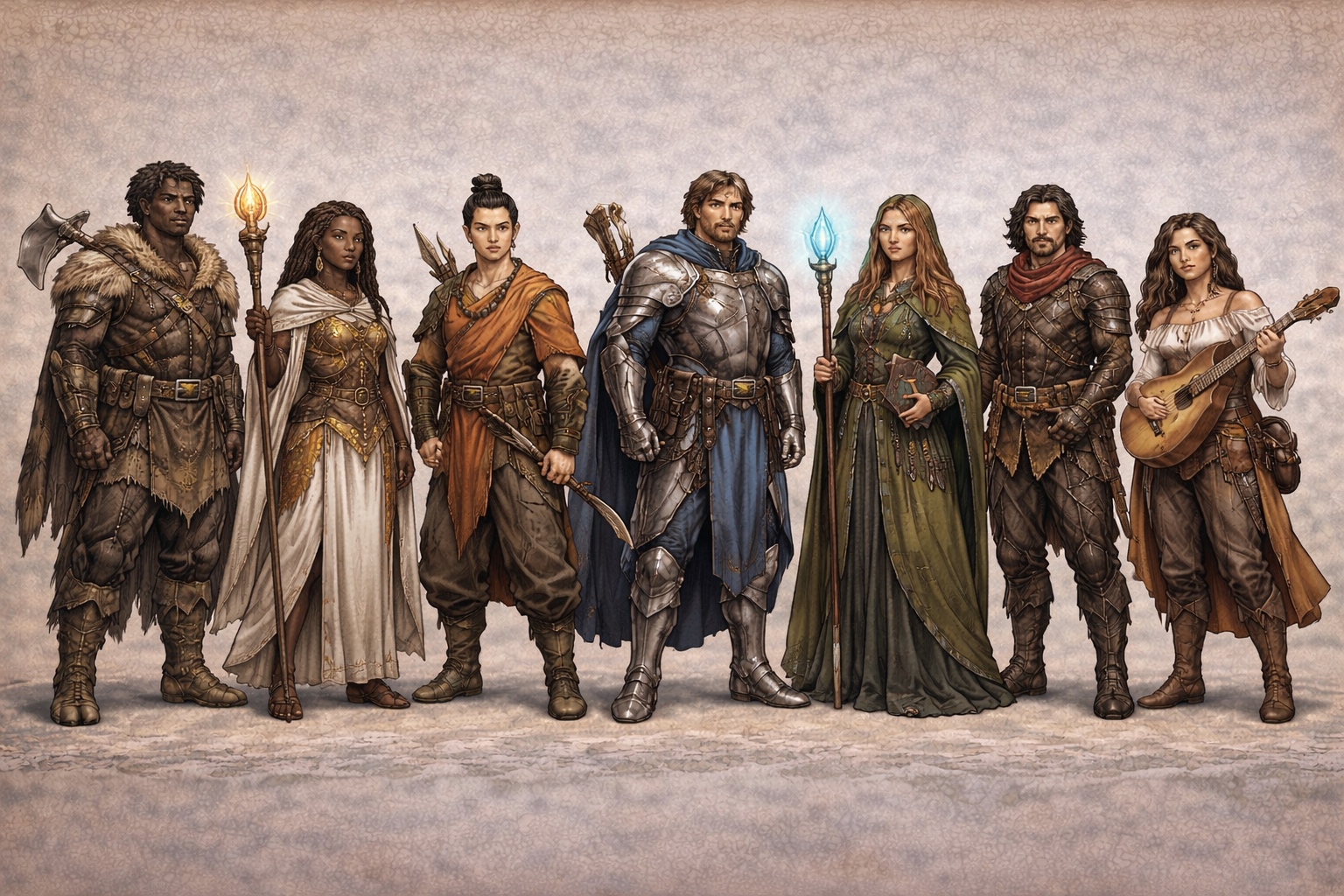
Humans have no single appearance. They are the most physically variable race in Dort, with complexion, build, hair, and facial structure varying dramatically by land and people. What is consistent is the humanoid baseline (upright posture, two arms, two legs, proportions suited to moderate terrain in moderate climates) and a size that places them in the middle range of Dort's peoples: taller than Smalings and Gnomes, shorter than Goliaths and Taurik, roughly matched to Dwarves in body mass though typically taller. Beyond the baseline, describing "a human" appearance requires knowing which human from which land.
Size Ranges
- Typical height: 5'0" to 6'4" across all populations, with significant variance by region; Irna's northern mountain peoples tend toward the taller end; Funta's eastern seaboard peoples toward the shorter; Shoing's populations cover the full range
- Typical weight/build: 120–230 lbs; build varies more dramatically than height: Funta's tribal warriors tend toward lean and powerful; Irna's central agricultural peoples toward stocky; Shoing's interior peoples toward wiry
Distinguishing Features
There are no features that reliably mark all humans as human to an outside observer except, perhaps, the absence of other distinguishing features. Humans have no horns, no tails, no feathers, no scales, no tusks, no unusual ear structure, no visible magic in their eyes. They are the unmarked baseline against which many other races define their differences. The things that mark a specific human (the patterns of facial structure, the complexion range, the hair type and texture) are regional and demographic, not race-wide. In heavily mixed cities, experienced observers can read a human's origin lands from these cues; in less cosmopolitan contexts, people simply recognize what is familiar and regard the rest as foreign.
Sexual Dimorphism
Present and moderate. Humans show the typical variation associated with humanoid sexual dimorphism: average height difference, different muscle mass distribution, different patterns of visible aging. The degree to which this is treated as significant varies enormously by region and culture. Irna's imperial legal structures historically treated it as highly significant. Funta's tribal traditions vary enormously tribe to tribe. Shoing's urban populations have largely moved toward more fluid practical arrangements. The biology is consistent; the cultural weight placed on it is not.
Aging Patterns
Humans age quickly by the standards of most long-lived races. Childhood is relatively short; most human cultures consider children capable of real work by age 8 or 10, and adult standing is typically reached between 16 and 20. Humans in their thirties are in full social power. Humans in their sixties are considered elder by most standards and often occupy positions of institutional authority. A human past eighty is old, and past ninety is considered remarkable in most lands. The brevity of this arc is the defining fact of human psychology and civilization; everything humans build must be built quickly, because they will not live to see something that takes a thousand years.
Regional Variation
Human complexion across Dort follows broad geographic patterns corresponding to the populations that settled each land:
Irna: The widest range of any land, reflecting the diversity of peoples within it. The lands from The Crown south to the Mocan Sea produce humans of fair to warm-golden complexion, with hair ranging from pale flaxen to dark brown. The northeastern tribal plains peoples are deeper-toned with straight dark hair. The northern mountain peoples are fair to ruddy, often with hair that runs to red and sandy. The western arctic mountain peoples are pale, broad-featured, with dark eyes and dark hair.
Shoing: The east of Shoing produces humans with warm to amber complexions, predominantly straight dark hair, and typically narrower facial features. The far north carries paler complexion with heavier builds adapted to the cold. The southwestern lands, which have an older and more distinct cultural tradition, produce humans of warm brown complexion with wavy-to-curling dark hair.
Funta: The broad interior of Funta produces humans of rich to very deep brown complexion, the deepest complexion range of any land, with tightly coiling or close-cropped hair and builds adapted to heat and physical exertion. The eastern seaboard, which has the longest history of contact with Irna, carries more variation: warm tawny to deep complexions and more hair texture variety reflecting generations of intermingling.
Jazirah: Warm olive to warm brown complexions predominate, with hair that runs from dark brown to black, typically straight or lightly wavy. The Irna-descended settler communities carry somewhat lighter average complexions than the peoples whose roots predate the settlement, though generations of intermarriage have blurred these distinctions in most cities.
Antaea: The northern peoples of Antaea have warm bronze to deep warm-brown complexions, typically with straight or wavy dark hair. Builds tend toward lean and rangy in the interior peoples and stockier in the coastal communities. The southern Antaean peoples who are hostile to the wider world show more extreme variation; scholars have limited observation of them.
BIOLOGY
Diet
Humans are omnivores with no significant biological dietary restrictions and a wide tolerance for varied diets. This adaptability is part of what allows them to thrive in every climate Dort offers: the Funta tribal warrior eats game and grain suited to the savannah; the Shoing city-dweller eats from a tradition of elaborate grain and vegetable preparation; the Irna coastal communities eat heavily from the sea. No human diet tradition is biologically constrained, only culturally shaped. The Smaling tradition of multiple daily meals is not natural to most human populations, which tend toward two to three meals depending on the workload of the day.
Reproduction Basics
Human gestation is approximately nine months. Single births are most common; twins occur at a moderate rate and are culturally regarded variously: propitious in some Funta traditions, neutral in Irna, occasionally seen as an omen in more superstitious communities. Human birth rates are high relative to elves, dwarves, or goliaths, and this reproductive pace is a significant factor in human population dominance. Parents typically invest heavily in children's upbringing relative to short-lived creatures, though substantially less than the long-lived races who treat each child as a multi-century project.
Lifespan Ranges
- Typical lifespan: 70–90 years; well-resourced and healthy individuals in safe conditions may reach 100
- Maturity: Socially adult between 16 and 20, depending on land and culture; biologically mature somewhat earlier
- Elderhood: Considered elder around 60–65; past 80 is old; past 90 is remarked upon
Environmental Adaptations
Humans have few extreme biological adaptations but a very wide tolerance envelope. They are not the best at any single extreme (not as cold-resistant as the mountain peoples of other races, not as heat-adapted as a Desert-kin Serathi, not as altitude-comfortable as Goliaths), but they function adequately across more conditions than most races. Their adaptations are primarily behavioral and cultural rather than biological: they build shelter appropriate to the climate, learn to eat what is available, and organize their social patterns around the demands of their environment. This flexibility is the human adaptation. Given sufficient generations of settlement in one climate, human populations do develop modest physical tendencies toward that climate: not enough to constitute a biological variant, but enough to make a Funta plains-human noticeably different in build and complexion from an Irna northlander.
PSYCHOLOGY & CULTURE
These tendencies describe broad patterns, not absolutes. Internal human diversity is so extreme that any generalization about "humans" will have enormous regional exceptions. The patterns below describe tendencies that are consistent across most human populations.
Typical Temperament
Humans are defined by urgency. Whether or not they are consciously aware of their short lives (and most of them aren't, most of the time), their emotional register is faster-paced, more volatile, and more intensely attached to the immediate than most long-lived peoples. They commit quickly, grieve hard, celebrate loudly, and move on faster than elves or dwarves think is appropriate. This is not shallowness (human attachments are real and deep); it is the natural product of a lifespan that does not allow for the long patience of races who have centuries to decide. Where elves deliberate, humans act. Where dwarves consolidate, humans expand. The urgency that drives this produces both great achievements and catastrophic mistakes in rough proportion.
Cultural Values
- Achievement: Humans across most lands measure status by what a person has built, earned, won, or done. Legacy matters; humans are acutely aware that they will die and that what they leave behind is how they persist.
- Lineage: Family names, noble houses, tribal bloodlines, and dynastic succession are human inventions, built from the need to create continuity that individual lifespans cannot provide. The family is the institution that allows human culture to pass things forward.
- Adaptability: Treated as a virtue in most human cultures: the ability to change, to learn, to adopt new ways when old ones stop working. This is praised as intelligence in Shoing, as practical wisdom in Funta, as strategic intelligence in Irna.
- Ambition: Controversial even within human cultures. Celebrated when it produces empires and great works; condemned when it produces tyrants and wars. Humans argue about ambition constantly, which is itself revealing.
Taboos
- Betrayal of family: Across virtually every human culture, betraying your own bloodline is among the deepest social crimes. The specifics vary enormously (what counts as family, what counts as betrayal), but the principle is consistent.
- Oath-breaking: Humans built entire legal and diplomatic systems around the weight of sworn promises. Breaking a formal oath is a serious transgression in almost all human legal traditions.
- Cowardice in context: What counts as cowardice varies sharply by culture, but failure to meet the obligations your station demands (whether that is a warrior's duty, a merchant's financial responsibility, or a lord's protection of their people) is treated as shameful.
Social Structures
Human social structures are the most varied in Dort and have produced more forms than any other race: imperial hierarchies, tribal confederacies, merchant republics, theocratic states, hereditary feudal systems, city-state oligarchies, and democratic assemblies. The thing they have in common is that humans invented most of them, tested them in practice, and continue to argue about which is best. Most of the civilized world currently operates under some variant of the imperial system that Irna established, where kingdoms exist under the nominal authority of an emperor and conduct their internal affairs with considerable autonomy.
Family Structure
The household is the organizing unit of human social life across most cultures, though what constitutes a household varies. In Irna's central lands, the extended family claim, multiple generations under one roof or one estate, is the norm. In Funta, the tribe functions as the extended family, with bloodlines tracked but practical obligations organized around the larger group. In Shoing's cities, the nuclear household is increasingly common as urbanization breaks down older extended structures. Inheritance is almost universally patrilineal in Irna's imperial tradition; Funta's tribal inheritance varies tribe to tribe and includes matrilineal traditions; Shoing has developed property inheritance systems that are more transactional and less dependent on bloodline than either.
Leadership Patterns
Humans default to hierarchical leadership with legitimacy derived from bloodline (aristocracy and monarchy), demonstrated competence (meritocratic traditions in Shoing and among Funta's warrior classes), divine sanction (Jazirah under Oshala's faith), or elected authority (a minority tradition found in some Antaean city-states and occasional Irna councils). The hereditary principle is most dominant across the world, reinforced by the Irna imperial system, but the competing legitimacies are always present and human political history is largely the story of those competing legitimacies contesting for dominance.
GEOGRAPHIC DISTRIBUTION
Primary Homelands
- Irna: The original human homeland and the seat of the world's first civilization. Irna's human populations are diverse; the central empire lands, the northeastern tribal territories, the northern mountain peoples, and the western arctic communities are all distinct cultures that have co-existed under Irna's imperial structure for centuries. Human presence here is the deepest and most established in the world.
- Shoing: The most populated land in Dort, with human populations that dwarf those of Irna in raw numbers. Shoing's agricultural fertility and relative freedom from major predators allowed human populations to grow faster here than anywhere. The great city of Gwajin, with over a million inhabitants, is the largest human city in the known world and a point of active Shoing pride.
- Funta: Human presence in Funta predates the Irna contact period; the tribal peoples of Funta's interior and the eastern seaboard communities have their own deep histories. The Irna "discovery" in 350ME was, from the Funtaan perspective, the arrival of strangers with armies; the peace eventually settled is now several centuries old and has produced a complex cultural relationship. Thousands of named tribes exist in Funta, each with its own history and traditions.
- Jazirah: Settled by Irna in 540ME, with a history permanently shaped by the genocide of the Sand Elves and the subsequent rise of Oshala's faith. Modern Jazirah's human population is predominantly Oshala-following, with a smaller resistance population and an even smaller secular remnant. The faith is more than religion here; it is the organizing principle of the state, the legal system, and daily social life.
- Antaea: The most recent of the major civilized settlements, with Irna contact beginning in 1244ME. The indigenous human peoples of northern Antaea, who had been holding their own against the humanoid monster races that overran much of the continent, welcomed the Irna arrivals as allies. The resulting kingdoms are independent-minded, with limited interest in Irna's oversight, and are known throughout the world for the quality of their craftwork.
Secondary Populations (Diaspora)
- The Second Lands: A tiny but notable human presence exists in the two major fortified settlements of The Second Lands. These humans are a specific type: those who find the rest of civilization too confining, too watched, or too structured. They have come to a land that will kill them if they relax, and they stay willingly.
Migration Patterns
The great pattern of human migration is Irna outward: the founding civilization sending explorers, settlers, soldiers, and eventually whole populations into every accessible land. This pattern began before recorded history in Irna's case and continued through the current era. Each land's human populations now carry both the ancient roots of whatever peoples were there before Irna contact and the layered additions of Irna-descended settlers. The proportions vary by land: in Funta, the pre-contact populations are dominant and the Irna-descended settlers are a visible but minority presence; in Jazirah, centuries of intermarriage have blurred the distinction almost entirely. The driving forces are consistent across all migrations: land, resources, escape from old obligations, religious persecution, and simple restlessness.
Adaptations by Region
Human material culture adapts completely to local conditions. Irna's northern peoples build for cold and snow: heavy construction, underground root storage, layered wool and fur clothing. Funta's tribal peoples build for heat and movement: lightweight, portable structures for the nomadic traditions; permanent compounds for the eastern seaboard settled communities. Shoing's urban populations have built dense cities with sophisticated water management suited to agricultural abundance. Jazirah's populations build around water scarcity: cisterns, covered markets, architecture that manages heat. Antaea's craftspeople are renowned across the world for the quality of worked materials, which reflects both local resource availability and a cultural investment in craft mastery.
Cultural Differences Between Lands
The most significant cultural divergence between human populations is between Jazirah and every other land. Oshala's faith has produced a civilization whose organizing values (purity, obedience to divine law, the obligation to extend the faith) are fundamentally different from the transactional pragmatism that governs Irna's imperial tradition, the agricultural prosperity ethos of Shoing, or the tribal independence traditions of Funta. Beyond Jazirah, the sharpest distinction is between Irna's hierarchical aristocratic tradition and Shoing's increasingly meritocratic urban culture. Funta's tribal diversity is so extreme that generalizations are almost useless; the warrior traditions of the interior plains peoples share more in common with certain Irna northern tribes than with Funta's eastern seaboard city cultures. Antaea has developed a craftwork-centered cultural identity that cuts across its internal diversity and functions as the one thing all Antaeans agree they are proud of.
HISTORY
Origins
Human origins in Dort are, like the origins of all peoples, wrapped in a mixture of mythology and fragmented ancient record. The dominant account, shared across most human cultures in some form, is that after the Ancients shattered Ix and were banished, and after Echo was born to answer the peoples' suffering, humans were among those who thrived in the aftermath. Irna's mythological tradition places the founding of the first city as a divine gift, a reward for faith. Funta's tribal oral histories describe the pre-Echo age as a time of constant predation and the coming of Echo as a liberation. Shoing's oldest texts describe human origins as simply what was already there when the world became survivable. The scholar consensus is that humans, like most races, predate the post-Echo flourishing but were too dispersed and too primitive to constitute civilization until the conditions were right.
Major Turning Points
The founding of The Crown in Irna is treated by most historians as the formal beginning of the human civilizational project: the first city-state organized around law, institution, and political structure rather than around tribe, clan, or immediate survival. From The Crown, the imperial model spread.
The colonization of Funta in 350ME, and the wars and eventual peace that followed, established the first template for how Irna's expansion would interact with existing peoples in new lands: a template of initial conflict, negotiated settlement, and long-term cultural layering that has repeated in every subsequent expansion.
The genocide of the Sand Elves in Jazirah remains the greatest single moral stain on human civilizational history. A general's paranoia and manufactured grievance produced the first systematic attempt to eliminate an entire people. The Sand Elves survived; the shame did not diminish. Jazirah's subsequent conversion to Oshala is, in part, a history that runs directly through that event.
The rise of Oshala in Jazirah is the most significant recent civilizational development involving humans: a faith that has reoriented an entire land, is building military forces, and has explicitly declared its intention to extend itself to the other lands of Dort.
Current Historical Posture
Humans are, by virtually any measure, at the height of their world influence. The imperial system holds. Irna Common connects the world's ports. Shoing's human populations are the largest population bloc in Dort and growing. But the cracks are present: Jazirah is a threat on a generational timeline that no one has solved. Shoing increasingly resents Irna's nominal primacy. Antaea's kingdoms resist Irna's oversight more openly than before. The human world is stable, prosperous in most places, and quietly preparing for conflicts that most of its inhabitants hope will not arrive in their lifetime.
LANGUAGE
Language Name(s)
Each land has its own Common tongue, and in Dort, "Common" means the human language of that land. There is no single Human language. Irna Common, however, functions as the world trade and diplomatic language, the default for cross-land communication between peoples who share no other tongue. Shoing Common is the second most widely spoken Common in the world, reflecting Shoing's population size and trade reach. Funta Common, Jazirah Common, and Antaea Common are each their own distinct languages, mutually unintelligible with one another and with Irna Common.
Script
Each land has its own script tradition. Irna's script is the most widely known and is used in formal diplomatic and trade documents across the world. Funta's tribal oral traditions often precede formal written records, and literacy varies more by community there than in Irna or Shoing. Jazirah's script is tied to Oshala's holy texts and the faith's clerics are the primary literate class in most communities.
Trade Language Status
Irna Common is the closest thing Dort has to a universal trade language. Any merchant, diplomat, or adventurer operating across land boundaries can expect Irna Common to be understood in any port city and most significant inland trade posts. For a human, speaking only their home Common and no Irna Common is a significant disadvantage outside their native land.
Dialect Range
Enormous. Within Irna alone, the dialects of the northern mountain peoples and the Mocan Sea coast peoples are distinct enough that communication requires effort. Across lands, the five Commons are fully separate languages. Human linguistic diversity is, like their physical diversity, the broadest of any race in Dort.
Naming Agent Cross-Reference
Human names vary completely by land and people group. No single naming convention applies. See _Cannon/Race naming ai agents/Fantasy Name Generator - Human.md for full naming rules and generation guidance across all seven regional registers. Individual land documentation remains authoritative for specific settlements, houses and tribes.
NAMING CONVENTIONS
Personal Name Structure
Human naming structures are as varied as the cultures that produce them. The Irna imperial tradition uses a personal name followed by a family name, with the family name carrying legal and hereditary weight. Funta's tribal traditions use a personal name and a tribal designation; the tribe-name functions as identity marker more than surname. Shoing's urban traditions have evolved toward personal name plus family name, with family name first in formal address (family name precedes personal name in formal Shoing Common usage). Jazirah's faith tradition adds religious epithets and often replaces family names with lineage-of-faith designations after formal initiation. Antaea's traditions differ by which of the continent's three population strata a person descends from.
The Seven Registers
Human naming resolves into seven distinct registers, several of which coexist within a single land. A human's register is the single most informative thing their name conveys.
| Register | Land | Character |
|---|---|---|
| Irna: Noble & Common | Irna, Oceanic, The Second Lands | Anglo-Germanic core, with Norse strata in the north and Celtic strata in the west and islands |
| Irna: Plains & Coastal Tribes | Irna (Sequan, Pomo, Hesutu, Kiowa) | Wholly separate from the noble tradition; no family names; earned descriptive by-names |
| Funta | Funta | Plural by design: at least six tribal-linguistic streams, from the western coast to the northern highlands |
| Shoing: East & Southeast Asian | Shoing | The dominant register; family-name-first; place-derived house names |
| Shoing: South Asian Lineages | Shoing (Houses Mehta, Dharmakar, Thakur) | Old commercial lineages retaining given-name-first order as an identity marker |
| Jazirah | Jazirah | Faith-governed, with a distinct eastern stratum; the most systematically rule-governed of the registers |
| Antaea | Antaea | Three layered strata: indigenous, colonial-era, and Irnan settler |
Oceanic and The Second Lands were founded from Irna and use Irna's noble and common conventions. Their settlement names are frontier constructions, a founder's name joined to a structure word (Fort Angoth, Shilder's Outpost, Sir Mordin's Port, Wessen's Tower).
Clan / House / Line Names
Irna's noble houses are among the most elaborately structured collective names in Dort, with house names that can be traced for hundreds of years and carry specific legal rights and obligations. They are built on four authentic patterns: patronymic, locative, occupational, and Norse clan-form. Funta's tribal names function similarly but with a collective-identity emphasis rather than a property-rights emphasis; some Funta lineages carry a surname, others are known by given name and tribe alone. Shoing's family names are primarily practical, tracking lineage for inheritance and trade trust, and its noble houses characteristically share a name with the territory they govern. Irna's tribal peoples and Antaea's indigenous communities carry no family name at all; affiliation to tribe or community fills that role, and canon is explicit that among the Hesutu "the tribe's name, not the chief's family name, carries the institutional identity forward."
Regional Name Differences
Names are among the most reliable indicators of a human's origin land. An Irna name typically features hard consonants and vowel combinations that feel architectural, structured and purposeful. A Funta name, depending on tribe, may be lyrical and extended or short and percussive, reflecting the oral traditions of specific tribal lineages. Shoing names, particularly in the formal family-first convention, have a quality that Irna Common speakers often find initially reversed. Jazirah names increasingly follow patterns established in Oshala's holy texts, with many names being variants of faith-sanctioned names. Antaean names announce their stratum immediately: the oldest peoples' names close on a consonant and avoid the rolled R entirely, the colonial-era names are vowel-final and musical, and the settler names are indistinguishable from Irna's.
Sex and Name Form
Human registers mark sex in three different ways, and confusing them is the most common error in human naming.
- Grammatically marked: Antaea's colonial-era stratum and Jazirah both inflect. Jazirah's feminine is genuinely generative: Karim becomes Kareema, Rashid becomes Rasheeda, Salim becomes Saleema. Antaea's -o and -a endings do the same work. Jazirah's patronymic particle also inflects: a son is ibn, a daughter is bint, and this is grammar rather than preference.
- Systematically marked by ending: Irna (Norse -rid, -eig, -ild feminine against -ard, -var, -nar masculine) and Shoing's South Asian lineages (-a, -i, -ya, -ita feminine against -an, -esh, -av, -endra masculine).
- Marked lexically: Irna's tribal peoples, Funta, Shoing's East Asian register and Antaea's indigenous stratum assign sex by which names belong to whom by tradition, not by any ending that signals it. A great many names in these registers are used for either sex, and no ending can be added to change one into the other. Funta's Akan day-names carry an inherent pairing (Kwame with Akosua, Kofi with Afua) that should be respected rather than crossed.
Family names, lineage names, tribe names and house names never inflect for sex in any human register. Earned epithets and by-names do not inflect either.
Formal vs. Informal Names
All human cultures distinguish formal from informal address, though the specifics differ. In Irna's imperial tradition, titles take precedence in formal contexts; a lord is addressed by title before name. In Funta, elder status and warrior status are marked in address. In Shoing's urban culture, professional titles function as honorifics in commerce and governance. Among Jazirah's Oshala-following communities, religious titles are primary honorifics and precede all other markers.
Titles & Honorifics
- Lord / Lady (Irna): Noble title; inherited; marks house membership and the obligations that come with it
- Elder (Funta): Earned through age and demonstrated wisdom; tribe-specific; the highest informal authority in most tribal structures
- Honored (Shoing urban): Formal address for any person of established reputation in trade or craft; roughly equivalent to "esteemed colleague"
- Faithful / Devotee (Jazirah): Marks Oshala faith membership; those without this marker are socially marked as outsiders in Oshala-controlled territories
- Chief (Irna tribal): Elected by the elders, by consensus or vote depending on the tribe; held by continued community confidence rather than for a fixed term, and displaces the personal name in formal address
- Don / Doña (Antaea): Used in colonial-era and old-family households; marks standing within a community rather than a title granted from above, consistent with Antaea's preference for coordination over subordination
- Thakur (Shoing, South Asian lineages): Functions as both a title preceding a given name and a surname in its own right; both uses are correct
Name Examples
Irna: Noble & Common
- Given names: Aldric, Maren, Edvard, Solveig, Brennan, Tilda, Percival, Charlotte, Reginald, Priscilla, Erik, Freya, Cian, Ronan, Kathin, Kaidi, Hussa, Margent, Thrain, Slvanna
- House / family names: Valdrenmark, Ashford, Thornwick, Seravel, Duncroft, Geofferson, Oxwell, Metzger, Collins, Kaldersteinn, Frost, Orn, Carna, Keegan, Aherne, Yukan
- Full name examples: Aldric Thornwick (noble); Charlotte Geofferson (noble); Erik Kaldersteinn (northern clan); Cian Aherne (western); Ned Fischer (common, occupational)
Irna: Plains & Coastal Tribes
- Given names: Nahinni, Istaqa, Mosi, Takoda, Jaqui, Tiponi, Honovi, Nascha, Anoki, Talutah
- Tribe names: Sequan, Pomo, Hesutu, Kiowa
- Earned by-names: Running Foot, Two Rivers, Grey Elk, Standing Bear, Quiet Water, Long Winter
- Full name examples: Nahinni of the Sequan; Chief Jaqui Running Foot; Istaqa of the Hesutu; no family names are used in this register
Funta
- Given names: Amara, Kofi, Zola, Nneka, Tariq, Bisa, Kwame, Sefu, Amina, Thabisa, Tendai, Azibo, Akiki, Lekan, Erevu, Jabari, Ngozi, Adeola, Selam
- Lineage / family names: Nia, Oni, Chijioke, Zuberi, Jengo, Niazi, Koma, Tamrat, Mwangi, Boateng, Nkomo
- Tribe names: Kosi, Amina, Niazi, Tamrat, Koma
- Full name examples: Amara of the Kosi (tribal); Kwame Nia; Sefu Oni; Tendai Chijioke; Thabisa of Chigobo
Shoing: East & Southeast Asian (family name precedes given name)
- Given names: Haowei, Yuna, Mingzhu, Taijin, Liang, Jiang, Mori, Kenji, Emiko, Ami, Boro, Yim, Wei, Ling, Thanh, Mai
- Family / house names: Lianjing, Higatomo, Karubo, Galshi, Gwajin, Belon, Kegun, Patok, Zazua, Tessawa, Murano, Veshi, Sarko
- Full name examples: Lianjing Haowei (family-name-first formal); Higatomo Kenji; Karubo Emiko; Galshi Liang
Shoing: South Asian Lineages (given name precedes family name; the reverse of the dominant register, and deliberately so)
- Given names: Arjun, Prem, Aarav, Rohan, Vikram, Kiran, Priya, Meera, Anjali, Divya
- Family names: Mehta, Dharmakar, Thakur, Desai, Joshi, Rao, Deshmukh, Kulkarni
- Full name examples: Thakur Arjun (title-form); Prem Mehta; Arjun Dharmakar; Meera Deshmukh
Jazirah
- Given names: Rashid, Maryam, Tariq, Zainab, Khalid, Fatima, Hasan, Yusuf, Karim, Bashir, Jalal, Murtaza, Suha, Layla, Aziz, Samira
- Eastern stratum: Darius, Kaveh, Sohrab, Anahita, Shirin, Yasmin
- Nisba / lineage forms: al-Iskashi, al-Yabrini, al-Marwahi, al-Najjar, al-Haddad
- Full name examples: Rashid ibn Marzuq al-Mukhlis (faith-lineage full form); Maryam bint Yusuf; Tariq al-Iskashi; Hasan ibn Karim; Umm Layla (teknonym)
Antaea
- Given names (indigenous stratum): Itzal, Mirapan, Coatl, Xochil, Temiyan, Citlalin, Tenoch, Metztli, Ixchel, Chimalli
- Given names (colonial-era stratum): Ysavela, Leander, Alonso, Mateo, Isabela, Valentina, Ximena, Rodrigo, Paloma, Emilio
- Given names (Irnan settler stratum): Shannon, Mary, and the full Irna noble and common inventory
- Family names: Montoya, Alvarez, Delgado, Cabral, Ribera, de la Vega, del Sol, de Claragua, Salcedo, and the settler houses Glassowl and Wettin
- Full name examples: Xochil of Chumbicha (indigenous, community affiliation); Mateo Alvarez Montoya (old family, double surname); Itzal Montoya (mixed lineage); Lady Mary Wettin (settler); Isabela de la Vega
SOCIETY
Common Professions
Humans occupy every profession in Dort without exception; they are the generalists by necessity. Because there are more humans than any other people in most lands, they fill roles that other races specialize in, often less expertly but in far greater numbers. The professions most strongly associated with humans specifically are those that require rapid acquisition of power: political administration, military command, trade at scale, religious leadership, and exploration. Humans are disproportionately kings, generals, merchant princes, high priests, and expedition leaders: not because they are inherently better at these roles, but because the imperial structures of the world were built by and for human timescales, and humans move through their careers fast enough to accumulate institutional power before aging out.
Craft Traditions
Human craft traditions vary so dramatically by land that no single tradition can be called "human craft." Antaea's craftspeople are world-renowned; the quality of Antaean worked metal, woven fabric, and carved goods commands premium prices in every market. Funta's tribal traditions include some of the world's most sophisticated textile work and warrior-equipment crafting. Irna's imperial craft tradition is technically proficient but known more for volume and reliability than for exceptional artistry. Shoing's urban workshops have developed guild-based craft organization that prioritizes consistent quality at scale.
Trade Roles
Humans dominate trade infrastructure. The roads, the ports, the trading standards, the currency conventions that the world operates on were built by human administrators and merchants, primarily from Irna, and were designed to make human-controlled trade routes profitable. Irna Common as a trade language is the most concrete expression of this dominance; you cannot participate fully in world commerce without speaking it. Individual human merchants range from small-scale peddlers to the great trading houses of Shoing and Irna, some of which are wealthier than minor kingdoms.
Military Tendencies
Human military doctrine is as varied as human civilization, but the most influential tradition is Irna's: an organized standing army with professional soldiers, centralized command, siege capability, and the logistical infrastructure to sustain campaigns across long distances. This professional-army model was what gave Irna's expansion forces the edge over the tribal and militia-based defenses of most lands they encountered. Funta's military tradition runs in the opposite direction: tribal warrior excellence, individual mastery, and the devastating effectiveness of small elite forces, the Fire Swingers being the extreme expression of this. Jazirah is currently building toward a holy war military, combining the professional-army model with religious motivation in a combination that worries the scholars who are paying attention.
Religious Tendencies
Humans practice religion across the full spectrum of Dort's faiths, with no single deity or tradition claiming all humans. In Irna, the imperial religious tradition is pluralistic; the gods are honored through temples and festivals, and the state does not mandate a single faith. Funta's tribal traditions are diverse, often organized around ancestor veneration and land-spirits specific to the tribe's territory. Shoing's religious practice tends toward the civic and the ancestral, with less emphasis on individual divine relationship and more on collective ritual. Jazirah is the outlier: Oshala's faith has become total there, and human religious identity in Jazirah is largely synonymous with Oshala-faith identity for the majority population.
INTERACTIONS
Relations with Other Races
- Dwarves: Long-standing mutual respect based on centuries of trade and complementary strengths. Dwarves build what humans need and humans provide the markets. Friction arises when human expansion pressures dwarven mountain territories.
- Elves: Complex. High Elves and humans have co-existed in Irna long enough to develop genuine cultural exchange, but the memory gap (elves remember things humans have long since forgotten) creates persistent asymmetry. Sea Elves have a functional trade relationship with human port cities. Sand Elves carry a historical grievance against humans that is entirely justified and has not been resolved.
- Smalings: Generally positive. Smaling agricultural communities and human markets are naturally complementary, and Smalings have found humans to be reliable enough neighbors that their reputation for trustworthiness has survived centuries of cohabitation. The power differential is acknowledged by both sides and generally not weaponized.
- Orcs: Contested. The imperial expansion of Irna pushed into Orc territories in the northern lands, and the historical memory of that is alive. Urban Orcs in human cities live under social suspicion that has nothing to do with them personally. The relationship is not repaired; it is managed.
- Sand Elves: The wound from the Jazirah genocide is old but not healed. Sand Elves who interact with non-Jazirah humans often carry a wariness that is reasonable given history. The broader human world's silence during and after the genocide is something Sand Elf historians have not forgotten.
- Canix: Functional and often warm. Canix communities in Irna developed deep integration with human military and working life, and in Funta and Jazirah the relationship is similarly practical. Humans tend to regard Canix well; their reliability registers positively with human values.
Stereotypes (Given and Received)
- Stereotypes about humans: Short-sighted (literally and culturally; they act for their lifetime, not for centuries); aggressive; ambitious to the point of recklessness; talented but impatient; surprisingly adaptable. These are largely accurate in the aggregate.
- Stereotypes they hold: Elves are inflexible (half-true; elves are patient, not inflexible); Dwarves are stubborn (accurate more often than dwarves would like); Smalings are soft (false; they are conflict-averse, which is different); Orcs are violent (inaccurate for the general population, accurate for specific factions; humans apply it wholesale).
Cooperation Patterns
Humans cooperate most naturally with peoples who operate on comparable timescales and who benefit from the infrastructure humans build. Dwarves, Gnomes, and Smalings fall into this category; they plug into human trade and administrative systems and generally find the arrangement workable. Humans cooperate well with anyone who has something they want and the leverage to negotiate from. They are transactional by nature, and transaction is a relatively universal language.
Conflict Patterns
Human conflict with other peoples clusters around land use (expansion pressing on settled territories), trade disputes (the leverage of human infrastructure being used to extract unfavorable terms), religious imposition (particularly Jazirah's Oshala expansion), and the accumulated grievances of historical violence that has never been adequately addressed. Internally, human conflict is primarily imperial rivalry: kingdoms against kingdoms, houses against houses, Irna's nominal primacy against Shoing's ambition.
VARIANTS
Physical / Regional Variants
Humans do not have formal biological variants in the way that Dwarves have Surface and Deep lineages or Elves have High, Sea, and Sand branches. Their regional variation is continuous rather than discrete, a gradient of physical types corresponding to where populations have lived for generations. Scholars occasionally categorize Dort's human populations into regional groupings for reference (Irna central, Irna northern, Funta interior, Funta eastern seaboard, Shoing eastern, Shoing southwestern, Shoing northern, Jazirah, Antaea northern), but these are analytical conveniences, not distinct biological categories.
Cultural Branches
The Oshala Faithful (Jazirah)
- Defining traits: Complete integration of religious law into civil life; obligations of outward observance and inward devotion; mission to extend the faith
- Range / location: Dominant in Jazirah; diaspora communities in trade cities of other lands
- Notes: Non-Oshala humans interacting with Jazirah communities are formally tolerated in trade contexts and socially marginal in all others. The faith's political leadership is building toward expansion by force; most of the faithful are ordinary people who practice their religion without violent intent.
The Irna Imperial Tradition
- Defining traits: Hierarchical social organization; house names and hereditary obligation; the world calendar; Irna Common as default language
- Range / location: Strongest in Irna; has influence across all settled lands through the imperial system
- Notes: To outsiders, particularly those who have been on the receiving end of Irna's expansion, "Irna Imperial Tradition" reads as an ideology of dominance. To insiders, it reads as civilization itself. Both readings contain truth.
Funta's Tribal Peoples
- Defining traits: Tribe-first identity; warrior tradition; oral history; intense pride in tribal distinctiveness
- Range / location: The vast majority of Funta's interior; tribal communities exist in the thousands
- Notes: Funta's tribal peoples are internally more diverse than any other single "cultural branch" designation can capture. What they share is the tribal-identity structure and the warrior excellence tradition. The Fire Swingers, as mercenary forces, are the most world-visible expression of this tradition.
DEVELOPMENT NOTES (Author use only, not canon)
Story Hooks
- The Jazirah expansion: Oshala's military build-up is not a secret, but no coalition has formed to address it. A human adventurer from Irna, Funta, or Antaea might have very different stakes in whether or how this conflict arrives.
- Sand Elf historical grievance: A campaign exploring the actual events of the Jazirah genocide (what happened, who survived, what was covered up) would necessarily put human characters in uncomfortable relationship to their ancestors' actions.
- Shoing vs. Irna: The tension between Shoing's population dominance and Irna's institutional primacy is a slow-moving political conflict that periodically produces flashpoints. A human from either land navigating the other's institutions has a natural built-in friction.
- A human character whose lineage crosses multiple lands (Irna-born, Funta-raised, Shoing-educated) carries the cultural contradictions of the whole world in a single person.
Unresolved Lore / Open Questions
- What were the pre-Echo human populations like? The template says races survived as best they could: what did human society look like before the first civilization in Irna?
- Is the Irna Emperor position hereditary, elected, or something else? The lore implies a single emperor but does not specify the succession mechanism.
- What is the actual relationship between the Irna-descended settler communities in Funta and the indigenous tribal peoples today? The peace was settled "once enough people had died": what does that settlement look like in practice?
Development Notes
- Continental appearance section written to describe demographic tendencies using in-world language only; the real-world cultural analogs in the Welcome file are intentionally not reproduced here
- Naming examples are necessarily approximate; a dedicated naming agent file per land would be the appropriate long-term development, not a single Human naming section
- The Antaean indigenous peoples and their naming/cultural traditions are underspecified in existing lore; the entries here are minimal and should be expanded when Antaea documentation develops