Taurik
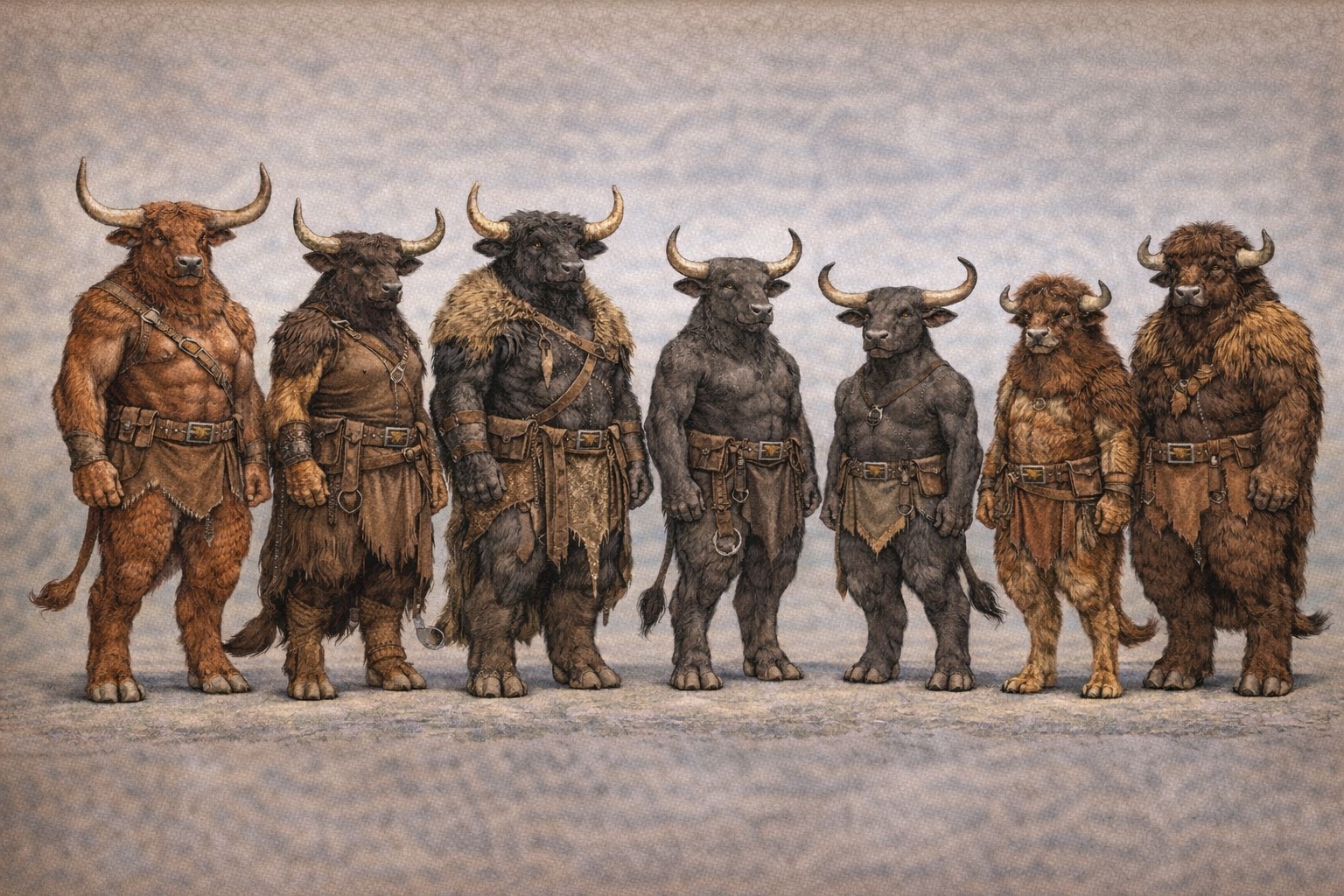
Taurik
Core Identity
Pronunciation: TAU-rick
Singular/Plural: Taurik (singular and plural identical)
Demonym: Taurik
Classification: Beastfolk, Bovine
Also called: Bull-folk, Horn-kin, Labyrinth-keepers (ceremonial/honorific, used in some Irna contexts)
The Taurik are bovine beastfolk shaped by a mage who carried with them a particular tragedy: the myth of a being placed inside a maze it did not build, given a nature it did not choose, and asked to become a monster by everyone who entered. The mage who designed the Taurik was captivated not by the hero who slew the labyrinth's occupant but by the occupant himself. The Taurik are the inheritors of that sympathy: a people whose naming tradition encodes the specific weight of enduring what was placed upon you with patience and without bitterness, or with bitterness, and enduring it anyway.
This does not make the Taurik tragic. It makes them, more than almost any other people on Dort, deeply deliberate about what they build, where they stand, and what they will not be moved from.
Overview
The Taurik are among the largest people on Dort: tall, massively built, and characterized above all by their horns, which no other people possess in the same structural form. They are physically formidable in ways that have shaped every chapter of their history, from the earliest territorial conflicts to the long architectural tradition that represents their most enduring civilizational contribution.
What the Taurik are known for, among those who have spent time among them rather than merely heard about them, is patience. The specific, absolute patience of something that has stood in the same place through several generations of shorter-lived peoples' urgencies. Taurik communities do not rush. Their decision-making processes are famously slow by the standards of most peoples and famously reliable in their outcomes. A Taurik compact, once made, is considered as close to permanent as anything on Dort that is not carved in stone, and most Taurik compacts are, in fact, carved in stone.
They are builders. They are defenders. They are, in the quiet spaces between those roles, philosophers of endurance.
Physical Traits
Taurik are the largest of the beastfolk peoples, with all four lineages substantially larger than most other beastfolk and larger than all non-giant folk on Dort. All Taurik share:
- Horns. Every Taurik has horns emerging from the skull behind and above the brow. Horn shape, size, and curvature vary significantly by lineage (from the wide spreading curve of Bull-kin to the compact upswept horn of Bison-kin), but all are genuine bone-core keratin-sheathed structures, permanent (not shed), and structurally significant. Horns continue growing slowly throughout life; elder Taurik horns are notably more massive than younger individuals'. Horns are not weapons in any Taurik cultural framing, though they are structurally capable of serious force; they are markers of identity and lineage.
- Hooved feet. Taurik have hooved rather than clawed or pawed feet, split-hooved, bovine-style. This means they move with a characteristic sound on hard surfaces and are poorly suited to climbing, but are extremely well-suited to sustained travel on flat ground. Hooved feet are a practical concern in mixed urban environments: Taurik-accessible buildings require adequate floor-load engineering and hooved-appropriate ground surfaces in some contexts.
- Tail. A bovine-style tail (long, rope-like, with a tuft at the end) used primarily for insect management. The tail moves with mood and is a minor but readable emotional indicator.
- Ruminant digestion. Taurik can extract nutrition from very coarse plant material that would be useless to most other peoples. They can survive on plant matter that most herbivores cannot process efficiently. This gave early Taurik communities extreme resilience in difficult territory and shapes Taurik cuisine traditions.
- Shoulder and neck musculature. Taurik have disproportionate forward-drive muscle mass; the shoulder and neck are significantly more powerful than the equivalent musculature of most other large beings. Taurik are exceptionally strong in pushing, bracing, and forward motion. They are not especially agile.
- Size. All Taurik lineages are substantial. Height ranges from 7'0" to 8'6" depending on lineage and individual. Mass is correspondingly large. Taurik-appropriate furniture, doorways, and ceilings are a practical concern in mixed communities.
Biology
Horns as living tissue. Taurik horns are bone-core structures covered in continuously growing keratinous sheath. The sheath grows throughout life, adding layers that record something of the individual's lifetime in their texture; elder horns have a layered, weathered quality distinct from young individuals' smooth horn. Horns cannot regenerate if broken at the core; surface sheath damage heals. Horn care (cleaning, conditioning the sheath, checking for structural damage) is a personal hygiene practice treated with the same normalcy as dental care in other peoples.
Ruminant digestion. Taurik are ruminants; they have multi-chambered digestion that processes plant material through a cud-chewing cycle. This is a private biological function managed discretely; Taurik do not cud-chew in formal company and consider it impolite to reference in mixed social settings. The practical implications are significant: Taurik can survive on plant material unavailable to most peoples, have high daily caloric intake requirements (their bulk requires substantial fuel), and digest slowly enough that they are rarely in a hurry to eat.
Lifespan: 120–160 years, with slow maturation. Taurik are not considered adult until approximately age 22–25. Full elder status, recognized with particular social weight in Taurik communities, comes only after about age 80. The very long adult period and the high regard for elders shapes Taurik cultural values around patience and the long view.
Temperature tolerance. Taurik are warm-blooded with good thermal regulation and broader temperature tolerance than Serathi. Highland-kin and Bison-kin are notably cold-tolerant; Plain-kin and Bull-kin are better adapted to heat. All lineages prefer moderate temperatures for extended physical work.
Reproduction. Single births are the norm; twins are rare and considered auspicious. Gestation approximately 14 months. Calves are large at birth and mobile within weeks. The bonding period in early childhood is intensive; the first three years are considered the most formative in Taurik development, with the relationship between calf and primary caregiver carrying cultural significance it maintains for life.
Psychology and Culture
The core of Taurik psychology is the philosophical tradition they call Thrakhon, "the holding." The holding is not passive. It is the active choice to remain: in a position, in a commitment, in a truth, in a piece of land. Where other peoples may experience staying as the default and leaving as the active choice, Taurik experience it inverted; staying is a continuous act of will. You choose, every day, to continue holding.
This produces a people with extraordinary resistance to being moved (physically, politically, or philosophically) and a deep cultural suspicion of urgency. When someone is rushing a Taurik, the instinctive response is to slow down further. Not out of stubbornness, though it can present that way. The Taurik reasoning is: urgency is what other people want to impose on you. The holding means deciding for yourself when to move.
The labyrinth as home. The foundational myth that the mage built into the Taurik naming tradition, a being placed in a labyrinth it did not build, has been interpreted and reinterpreted across centuries. The most widely held Taurik reading is not tragic but architectural: the labyrinth is yours. You did not ask for it, but it is yours. You know every passage. Nothing that enters can navigate it the way you can. The question is not how to escape it but what to do with it. Most Taurik philosophers arrive at the same answer: build more of it, carefully, and know every stone.
The Compact and the Wall. Taurik social agreements are called compacts and are treated with extreme formality. A compact is always written, always witnessed, and always (by tradition) carved into stone at its conclusion. The stone-carving is not symbolic; it is practical: Taurik expect their agreements to outlast the people who made them. Their inter-community relations are maintained through a dense web of carved-stone compacts, the oldest of which are centuries old and still technically binding.
Building culture. The Taurik architectural tradition is the most substantial physical legacy of any beastfolk people on Dort. Taurik-built structures are distinctive for their scale (doorways built for 8-foot beings, ceiling heights to match), their material (dressed stone preferred, mortar-optional; many elder Taurik structures are dry-stone), and their longevity (Taurik builders build to last centuries). Where Taurik communities have been established for multiple generations, the built environment reflects it absolutely. Taurik bridges, walls, and foundations are often the oldest surviving infrastructure in a region.
Horn customs. While horns carry no explicit symbolic system, there are strong informal associations: the angle and curve of a horn can suggest lineage background to experienced observers, and elders' larger horns carry inherent social weight. Direct touching of another Taurik's horns is an intimate gesture, generally reserved for family and close bond-partners. Among non-Taurik peoples, touching a Taurik's horns without invitation is considered a significant social violation. Most Taurik extend significant patience to peoples who do not know this but expect it to be corrected once known.
Geographic Distribution
Taurik communities are found on every continent but are least common where conditions make large-scale construction impractical (dense jungle, extreme cold) and most common where they have had generations to build.
- Bull-kin are the most widely distributed lineage, with significant presence in Irna and the temperate zones of Funta. They are the Taurik most often encountered in mixed urban settings.
- Highland-kin cluster in the mountain ranges of northern Irna and the highland zones of Shoing. Their cold tolerance makes them the most present Taurik lineage in cold regions.
- Plain-kin are concentrated in Funta's river lowlands and the warm wetland zones of Antaea's coasts. They are the largest population group by raw numbers.
- Bison-kin range across the northern interior of Irna and into the highland plateaus. They are the least common Taurik lineage in mixed urban settings; their preference for open territory makes dense city living an uncomfortable compromise.
History
The Astermon Myth. The founding figure of Taurik mythology (Astermon, "the starlit one") is a being who did not ask to be what he was, who was placed where he was placed, and who became in his solitude more knowledgeable of his space than any being who entered it. The myth's resonance is not in Astermon's death (which the myth includes but does not treat as its ending point) but in his knowledge: he knew his labyrinth completely. No one who came in knew it at all. That asymmetry of knowledge, in Taurik philosophy, is the definition of home.
The myth is not universally interpreted as triumph. There is a significant Taurik philosophical tradition (the Khremon school, named for an early philosopher) that reads the Astermon myth as a genuine critique: Astermon was wronged, the labyrinth was a prison regardless of how he came to know it, and the job of Taurik people is to build labyrinths that are actually homes, not prisons that merely become familiar. The Khremon school and the dominant Thrakhon school have argued this distinction for centuries without resolution, which most Taurik philosophers consider appropriate.
The Compact of the Standing Wall (~17 centuries ago). The oldest surviving written Taurik compact, a stone-carved agreement between four Bull-kin herd-territories in central Irna, established the first formal Taurik territorial boundary system. Before the Compact, territorial disputes between Taurik herds were resolved through direct confrontation, which typically produced decisive outcomes but significant loss. The Compact established the principle of the negotiated wall: territorial boundaries are agreed in advance, carved in stone, and honored on both sides. The principle spread across Taurik communities over the following centuries and is now foundational to Taurik inter-community law.
The Great Burning (~13 centuries ago). A period of sustained conflict between Taurik communities and expanding short-lived peoples' empires in Irna. Several major Taurik-built settlements were destroyed; Taurik communities were expelled from territory they had held for generations. The Great Burning is the historical event most referenced in Taurik philosophical and political discourse, not because of what was done to them, but because of what it revealed about the limits of the Thrakhon philosophy: standing your ground is not sufficient if what stands against you has more numbers and less concern for the cost. The Compact tradition was partly reshaped in response: post-Burning Taurik compacts were more likely to specify enforcement mechanisms.
The Road Decades (~10 centuries ago). A multi-generational period of Taurik infrastructure contribution across Irna: the construction of the major road network that connected highland and lowland communities across central Irna was accomplished primarily through Taurik building labor and engineering. The Road Decades established Taurik infrastructure guilds as a distinct institution and gave the Taurik a non-territorial presence in mixed civilization: the builders who make roads between other peoples' cities have a relationship with those cities even when they do not live in them. The roads built during the Road Decades, or rebuilt on their foundations, are still in use.
The Horn Wars (~7 centuries ago). A series of conflicts between Bison-kin highland communities and Irna lowland empires over grazing and mining rights in the northern plateau. The Horn Wars were formally concluded by the Compact of the Open Plateau, one of the few Taurik compacts in which non-Taurik parties are co-signatories. The Compact of the Open Plateau is still considered binding by Taurik communities and has been invoked in political disputes as recently as two centuries ago.
The Urban Entry (~5 centuries ago). The large-scale integration of Taurik communities into major mixed-population cities. This was not smooth. Taurik-appropriate architecture required modification of existing buildings; hooved floors, adequate ceiling heights, and the physical presence of large beings in dense urban spaces created both practical challenges and social friction. The period produced extensive Taurik architectural modification of urban infrastructure and the formation of the first specifically urban Taurik guild-councils to negotiate building rights, zoning, and herd-territory within city limits.
Language
Spoken language: Thrakhis ("labyrinth-tongue"). Thrakhis is a formal, weighted language; the phonological character of Ancient Greek is present in every aspect: the measured endings, the classical gravity, the sense that every word has been considered before being spoken. Thrakhis is not a fast language and it is not designed for small talk. It is built for declaration and compact: the language is excellent at stating positions, defining terms, and recording agreements. It is less well suited to ambiguity, which most Taurik consider a feature rather than a limitation.
Thrakhis has a formal register and a working register. The formal register (used for compacts, legal proceedings, philosophical discourse, and ceremonial occasions) is almost a different language in structure: longer compound words, stricter word-order, expanded case markers. The working register is more fluid and is what Taurik use in daily life.
Written script: Wallmarks. Taurik writing is stone-writing; the Wallmarks script was developed from origin for carving into stone with hammer and chisel. Characters are angular, deep-cut, and designed to be legible at a distance and durable across centuries. Wallmarks are the most physically large standard script on Dort: a properly carved Wallmarks text uses character sizes that can be read by someone standing ten feet away. This is practical rather than aesthetic; the primary function of Taurik writing has always been to mark territory, record compacts, and document decisions in forms that will survive both the writers and their descendants.
A secondary inscription tradition, Smallmarks, uses finer tools and more compact characters for documents, personal correspondence, and internal records. Smallmarks are fully legible to Wallmarks readers but are not considered formal.
Naming tradition. Taurik names draw from the phonological tradition of the mage who shaped them: Ancient Greek in character, formal and weighted, with the specific quality of something that could appear in a classical footnote. Names typically feature opening consonant clusters (Thr-, Ast-, Bront-, Str-) and classical endings (-os, -on, -es, -emon). Taurik carry a given name and a lineage name: the line from a founding figure, named with the Greek clan-suffix tradition.
Example given names: Asteron, Thrakon, Brontios, Khremon, Mykron, Stremas, Eurymon, Menias, Arktemon, Themon
Example lineage names: Astermonides, Thrakhonion, Khremonaion, Brontiadai, Mykronides
Naming Conventions
Naming Agent Cross-Reference
See _Cannon/Race naming ai agents/beastfolk/Beastfolk - Bovine.md for full naming rules and generation guidance.
Personal Name Structure
Taurik carry a given name and a lineage name: the line from a founding figure, named with the Greek clan-suffix tradition. Both are drawn from Thrakhis phonology: formal and weighted, with opening consonant clusters (Thr-, Ast-, Bront-, Str-) and classical endings. Formal address uses both names; the given name alone is standard among those who know each other.
Sex and Name Form
Sex is marked in the ending, systematically and unambiguously, which suits a language canon describes as "built for declaration and compact." The masculine endings -os, -on, -es, -is, -ias, -emon and -or contrast with the feminine -a, -e, -eia, -o and -ione, and the feminine is generative: any masculine name can be feminized by exchanging its ending, so Asteron becomes Asteria and Brontios becomes Bronte.
Long vowels, the eta and omega endings, add formality and elder weight in both sexes rather than marking sex themselves. Opening clusters are sex-neutral: a Taurik woman named Thrakia or Brontione opens her name exactly as a man would, and softening a woman's name by dropping its cluster is an error.
Lineage names do not inflect. The Greek clan-suffix marks descent, not the descendant; every child of the Asteron line carries Astermonides regardless of sex.
Name Examples
- Given names: Asteron, Thrakon, Brontios, Khremon, Mykron, Stremas, Eurymon, Menias, Arktemon, Themon
- Given names (feminine forms): Asteria, Bronte, Thrakia, Mykreia, Khremona, Streme, Menoeia, Eurymeia
- Lineage names: Astermonides, Thrakhonion, Khremonaion, Brontiadai, Mykronides
- Full name examples: Asteron Astermonides; Bronte Brontiadai; Khremon Khremonaion; Mykreia Mykronides
Society
Herds. The basic Taurik social unit is the herd: 20 to 80 members, typically of mixed lineages in urban settings and more lineage-uniform in rural communities. The herd holds territory collectively and makes collective decisions. The herd's decision-making authority rests with the Grey-Brow: the elder council, named for the characteristic lightening of the brow coat that comes with age. The Grey-Brow is not a single leader but a council of recognized elders; decisions require consensus.
Compact culture. Every significant herd agreement (with other herds, with non-Taurik peoples, about territory, about building rights, about resource sharing) results in a carved-stone compact. A well-established Taurik herd-territory has walls covered in compacts. The oldest compacts receive the most physical care: they are re-incised when weathering threatens legibility. The compact archives of major Taurik communities are among the oldest continuously maintained legal records on Dort.
Infrastructure guilds. The Taurik building tradition is organized through professional guilds: the Thrakhon-builders, who specialize in stone walls and permanent structures; the Stremas-guild, who specialize in roads and bridges; the Khremon-architects, who specialize in interior space design (the irony of the Khremon name applied to architecture is noted and embraced). Guild membership is open to all Taurik regardless of lineage. Guild mastery takes decades to achieve and carries significant social prestige.
The long wait. Taurik governance is slow. Deliberate, patient, and thorough, but slow. A Grey-Brow council considering a major new compact may take months. Decisions that affect inter-herd relations may take years. Taurik do not apologize for this pace; they point to the track record of their compacts, most of which outlast the urgencies that other peoples wanted them to address more quickly.
Interactions with Other Peoples
Borun. The relationship between Taurik and Borun is one of mutual recognition across two peoples who share a cultural commitment to territory and deliberation. Both build, both compact, both move slowly on purpose. The Borun Grove-system and the Taurik Herd-compact system have interfaced successfully in mixed regions for centuries. Taurik build walls; Borun manage the forest beyond them. The arrangement works because neither people is in a hurry and both keep their agreements.
Serathi. Taurik and Serathi are the two longest-lived non-Draconic peoples on Dort, and they know it about each other. There is a specific mutual recognition between a people whose knowledge is recorded in stone and a people whose knowledge is preserved through patient scholarly tradition; both are concerned, in their own ways, with making sure the past is not lost. The Serathi River Compact and Taurik Compact of the Standing Wall are roughly contemporary, and Serathi-Taurik joint historical scholarship is a real if small tradition.
Shorter-lived peoples (general). The Taurik relationship with shorter-lived peoples is complicated by scale in both the literal and metaphorical sense. Literally: Taurik bodies require architectural accommodation that most short-lived peoples' buildings don't provide. Metaphorically: Taurik decision-making pace is incompatible with some shorter-lived peoples' planning horizons. A people who make fifty-year decisions in communities where most adults live thirty years find the Taurik compact process maddening. The Taurik response to this is patient and not always sympathetic: "your urgency is not my emergency" is a Thrakhis expression with no clean translation, but its meaning is understood.
Lapori. One of the more productive unlikely relationships on Dort. Lapori process faster than any other people; Taurik process slower than most. Both communities have learned, in mixed urban settings, that this creates a useful complementarity: Lapori networks provide rapid information flow that Taurik institutions lack, and Taurik institutions provide lasting structural stability that Lapori warrens occasionally need. The relationship works best in cities where both have been present for generations.
Biological Lineages
The Taurik encompass four biological lineages, each tracing to a distinct bovine ancestor-type. All lineages are Taurik; all carry the foundational horn-bearing biology; all hold the Thrakhon philosophical tradition. The differences between lineages are biological and environmental in emphasis.
Bull-kin
Aurochs / horned bull type. The most widely known Taurik lineage.
Physical character. Bull-kin are the "standard" Taurik body plan that most peoples encounter first. Their most distinctive feature is their horns: wide-spreading, dramatically curved, with the broadest arc of any lineage. The tips of an adult Bull-kin's horns may be five or six feet apart at full span. The horns sweep outward and slightly upward. Coloring is widely variable across individuals: brown, black, red-brown, grey, and their blends. No consistent pattern; individuals are recognizable individually. Adults range from 7'4" to 8'2".
Cultural character. Bull-kin are the most represented Taurik lineage in mixed urban settings and in formal diplomatic and compact contexts. They are the lineage most often taken as representative of all Taurik by peoples who have not met the others. Their wide horn-spread makes them the most physically distinctive in confined spaces; Bull-kin navigating a human-scaled doorway is a common experience that neither party finds comfortable, and it has given Bull-kin a specific expertise in negotiating architectural accommodation in mixed cities.
Highland-kin
Yak / highland cattle type. Cold-adapted, heavily coated, the most stoic Taurik lineage.
Physical character. Highland-kin are distinguished by their coat: a dense, shaggy double-layer covering the body from shoulder to ankle, significantly longer and heavier than other Taurik lineages. In cold months, the outer coat grows dramatically; in warm months, they shed the outer layer and run noticeably leaner. Horns are robust but less dramatically wide than Bull-kin, a more compact, upswept curve that sits closer to the head. Coloring tends toward the darker range: black, dark brown, occasionally a deep rust. Adults range from 7'0" to 7'10".
Cultural character. Highland-kin communities in mountain territories are among the most isolated Taurik settlements, not by preference but by geography. Extended isolation has given Highland-kin communities a cultural depth and an internal philosophical development that lowland Taurik sometimes find startling when they encounter it. The Khremon philosophical school originated in a Highland-kin community and was carried down to lowland debate contexts by scholars. Highland-kin are, by Taurik standards, the most contemplative lineage.
Plain-kin
Water buffalo / zebu type. Heat-adapted, water-comfortable, the most numerous lineage.
Physical character. Plain-kin are the broadest of the lineages without being the tallest: wide through the chest and shoulders, lower center of gravity, the widest feet of any Taurik lineage (a functional adaptation for soft ground). Their horns sweep backward and outward in a wide arc, with less vertical rise than Bull-kin. They are the most comfortable Taurik lineage in water; Plain-kin can ford rivers and swim with a competence the other lineages lack. Coat is short, smooth, and dark: charcoal, deep brown, with occasional grey. Adults range from 7'2" to 8'0".
Cultural character. Plain-kin are the most populous Taurik lineage and the one with the longest continuous presence in Funta's river lowlands. The major Taurik infrastructure guilds in Funta are predominantly Plain-kin. Their building tradition has adapted to lowland conditions: where Highland-kin build with mountain stone, Plain-kin developed fired-brick techniques that allow substantial construction in regions without local stone supply. The fired-brick tradition is now used by all Taurik lineages but traces specifically to Plain-kin engineering.
Bison-kin
Bison / aurochs-heavy type. Heaviest overall build, prominent shoulder hump, shortest horns relative to body.
Physical character. Bison-kin are the most massive Taurik lineage in terms of total body weight; the pronounced shoulder hump is an adaptation for forward-drive power, a large muscle mass that gives Bison-kin an extraordinary ability to apply sustained force in a forward direction. Their horns are the smallest relative to body size of any lineage, short, upswept curves that sit close to the head. Coat is dense, shaggy around the head and shoulders, shorter over the hindquarters, creating the characteristic heavy-fronted profile. Coloring is brown to dark brown. Adults range from 7'6" to 8'6", with mass significantly exceeding other lineages at equivalent height.
Cultural character. Bison-kin are the most land-committed Taurik lineage; their preference for open territory with clear sight-lines in every direction makes dense urban living particularly uncomfortable. The largest Bison-kin populations are in the northern interior of Irna, where their cold tolerance and comfort with open territory align with the landscape. Bison-kin are overrepresented in Taurik infrastructure roles that involve large-scale earthworks: road grading, foundation excavation, wall construction requiring sustained heavy physical work. The Taurik saying "send the Bison-kin first" is not a statement about expendability but about who is best suited to the part of building that requires moving the most earth.
Development Notes
On scale. Taurik are large. This should have practical narrative implications: doors, ceilings, furniture, horses (no standard horse carries a Taurik easily), and the social experience of being the largest person in most rooms. Neither play this for comedy nor ignore it; it is part of how Taurik experience the world.
On patience as an active philosophy. The Thrakhon "holding" is not passivity. A Taurik who refuses to be rushed is not refusing to act; they are refusing to act on someone else's timeline. This distinction matters for how Taurik characters behave in fast-moving situations: they may move decisively, but they will not move before they have assessed. They may choose not to explain why.
On the Astermon myth. This is available as active philosophical terrain; Taurik characters may hold Thrakhon or Khremon interpretations, and this will affect how they approach constraint, endurance, and what constitutes a home versus a prison. Neither position is the "right" Taurik view; the debate is the tradition.
On the compacts. Every significant Taurik relationship with other peoples is, in their cultural framework, a compact, an agreement with parties and terms. Taurik who encounter commitments made verbally and then not honored are not surprised but are genuinely aggrieved. "Where is the stone?" is a direct Thrakhis expression for asking where a commitment is recorded.