Vaelhari
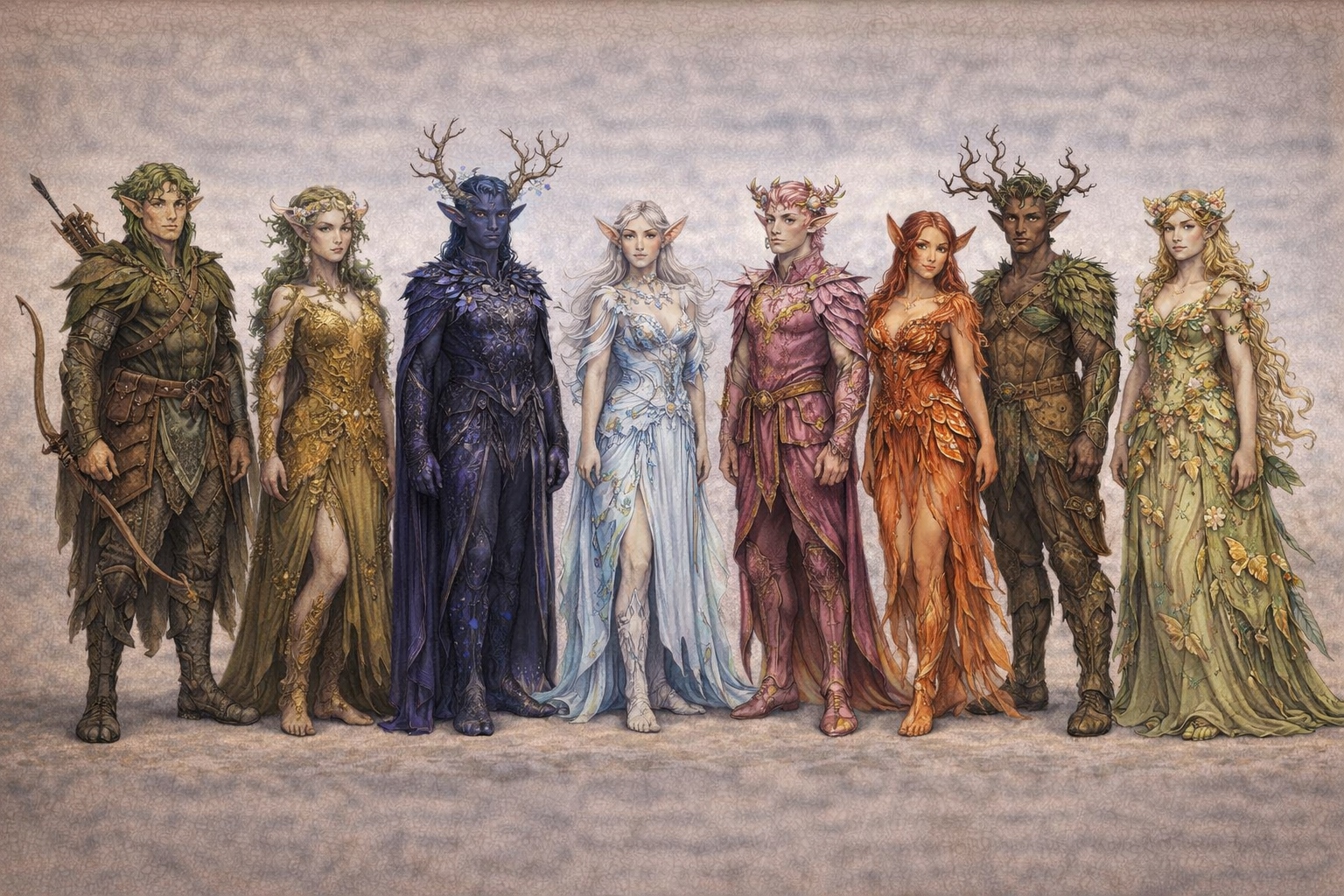
Vaelhari
"It takes a moment to understand what you are seeing. The woman at the far end of the hall looks exactly as she did this morning: same height, same bearing, same face. But the light around her is different. Not the room's light. Hers. You realize you have been watching her shift for the past hour and could not name when it began."
from the personal correspondence of a diplomat stationed in Vel Carath, [Irna](Irna/Welcome to Irna)
CORE IDENTITY
- Race Name: Vaelhari
- Plural Name: Vaelhari
- Adjective Form: Vaelhari (unchanged); occasionally Vaelharin in formal scholarly contexts
- Alternate Names: The Sky-Tethered; the Wanderer-Kin; the Phase-Walkers (a common [Irna](Irna/Welcome to Irna) colloquialism, not considered offensive)
- Self-Name (Endonym): Thariel, meaning approximately "children of the Third Light" in Vaelith, referencing Vaeltharis, the wandering planet their biology is tied to
- Outsider Names (Exonyms): False Elves (historically used by the Zealots of Pasha and their descendants in parts of [Funta](Funta/Welcome to Funta); considered a slur); Moonwalkers (archaic, poetic, used in some [Antaea](Antaea/Welcome to Antaea) literature); the Threefold (used occasionally in [Shoing](Shoing/Welcome to Shoing))
OVERVIEW
Short Description
The Vaelhari are a long-lived, innately magical people whose inner life and outer form are governed not by season but by the position of Vaeltharis, a pale wandering planet visible in Dort's sky three times each year. As this celestial body rises, descends, and vanishes, the Vaelhari shift with it: in thought, in temperament, and in the physical substance of their skin and presence. They are among the oldest peoples known, originating not from Dort itself but from the Deep Arcana (the inhabited inner regions of the Arcane Plane), and they carry that origin in their blood in ways that are neither metaphorical nor subtle. Small in number, scattered across continents by history, and still hunted in parts of the world, the Vaelhari endure with the particular resilience of those who have learned that survival and belonging are not the same thing.
General Reputation
To most of Dort, the Vaelhari are a curiosity that becomes something more unsettling the closer you get. At a distance (in rumor, in travelers' tales, in the margins of history books) they are beautiful and strange and clearly not quite like anyone else. Up close, the phase shifts are viscerally real: the skin changes, the eyes change, the quality of presence in a room changes. People who have never met a Vaelhari tend to romanticize them. People who have met one during a Low Ember period tend not to. In [Irna](Irna/Welcome to Irna), where the largest population lives and has lived for centuries, they are reasonably well understood and functionally integrated, with the usual undercurrent of unease that attends a people who are older than most institutions and clearly not entirely of this world. In [Funta](Funta/Welcome to Funta), the reputation ranges from wariness to active hostility; in [Antaea](Antaea/Welcome to Antaea), the complicated weight of history sits uneasily on every interaction.
Role in the World
The Vaelhari occupy the role of the diaspora scholar-mystic: never numerous enough to be a political force, always present enough to be culturally significant. Their innate relationship with arcane practice, their access to knowledge preserved across centuries of personal memory, and their position as observers who have watched empires rise and fall from the margins have made them sought-after advisors, chroniclers, and practitioners wherever they are tolerated. Where they are not tolerated, they survive. They have not built empires. They have outlasted several.
PHYSICAL TRAITS
General Appearance
The Vaelhari read immediately as elf-adjacent: tall, lean, with the long limbs, pronounced cheekbones, and pointed ears that mark the elven family. The resemblance is real and the relationship is genuine, though the question of which people preceded which has generated more academic bitterness than it deserves. Where the Vaelhari diverge from the elven baseline is in what their bodies do over time and circumstance. A Vaelhari standing still in a neutral phase looks like a particularly striking elf. A Vaelhari in active transition looks like something else entirely, something that has never been quite fully present in this world, which is, in one sense, accurate.
Size Ranges
- Typical height: 180 to 210 centimeters; taller than most elves on average, though individual range varies
- Typical weight/build: Lean throughout; muscle is present but does not bulk in the manner of heavier-built peoples; the impression is of someone built for distance rather than force
Distinguishing Features
The pointed ears are present and pronounced. The phase shifts are the definitive identifier; no other people changes the way Vaelhari do.
In High Crown, when Vaeltharis stands near zenith, the skin becomes cooler to the touch and takes on a slightly glassy quality, as though the surface has thinned. Hair lightens toward silver or pale gold. The eyes achieve a crystalline clarity, the iris appearing almost faceted. Veins may be faintly visible at the temples. The overall impression is of someone lit from within by something cold and far away.
In Low Ember, when Vaeltharis hangs low near the horizon, the skin warms visibly and physically, becoming genuinely hotter to the touch and taking on a rougher, almost granular texture at the forearms and neck. Hair deepens in tone toward amber or dark copper. The eyes become vivid, the color saturating. Movement grows more deliberate and weighted, as though the body is more fully present in the room than it was an hour ago.
In The Veiled Turn, when Vaeltharis disappears from the sky, the skin cools again but differently: not the crystalline quality of High Crown but a dimness, a quality of absorbing light rather than reflecting it. Features settle inward. The voice softens. Some Vaelhari's hair takes on blue-dark undertones during this phase. The eyes become harder to read, the focus directed somewhere slightly behind the visible world.
Between phases, during the transition hours, the shifts are visible in real time if you know to look: a warmth moving through the hands, a shifting in the light around the face, the skin tone migrating between states as though water is being poured from one vessel into another.
Aging Patterns
Vaelhari children are physically indistinguishable from elven children until puberty: pointed ears, the lean build beginning to establish itself, but no phase manifestation. Somewhere in early adolescence, the First Turning arrives, and it arrives without warning or grace. Phase shifts begin occurring on their own schedule, uncoupled from Vaeltharis's actual position, triggered by stress, grief, awe, proximity to other Vaelhari, or nothing visible at all. A young Vaelhari may wake High-Crowned and be fully Low Ember by midday. This period, called the Unmoored Years, lasts between seven and twelve years on average, occasionally longer, and it is considered both the most dangerous and the most formative period of a Vaelhari life.
True adulthood is considered established when the cycle locks to Vaeltharis's actual position: when the Vaelhari's phases begin following the wandering planet rather than running loose. This settlement takes work; it is not automatic. Vaelhari who are isolated during the Unmoored Years, without elders to model the discipline of attunement, sometimes fail to lock fully and spend decades in partial phase-drift. By middle age, phase transitions are smooth, predictable, and personally understood in the way that experienced practitioners understand the behavior of their own craft.
Visible aging in the Vaelhari is subtle. The features become more defined with age, not softer. Ancient individuals have a quality of resolution, as though the phases, having cycled thousands of times, have carved everything unnecessary away. The oldest Vaelhari do not look frail. They look finished.
Regional Variation
The Vaelhari's phase-based changes are universal across populations and do not vary by continent; biology tied to a celestial body is not reshaped by geography. What varies between populations is the baseline coloration between phases and the intensity of the shift; Vaelhari who have lived in [Irna](Irna/Welcome to Irna) for many generations tend toward cooler base tones, with the phase shifts expressed against that cooler baseline, while the small population in [Shoing](Shoing/Welcome to Shoing) shows somewhat warmer resting-state coloration. These are subtle differences of the kind that only register in direct comparison.
BIOLOGY
Diet
The Vaelhari are omnivorous with no significant dietary restrictions unique to the race. There is some evidence that they process certain foods more efficiently during specific phases (Low Ember periods are associated with greater appetite and more efficient caloric use; Veiled Turn periods are sometimes associated with reduced appetite and a preference for lighter foods), but these tendencies are biological rather than absolute, and cultural tradition varies considerably in how strictly they are observed.
Reproduction Basics
Gestation is approximately eighteen months, notably longer than the humanoid baseline. Vaelhari children are born singly; twins are rare enough to carry some cultural significance in most communities. Both parents are typically involved in early childcare, and the community is expected to expand that circle when the Unmoored Years begin. The extended family or community unit, rather than the household alone, is considered the appropriate scale for raising a child through the First Turning.
Lifespan Ranges
- Typical lifespan: In the Deep Arcana, Vaelhari have been known to live for over a thousand years; in the Prime, where they are not in their native plane, the lifespan is roughly half that: four to six centuries in practice, occasionally more
- Maturity: Physical maturity around thirty years; functional adulthood in the Vaelhari sense (phase-locked, emotionally self-governing) typically closer to forty to sixty, sometimes later
- Elderhood: From the third or fourth century onward; elders who have lived through eight or nine centuries of Prime-world history are rare but not unprecedented
The shortened lifespan outside Arcana is not considered a medical condition or a disease; it is simply the cost of existing in a world that is not the one they were made for. Vaelhari do not grieve it publicly, but it sits at the center of their understanding of themselves: they are long-lived, and they are still dying sooner than they should.
Environmental Adaptations
The Vaelhari have no specific environmental advantages or vulnerabilities. Their origins in Arcana did not equip them for any particular physical environment, and four centuries of scattered diaspora existence have produced no consistent regional adaptation. They are not cold-resistant, not heat-tolerant, not gifted with unusual endurance. What they carry is internal: the arcane constitution that in Arcana was ordinary, and in the Prime is extraordinary.
PSYCHOLOGY & CULTURE
Typical Temperament
The Vaelhari are not one thing. The phase cycle means that the person you meet in High Crown (precise, elevated, emotionally cooled, a little remote) is genuinely different in texture from the same person in Low Ember, who burns hotter, reacts faster, and fills more of the room. Those who interact with Vaelhari regularly learn to read the current phase, and those who never do may form entirely opposite impressions of the same individual. The baseline between phases tends toward patience, attentiveness, and a watchfulness that comes from knowing you have outlived most of what you observe. Whether this reads as calm or as unsettling depends on the observer.
Cultural Values
-
The Attunement: The principle that one's inner life should align with Vaeltharis's position rather than resist it, that the phases are not problems to be managed but truths to be inhabited. This is the central discipline of Vaelhari adulthood, and failures of attunement are the primary framework through which personal dysfunction is understood. A Vaelhari who is "drifting" (whose phases no longer track the planet, or who suppresses the shifts) is considered genuinely unwell, not merely emotionally irregular.
-
The Witness: Long life creates the obligation to remember. Vaelhari culture places high value on being accurate witnesses to their own history, individual and collective, and on the transmission of that memory to younger generations. The cultural expectation is not that elders lecture but that they are available: that the young can ask, and the old will answer truthfully.
-
Gender Equality: Vaelhari society maintains no formal distinction between the social, civic, or spiritual roles available to individuals on the basis of sex. This is not a political position for them; it is simply the arrangement that has always existed. The friction this creates in certain parts of Dort is, from the Vaelhari perspective, a feature of those places, not a problem with themselves.
-
Equal Magic: Related to the above: magical practice among the Vaelhari is neither restricted nor stratified. Any Vaelhari who has the capacity, which is virtually all of them, may practice without limitation. There are no practitioners' orders, no licensing bodies, no formal structures of arcane authority. This occasionally distresses the scholarly institutions of other races considerably.
Taboos
-
Suppressing the Turn: Artificially preventing the phase shift through alchemical or arcane means is deeply taboo. The phase is self; suppressing it is considered a form of self-erasure. Practitioners who have lost their phases through Qualin's extraction are not shamed; those who choose suppression are a different matter, though this distinction is sometimes difficult to explain to outsiders.
-
Speaking the True Name: A Vaelhari's true name, the full Vaelith name spoken in its complete form by anyone other than the Vaelhari themselves, is a violation of the deepest kind. The known name is offered freely and is socially the entirety of the name in common use. The true name is personal, private, and not to be spoken by others under any circumstances.
-
Breaking Silence During the Veiled Turn: Not universal, but widespread: speaking unnecessarily during the Veiled Turn's deepest days is considered poor form. The culture around the Veiled Turn tends toward quiet and inward presence. Outsiders who do not know this tradition have caused significant offense without understanding why.
Social Structures
Vaelhari communities are small by the standards of any other people (their population has never recovered to pre-Betrayal levels) and tend to organize around elder households with extended kin networks. In [Irna](Irna/Welcome to Irna), where the largest communities exist, several families may cluster around a shared sky-watching tower, which serves as both a practical observation post for tracking Vaeltharis and as a civic and spiritual center. Leadership sits with those whose attunement is most precise and whose memories are longest, though this is understood as a function of demonstrated wisdom rather than formal authority.
Family Structure
Marriages are understood to be long-term partnerships rather than permanent metaphysical bindings, given the century-scale of Vaelhari lifespans. The tradition of considering phase compatibility in pairing is well established and widely practiced. Two High-Crowned individuals may find long partnership emotionally distant; two Low Ember pairs may burn through each other. The most admired pairings are those with complementary phase relationships: not so different that there is no common ground, but not so identical that neither person provides a different perspective. Elders often informally advise younger Vaelhari on compatibility, though the advice is not binding. Raising children is considered a community responsibility, especially during the Unmoored Years.
Leadership Patterns
Leadership in Vaelhari communities emerges from demonstrated attunement (phase-discipline, historical knowledge, and the respect of younger community members) rather than from formal election or bloodline inheritance. The eldest are listened to, but age alone confers nothing; an elder in drift, whose phases have become unstable or who cannot accurately witness their own past, loses standing regardless of years. There are no hereditary positions and no formal hierarchy above the community scale. Above that level, Vaelhari generally have no governing body; they make local decisions locally, and broader concerns are addressed through meeting and consensus.
GEOGRAPHIC DISTRIBUTION
Primary Homelands
-
[Irna](Irna/Welcome to Irna): The largest Vaelhari population on Dort. The continent's relative social tolerance, its tradition of cosmopolitan city-states, and the centuries of established community mean that the Vaelhari here are as settled as any diaspora people can be. Communities are concentrated in the interior highlands and in several cities where Vaelhari have lived long enough to be simply part of the furniture of the place. Sky-watching towers in these communities are old, multi-generational, and often architecturally significant. The relationship with the local population is far from simple (there are histories of friction, neighborhood tension, and moments of collective violence in the record), but the overall pattern is coexistence that has, over the generations, shaded toward integration in some places.
-
[Shoing](Shoing/Welcome to Shoing): The Vaelhari are present in [Shoing](Shoing/Welcome to Shoing) in modest numbers and live there with less friction than almost anywhere else, which they find slightly disconcerting. [Shoing](Shoing/Welcome to Shoing)'s general tolerance for the unusual, or perhaps its general preoccupation with other things, means that phase-shifting people who speak of a wandering planet and have their own relationship with magic are not the strangest thing in many [Shoing](Shoing/Welcome to Shoing) communities. Most Vaelhari in [Shoing](Shoing/Welcome to Shoing) acknowledge that they are comfortable there without ever quite deciding they belong there.
Secondary Populations
-
[Antaea](Antaea/Welcome to Antaea): The continent where the Vaelhari first arrived in Dort, and where the Elven Betrayal was centered, [Antaea](Antaea/Welcome to Antaea) has a complicated relationship with the Vaelhari that has not fully resolved in the centuries since. The population here is small and tends to cluster in communities with significant political cover, the protection of a notable lord or the anonymity of a large city. The unease is mutual: [Antaea](Antaea/Welcome to Antaea) Vaelhari are often the most politically aware of any regional population, and the most cautious.
-
[Jazirah](Jazirah/Welcome to Jazirah): Vaelhari presence in [Jazirah](Jazirah/Welcome to Jazirah) is sparse, and the cultural friction is specific and sustained. Vaelhari society's foundational principle of gender equality (of equal standing in civic, magical, and social life regardless of sex) does not sit easily with significant portions of [Jazirah](Jazirah/Welcome to Jazirah)'s social structure. Vaelhari women in [Jazirah](Jazirah/Welcome to Jazirah) do not accept the constraints their society would impose, and Vaelhari men do not accept those constraints on behalf of their companions. This has made settled community life in much of [Jazirah](Jazirah/Welcome to Jazirah) essentially untenable. Individual Vaelhari pass through, and a small number maintain very quiet lives in more cosmopolitan [Jazirah](Jazirah/Welcome to Jazirah) cities, but there are no established communities.
-
[Funta](Funta/Welcome to Funta): The Vaelhari are actively hunted in parts of [Funta](Funta/Welcome to Funta), and trace-level presence here is maintained by individuals moving carefully rather than by settled community. The mage Qualin, operating out of the city of LaHale, has made [Funta](Funta/Welcome to Funta) the most dangerous continent for any Vaelhari. Her process for extracting the magical essence she calls feyion, which requires a living Vaelhari and typically destroys what it extracts from, is an ongoing threat. Vaelhari who must pass through [Funta](Funta/Welcome to Funta) do so in concealment, or do not.
Migration Patterns
The first great migration was the voluntary exile from Arcana, tens of thousands arriving in [Antaea](Antaea/Welcome to Antaea) through a portal that no one has been able to reopen since the wizard who made it was killed. Over the following generations, smaller waves continued to arrive through that same portal until its source was destroyed. The second great migration, the Wanderlust, was forced: the aftermath of the Elven Betrayal scattered the Vaelhari from [Antaea](Antaea/Welcome to Antaea) to the far corners of Dort, with deliberate purpose. The decision to spread and not concentrate was made collectively, out of the understanding that a people gathered in one place could be targeted in one place. That dispersal is still the shape of the Vaelhari world. Communities that form now do so knowing that they are islands in a diaspora rather than a foothold toward some eventual reclamation.
Adaptations by Region
Vaelhari communities build sky-watching towers wherever they settle with any permanence; the design varies by local material and architectural tradition, but the purpose is consistent. In [Irna](Irna/Welcome to Irna)'s highlands, these tend to be stone, built into or alongside existing structures, designed to function as community space as well as observation platform. In more urban [Irna](Irna/Welcome to Irna) settings, the tower may be a rooftop modification on a residential building. Clothing in [Irna](Irna/Welcome to Irna) communities tends to accommodate phase-shift tactile changes; fabrics that feel comfortable against both the cooled, smooth High Crown skin and the warmer, roughened Low Ember skin are favored. In [Shoing](Shoing/Welcome to Shoing), adaptation is informal and community-specific.
Cultural Differences Between Lands
The major cultural divergence between Vaelhari populations is the relationship to visibility. [Irna](Irna/Welcome to Irna) communities have been established long enough that most of them do not conceal their nature; a Vaelhari in [Irna](Irna/Welcome to Irna) is generally known to be what they are, and the phase shifts are understood as that rather than as magic or illness. [Antaea](Antaea/Welcome to Antaea) populations are far more careful about public phase visibility; cultural norms around managing the appearance of the shift in public (not suppressing it, but containing its external expression) are more developed there. The Vaelhari who pass through [Funta](Funta/Welcome to Funta) and [Jazirah](Jazirah/Welcome to Jazirah) manage visibility as a survival practice, not a cultural preference.
HISTORY
Origins
In the beginning, the Vaelhari were people of Arcana: not visitors to the Arcane Plane, not practitioners who had learned to access it, but inhabitants of the Deep Arcana, the innermost inhabited regions of the plane where magic is not a force that exists alongside reality but the substance from which reality is composed. There, they had lived for what their oldest traditions hold to be tens of thousands of years. They predate the creation of elves. They may have been the template from which the elves were shaped, though Vaelhari historians note that the relationship between "template" and "original" has been the source of more violence than it deserved. In the Deep Arcana, the Vaelhari were also what they called the Thariel, children of the Third Light, though Vaeltharis, visible above Dort's sky as a wandering planet, may not have been visible to them as such until the exile made them need a way to track it.
The question of what Vaeltharis actually is remains open. Human astrologers and Dwarven astronomers disagree about its physical nature. Vaelhari mystics hold that it is a tether, a piece of Arcana anchored in Dort's sky when the exile began, so that the Vaelhari would never be entirely without their home plane. Some ancient texts suggest that Ix placed it deliberately: not as punishment, but as mercy. Others suggest it is a wound, the mark left where the connection to Arcana was severed. The Vaelhari themselves do not agree on this, and the disagreement is a live theological question rather than a resolved one.
Major Turning Points
The Division and the Exile. The discovery of a portal to the Prime material plane by a young scholar in the Deep Arcana split Vaelhari society into three factions: those who wanted to go, those who wanted to prevent anyone from going, and those who did not particularly care. After extensive and eventually violent argument (in which every faction claimed the other had thrown the first blow, which is generally considered accurate for each of them), the indifferent majority made the only decision that could end the conflict: those who wished to go could, and could not come back. Tens of thousands passed through the portal into [Antaea](Antaea/Welcome to Antaea). The portal remained in use for some years afterward, including use as a one-way route for criminals and as a black-market channel for those who could pay the portal's keeper for passage in both directions. This second use is not a part of the history the Vaelhari remember with pride.
First Contact. The arrival in [Antaea](Antaea/Welcome to Antaea) was difficult. The Prime was cold and static in ways Arcana was not, and the Vaelhari spent their first years in Dort learning how to exist in a world where magic did not compose the ground under their feet. The first human contact (through the explorers Wetha and Frost, who documented the encounter extensively) established the pattern that would define Vaelhari-mortal relations for generations: wariness from both sides, the Vaelhari's innate magic registering as threatening, their willingness to trust ultimately outrunning the evidence. The lord of the region chose coexistence. Most others followed his lead. The elves did not.
The Elven Betrayal. A few centuries after the Vaelhari's arrival in Dort, an organized faction within the elven population (naming themselves the Zealots of Pasha, after the elf who had first declared the Vaelhari "false elves" and corrupted versions of the true form) conspired with disaffected elements from the Arcana side of the closed portal to permanently end the Vaelhari presence in Dort. The assault was coordinated. The wizard who maintained the portal was killed. The attackers came through into [Antaea](Antaea/Welcome to Antaea) and began killing Vaelhari wherever they found them. The lord's forces eventually defeated the Zealots, but the damage to Vaelhari numbers was catastrophic and irreversible. The portal was permanently closed.
The Wanderlust. In the aftermath of the Betrayal, the surviving Vaelhari made a collective decision to scatter (deliberately, permanently, to every corner of Dort) so that they could never again be targeted as a unified group. The Wanderlust, as it came to be called in later tradition, was understood even at the time as a strategy for survival rather than a retreat, but it also meant the end of any possibility of a Vaelhari homeland in the conventional sense. The communities that formed in its wake were islands, not a nation.
The Present Threat. Within living memory, the mage Qualin of LaHale, [Funta](Funta/Welcome to Funta), has developed a process for extracting the arcane essence of living Vaelhari, which she calls feyion, to power her own ritual work. Her stated goal is to unlock transit to the Deep Arcana. The extraction process is usually fatal. Vaelhari who survive it lose their phase-shifting ability and their innate magical connection permanently. Qualin's network in [Funta](Funta/Welcome to Funta) is active and well-funded, and the threat she represents is treated by Vaelhari communities with the same seriousness as the Elven Betrayal, not a distant historical trauma but an ongoing one.
Current Historical Posture
The Vaelhari endure. They do not describe themselves as recovering, because that implies a trajectory toward something they are not sure they can reach: stable community, sufficient numbers, freedom from threat. What they have is the accumulated weight of their own long memory, the discipline of attunement, and the particular clarity that comes from having outlived every catastrophe so far. Their historical self-understanding is not optimistic or despairing; it is patient, in the way that people become patient when they have had no choice but to become patient, and have decided to do it with their eyes open.
LANGUAGE
Language Name(s)
Vaelith: the language common to the Vaelhari and to the other peoples of the Deep Arcana. It is not exclusively a Vaelhari tongue; it is the shared language of Arcana's inhabited regions, the same way Common is the shared language of much of Dort's surface world. Among Vaelhari in the diaspora, it serves both as a practical communication language and as a marker of community membership. Children are taught it alongside whatever regional language their community uses.
Script
Vaelith writing uses a script that originated in the Deep Arcana. It is written in curves rather than strokes, a flowing, continuous hand that was originally developed on surfaces that rewarded flowing marks. On paper or parchment it appears as a style unlike any Dort-native script. Most Vaelhari communities maintain the script in their own record-keeping; outside communication is typically in the regional script of wherever they live.
Trade Language Status
Vaelith is not used as a trade language outside Vaelhari communities. The Vaelhari generally learn the dominant language of whatever region they inhabit, and most who have any regular contact with non-Vaelhari are fluent in Common or the relevant regional tongue. In communities that have been established for many generations, fluency in the local language at a native level is the norm.
Dialect Range
Regional variation in Vaelith is modest across the diaspora, given that communities have been separated for only a few centuries, shallow compared to the language's total age. The most notable divergence is in the vocabulary of phase experience: [Irna](Irna/Welcome to Irna) communities have developed richer, more nuanced terminology for the phase transitions themselves, while [Antaea](Antaea/Welcome to Antaea) communities, who have more reason to manage phase expression carefully in public contexts, have developed a larger vocabulary for the practice of concealing transition.
Naming Agent Cross-Reference
See _Cannon/Race Naming AI Agents/Fantasy Name Generator - Fey.md for full phonological rules and generation guidelines. The Vaelhari use the Seelie register for standard names; the true name / known name mechanic documented there is standard Vaelhari practice.
NAMING CONVENTIONS
Personal Name Structure
The Vaelhari use two names: a true name and a known name. The true name is long, formally constructed in Vaelith's Welsh-influenced phonological tradition, and is never spoken by anyone other than the Vaelhari themselves except in the most intimate possible contexts. The known name is derived from the sounds of the true name (reassembled, not abbreviated) and is the name used in all social contexts, including formal ones. To offer your known name to someone is standard courtesy. To learn or speak their true name without invitation is one of the deepest possible violations of Vaelhari social norms.
There are no family or clan names. A Vaelhari is one name.
Formal vs. Informal Names
The known name is used in virtually all circumstances: with strangers, with intimates, in formal proceedings, in writing. There are no formal-only names and no nicknames derived from the known name (diminutives of an already-short name lose the phonological integrity that makes the known name function as a mask for the true one). In some elder contexts, particularly among Vaelhari of great age, the community may refer to an elder by a descriptive title rather than a name, not because the name is being withheld but as a form of honorific that displaces the name with the role.
Titles & Honorifics
- The Unmoored: Used to describe a young Vaelhari in the Unmoored Years, not as a name but as a status marker; used with compassion, not condescension
- Phase-Elder (approximate translation): Applied to Vaelhari whose attunement is considered exceptional, whose phases track Vaeltharis with unusual precision and whose transitions are sources of cultural modeling for younger members of the community
- The Witness: An honorary title for individuals who are recognized as keepers of community historical memory, those whose accounts of the past are understood to be authoritative
Naming Agent Cross-Reference
See _Cannon/Race naming ai agents/Fantasy Name Generator - Fey.md for full naming rules and generation guidance; that entire file is the Vaelhari register, including the true name / known name construction mechanic.
Sex and Name Form
Vaelhari names do not mark sex, and the reason is structural rather than cultural. A known name is assembled from the sounds of the true name, deliberately rearranged. A gendered ending would have to be present in the true name already, constraining it for no reason, or added from outside, which breaks the mechanic. A known name containing a sound absent from the true name is not a Vaelhari name. That single rule forecloses sex-marking entirely.
Vaelith retains the Welsh distinction between -wen and -wyn, and where a true name happens to contain such material the known name may inherit it. But the marking is accidental rather than systematic: since the true name is almost never spoken, it is a property nobody encounters. A Vaelhari's known name will usually carry no sex information whatever, and outsiders routinely guess wrong. The Vaelhari find this useful and have no interest in correcting it.
A Vaelhari's apparent presentation and their name are unrelated, and there are no family or clan names to inflect.
Name Examples
- Known names (Seelie register): Nara, Thirl, Volen, Yonn, Falor, Thyne, Naril, Ravel, Yolith, Therin
- True names (for author reference, with pronunciation): Arianrhodael (ar-ee-AN-hro-dyle), Lloerithdwyn (THLOY-rith-dwin), Rhyddfionaeth (HRETH-vee-on-eyth), Cânthellorwyn (KAHN-thel-or-win), Vaelthionrach (VAY-el-thee-on-rach), Blodvithaelon (blod-VITH-ay-lon)
- Honorific examples: Volen the Witness; Thirl Phase-Elder; the Unmoored Naril
SOCIETY
Common Professions
The Vaelhari are disproportionately represented in any field where arcane practice, long memory, or careful observation confer advantage. They appear frequently as advisors to courts and institutions that can stomach their presence, as independent scholars and chroniclers, as practitioners in the craft of what other cultures call magic and they simply call their way of working. They are less represented in occupations that require large organized effort (armies, merchant fleets, civic administration) because their numbers are insufficient and their communities too dispersed to sustain institutional participation at scale. Individual Vaelhari have occupied every role that every other people occupies; the population distribution is shaped by necessity and history rather than capability.
Craft Traditions
Vaelhari craft is inseparable from their arcane practice. Objects they make (particularly in leather, textile, and certain metalwork traditions) often have properties that non-Vaelhari craftspeople cannot replicate, not because the technique is secret but because the technique involves a relationship to material that the Vaelhari have and others do not. Vaelhari leatherwork in some [Irna](Irna/Welcome to Irna) communities is known specifically for producing goods that hold their properties across temperature and humidity extremes, a quality attributed to the phase-attuned crafting process.
Sky-watching architecture is the most culturally specific craft tradition: the design principles for towers that track Vaeltharis have been refined over several centuries of diaspora community-building and represent a genuine architectural tradition distinct from anything practiced by other peoples.
Trade Roles
The Vaelhari are not traders in the large-scale sense; their population does not support trade networks of their own. Individuals engage with local economies in whatever way suits their circumstances. The goods they are most likely to trade in are their own knowledge and skill, particularly in arcane matters, and the long-term memory of their community, which functions as a form of institutional knowledge that can be worth considerably more than any material good to the right buyer.
Military Tendencies
The Vaelhari have no military tradition in any formal sense. Their history of threat (the Elven Betrayal, Qualin's hunters) has been met with dispersal and concealment rather than organized defense. Individual Vaelhari are not pacifists, and their innate magical capacity makes any individual a meaningful threat; but the culture does not valorize martial organization and has no equivalent of other peoples' warrior traditions. This is not cowardice; it is the practical calculation of a people who cannot afford to lose anyone.
Religious Tendencies
Vaelhari religious practice centers on Vaeltharis as a sacred object and on the cycle as a spiritual discipline. The sky-watching towers are simultaneously astronomical instruments, community gathering spaces, and temples; the distinction between these functions is not made in Vaelhari understanding. Theological opinion varies on what Vaeltharis actually is (a tether, a wound, a deliberate placement by Ix), and this variation is treated as genuine intellectual inquiry rather than heresy. Vaelhari have a complicated relationship with the broader religious traditions of the peoples they live among; they do not typically convert and do not typically proselytize.
INTERACTIONS
Relations with Other Races
-
Elves: The relationship sits in the long shadow of the Elven Betrayal. Most elves alive today had nothing to do with it, and the Zealots of Pasha as an organized body were destroyed. What remains is a mutual awareness of the history; the Vaelhari remember it with a precision that centuries do not blur, and elves in cultures with any historical self-knowledge know what their ancestors did. Individual relationships can be and frequently are excellent. The collective relationship is not warm. In [Antaea](Antaea/Welcome to Antaea) in particular, where both peoples have significant populations, the history is closer to the surface.
-
Humans: The most frequent relationship, and the most variable. In [Irna](Irna/Welcome to Irna) where human and Vaelhari communities have coexisted for generations, individual relationships range from deep friendship and intermarriage to low-grade unease. Humans tend to be uncertain how to categorize people who are clearly not human but who also aren't elves and who don't seem to fit any of the expected categories. The Vaelhari find humans easier to read than their own history with other peoples might lead them to expect; there is no institutional memory in human communities of the Vaelhari's longer past, which is, from the Vaelhari's perspective, both a relief and a form of loneliness.
-
Dwarves: Functional and low-friction in most contexts. Dwarven astronomical traditions have documented Vaeltharis with considerable precision, and there is a genuine basis for scholarly exchange. The Vaelhari's arcane practice and the Dwarven tradition of material craft find occasional ground for collaboration. No historical grievances between the peoples; no particular warmth either.
-
Qualin and her network: Not a people, but a directed threat. The Vaelhari's understanding of Qualin is that she is after Arcana (transit to the Deep Arcana, access to what was left behind when the portal closed) and that she has decided the Vaelhari's extracted magical essence is her tool for achieving it. This gives the threat a particular weight: she is trying to use their connection to their own origin as the key to a door they can never open themselves. The communities in [Irna](Irna/Welcome to Irna) and [Shoing](Shoing/Welcome to Shoing) maintain intelligence networks specifically tracking Qualin's movements and the reach of her agents.
Stereotypes (Given and Received)
-
Stereotypes about them: That they are emotionally unstable (half-true; the Unmoored Years are real, but adult Vaelhari's phase discipline makes them generally more emotionally self-aware than this stereotype implies); that they are arrogant, given their age and their claimed prehistory (partially true, in the sense that anyone who has been alive for three centuries and remembers things first-hand that others know only from books develops a particular relationship with institutional authority); that their magic is unpredictable (false; Vaelhari arcane practice is instinctive, not erratic, and the lack of formal structure does not mean lack of control); that they are untrustworthy because they don't fit any familiar category (false as a general claim, though historically legible as a fear response).
-
Stereotypes they hold: Vaelhari are wary of elves in ways that are historically grounded but that sometimes color initial interactions with elves who have no stake in the old grievance. They tend to underestimate the institutional memory of human societies, which is shorter than their own, but human settlements sometimes carry the weight of what happened before living memory in ways that surprise even long-lived Vaelhari. They sometimes have difficulty trusting that coexistence in any given place is stable rather than temporary.
Cooperation Patterns
The Vaelhari cooperate most readily with institutions and individuals that value long memory, careful observation, and arcane practice on its own terms rather than through the lens of formal training and licensing. They have productive relationships with independent scholars, with courts interested in historical counsel, and with any community that has dealt with them long enough to have mutual trust established.
Conflict Patterns
Persistent friction with organized arcane institutions that view the Vaelhari's unstructured innate practice as either a threat or a disorder. Cultural friction in societies with formal gender hierarchy. Historical tension with elven institutions that have not fully reckoned with the Zealots' history. Active threat from Qualin's [Funta](Funta/Welcome to Funta) network.
VARIANTS
Cultural Branches
The Phase-Locked Communities
The established [Irna](Irna/Welcome to Irna) communities, settled for multiple generations around sky-watching towers, represent the most fully developed expression of Vaelhari culture in the diaspora. Their relationship to the phase cycle is publicly acknowledged and culturally central; the towers are known landmarks; the community's historical memory spans centuries.
- Defining traits: Public phase visibility; established sky-watching traditions; multigenerational community history; most developed legal and social standing of any Vaelhari population in Dort
- Range / location: Interior highlands and several cities of [Irna](Irna/Welcome to Irna)
- Notes: The model these communities represent (visible, rooted, historically legible) is aspirational for other diaspora populations; it is also understood to be a product of [Irna](Irna/Welcome to Irna)'s specific social conditions and not easily transferable elsewhere
The Watchful
The [Antaea](Antaea/Welcome to Antaea) population, shaped by the weight of being in the continent where the Betrayal happened and by the continued complexity of coexisting with elves in large numbers. More politically aware, more careful with public expression of the phase, and carrying a heavier relationship to collective history.
- Defining traits: Developed cultural norms around managed phase visibility in public; extensive institutional memory of the Betrayal; more formal relationship to phase-expression discipline
- Range / location: [Antaea](Antaea/Welcome to Antaea), concentrated in cities with significant political protection
- Notes: The Watchful's particular combination of cultural caution and historical precision has produced some of the most important Vaelhari scholars of the past two centuries; proximity to threat sharpens certain kinds of attention
DEVELOPMENT NOTES (Author use only, not canon)
Story Hooks
- A Vaelhari whose phases no longer track Vaeltharis (drifted, not extracted) is seeking help understanding why the attunement broke, and what it means. Is it Qualin? Personal trauma? Something else?
- The sky-watching tower of an established [Irna](Irna/Welcome to Irna) community has recorded an anomaly in Vaeltharis's orbit; it is not completing its cycle on schedule. The Vaelhari elders are treating this with a seriousness the local astronomical community doesn't understand yet.
- A Vaelhari who survived Qualin's extraction (phases gone, arcane connection severed) has information about Qualin's current location and methods, but extracting and verifying that information requires navigating their profound trauma around what was taken from them.
- The question of whether the true name mechanic creates a genuine power-over-the-named situation has been tested: someone has obtained a true name and is trying to use it. What does that use actually look like?
Unresolved Lore / Open Questions
- What exactly is Vaeltharis? The theological debate (tether, wound, Ix's deliberate placement) is intentionally open; this is a story question, not a world question with a settled answer
- Is there any remaining population in the Deep Arcana, and if so, do they know about the diaspora? Is there any conceivable way the portal could be reopened?
- Has Qualin gotten closer to transit to the Deep Arcana? What does her current feyion stockpile represent in terms of progress toward her goal?
- What happens to a Vaelhari whose phases are permanently severed, biologically, not just experientially? Is there a lifespan effect?
Development Notes
- Color palettes for each phase state are pending: the physical descriptions above use logical elemental color reasoning; update with canon palettes when established
- The naming agent file (Fantasy Name Generator - Fey.md) was built for the Seelie/Unseelie Fey framework; verify whether Vaelhari use strictly Seelie register or whether some populations use mixed registers
- The Fey Dragons in /Creatures/Monsters/Fey Dragons.md are legacy 5e stat block content; if the seasonal-dragon concept is being kept for 5e use only, cross-reference accordingly; in Dort ecology, the Prism Dragon covers Arcane Plane dragon territory
- The legacy Eladrin history section in History of the Feyael in Dort.md is marked for removal; once this race page is canon, that source document can be archived or stripped of the legacy section
Race Template v2.0, Dort World